
graph attention network(ICLR2018)官方代码详解(tensorflow)-稀疏矩阵版
论文地址:https://arxiv.org/abs/1710.10903
代码地址: https://github.com/Diego999/pyGAT
之前非稀疏矩阵版的解读:https://www.cnblogs.com/xiximayou/p/13622283.html
我们知道图的邻接矩阵可能是稀疏的,将整个图加载到内存中是十分耗费资源的,因此对邻接矩阵进行存储和计算是很有必要的。
我们已经讲解了图注意力网络的非稀疏矩阵版本,再来弄清其稀疏矩阵版本就轻松了,接下来我们将来看不同之处。
主运行代码在:execute_cora_sparse.py中
同样的,先加载数据:
adj, features, y_train, y_val, y_test, train_mask, val_mask, test_mask = process.load_data(dataset)
其中adj是coo_matrix类型,features是lil_matrix类型。
对于features,我们最终还是:
def preprocess_features(features):

    """Row-normalize feature matrix and convert to tuple representation"""

    rowsum = np.array(features.sum(1))

    r_inv = np.power(rowsum, -1).flatten()

    r_inv[np.isinf(r_inv)] = 0.

    r_mat_inv = sp.diags(r_inv)

    features = r_mat_inv.dot(features)

    return features.todense(), sparse_to_tuple(features)
将其:
features, spars = process.preprocess_features(features)
转换为原始矩阵。
对于biases:
if sparse:

    biases = process.preprocess_adj_bias(adj)

else:

    adj = adj.todense()

    adj = adj[np.newaxis]

    biases = process.adj_to_bias(adj, [nb_nodes], nhood=1)
如果是稀疏格式的,就调用biases = process.preprocess_adj_bias(adj):
def preprocess_adj_bias(adj):

    num_nodes = adj.shape[0] #

    adj = adj + sp.eye(num_nodes)  # self-loop 给对角上+1

    adj[adj > 0.0] = 1.0 #大于0的值置为1

    if not sp.isspmatrix_coo(adj):

        adj = adj.tocoo()

    adj = adj.astype(np.float32) #类型转换

    indices = np.vstack((adj.col, adj.row)).transpose()  # This is where I made a mistake, I used (adj.row, adj.col) instead

    # return tf.SparseTensor(indices=indices, values=adj.data, dense_shape=adj.shape)

    return indices, adj.data, adj.shape
这里看两个例子:

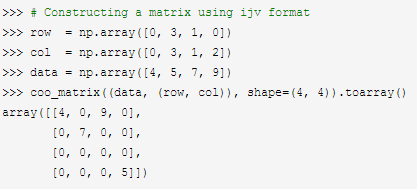
我们可以通过indices,data,shape来构造一个coo_matrix。
在定义计算图中的占位符时:
       if sparse:

            #bias_idx = tf.placeholder(tf.int64)

            #bias_val = tf.placeholder(tf.float32)

            #bias_shape = tf.placeholder(tf.int64)

            bias_in = tf.sparse_placeholder(dtype=tf.float32)

        else:

            bias_in = tf.placeholder(dtype=tf.float32, shape=(batch_size, nb_nodes, nb_nodes))
使用bias_in = tf.sparse_placeholder(dtype=tf.float32)。
再接着就是模型中了,在utils文件夹下的layers.py中:
# Experimental sparse attention head (for running on datasets such as Pubmed)

# N.B. Because of limitations of current TF implementation, will work _only_ if batch_size = 1!

def sp_attn_head(seq, out_sz, adj_mat, activation, nb_nodes, in_drop=0.0, coef_drop=0.0, residual=False):

    with tf.name_scope('sp_attn'):

        if in_drop != 0.0:

            seq = tf.nn.dropout(seq, 1.0 - in_drop)

        seq_fts = tf.layers.conv1d(seq, out_sz, 1, use_bias=False)

        # simplest self-attention possible

        f_1 = tf.layers.conv1d(seq_fts, 1, 1)

        f_2 = tf.layers.conv1d(seq_fts, 1, 1)

        f_1 = tf.reshape(f_1, (nb_nodes, 1))

        f_2 = tf.reshape(f_2, (nb_nodes, 1))

        f_1 = adj_mat*f_1

        f_2 = adj_mat * tf.transpose(f_2, [1,0])

        logits = tf.sparse_add(f_1, f_2)

        lrelu = tf.SparseTensor(indices=logits.indices,

                values=tf.nn.leaky_relu(logits.values),

                dense_shape=logits.dense_shape)

        coefs = tf.sparse_softmax(lrelu)

        if coef_drop != 0.0:

            coefs = tf.SparseTensor(indices=coefs.indices,

                    values=tf.nn.dropout(coefs.values, 1.0 - coef_drop),

                    dense_shape=coefs.dense_shape)

        if in_drop != 0.0:

            seq_fts = tf.nn.dropout(seq_fts, 1.0 - in_drop)

        # As tf.sparse_tensor_dense_matmul expects its arguments to have rank-2,

        # here we make an assumption that our input is of batch size 1, and reshape appropriately.

        # The method will fail in all other cases!

        coefs = tf.sparse_reshape(coefs, [nb_nodes, nb_nodes])

        seq_fts = tf.squeeze(seq_fts)

        vals = tf.sparse_tensor_dense_matmul(coefs, seq_fts)

        vals = tf.expand_dims(vals, axis=0)

        vals.set_shape([1, nb_nodes, out_sz])

        ret = tf.contrib.layers.bias_add(vals)

        # residual connection

        if residual:

            if seq.shape[-1] != ret.shape[-1]:

                ret = ret + conv1d(seq, ret.shape[-1], 1) # activation

            else:

                ret = ret + seq

        return activation(ret)  # activation
相应的位置都要使用稀疏的方式。
graph attention network(ICLR2018)官方代码详解(tensorflow)-稀疏矩阵版的更多相关文章
- graph attention network(ICLR2018)官方代码详解(te4nsorflow)
论文地址:https://arxiv.org/abs/1710.10903 代码地址: https://github.com/Diego999/pyGAT 我并没有完整看过这篇论文,但是在大致了解其原 ...
- 代码详解:TensorFlow Core带你探索深度神经网络“黑匣子”
来源商业新知网,原标题:代码详解:TensorFlow Core带你探索深度神经网络“黑匣子” 想学TensorFlow?先从低阶API开始吧~某种程度而言,它能够帮助我们更好地理解Tensorflo ...
- DeepLearning tutorial(3)MLP多层感知机原理简介+代码详解
本文介绍多层感知机算法,特别是详细解读其代码实现,基于python theano,代码来自:Multilayer Perceptron,如果你想详细了解多层感知机算法,可以参考:UFLDL教程,或者参 ...
- ARM Cortex-M底层技术(2)—启动代码详解
杂谈 工作了一天,脑袋比较乱.一直想把底层的知识写成一个系列,希望可以坚持下去.为什么要写底层的东西呢?首先,工作用到了这部分内容,最近和内部Flash打交道比较多,自然而然会接触到一些底层的东西:第 ...
- 论文解读(FedGAT)《Federated Graph Attention Network for Rumor Detection》
论文信息 论文标题:Federated Graph Attention Network for Rumor Detection论文作者:Huidong Wang, Chuanzheng Bai, Ji ...
- BM算法 Boyer-Moore高质量实现代码详解与算法详解
Boyer-Moore高质量实现代码详解与算法详解 鉴于我见到对算法本身分析非常透彻的文章以及实现的非常精巧的文章,所以就转载了,本文的贡献在于将两者结合起来,方便大家了解代码实现! 算法详解转自:h ...
- ASP.NET MVC 5 学习教程:生成的代码详解
原文 ASP.NET MVC 5 学习教程:生成的代码详解 起飞网 ASP.NET MVC 5 学习教程目录: 添加控制器 添加视图 修改视图和布局页 控制器传递数据给视图 添加模型 创建连接字符串 ...
- Github-karpathy/char-rnn代码详解
Github-karpathy/char-rnn代码详解 zoerywzhou@gmail.com http://www.cnblogs.com/swje/ 作者:Zhouwan 2016-1-10 ...
- 十图详解tensorflow数据读取机制(附代码)转知乎
十图详解tensorflow数据读取机制(附代码) - 何之源的文章 - 知乎 https://zhuanlan.zhihu.com/p/27238630
随机推荐
- 2020-07-24:聊一下zookeeper的同步算法。
福哥答案2020-07-24: 同步算法基于 ZAB 协议,一种快速 Paxos 算法. 快速Paxos算法Paxos算法可能出现死循环,就是在两个Proposer总是在交替prepare.并且,Pa ...
- Revit二次开发——非模态窗口的事件处理
一.起因 自己在写revit二开时,有一个Winform窗体按钮点击事件需要 触发调用事务进行处理,结果出现“异常“Starting a transaction from an external ...
- markdown使用手册
github上找到了一个挺全面的项目,mark一下. https://github.com/nicejade/nice-front-end-tutorial/blob/master/tutorial/ ...
- 简单解析PAT、PMT的程序
刚开始学习有关TS.PAT.PMT方面的内容,参考了别人的一些程序,然后写了一个简单的解析TS的小程序.如果有地方错误,请发邮件给我843036544@qq.com. #include<stdi ...
- openvswitch 流表操作
流表组成 每条流表规则由一些列字段组成,可以分为**基础字段.匹配字段和动作字段**三部分. 在打印流表时,在流表中还存在一些显示字段,如duration,idle_age等,此处把这些字段也暂时归之 ...
- 第三篇Scrum冲刺博客--Interesting-Corps
第三篇Scrum冲刺博客 站立式会议 1.会议照片 2.队友完成情况 团队成员 昨日完成 今日计划 鲍鱼铭 主页页面跳转社区功能及社区设计及布局实现 搜索页面跳转.设计及布局实现 叶学涛 编写个人页面 ...
- DeepCoder: A Deep Neural Network Based Video Compression
郑重声明:原文参见标题,如有侵权,请联系作者,将会撤销发布! Abstract: 在深度学习的最新进展的启发下,我们提出了一种基于卷积神经网络(CNN)的视频压缩框架DeepCoder.我们分别对预测 ...
- SPSSAU数据分析思维培养系列2:方法选择篇
大家好!在上篇文章中,我们一起学习了如何[掌握正确的数据处理思维].在完成数据准备和清理工作后,就要进入到正式分析阶段,而选择什么样的数据分析方法进行分析是关键. 想要进行科学和系统化的数据分析,分析 ...
- CentOS基础操作
一.修改IP地址 vim ../etc/sysconfig/network-scripts/ifcfg-ens33 在文件中修改或添加以下内容 TYPE=Ethernet PROXY_METHOD= ...
- Java多线程_生产者消费者模式1
生产者消费者模型 具体来讲,就是在一个系统中,存在生产者和消费者两种角色,他们通过内存缓冲区进行通信,生产者生产消费者需要的资料,消费者把资料做成产品.生产消费者模式如下图.(图片来自网络 ...