
Wayland architecture
Introduction
Motivation
Most Linux and Unix-based systems rely on the X Window System (or simply X) as the low-level protocol for building bitmap graphics interfaces. On these systems, the X stack has grown to encompass functionality arguably belonging in client libraries, helper libraries, or the host operating system kernel.
X has grown to incorporate modern features like offscreen rendering and scene composition, but subject to the limitations of the X architecture. For example, the X implementation of composition adds additional context switches and makes things like input redirection difficult.
Over time, X developers came to understand the shortcomings of this approach and worked to split things up. Over the past several years, a lot of functionality has moved out of the X server and into client-side libraries or kernel drivers. One of the first components to move out was font rendering, with freetype and fontconfig providing an alternative to the core X fonts. Direct rendering OpenGL as a graphics driver in a client side library went through some iterations, ending up as DRI2, which abstracted most of the direct rendering buffer management from client code. Then cairo came along and provided a modern 2D rendering library independent of X, and compositing managers took over control of the rendering of the desktop as toolkits like GTK+ and Qt moved away from using X APIs for rendering. Recently, memory and display management have moved to the Linux kernel, further reducing the scope of X and its driver stack. The end result is a highly modular graphics stack.
Wayland
Wayland is a new display server and compositing protocol, and Weston is the implementation of this protocol which builds on top of all the components above.
Overall, the philosophy of Wayland is to provide clients with a way to manage windows and how their contents is displayed. Rendering is left to clients, and system wide memory management interfaces are used to pass buffer handles between clients and the compositing manager.
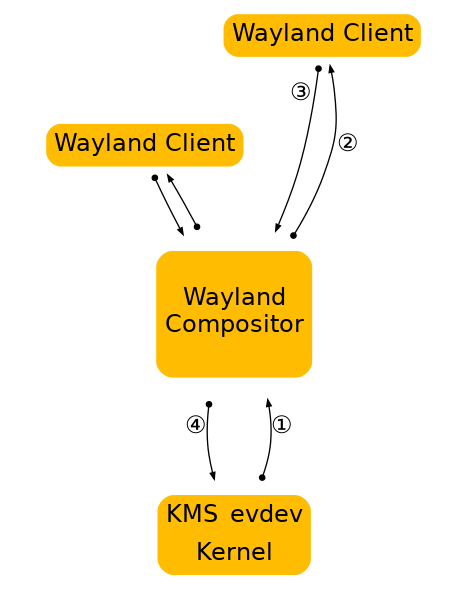
The figure above illustrates how Wayland clients interact with a Wayland server. Note that window management and composition are handled entirely in the server, significantly reducing complexity while marginally improving performance through reduced context switching. The resulting system is easier to build and extend than a similar X system, because often changes need only be made in one place. Or in the case of protocol extensions, two (rather than 3 or 4 in the X case where window management and/or composition handling may also need to be updated).
Wayland compositors
System Compositor
A system compositor can run from early boot until shutdown. It effectively replaces the kernel vt system, and can tie in with the systems graphical boot setup and multiseat support.
A system compositor can host different types of session compositors, and let us switch between multiple sessions (fast user switching, or secure/personal desktop switching).
A linux implementation of a system compositor will typically use libudev, egl, kms, evdev and cairo.
For fullscreen clients, the system compositor can reprogram the video scanout address to read directly from the client provided buffer.
Session Compositor
A session compositor is responsible for a single user session. If a system compositor is present, the session compositor will run nested under the system compositor. Nesting is feasible because the protocol is asynchronous; roundtrips would be too expensive when nesting is involved. If no system compositor is present, a session compositor can run directly on the hw.
X applications can continue working under a session compositor by means of a root-less X server that is activated on demand.
Possible examples for session compositors include
- gnome-shell
- moblin
- kwin
- kmscon
- rdp session
- Weston with X11 or Wayland backend is a session compositor nested in another session compositor.
- fullscreen X session under Wayland
Embedding Compositor
X11 lets clients embed windows from other clients, or lets clients copy pixmap contents rendered by another client into their window. This is often used for applets in a panel, browser plugins and similar. Wayland doesn't directly allow this, but clients can communicate GEM buffer names out-of-band, for example, using D-Bus, or command line arguments when the panel launches the applet. Another option is to use a nested Wayland instance. For this, the Wayland server will have to be a library that the host application links to. The host application will then pass the Wayland server socket name to the embedded application, and will need to implement the Wayland compositor interface. The host application composites the client surfaces as part of it's window, that is, in the web page or in the panel. The benefit of nesting the Wayland server is that it provides the requests the embedded client needs to inform the host about buffer updates and a mechanism for forwarding input events from the host application.
An example for this kind of setup is firefox embedding the flash player as a kind of special-purpose compositor.
Wayland Architecture
Figure 3.1. X architecture diagram
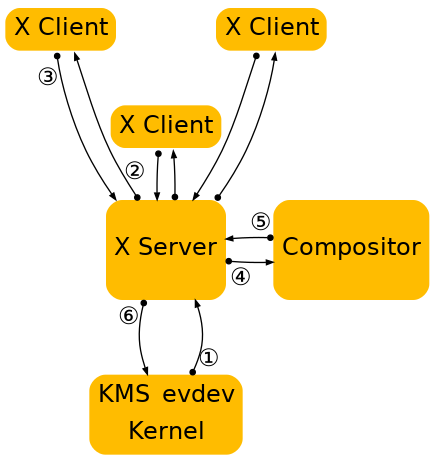
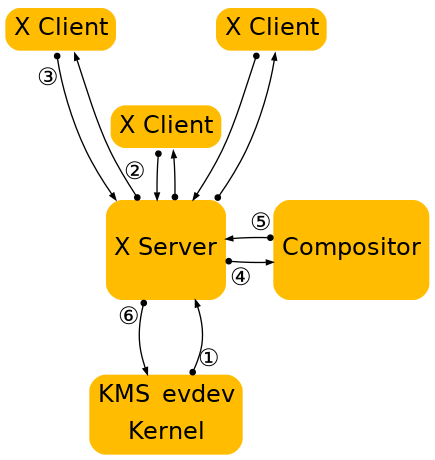
The kernel gets an event from an input device and sends it to X through the evdev input driver. The kernel does all the hard work here by driving the device and translating the different device specific event protocols to the linux evdev input event standard.
The X server determines which window the event affects and sends it to the clients that have selected for the event in question on that window. The X server doesn't actually know how to do this right, since the window location on screen is controlled by the compositor and may be transformed in a number of ways that the X server doesn't understand (scaled down, rotated, wobbling, etc).
The client looks at the event and decides what to do. Often the UI will have to change in response to the event - perhaps a check box was clicked or the pointer entered a button that must be highlighted. Thus the client sends a rendering request back to the X server.
When the X server receives the rendering request, it sends it to the driver to let it program the hardware to do the rendering. The X server also calculates the bounding region of the rendering, and sends that to the compositor as a damage event.
The damage event tells the compositor that something changed in the window and that it has to recomposite the part of the screen where that window is visible. The compositor is responsible for rendering the entire screen contents based on its scenegraph and the contents of the X windows. Yet, it has to go through the X server to render this.
The X server receives the rendering requests from the compositor and either copies the compositor back buffer to the front buffer or does a pageflip. In the general case, the X server has to do this step so it can account for overlapping windows, which may require clipping and determine whether or not it can page flip. However, for a compositor, which is always fullscreen, this is another unnecessary context switch.
As suggested above, there are a few problems with this approach. The X server doesn't have the information to decide which window should receive the event, nor can it transform the screen coordinates to window-local coordinates. And even though X has handed responsibility for the final painting of the screen to the compositing manager, X still controls the front buffer and modesetting. Most of the complexity that the X server used to handle is now available in the kernel or self contained libraries (KMS, evdev, mesa, fontconfig, freetype, cairo, Qt etc). In general, the X server is now just a middle man that introduces an extra step between applications and the compositor and an extra step between the compositor and the hardware.
In Wayland the compositor is the display server. We transfer the control of KMS and evdev to the compositor. The Wayland protocol lets the compositor send the input events directly to the clients and lets the client send the damage event directly to the compositor:
Figure 3.2. Wayland architecture diagram
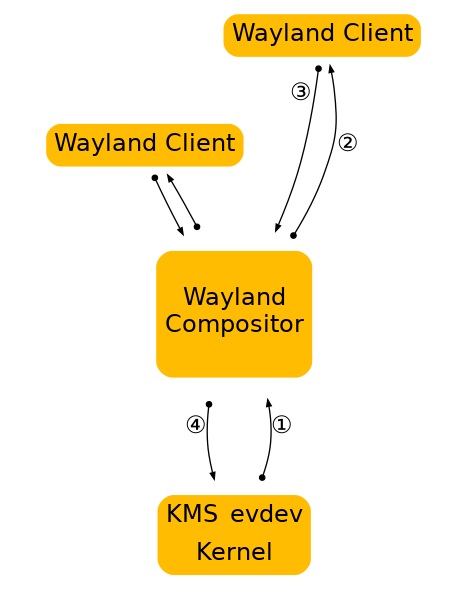
The kernel gets an event and sends it to the compositor. This is similar to the X case, which is great, since we get to reuse all the input drivers in the kernel.
The compositor looks through its scenegraph to determine which window should receive the event. The scenegraph corresponds to what's on screen and the compositor understands the transformations that it may have applied to the elements in the scenegraph. Thus, the compositor can pick the right window and transform the screen coordinates to window-local coordinates, by applying the inverse transformations. The types of transformation that can be applied to a window is only restricted to what the compositor can do, as long as it can compute the inverse transformation for the input events.
As in the X case, when the client receives the event, it updates the UI in response. But in the Wayland case, the rendering happens in the client, and the client just sends a request to the compositor to indicate the region that was updated.
The compositor collects damage requests from its clients and then recomposites the screen. The compositor can then directly issue an ioctl to schedule a pageflip with KMS.
Wayland architecture的更多相关文章
- Linux Graphic DRI Wayland 显示子系统
转:https://blog.csdn.net/u013165704/article/details/80709547 1. 前言 上篇文章(Linux graphic subsytem(1)_概述) ...
- Undefined symbols for architecture arm64解决方案
在iOS开发中经常遇到的一个错误是Undefined symbols for architecture arm64,这个错误表示工程某些地方不支持arm64指令集.那我们应该怎么解决这个问题了?我们不 ...
- Optimal Flexible Architecture(最优灵活架构)
来自:Oracle® Database Installation Guide 12_c_ Release 1 (12.1) for Linux Oracle base目录命名规范: /pm/s/u 例 ...
- EF框架组件详述【Entity Framework Architecture】(EF基础系列篇3)
我们来看看EF的框架设计吧: The following figure shows the overall architecture of the Entity Framework. Let us n ...
- [Architecture] 系统架构正交分解法
[Architecture] 系统架构正交分解法 前言 随着企业成长,支持企业业务的软件,也会越来越庞大与复杂.当系统复杂到一定程度,开发人员会发现很多系统架构的设计细节,很难有条理.有组织的用一张大 ...
- Stack Overflow: The Architecture - 2016 Edition
To get an idea of what all of this stuff “does,” let me start off with an update on the average day ...
- ios build时,Undefined symbols for architecture xxx问题的总结
简单来说,Undefined symbols基本上等于JAVA的ClassNotFoundException,最常见的原因有这几种: build的时候没有加framework 比如说,有一段代码我用了 ...
- Undefined symbols for architecture x86_64: "_OBJC_CLASS_$_The49DayPersonalFullscreenGiftModel", referenced from: objc-class-ref in The49DayPersonalRoomGiftModel.o ld: symbol(s) not found for a
Undefined symbols for architecture x86_64: "_OBJC_CLASS_$_The49DayPersonalFullscreenGiftModel&q ...
- ios开发错误之: Undefined symbols for architecture x86_64
错误如下: Undefined symbols for architecture x86_64: "_OBJC_CLASS_$_RoutingHTTPServer", refere ...
随机推荐
- Java初体验
参考书籍「Java语言程序设计基础篇」 比特与字节 计算机中只有0和1,二进制,即比特(bit,二进制数): 字节(byte)是最小的存储单元,每个字节有8个比特组成 即:1byte=8bit 各种数 ...
- MySQL常用SQL语句1
-- 创建表 CREATE TABLE USER ( -- id默认每个表都该拥有(非空 不重复) -- (id是每一行的唯一标识) -- 其他字段可能会重复,我们无法依赖其他的字段去确定某一行记录 ...
- 【poj 2976】Dropping tests(算法效率--01分数规划 模版题+二分){附【转】01分数规划问题}
P.S.又是一个抽时间学了2个小时的新东西......讲解在上半部分,题解在下半部分. 先说一下转的原文:http://www.cnblogs.com/perseawe/archive/2012/05 ...
- java大数函数(附官方文档链接)
java文档 字段摘要 static BigInteger ONE BigInteger 的常量 1. static BigInteger TEN BigInt ...
- Codeforces Round #687 (Div. 2, based on Technocup 2021 Elimination Round 2) C. Bouncing Ball (后缀和,枚举)
题意:有一长度为\(n\)的平台,平台有的位置有木桩,可以使小球弹起来,小球必须从第\(p\)个位置开始,而且每次都会向右弹\(k\)个单位,然后有的位置是没有木桩的,你可以在这些的空的位置放一个木桩 ...
- Codeforces Round #171 (Div. 2) B. Books (模拟队列)
题意:有一组数,问子数组和最大不超过\(t\)的最多元素个数. 题解:用数组模拟队列,不断的往里面放,队列中的元素之和大于\(t\),就不断地从队头弹出直到满足条件,维护一个最大值即可. 代码: in ...
- C# ArrayList和List的区别
ArrayList存的是object对象,可以装任何类型,但涉及装箱拆箱,效率低,类型转换可能报错 List只能存一种类型,不涉及装箱拆箱,效率高 总结:一般情况用List吧
- 手撕 part1
1.宏定义三个数最大值 挺有意思 max((a), (b), (c)) (a) > (b)? ((a) > (c)? (a) : (c)) ((b) > (c)? (b) : (c) ...
- Chart.js & CPU 性能监控
Chart.js 可视化动态 CPU 性能监控 https://github.com/gildata/RAIO/issues/337 https://github.com/chartjs/Chart. ...
- Bearer Token & OAuth 2.0
Bearer Token & OAuth 2.0 access token & refresh token http://localhost:8080/#/login HTTP Aut ...