
使用jdk8 stream简化集合操作
使用stream的前提是对lambda表达式和函数式接口有一定的了解,同时对方法引用和普通传参的区别有一定的认识。
stream的三大特性:1、不存储数据2、不改变源数据3、延时执行。
stream优点:1、简化代码2、使用并行流可以利用多核特性,提升效率。
stream上的所有操作分为两类:中间操作和结束操作,中间操作只是一种标记,只有结束操作才会触发实际计算。
常用api如下
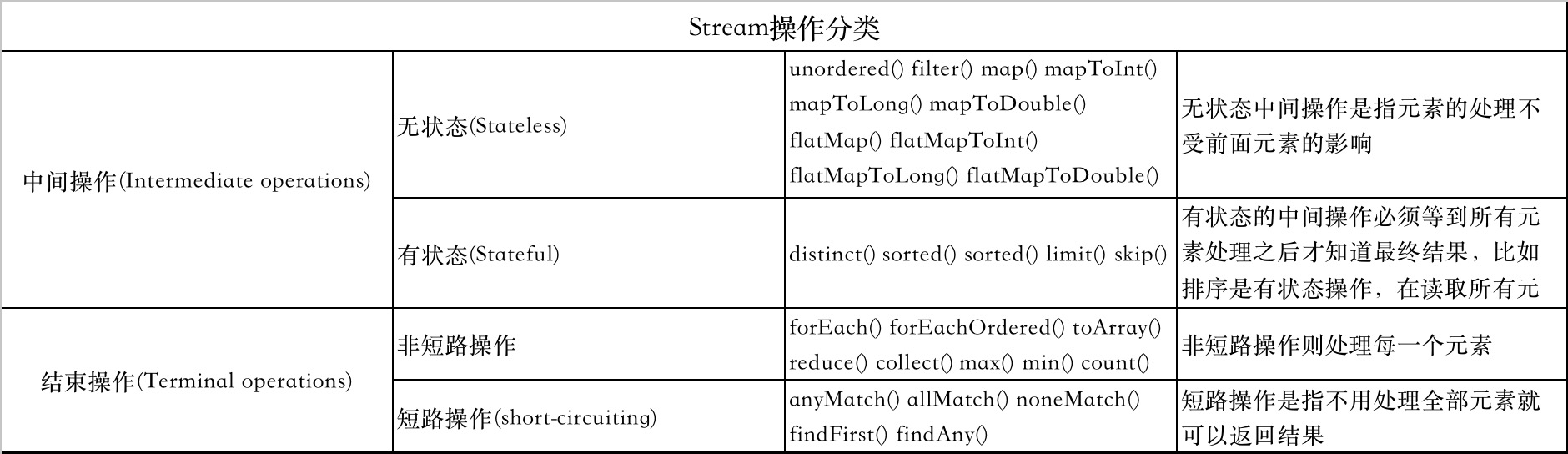
中间操作
filter:过滤流,过滤流中的元素,返回一个符合条件的Stream
map:转换流,将一种类型的流转换为另外一种流。(mapToInt、mapToLong、mapToDouble 返回int、long、double基本类型对应的Stream)
flatMap:简单的说,就是一个或多个流合并成一个新流。(flatMapToInt、flatMapToLong、flatMapToDouble 返回对应的IntStream、LongStream、DoubleStream流。)
distinct:返回去重的Stream。
sorted:返回一个排序的Stream。
peek:主要用来查看流中元素的数据状态。
limit:返回前n个元素数据组成的Stream。属于短路操作
skip:返回第n个元素后面数据组成的Stream。
结束操作
forEach: 循环操作Stream中数据。
toArray: 返回流中元素对应的数组对象。
reduce: 聚合操作,用来做统计。
collect: 聚合操作,封装目标数据。
min、max、count: 聚合操作,最小值,最大值,总数量。
anyMatch: 短路操作,有一个符合条件返回true。
allMatch: 所有数据都符合条件返回true。
noneMatch: 所有数据都不符合条件返回true。
findFirst: 短路操作,获取第一个元素。
findAny: 短路操作,获取任一元素。
forEachOrdered: 暗元素顺序执行循环操作。
流的创建demo
package com.example.test.stream;

import java.util.Arrays;

import java.util.List;

import java.util.Random;

import java.util.stream.IntStream;

import java.util.stream.Stream;

public class StreamCreate {

    public static void main(String[] args) {

        unLimitStream2();

    }

    public static void testArrayStream(){

        int[] arr = new int[]{1,2,3,4,5};

        IntStream intStream = Arrays.stream(arr);

        Student[] students = new Student[]{Student.builder().name("zhangsan").age(12).score(12).build(),Student.builder().name("zhangsan").age(12).score(12).build()};

        Stream<Student> studentStream = Arrays.stream(students);

        Stream<Integer> integerStream =Stream.of(1,2,5,4,6);

        Stream<int[]> intArrayStrean = Stream.of(arr,arr);

        intArrayStrean.forEach(System.out::println);

    }

    public static void testCollectionStream(){

        List<String> strings = Arrays.asList("sdf","sdfdsf","ertert","sdfdsf");

        //创建普通流

        Stream<String> stringStream = strings.stream();

        //创建并行流

        Stream<String> parallelStream = strings.parallelStream();

    }

    public static void emptyStream(){

        Stream<Integer> stream = Stream.empty();

    }

    public static void unLimitStream(){

        Stream.generate((() -> "number" + new Random().nextInt())).limit(20).forEach(System.out::println);

    }

    public static void unLimitStream2(){

        Stream.iterate(0,x ->x+1).limit(10).forEach(System.out::println);

        Stream.iterate(0,x ->x).limit(10).forEach(System.out::println);

    }

}
流的操作demo
package com.example.test.stream;

import java.util.*;

import java.util.stream.Collectors;

import java.util.stream.Stream;

public class OpepateStream {

    private static String[] arr = new String[]{"b","ab","abc","abcd","abcde"};

    public static void main(String[] args) {

        testFlatMap();

    }

    public static void testMap(){

        String[] str = {"sdf","sdfdsFFF","dfsGdsf"};

        Stream.of(str).map(t ->t.toUpperCase()).forEach(System.out::println);

    }

    public static void filter(){

        String[] str = {"sdf","sdfdsFFF","dfsGdsf"};

        Stream.of(str).filter(t -> ! t.equals("sdf")).forEach(System.out::println);

    }

    public static void testFlatMap(){

        List<String> list = Arrays.asList("beijing changcheng", "beijing gugong", "beijing tiantan",

                "gugong tiananmen");

        list.stream().map(item -> Arrays.stream(item.split(" "))).forEach(System.out::println);

        list.stream().flatMap(item -> Arrays.stream(item.split(" "))).forEach(System.out::println);

        List<Integer> a=new ArrayList<>();

        a.add(1);

        a.add(2);

        List<Integer> b=new ArrayList<>();

        b.add(3);

        b.add(4);

        List<Integer> figures=Stream.of(a,b).flatMap(u->u.stream()).collect(Collectors.toList());

        figures.forEach(f->System.out.println(f));

    }

    public static void sort(){

        String[] arr1 = {"abc","a","bc","abcd"};

        Arrays.stream(arr1).sorted(Comparator.comparing(String::length).reversed()).forEach(System.out::println);

    }

    public static void sort2(){

        String[] arr1 = {"abc","a","bc","abcd"};

        Arrays.stream(arr1).sorted(Comparator.comparing(String::length).reversed()).forEach(System.out::println);

    }

    public static void sort3(){

        String[] arr1 = {"abc","a","bc","abcd"};

        Arrays.stream(arr1).sorted(Comparator.comparing(OpepateStream::com1).thenComparing(String::length)).forEach(System.out::println);

    }

    public static char com1(String x){

        return x.charAt(0);

    }

    public static void testMaxAndMin(){

        Optional<String> option = Stream.of(arr).max(Comparator.comparing(String::length));

        option.ifPresent(System.out::println);

        Stream.of(arr).min(Comparator.comparing(String::length)).ifPresent(System.out::println);

    }

    public static void findFirst(){

        String str = Stream.of(arr).parallel().filter(t -> t.length()>3).findFirst().orElse("noting");

        System.out.println(str);

    }

    public static void testFindAny(){

        Optional<String> optional = Stream.of(arr).parallel().filter(x->x.length()>3).findAny();

        optional.ifPresent(System.out::println);

    }

    public static void reduceTest(){

        Optional<Integer> optional = Stream.of(1,2,3).reduce((x,y) -> x+y);

        optional.ifPresent(System.out::println);

    }

    public static Optional<Double> inverse(Double x) {

        return x == 0 ? Optional.empty() : Optional.of(1 / x);

    }

    public static Optional<Double> squareRoot(Double x) {

        return x < 0 ? Optional.empty() : Optional.of(Math.sqrt(x));

    }

    public static void testStream2() {

        double x = 4d;

        Optional<Double> result1 = inverse(x).flatMap(OpepateStream::squareRoot);

        result1.ifPresent(System.out::println);

        Optional<Double> result2 = Optional.of(4.0).flatMap(OpepateStream::inverse).flatMap(OpepateStream::squareRoot);

        result2.ifPresent(System.out::println);

    }

    public static void testToMap(){

        List<Student> studentList = new ArrayList<Student>(){

            {

                for (int i = 0; i < 10; i++) {

                    add(Student.builder().name("student" + i).age(12).score(i).build());

                }

            }

        };

        studentList.add(Student.builder().name("student08").age(12).score(1000).build());

        studentList.add(Student.builder().name("student08").age(12).score(234).build());

        studentList.add(Student.builder().name("student08").age(12).score(123).build());

        studentList.add(Student.builder().name("student08").age(12).score(3000).build());

        Map<String,Integer> map = studentList.stream().collect(Collectors.toMap(Student::getName,Student::getScore,(a,b) -> b));

        map.forEach((x,y) -> System.out.println(x + "->" + y));

    }

    public static void toAssign(){

        List<Student> studentList = new ArrayList<Student>(){

            {

                for (int i = 0; i < 100; i++) {

                    add(Student.builder().name("student" + i).age(12).score(i).build());

                }

            }

        };

            HashSet<Student> s = studentList.stream().collect(Collectors.toCollection(HashSet::new));

            s.forEach(System.out::println);

    }

    public static void aggregation(){

        List<Student> studentList = new ArrayList<Student>(){

            {

                for (int i = 0; i < 100; i++) {

                    add(Student.builder().name("student" + i).age(12).score(i).build());

                }

            }

        };

        IntSummaryStatistics summaryStatistics = studentList.stream().collect(Collectors.summarizingInt(Student::getScore));

        System.out.println("getAverage->"+summaryStatistics.getAverage());

        System.out.println("getMax->"+summaryStatistics.getMax());

        System.out.println("getMin->"+summaryStatistics.getMin());

        System.out.println("getCount->"+summaryStatistics.getCount());

        System.out.println("getSum->"+summaryStatistics.getSum());

    }

    public static void group(){

        List<Student> studentList = new ArrayList<Student>(){

            {

                for (int i = 0; i < 100; i++) {

                    add(Student.builder().name("student" + i).age(12).score(i).build());

                }

            }

        };

        Map<Boolean,Integer> map  = studentList.stream().collect(Collectors.groupingBy((x -> x.getScore()>50) ,Collectors.summingInt(Student::getScore)));

        map.forEach((x,y) -> {

            System.out.println(x);

            System.out.println(y);

        });

        Map<String,Set<Integer>> map4 = studentList.stream().collect(Collectors.groupingBy(Student::getName,Collectors.mapping(Student::getScore,Collectors.toSet())));

        map4.forEach((x,y)-> System.out.println(x+"->"+y));

    }

    public static void group1(){

        List<Student> studentList = new ArrayList<Student>(){

            {

                for (int i = 0; i < 100; i++) {

                    add(Student.builder().name("student" + i).age(12).score(i).build());

                }

            }

        };

        Map<Boolean,Integer> map  = studentList.stream().collect(Collectors.groupingBy((x -> x.getScore()>50) ,Collectors.summingInt(Student::getScore)));

        map.forEach((x,y) -> {

            System.out.println(x);

            System.out.println(y);

        });

        Map<String,List<Student>> map4 = studentList.stream().collect(Collectors.groupingBy(Student::getName));

        map4.forEach((x,y)-> System.out.println(x+"->"+y));

    }

}
并行流
package com.example.test.stream;

import java.util.stream.Stream;

public class ParalellTest {

    public void peek1(int x) {

        System.out.println(Thread.currentThread().getName() + ":->peek1->" + x);

    }

    public void peek2(int x) {

        System.out.println(Thread.currentThread().getName() + ":->peek2->" + x);

    }

    public void peek3(int x) {

        System.out.println(Thread.currentThread().getName() + ":->final result->" + x);

    }

    public static void main(String[] args) {

        ParalellTest paralellTest = new ParalellTest();

        Stream<Integer> stream = Stream.iterate(1,x -> x+1).limit(10);

        stream.peek(paralellTest::peek1).filter(x -> x>5)

                .peek(paralellTest::peek2).filter(x -> x<9)

                .peek(paralellTest::peek3).forEach(System.out::println);

        System.out.println("-------------------------------------");

        Stream<Integer> stream2 = Stream.iterate(1,x -> x+1).limit(10).parallel();

        stream2.peek(paralellTest::peek1).filter(x -> x>5)

                .peek(paralellTest::peek2).filter(x -> x<9)

                .peek(paralellTest::peek3).forEach(System.out::println);

    }

}
综合应用
package com.example.test.stream;

import java.util.ArrayList;

import java.util.Comparator;

import java.util.List;

import java.util.Random;

import java.util.stream.Collectors;

import java.util.stream.Stream;

public class StreamTest {

    public static void main(String[] args) {

        test2();

    }

    public static void test1(){

        Random random = new Random();

        List<Student> studentList = new ArrayList<Student>(){

            {

                for (int i = 0; i < 100; i++) {

                    add(Student.builder().name("student" + i).age(12).score(i).build());

                }

            }

        };

        List<String> names =  studentList.stream().filter(t -> t.getScore()>50)

                .sorted(Comparator.comparingDouble(Student::getScore).reversed())

                .map(Student::getName).collect(Collectors.toList());

        System.out.println(names);

    }

    public static void test2(){

        List<Student> studentList = new ArrayList<Student>(){

            {

                for (int i = 0; i < 100; i++) {

                    add(Student.builder().name("student" + i).age(12).score(i).build());

                }

            }

        };

        Stream<Student> stream = studentList.stream().filter(StreamTest::filter)

                .sorted(Comparator.comparingDouble(Student::getScore).reversed());

        System.out.println("--------------");

        System.out.println(stream.map(Student::getName).collect(Collectors.toList()));

    }

    private static boolean filter(Student student){

        System.out.println("123123123");

        return student.getScore() >50;

    }

}
使用jdk8 stream简化集合操作的更多相关文章
- C# 使用 Index 和 Range 简化集合操作
C# 使用 Index 和 Range 简化集合操作 Intro 有的语言数组的索引值是支持负数的,表示从后向前索引,比如:arr[-1] 从 C# 8 开始,C# 支持了数组的反向 Index,和 ...
- JAVA8 Stream集合操作:中间方法和完结方法
StreamLambda为java8带了闭包,这一特性在集合操作中尤为重要:java8中支持对集合对象的stream进行函数式操作,此外,stream api也被集成进了collection api, ...
- Java8 新特性之集合操作Stream
Java8 新特性之集合操作Stream Stream简介 Java 8引入了全新的Stream API.这里的Stream和I/O流不同,它更像具有Iterable的集合类,但行为和集合类又有所不同 ...
- Java 8 Lambda 表达式及 Stream 在集合中的用法
简介 虽然 Java 8 已经发布有一段时间了,但是关于 Java 8 中的 Lambda 表达式最近才开始系统的学习,刚开始就被 Stream 的各种骚操作深深的吸引住了,简直漂亮的不像 Java. ...
- 试水jdk8 stream
jdk8出来日子不短了,jdk11都出来了,不过用的最多的不过是1.5罢了. 今年终于鼓起勇气认真对待它,在18年记录下学习stream,画上一个圆. 先看个图 Java8中有两大最为重要的改变.第一 ...
- JDK8 Stream 数据流效率分析
JDK8 Stream 数据流效率分析 Stream 是Java SE 8类库中新增的关键抽象,它被定义于 java.util.stream (这个包里有若干流类型: Stream<T> ...
- 恕我直言你可能真的不会java第11篇-Stream API终端操作
一.Java Stream管道数据处理操作 在本号之前写过的文章中,曾经给大家介绍过 Java Stream管道流是用于简化集合类元素处理的java API.在使用的过程中分为三个阶段.在开始本文之前 ...
- Java8中的Stream流式操作 - 入门篇
作者:汤圆 个人博客:javalover.cc 前言 之前总是朋友朋友的叫,感觉有套近乎的嫌疑,所以后面还是给大家改个称呼吧 因为大家是来看东西的,所以暂且叫做官人吧(灵感来自于民间流传的四大名著之一 ...
- 函数式Android编程(II):Kotlin语言的集合操作
原文标题:Functional Android (II): Collection operations in Kotlin 原文链接:http://antonioleiva.com/collectio ...
随机推荐
- 关于Scanner调用 sc.nextInt() 异常try后不能二次输入导致死循环问题
先看下简化的代码,引出问题所在: public class Run { public static void main(String[] args) { Scanner sc = new Scanne ...
- Linux 系统配置IPv6
1.自动获取IPV6地址 1)修改/etc/sysconfig/network文件,修改如下字段,不存在则手动添加,部分系统默认是开启的NETWORKING_IPV6=yes 2)修改/etc/sys ...
- ASP.NET MVC传递Model到视图的多种方式之通用方式的使用
ASP.NET MVC传递Model到视图的多种方式总结——通用方式的使用 有多种方式可以将数据传递到视图,如下所示: ViewData ViewBag PartialView TempData Vi ...
- [java]三种自定义链表排序方式
代码: import java.util.ArrayList; import java.util.Comparator; import java.util.List; class Emp{ Strin ...
- libcurl在mac上编译
wget http://ftp.gnu.org/gnu/m4/m4-1.4.17.tar.gz wget http://ftp.gnu.org/gnu/autoconf/autoconf-2.69.t ...
- VSCode 设置 Tab 空格
Windows 点击左下角的 Setting 按钮 输入 tabSize 进行查找
- Android Studio 3.5新特性
Android Studio 3.5新特性 原文链接:https://blog.csdn.net/jklwan/article/details/99974869 Android Studio ...
- labelimg data
<annotation> <folder>img_data_box_1500</folder> <filename>798.jpg</filena ...
- 解决Jmeter跨线程组取参数值难题!(还没试)
来源 https://mp.weixin.qq.com/s/q7ArxwnX1sOfa9tfHouSBQ 如果你工作中已经在用jmeter做接口测试,或性能测试了,你可能会遇到一个麻烦. 那就是j ...
- Linux -- GCC Built-in functions for atomic memory access
下列内建函数旨在兼容Intel Itanium Processor-specific Application Binary Interface, section 7.4. 因此,这些函数区别于普通的G ...