
stanford coursera 机器学习编程作业 exercise 3(逻辑回归实现多分类问题)
本作业使用逻辑回归(logistic regression)和神经网络(neural networks)识别手写的阿拉伯数字(0-9)
关于逻辑回归的一个编程练习,可参考:Stanford coursera Andrew Ng 机器学习课程编程作业(Exercise 2)及总结
下面使用逻辑回归实现多分类问题:识别手写的阿拉伯数字(0-9),使用神经网络实现:识别手写的阿拉伯数字(0-9),请参考:神经网络实现
数据加载到Matlab中的格式如下:

一共有5000个训练样本,每个训练样本是400维的列向量(20X20像素的 grayscale image),用矩阵 X 保存。样本的结果(label of training set)保存在向量 y 中,y 是一个5000行1列的列向量。
比如 y = (1,2,3,4,5,6,7,8,9,10......)T,注意,由于Matlab下标是从1开始的,故用 10 表示数字 0
①样本数据的可视化
随机选择100个样本数据,使用Matlab可视化的结果如下:

②使用逻辑回归来实现多分类问题(one-vs-all)
所谓多分类问题,是指分类的结果为三类以上。比如,预测明天的天气结果为三类:晴(用y==1表示)、阴(用y==2表示)、雨(用y==3表示)
分类的思想,其实与逻辑回归分类(默认是指二分类,binary classification)很相似,对“晴天”进行分类时,将另外两类(阴天和下雨)视为一类:(非晴天),这样,就把一个多分类问题转化成了二分类问题。示意图如下:(图中的圆圈 表示:不属于某一类的 所有其他类)
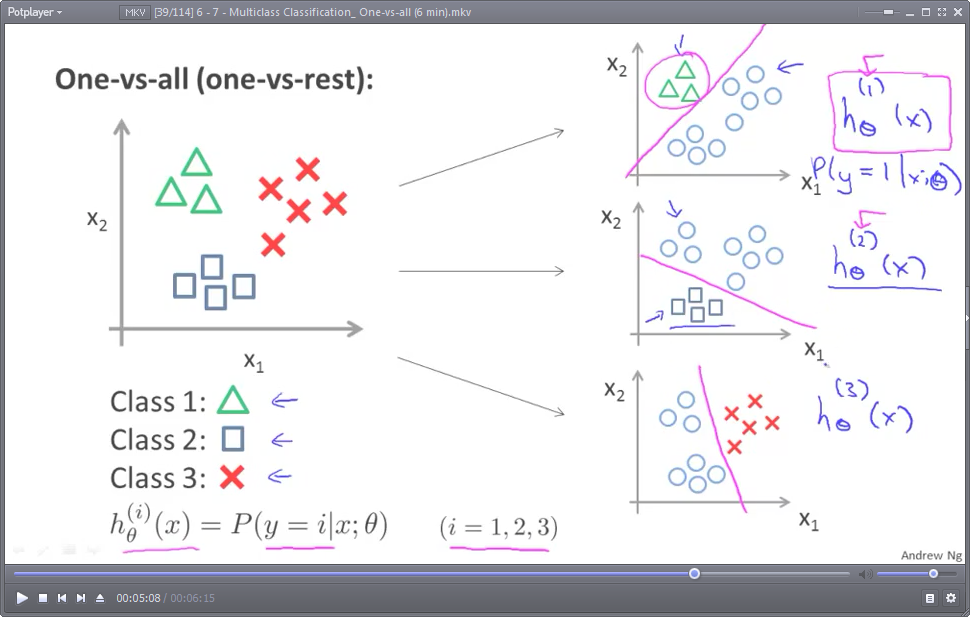
对于N分类问题(N>=3),就需要N个假设函数(预测模型),也即需要N组模型参数θ(θ一般是一个向量)
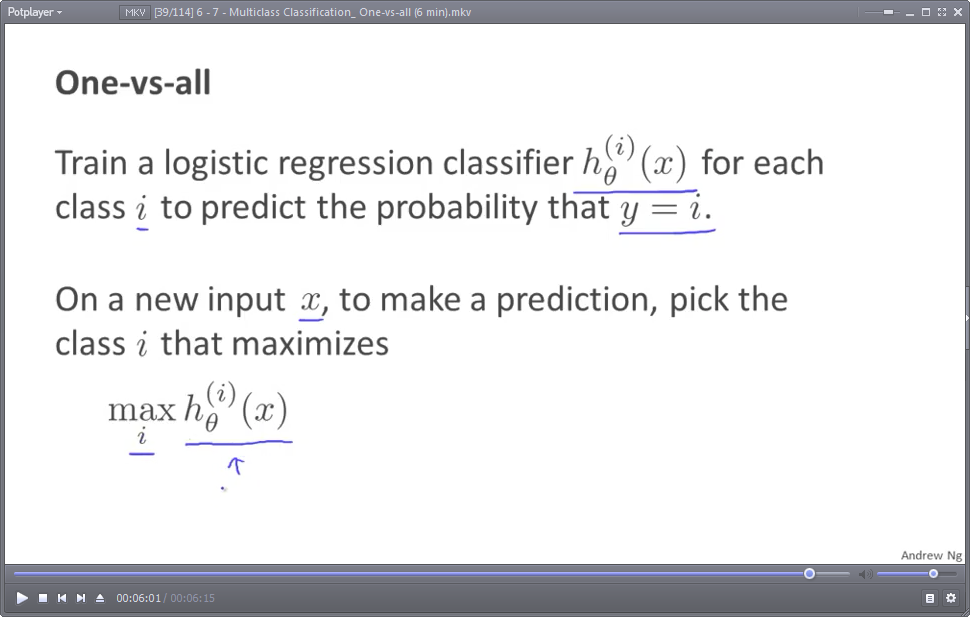
然后,对于每个样本实例,依次使用每个模型预测输出,选取输出值最大的那组模型所对应的预测结果作为最终结果。
因为模型的输出值,在sigmoid函数作用下,其实是一个概率值。,注意:hθ(1)(x),hθ(2)(x),hθ(3)(x)三组 模型参数θ 一般是不同的。比如:
hθ()(x),输出 预测为晴天(y==)的概率
hθ()(x),输出 预测为阴天(y==)的概率
hθ()(x),输出 预测为雨天(y==)的概率
③Matlab代码实现
对于上面的识别阿拉伯数字的问题,一共需要训练出10个逻辑回归模型,每个逻辑回归模型对应着识别其中一个数字。
我们一共有5000个样本,样本的预测结果值就是:y=(1,2,3,4,5,6,7,8,9,10),其中 10 代表 数字0
我们使用Matlab fmincg库函数 来求解使得代价函数取最小值的 模型参数θ
function [all_theta] = oneVsAll(X, y, num_labels, lambda)

%ONEVSALL trains multiple logistic regression classifiers and returns all

%the classifiers in a matrix all_theta, where the i-th row of all_theta

%corresponds to the classifier for label i

%   [all_theta] = ONEVSALL(X, y, num_labels, lambda) trains num_labels

%   logisitc regression classifiers and returns each of these classifiers

%   in a matrix all_theta, where the i-th row of all_theta corresponds

%   to the classifier for label i

% Some useful variables

m = size(X, 1);% num of samples

n = size(X, 2);% num of features

% You need to return the following variables correctly

all_theta = zeros(num_labels, n + 1);

% Add ones to the X data matrix

X = [ones(m, 1) X];

% ====================== YOUR CODE HERE ======================

% Instructions: You should complete the following code to train num_labels

%               logistic regression classifiers with regularization

%               parameter lambda.

%

% Hint: theta(:) will return a column vector.

%

% Hint: You can use y == c to obtain a vector of 1's and 0's that tell use

%       whether the ground truth is true/false for this class.

%

% Note: For this assignment, we recommend using fmincg to optimize the cost

%       function. It is okay to use a for-loop (for c = 1:num_labels) to

%       loop over the different classes.

%

%       fmincg works similarly to fminunc, but is more efficient when we

%       are dealing with large number of parameters.

%

% Example Code for fmincg:

%

%     % Set Initial theta

%     initial_theta = zeros(n + 1, 1);

%

%     % Set options for fminunc

%     options = optimset('GradObj', 'on', 'MaxIter', 50);

%

%     % Run fmincg to obtain the optimal theta

%     % This function will return theta and the cost

%     [theta] = ...

%         fmincg (@(t)(lrCostFunction(t, X, (y == c), lambda)), ...

%                 initial_theta, options);

%

initial_theta = zeros(n + 1, 1);

options = optimset('GradObj','on','MaxIter',50);

for c = 1:num_labels %num_labels 为逻辑回归训练器的个数,num of logistic regression classifiers

all_theta(c, :) = fmincg(@(t)(lrCostFunction(t, X, (y == c),lambda)), initial_theta,options );

end

% =========================================================================

end
lrCostFunction,完全可参考:http://www.cnblogs.com/hapjin/p/6078530.html 里面的 正则化的逻辑回归模型实现costFunctionReg.m文件
下面来解释一下 for循环:
num_labels 为分类器个数,共10个,每个分类器(模型)用来识别10个数字中的某一个。
我们一共有5000个样本,每个样本有400中特征变量,因此:模型参数θ 向量有401个元素。
initial_theta = zeros(n + 1, 1); % 模型参数θ的初始值(n == 400)
all_theta是一个10*401的矩阵,每一行存储着一个分类器(模型)的模型参数θ 向量,执行上面for循环,就调用fmincg库函数 求出了 所有模型的参数θ 向量了。
求出了每个模型的参数向量θ,就可以用 训练好的模型来识别数字了。对于一个给定的数字输入(400个 feature variables) input instance,每个模型的假设函数hθ(i)(x) 输出一个值(i = 1,2,...10)。取这10个值中最大值那个值,作为最终的识别结果。比如g(hθ()(x))==0.96 比其它所有的 g(hθ(i)(x)) (i = 1,2,...10,但 i 不等于8) 都大,则识别的结果为 数字
function p = predictOneVsAll(all_theta, X)

%PREDICT Predict the label for a trained one-vs-all classifier. The labels

%are in the range 1..K, where K = size(all_theta, 1).

%  p = PREDICTONEVSALL(all_theta, X) will return a vector of predictions

%  for each example in the matrix X. Note that X contains the examples in

%  rows. all_theta is a matrix where the i-th row is a trained logistic

%  regression theta vector for the i-th class. You should set p to a vector

%  of values from 1..K (e.g., p = [1; 3; 1; 2] predicts classes 1, 3, 1, 2

%  for 4 examples)

m = size(X, 1);

num_labels = size(all_theta, 1);

% You need to return the following variables correctly

p = zeros(size(X, 1), 1);

% Add ones to the X data matrix

X = [ones(m, 1) X];

% ====================== YOUR CODE HERE ======================

% Instructions: Complete the following code to make predictions using

%               your learned logistic regression parameters (one-vs-all).

%               You should set p to a vector of   (from 1 to

%               num_labels).

%

% Hint: This code can be done all vectorized using the max function.

%       In particular, the max function can also return the index of the

%       max element, for more information see 'help max'. If your examples

%       are in rows, then, you can use max(A, [], 2) to obtain the max

%       for each row.

%

[~,p] = max( X * all_theta',[],2); % 求矩阵(X*all_theta')每行的最大值,p 记录矩阵每行的最大值的索引

% =========================================================================

end
stanford coursera 机器学习编程作业 exercise 3(逻辑回归实现多分类问题)的更多相关文章
- stanford coursera 机器学习编程作业 exercise 3(使用神经网络 识别手写的阿拉伯数字(0-9))
本作业使用神经网络(neural networks)识别手写的阿拉伯数字(0-9) 关于使用逻辑回归实现多分类问题:识别手写的阿拉伯数字(0-9),请参考:http://www.cnblogs.com ...
- stanford coursera 机器学习编程作业 exercise 6(支持向量机-support vector machines)
在本练习中,先介绍了SVM的一些基本知识,再使用SVM(支持向量机 )实现一个垃圾邮件分类器. 在开始之前,先简单介绍一下SVM ①从逻辑回归的 cost function 到SVM 的 cost f ...
- stanford coursera 机器学习编程作业 exercise 5(正则化线性回归及偏差和方差)
本文根据水库中蓄水标线(water level) 使用正则化的线性回归模型预 水流量(water flowing out of dam),然后 debug 学习算法 以及 讨论偏差和方差对 该线性回归 ...
- stanford coursera 机器学习编程作业 exercise4--使用BP算法训练神经网络以识别阿拉伯数字(0-9)
在这篇文章中,会实现一个BP(backpropagation)算法,并将之应用到手写的阿拉伯数字(0-9)的自动识别上. 训练数据集(training set)如下:一共有5000个训练实例(trai ...
- Andrew NG 机器学习编程作业3 Octave
问题描述:使用逻辑回归(logistic regression)和神经网络(neural networks)识别手写的阿拉伯数字(0-9) 一.逻辑回归实现: 数据加载到octave中,如下图所示: ...
- Spark 多项式逻辑回归__多分类
package Spark_MLlib import org.apache.spark.ml.Pipeline import org.apache.spark.ml.classification.{B ...
- Spark 多项式逻辑回归__二分类
package Spark_MLlib import org.apache.spark.ml.Pipeline import org.apache.spark.ml.classification.{L ...
- Spark 二项逻辑回归__二分类
package Spark_MLlib import org.apache.spark.ml.Pipeline import org.apache.spark.ml.classification.{B ...
- 【原】Coursera—Andrew Ng机器学习—编程作业 Programming Exercise 2——逻辑回归
作业说明 Exercise 2,Week 3,使用Octave实现逻辑回归模型.数据集 ex2data1.txt ,ex2data2.txt 实现 Sigmoid .代价函数计算Computing ...
随机推荐
- jquery实现输入框实时输入触发事件代码
$('.aa').bind('input propertychange', function() { searchProductClassbyName(); }); function searchPr ...
- js判断radiobuttonlist的选中值显示/隐藏其它模块
<script> $(function () { var SelectVal = $("input[name='rblGJS']:checked").val(); if ...
- overflow 属性
写在前面的话: 2016年5月4日青年节,作为一名正青春的学生党,开始了博客生涯,励志做个勤奋上进的好青年.幻想着毕业后月薪W+ .走上人生巅峰的职场生活...... 然而 然而 然而 ,自制力有限的 ...
- ZedGraph饼图---傻瓜版
GraphPane pGraphPane=this.zedGraphControl1.GraphPane;//调用饼图类 pGraphPane.Title.Text = "重金属含量分析图& ...
- git 和 github 关系?
1.git 和 github 是什么关系? git是一种版本控制系统.跟svn.cvs是同级的概念. github是一个网站,给用户提供git服务.这样你就不用自己部署git系统,直接用注册个账号,用 ...
- 初学Spring有没有适合的书
初学者之前没有阅读java框架源码的习惯.没有阅读过源码,知道整体流程么?知道依赖注入的概念么?知道aop么?知道其中用到了哪些设计模式么?再说了,如果一上手就是源码?难道你没有注意到Spring的类 ...
- App Today Extension开发注意事项
从iOS 8起,就有了App Extension.Extension的种类至今也扩充到了19种,应用也很广泛,值得重点关注起来. Extension几乎可以看做一个内嵌的独立App,拥有独立的Bund ...
- iOS9 HTTP 通信报错解决方案
UIWebView *myview = [[UIWebView alloc] initWithFrame:CGRectMake(, , [UIScreen mainScreen].bounds.siz ...
- [其他]Ubuntu安装genymotion后unable to load VirtualBox engine
问题: Ubuntu安装genymotion后unable to load VirtualBox engine 解决办法: 如果没有安装VirtualBox,要先安装VirtualBox. 安装Vir ...
- 深入.net(数据类型)
C#究竟为我们提供了哪些“数据类型”供我们使用?这些类型有什么样的“特征”? 数据类型的分类: --- 数据类型是存放数据的容器.那么我们就以它们“存放数据的方式”分类! 1.值类型:变量中直接存放着 ...