
视音频数据处理入门:H.264视频码流解析
=====================================================
视音频数据处理入门系列文章:
=====================================================
前两篇文章介绍的YUV/RGB处理程序以及PCM处理程序都属于视音频原始数据的处理程序。从本文开始介绍视音频码流的处理程序。本文介绍的程序是视频码流处理程序。视频码流在视频播放器中的位置如下所示。
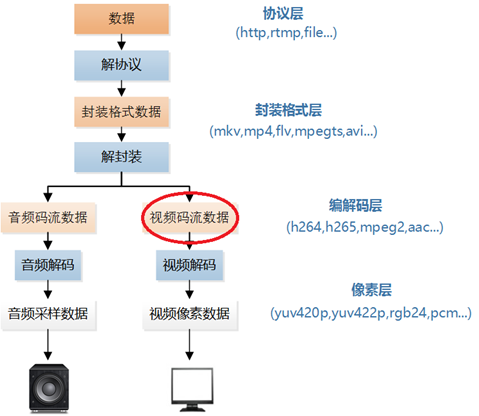
本文中的程序是一个H.264码流解析程序。该程序可以从H.264码流中分析得到它的基本单元NALU,并且可以简单解析NALU首部的字段。通过修改该程序可以实现不同的H.264码流处理功能。
原理
H.264原始码流(又称为“裸流”)是由一个一个的NALU组成的。他们的结构如下图所示。

其中每个NALU之间通过startcode(起始码)进行分隔,起始码分成两种:0x000001(3Byte)或者0x00000001(4Byte)。如果NALU对应的Slice为一帧的开始就用0x00000001,否则就用0x000001。
H.264码流解析的步骤就是首先从码流中搜索0x000001和0x00000001,分离出NALU;然后再分析NALU的各个字段。本文的程序即实现了上述的两个步骤。
代码
整个程序位于simplest_h264_parser()函数中,如下所示。
- /**
- * 最简单的视音频数据处理示例
- * Simplest MediaData Test
- *
- * 雷霄骅 Lei Xiaohua
- * leixiaohua1020@126.com
- * 中国传媒大学/数字电视技术
- * Communication University of China / Digital TV Technology
- * http://blog.csdn.net/leixiaohua1020
- *
- * 本项目包含如下几种视音频测试示例:
- * (1)像素数据处理程序。包含RGB和YUV像素格式处理的函数。
- * (2)音频采样数据处理程序。包含PCM音频采样格式处理的函数。
- * (3)H.264码流分析程序。可以分离并解析NALU。
- * (4)AAC码流分析程序。可以分离并解析ADTS帧。
- * (5)FLV封装格式分析程序。可以将FLV中的MP3音频码流分离出来。
- * (6)UDP-RTP协议分析程序。可以将分析UDP/RTP/MPEG-TS数据包。
- *
- * This project contains following samples to handling multimedia data:
- * (1) Video pixel data handling program. It contains several examples to handle RGB and YUV data.
- * (2) Audio sample data handling program. It contains several examples to handle PCM data.
- * (3) H.264 stream analysis program. It can parse H.264 bitstream and analysis NALU of stream.
- * (4) AAC stream analysis program. It can parse AAC bitstream and analysis ADTS frame of stream.
- * (5) FLV format analysis program. It can analysis FLV file and extract MP3 audio stream.
- * (6) UDP-RTP protocol analysis program. It can analysis UDP/RTP/MPEG-TS Packet.
- *
- */
- #include <stdio.h>
- #include <stdlib.h>
- #include <string.h>
- typedef enum {
- NALU_TYPE_SLICE = 1,
- NALU_TYPE_DPA = 2,
- NALU_TYPE_DPB = 3,
- NALU_TYPE_DPC = 4,
- NALU_TYPE_IDR = 5,
- NALU_TYPE_SEI = 6,
- NALU_TYPE_SPS = 7,
- NALU_TYPE_PPS = 8,
- NALU_TYPE_AUD = 9,
- NALU_TYPE_EOSEQ = 10,
- NALU_TYPE_EOSTREAM = 11,
- NALU_TYPE_FILL = 12,
- } NaluType;
- typedef enum {
- NALU_PRIORITY_DISPOSABLE = 0,
- NALU_PRIRITY_LOW = 1,
- NALU_PRIORITY_HIGH = 2,
- NALU_PRIORITY_HIGHEST = 3
- } NaluPriority;
- typedef struct
- {
- int startcodeprefix_len; //! 4 for parameter sets and first slice in picture, 3 for everything else (suggested)
- unsigned len; //! Length of the NAL unit (Excluding the start code, which does not belong to the NALU)
- unsigned max_size; //! Nal Unit Buffer size
- int forbidden_bit; //! should be always FALSE
- int nal_reference_idc; //! NALU_PRIORITY_xxxx
- int nal_unit_type; //! NALU_TYPE_xxxx
- char *buf; //! contains the first byte followed by the EBSP
- } NALU_t;
- FILE *h264bitstream = NULL; //!< the bit stream file
- int info2=0, info3=0;
- static int FindStartCode2 (unsigned char *Buf){
- if(Buf[0]!=0 || Buf[1]!=0 || Buf[2] !=1) return 0; //0x000001?
- else return 1;
- }
- static int FindStartCode3 (unsigned char *Buf){
- if(Buf[0]!=0 || Buf[1]!=0 || Buf[2] !=0 || Buf[3] !=1) return 0;//0x00000001?
- else return 1;
- }
- int GetAnnexbNALU (NALU_t *nalu){
- int pos = 0;
- int StartCodeFound, rewind;
- unsigned char *Buf;
- if ((Buf = (unsigned char*)calloc (nalu->max_size , sizeof(char))) == NULL)
- printf ("GetAnnexbNALU: Could not allocate Buf memory\n");
- nalu->startcodeprefix_len=3;
- if (3 != fread (Buf, 1, 3, h264bitstream)){
- free(Buf);
- return 0;
- }
- info2 = FindStartCode2 (Buf);
- if(info2 != 1) {
- if(1 != fread(Buf+3, 1, 1, h264bitstream)){
- free(Buf);
- return 0;
- }
- info3 = FindStartCode3 (Buf);
- if (info3 != 1){
- free(Buf);
- return -1;
- }
- else {
- pos = 4;
- nalu->startcodeprefix_len = 4;
- }
- }
- else{
- nalu->startcodeprefix_len = 3;
- pos = 3;
- }
- StartCodeFound = 0;
- info2 = 0;
- info3 = 0;
- while (!StartCodeFound){
- if (feof (h264bitstream)){
- nalu->len = (pos-1)-nalu->startcodeprefix_len;
- memcpy (nalu->buf, &Buf[nalu->startcodeprefix_len], nalu->len);
- nalu->forbidden_bit = nalu->buf[0] & 0x80; //1 bit
- nalu->nal_reference_idc = nalu->buf[0] & 0x60; // 2 bit
- nalu->nal_unit_type = (nalu->buf[0]) & 0x1f;// 5 bit
- free(Buf);
- return pos-1;
- }
- Buf[pos++] = fgetc (h264bitstream);
- info3 = FindStartCode3(&Buf[pos-4]);
- if(info3 != 1)
- info2 = FindStartCode2(&Buf[pos-3]);
- StartCodeFound = (info2 == 1 || info3 == 1);
- }
- // Here, we have found another start code (and read length of startcode bytes more than we should
- // have. Hence, go back in the file
- rewind = (info3 == 1)? -4 : -3;
- if (0 != fseek (h264bitstream, rewind, SEEK_CUR)){
- free(Buf);
- printf("GetAnnexbNALU: Cannot fseek in the bit stream file");
- }
- // Here the Start code, the complete NALU, and the next start code is in the Buf.
- // The size of Buf is pos, pos+rewind are the number of bytes excluding the next
- // start code, and (pos+rewind)-startcodeprefix_len is the size of the NALU excluding the start code
- nalu->len = (pos+rewind)-nalu->startcodeprefix_len;
- memcpy (nalu->buf, &Buf[nalu->startcodeprefix_len], nalu->len);//
- nalu->forbidden_bit = nalu->buf[0] & 0x80; //1 bit
- nalu->nal_reference_idc = nalu->buf[0] & 0x60; // 2 bit
- nalu->nal_unit_type = (nalu->buf[0]) & 0x1f;// 5 bit
- free(Buf);
- return (pos+rewind);
- }
- /**
- * Analysis H.264 Bitstream
- * @param url Location of input H.264 bitstream file.
- */
- int simplest_h264_parser(char *url){
- NALU_t *n;
- int buffersize=100000;
- //FILE *myout=fopen("output_log.txt","wb+");
- FILE *myout=stdout;
- h264bitstream=fopen(url, "rb+");
- if (h264bitstream==NULL){
- printf("Open file error\n");
- return 0;
- }
- n = (NALU_t*)calloc (1, sizeof (NALU_t));
- if (n == NULL){
- printf("Alloc NALU Error\n");
- return 0;
- }
- n->max_size=buffersize;
- n->buf = (char*)calloc (buffersize, sizeof (char));
- if (n->buf == NULL){
- free (n);
- printf ("AllocNALU: n->buf");
- return 0;
- }
- int data_offset=0;
- int nal_num=0;
- printf("-----+-------- NALU Table ------+---------+\n");
- printf(" NUM | POS | IDC | TYPE | LEN |\n");
- printf("-----+---------+--------+-------+---------+\n");
- while(!feof(h264bitstream))
- {
- int data_lenth;
- data_lenth=GetAnnexbNALU(n);
- char type_str[20]={0};
- switch(n->nal_unit_type){
- case NALU_TYPE_SLICE:sprintf(type_str,"SLICE");break;
- case NALU_TYPE_DPA:sprintf(type_str,"DPA");break;
- case NALU_TYPE_DPB:sprintf(type_str,"DPB");break;
- case NALU_TYPE_DPC:sprintf(type_str,"DPC");break;
- case NALU_TYPE_IDR:sprintf(type_str,"IDR");break;
- case NALU_TYPE_SEI:sprintf(type_str,"SEI");break;
- case NALU_TYPE_SPS:sprintf(type_str,"SPS");break;
- case NALU_TYPE_PPS:sprintf(type_str,"PPS");break;
- case NALU_TYPE_AUD:sprintf(type_str,"AUD");break;
- case NALU_TYPE_EOSEQ:sprintf(type_str,"EOSEQ");break;
- case NALU_TYPE_EOSTREAM:sprintf(type_str,"EOSTREAM");break;
- case NALU_TYPE_FILL:sprintf(type_str,"FILL");break;
- }
- char idc_str[20]={0};
- switch(n->nal_reference_idc>>5){
- case NALU_PRIORITY_DISPOSABLE:sprintf(idc_str,"DISPOS");break;
- case NALU_PRIRITY_LOW:sprintf(idc_str,"LOW");break;
- case NALU_PRIORITY_HIGH:sprintf(idc_str,"HIGH");break;
- case NALU_PRIORITY_HIGHEST:sprintf(idc_str,"HIGHEST");break;
- }
- fprintf(myout,"%5d| %8d| %7s| %6s| %8d|\n",nal_num,data_offset,idc_str,type_str,n->len);
- data_offset=data_offset+data_lenth;
- nal_num++;
- }
- //Free
- if (n){
- if (n->buf){
- free(n->buf);
- n->buf=NULL;
- }
- free (n);
- }
- return 0;
- }
上文中的函数调用方法如下所示。
- simplest_h264_parser("sintel.h264");
结果
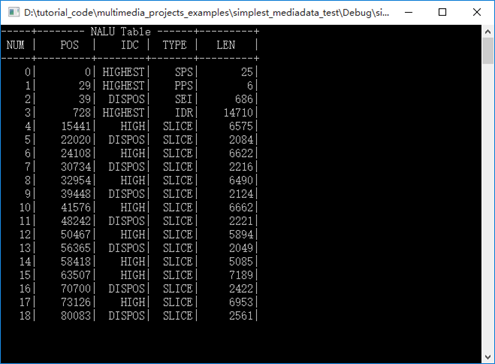
本程序的输入为一个H.264原始码流(裸流)的文件路径,输出为该码流的NALU统计数据,如下图所示。
下载
Simplest mediadata test
项目主页
SourceForge:https://sourceforge.net/projects/simplest-mediadata-test/
Github:https://github.com/leixiaohua1020/simplest_mediadata_test
开源中国:http://git.oschina.net/leixiaohua1020/simplest_mediadata_test
CSDN下载地址:http://download.csdn.net/detail/leixiaohua1020/9422409
本项目包含如下几种视音频数据解析示例:
(1)像素数据处理程序。包含RGB和YUV像素格式处理的函数。
(2)音频采样数据处理程序。包含PCM音频采样格式处理的函数。
(3)H.264码流分析程序。可以分离并解析NALU。
(4)AAC码流分析程序。可以分离并解析ADTS帧。
(5)FLV封装格式分析程序。可以将FLV中的MP3音频码流分离出来。
(6)UDP-RTP协议分析程序。可以将分析UDP/RTP/MPEG-TS数据包。
视音频数据处理入门:H.264视频码流解析的更多相关文章
- H.264/H265码流解析
H.264/H265码流解析 一.H.264码流解析 一个原始的H.264 NALU 单元常由 [StartCode] [NALU Header] [NALU Payload] 三部分组成 一个原始的 ...
- 视音频数据处理入门:AAC音频码流解析
===================================================== 视音频数据处理入门系列文章: 视音频数据处理入门:RGB.YUV像素数据处理 视音频数据处理 ...
- 视音频数据处理入门:UDP-RTP协议解析
===================================================== 视音频数据处理入门系列文章: 视音频数据处理入门:RGB.YUV像素数据处理 视音频数据处理 ...
- 视音频数据处理入门:FLV封装格式解析
===================================================== 视音频数据处理入门系列文章: 视音频数据处理入门:RGB.YUV像素数据处理 视音频数据处理 ...
- 视音频数据处理入门:PCM音频采样数据处理
===================================================== 视音频数据处理入门系列文章: 视音频数据处理入门:RGB.YUV像素数据处理 视音频数据处理 ...
- 视音频数据处理入门:RGB、YUV像素数据处理
===================================================== 视音频数据处理入门系列文章: 视音频数据处理入门:RGB.YUV像素数据处理 视音频数据处理 ...
- [转载] 视音频数据处理入门:RGB、YUV像素数据处理
===================================================== 视音频数据处理入门系列文章: 视音频数据处理入门:RGB.YUV像素数据处理 视音频数据处理 ...
- 视音频数据处理入门:RGB、YUV像素数据处理【转】
转自:http://blog.csdn.net/leixiaohua1020/article/details/50534150 ==================================== ...
- 【视频编解码·学习笔记】4. H.264的码流封装格式
一.码流封装格式简单介绍: H.264的语法元素进行编码后,生成的输出数据都封装为NAL Unit进行传递,多个NAL Unit的数据组合在一起形成总的输出码流.对于不同的应用场景,NAL规定了一种通 ...
随机推荐
- Alpha版本冲刺(四)
目录 组员情况 组员1(组长):胡绪佩 组员2:胡青元 组员3:庄卉 组员4:家灿 组员5:凯琳 组员6:丹丹 组员7:何家伟 组员8:政演 组员9:鸿杰 组员10:刘一好 组员:何宇恒 展示组内最新 ...
- VirtualBox安装及Linux基本操作(操作系统实验一)
VirtualBox安装教程博客链接(转载)https://blog.csdn.net/u012732259/article/details/70172704 实验名称:Linux的基本操作 实验目的 ...
- 数据库:XML,解析Dom4J
package com.itheima.util; import java.io.FileOutputStream; import java.net.URL; import org.dom4j.Doc ...
- spring时间管理
spring时间管理相比Quartz要简单的多,但功能不如quartz强大 spring.xml的配置 <?xml version="1.0" encoding=" ...
- charles使用教程 干货~
大部分内容来自前辈们的摘写,博客园是怎么去转载其他好的博呢~ 言归正传,教程看过后还是自己再来一遍理解和操作才会更加深刻. Charles 是在 Mac/WIN下常用的网络封包截取工具,在做移动开发时 ...
- node websocket学习研究
websocket作为不同于http的数据传输方式,是开发一些实时系统的不二选择. 最近在研究开发websocket方面的小程序.小程序客户端直接对websocket做了封装.自己只要写后端就可以了. ...
- Struts hibernate Spring 框架原理
转自:http://www.cnblogs.com/javaNewegg/archive/2011/08/28/2156521.html 原理:1.通过Configuration().configur ...
- 字符串拆分函数 func_splitstr
create type str_split is table of varchar2(4000) ; 1 CREATE OR REPLACE FUNCTION splitstr(p_string IN ...
- 计算机网络【2】—— CSMA/CD协议
参考文献: https://blog.csdn.net/loveCC_orange/article/details/79177129 一.认识以太网 最早的以太网是将许多计算机都连接到一根总线上. 使 ...
- Keil MDK中单个c文件生成LIB文件
看大多数说的都是简单地将整个工程转换成.LIB,在Project->Options for Target->Output下,选择Create Library,就可以了. 不过这样生成的li ...