
Spring (三)SpringAoP
1.Spring 的 AOP 简介
1.1 什么是 AOP
AOP 为 Aspect Oriented Programming 的缩写,意思为面向切面编程,是通过预编译方式和运行期动态代理实现程序功能的统一维护的一种技术。
AOP 是 OOP 的延续,是软件开发中的一个热点,也是Spring框架中的一个重要内容,是函数式编程的一种衍生范型。利用AOP可以对业务逻辑的各个部分进行隔离,从而使得业务逻辑各部分之间的耦合度降低,提高程序的可重用性,同时提高了开发的效率。
1.2 AOP 的作用及其优势
作用:在程序运行期间,在不修改源码的情况下对方法进行功能增强
优势:减少重复代码,提高开发效率,并且便于维护
1.3 AOP 的底层实现
实际上,AOP 的底层是通过 Spring 提供的的动态代理技术实现的。在运行期间,Spring通过动态代理技术动态的生成代理对象,代理对象方法执行时进行增强功能的介入,在去调用目标对象的方法,从而完成功能的增强。
1.4 AOP 的动态代理技术
常用的动态代理技术
- JDK 代理 : 基于接口的动态代理技术
- cglib 代理:基于父类的动态代理技术
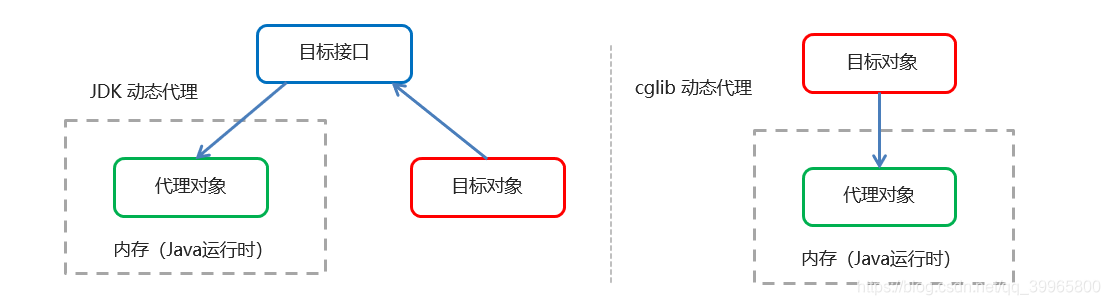
1.5 JDK 的动态代理
①目标类接口
public interface TargetInterface {

    public void save();

}
②目标类
public class Target implements TargetInterface{

    @Override

    public void save() {

        System.out.println("save running...");

    }

}
package com.itheima.proxy.jdk;

public class Advice {

    public void before(){

        System.out.println("前置增强。。");

    }

    public void afterReturning(){

        System.out.println("后置增强。。");

    }

}
③动态代理代码
public class ProxyTest {

    public static void main(String[] args) {

        //目标对象

        final Target target = new Target();

        //增强对象

        Advice advice =new Advice();

        //返回值就是动态生成的代理对象

        TargetInterface proxy=(TargetInterface) Proxy.newProxyInstance(

                target.getClass().getClassLoader(), //目标对象类加载器

                target.getClass().getInterfaces(),  //目标对象相同的接口字节码对象数组

                new InvocationHandler() {

                    //调用代理对象的任何方法 实质都是invoke方法

                    @Override

                    public Object invoke(Object proxy, Method method, Object[] args) throws Throwable {

                        advice.before();//前置增强

                        Object invoke = method.invoke(target, args);//执行目标方法

                        advice.afterReturning();//后置增强

                        return invoke;

                    }

                }

        );

 //调用代理对象的方法测试

        proxy.save();

    }

}
④ 调用代理对象的方法测试
C:\wusier\study\jdk-13.0.2_windows-x64_bin\jdk-13.0.2\bin\java.exe "-javaagent:C:\wusier\software\IntelliJ IDEA 2019.3.2\lib\idea_rt.jar=54689:C:\wusier\software\IntelliJ IDEA 2019.3.2\bin" -Dfile.encoding=UTF-8 -classpath "C:\Users\32611\Desktop\Key Documentd\Java\Spring\itheima_spring_aop\target\classes" com.itheima.proxy.jdk.ProxyTest

前置增强。。

save running...

后置增强。。
这是动态生成的代码
1.6 cglib 的动态代理
①目标类
public class Target {

    public void method() {

        System.out.println("Target running....");

    }

}
②动态代理代码
Target target = new Target(); //创建目标对象

Enhancer enhancer = new Enhancer();   //创建增强器

enhancer.setSuperclass(Target.class); //设置父类

enhancer.setCallback(new MethodInterceptor() { //设置回调

    @Override

    public Object intercept(Object o, Method method, Object[] objects,

    MethodProxy methodProxy) throws Throwable {

        System.out.println("前置代码增强....");

        Object invoke = method.invoke(target, objects);

        System.out.println("后置代码增强....");

        return invoke;

    }

});

Target proxy = (Target) enhancer.create(); //创建代理对象
public class ProxyTest {
public static void main(String[] args) {
//目标对象
final Target target = new Target();
//增强对象
final Advice advice = new Advice();
//返回值 就是动态生成的代理对象 基于cglib
//1、创建增强器
Enhancer enhancer = new Enhancer();
//2、设置父类(目标)
enhancer.setSuperclass(Target.class);
//3、设置回调
enhancer.setCallback(new MethodInterceptor() {
public Object intercept(Object proxy, Method method, Object[] args, MethodProxy methodProxy) throws Throwable {
advice.before(); //执行前置
Object invoke = method.invoke(target, args);//执行目标
advice.afterReturning(); //执行后置
return invoke;
}
});
//4、创建代理对象
Target proxy = (Target) enhancer.create();
proxy.save();
}
}
③调用代理对象的方法测试
//测试,当调用接口的任何方法时,代理对象的代码都无序修改

proxy.method();
感受一下行吧,不是很懂。好难
1.7 AOP 相关概念
Spring 的 AOP 实现底层就是对上面的动态代理的代码进行了封装,封装后我们只需要对需要关注的部分进行代码编写,并通过配置的方式完成指定目标的方法增强。
在正式讲解 AOP 的操作之前,我们必须理解 AOP 的相关术语,常用的术语如下:
Target(目标对象):代理的目标对象
Proxy (代理):一个类被 AOP 织入增强后,就产生一个结果代理类
Joinpoint(连接点):所谓连接点是指那些被拦截到的点。在spring中,这些点指的是方法,因为spring只支持方法类型的连接点,可以被增强的方法就是连接点
Pointcut(切入点):所谓切入点是指我们要对哪些 Joinpoint 进行拦截的定义
Advice(通知/ 增强):所谓通知是指拦截到 Joinpoint 之后所要做的事情就是通知
Aspect(切面):是切入点和通知(引介)的结合
Weaving(织入):是指把增强应用到目标对象来创建新的代理对象的过程。spring采用动态代理织入,而AspectJ采用编译期织入和类装载期织入
1.8 AOP 开发明确的事项
1)需要编写的内容
编写核心业务代码(目标类的目标方法)
编写切面类,切面类中有通知(增强功能方法)
在配置文件中,配置织入关系,即将哪些通知与哪些连接点进行结合
2)AOP 技术实现的内容
Spring 框架监控切入点方法的执行。一旦监控到切入点方法被运行,使用代理机制,动态创建目标对象的代理对象,根据通知类别,在代理对象的对应位置,将通知对应的功能织入,完成完整的代码逻辑运行。
3)AOP 底层使用哪种代理方式
在 spring 中,框架会根据目标类是否实现了接口来决定采用哪种动态代理的方式。
1.9 知识要点
aop:面向切面编程
aop底层实现:基于JDK的动态代理 和 基于Cglib的动态代理
aop的重点概念:
Pointcut(切入点):被增强的方法

Advice(通知/ 增强):封装增强业务逻辑的方法

Aspect(切面):切点+通知

Weaving(织入):将切点与通知结合的过程
开发明确事项:
谁是切点(切点表达式配置)

谁是通知(切面类中的增强方法)

将切点和通知进行织入配置
2. 基于 XML 的 AOP 开发
2.1 快速入门
①导入 AOP 相关坐标
②创建目标接口和目标类(内部有切点)
③创建切面类(内部有增强方法)
④将目标类和切面类的对象创建权交给 spring
⑤在 applicationContext.xml 中配置织入关系
⑥测试代码
①导入 AOP 相关坐标
<!--导入spring的context坐标,context依赖aop-->

<dependency>

  <groupId>org.springframework</groupId>

  <artifactId>spring-context</artifactId>

  <version>5.0.5.RELEASE</version>

</dependency>

<!-- aspectj的织入 -->

<dependency>

  <groupId>org.aspectj</groupId>

  <artifactId>aspectjweaver</artifactId>

  <version>1.8.13</version>

</dependency>
②创建目标接口和目标类(内部有切点)
public interface TargetInterface {

    public void method();

}

public class Target implements TargetInterface {

    @Override

    public void method() {

        System.out.println("Target running....");

    }

}
③创建切面类(内部有增强方法)
public class MyAspect {

    //前置增强方法

    public void before(){

        System.out.println("前置代码增强.....");

    }

}
④将目标类和切面类的对象创建权交给 spring
<!--配置目标类-->

<bean id="target" class="com.itheima.aop.Target"></bean>

<!--配置切面类-->

<bean id="myAspect" class="com.itheima.aop.MyAspect"></bean>
⑤在 applicationContext.xml 中配置织入关系
导入aop命名空间
<beans xmlns="http://www.springframework.org/schema/beans"

       xmlns:xsi="http://www.w3.org/2001/XMLSchema-instance"

       xmlns:context="http://www.springframework.org/schema/context"

       xmlns:aop="http://www.springframework.org/schema/aop"

       xsi:schemaLocation="

        http://www.springframework.org/schema/context

        http://www.springframework.org/schema/context/spring-context.xsd

        http://www.springframework.org/schema/aop

        http://www.springframework.org/schema/aop/spring-aop.xsd

        http://www.springframework.org/schema/beans

        http://www.springframework.org/schema/beans/spring-beans.xsd">
⑤在 applicationContext.xml 中配置织入关系
配置切点表达式和前置增强的织入关系
<aop:config>

    <!--引用myAspect的Bean为切面对象-->

    <aop:aspect ref="myAspect">

        <!--配置Target的method方法执行时要进行myAspect的before方法前置增强-->

        <aop:before method="before" pointcut="execution(public void com.itheima.aop.Target.method())"></aop:before>

    </aop:aspect>

</aop:config>
⑥测试代码
@RunWith(SpringJUnit4ClassRunner.class)

@ContextConfiguration("classpath:applicationContext.xml")

public class AopTest {

    @Autowired

    private TargetInterface target;

    @Test

    public void test1(){

        target.method();

    }

}
⑦测试结果

2.2 XML 配置 AOP 详解
1) 切点表达式的写法
表达式语法
execution([修饰符] 返回值类型 包名.类名.方法名(参数))访问修饰符可以省略[ ]
返回值类型、包名、类名、方法名可以使用星号* 代表任意
包名与类名之间一个点 . 代表当前包下的类,两个点 .. 表示当前包及其子包下的类
参数列表可以使用两个点 .. 表示任意个数,任意类型的参数列表
例如:
execution(public void com.itheima.aop.Target.method())

execution(void com.itheima.aop.Target.*(..))

execution(* com.itheima.aop.*.*(..))

execution(* com.itheima.aop..*.*(..))

execution(* *..*.*(..))
2) 通知的类型
通知的配置语法:
<aop:通知类型 method=“切面类中方法名” pointcut=“切点表达式"></aop:通知类型>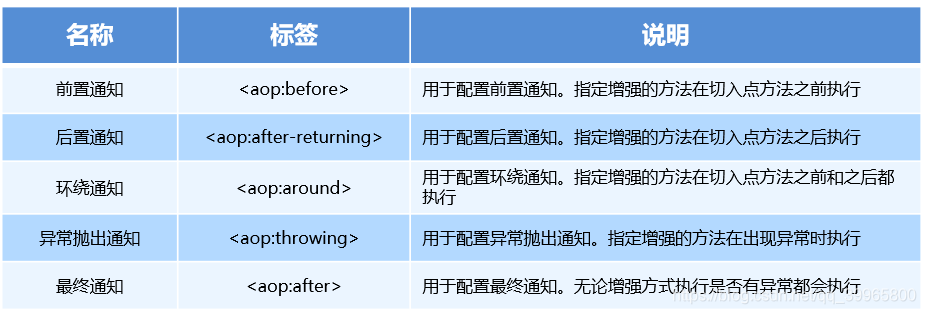
public class MyAspect {

    public void before(){

        System.out.println("前置增强..........");

    }

    public void afterReturning(){

        System.out.println("后置增强..........");

    }

    //Proceeding JoinPoint:  正在执行的连接点===切点

    public Object around(ProceedingJoinPoint pjp) throws Throwable {

        System.out.println("环绕前增强....");

        Object proceed = pjp.proceed();//切点方法

        System.out.println("环绕后增强....");

        return proceed;

    }

    public void afterThrowing(){

        System.out.println("异常抛出增强..........");

    }

    public void after(){

        System.out.println("最终增强..........");

    }

}
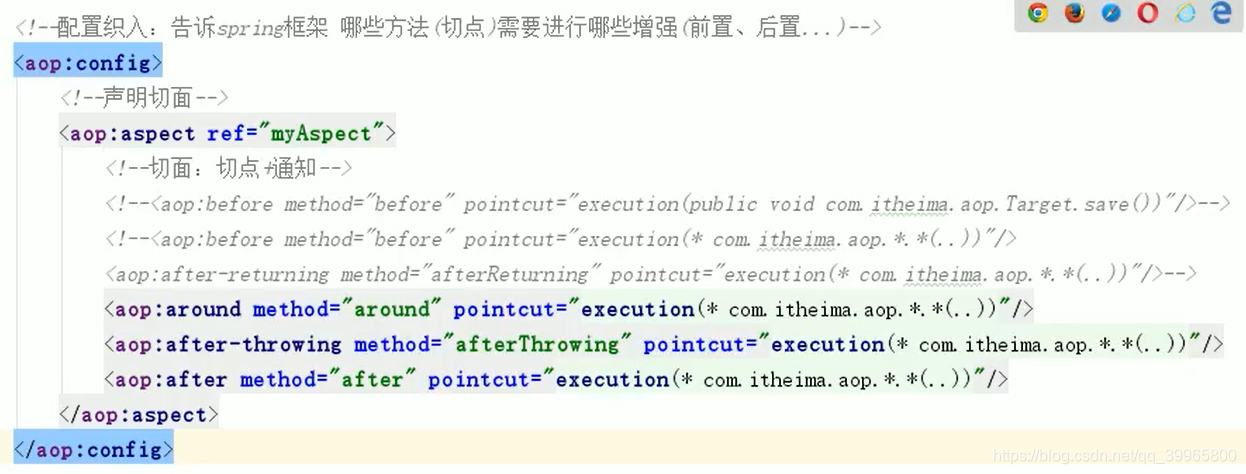
3) 切点表达式的抽取
当多个增强的切点表达式相同时,可以将切点表达式进行抽取,在增强中使用 pointcut-ref 属性代替 pointcut 属性来引用抽取后的切点表达式。
    <aop:config>

        <!--声明切面-->

        <aop:aspect ref="myAspect">

            <!--抽取切点表达式-->

            <aop:pointcut id="myPointcut" expression="execution(* com.itheima.aop.*.*(..))"></aop:pointcut>

            <!--切面:切点+通知-->

            <!--<aop:before method="before" pointcut="execution(public void com.itheima.aop.Target.save())"/>-->

            <!--<aop:before method="before" pointcut="execution(* com.itheima.aop.*.*(..))"/>

            <aop:after-returning method="afterReturning" pointcut="execution(* com.itheima.aop.*.*(..))"/>-->

            <!--<aop:around method="around" pointcut="execution(* com.itheima.aop.*.*(..))"/>

            <aop:after-throwing method="afterThrowing" pointcut="execution(* com.itheima.aop.*.*(..))"/>

            <aop:after method="after" pointcut="execution(* com.itheima.aop.*.*(..))"/>-->

            <aop:around method="around" pointcut-ref="myPointcut"/>

            <aop:after method="after" pointcut-ref="myPointcut"/>

        </aop:aspect>

    </aop:config>
2.3 知识要点
aop织入的配置
<aop:config>

    <aop:aspect ref=“切面类”>

        <aop:before method=“通知方法名称” pointcut=“切点表达式"></aop:before>

    </aop:aspect>

</aop:config>
通知的类型:前置通知、后置通知、环绕通知、异常抛出通知、最终通知
切点表达式的写法:
execution([修饰符] 返回值类型 包名.类名.方法名(参数))3.基于注解的 AOP 开发
3.1 快速入门
基于注解的aop开发步骤:
①创建目标接口和目标类(内部有切点)
②创建切面类(内部有增强方法)
③将目标类和切面类的对象创建权交给 spring
④在切面类中使用注解配置织入关系
⑤在配置文件中开启组件扫描和 AOP 的自动代理
⑥测试
①创建目标接口和目标类(内部有切点)
public interface TargetInterface {

    public void method();

}

public class Target implements TargetInterface {

    @Override

    public void method() {

        System.out.println("Target running....");

    }

}
②创建切面类(内部有增强方法)
public class MyAspect {

    //前置增强方法

    public void before(){

        System.out.println("前置代码增强.....");

    }

}
③将目标类和切面类的对象创建权交给 spring
@Component("target")

public class Target implements TargetInterface {

    @Override

    public void method() {

        System.out.println("Target running....");

    }

}

@Component("myAspect")

public class MyAspect {

    public void before(){

        System.out.println("前置代码增强.....");

    }

}
④在切面类中使用注解配置织入关系
@Component("myAspect")

@Aspect

public class MyAspect {

    @Before("execution(* com.itheima.aop.*.*(..))")

    public void before(){

        System.out.println("前置代码增强.....");

    }

}
⑤在配置文件中开启组件扫描和 AOP 的自动代理
<!--组件扫描-->

<context:component-scan base-package="com.itheima.aop"/>

<!--aop的自动代理-->

<aop:aspectj-autoproxy></aop:aspectj-autoproxy>
⑥测试代码
@RunWith(SpringJUnit4ClassRunner.class)

@ContextConfiguration("classpath:applicationContext.xml")

public class AopTest {

    @Autowired

    private TargetInterface target;

    @Test

    public void test1(){

        target.method();

    }

}
⑦测试结果

3.2 注解配置 AOP 详解
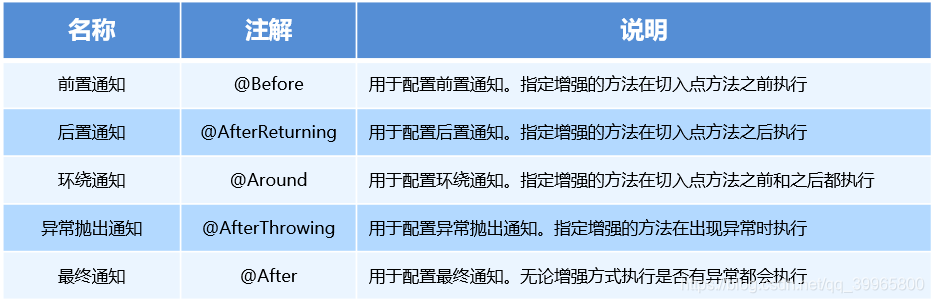
1) 注解通知的类型
通知的配置语法:@通知注解(“切点表达式")
2) 切点表达式的抽取
同 xml配置 aop 一样,我们可以将切点表达式抽取。抽取方式是在切面内定义方法,在该方法上使用@Pointcut注解定义切点表达式,然后在在增强注解中进行引用。具体如下:
@@Component("myAspect")

@Aspect

public class MyAspect {

    @Before("MyAspect.myPoint()")

    public void before(){

        System.out.println("前置代码增强.....");

    }

    @Pointcut("execution(* com.itheima.aop.*.*(..))")

    public void myPoint(){}

}
3.3 知识要点
注解aop开发步骤
①使用@Aspect标注切面类
②使用@通知注解标注通知方法
③在配置文件中配置aop自动代理<aop:aspectj-autoproxy/>
Spring (三)SpringAoP的更多相关文章
- spring三种实例化bean的方式
1构造函数实例化 2静态工厂方法实例化 3实例工厂方法实例化 service接口: package service; public interface PersonService { public v ...
- spring(三、spring中的eheche缓存、redis使用)
spring(三.spring中的eheche缓存.redis使用) 本文主要介绍为什么要构建ehcache+redis两级缓存?以及在实战中如何实现?思考如何配置缓存策略更合适?这样的方案可能遗留什 ...
- 面试阿里被“吊打”,一问Spring三不知,半年后二战终拿下offer
Spring框架是一个为Java应用程序的开发提供了综合.广泛的基础性支持的Java平台.Spring帮助开发者解决了开发中基础性的问题,使得开发人员可以专注于应用程序的开发. 近两年来,许多大厂在面 ...
- Spring源码系列(三)--spring-aop的基础组件、架构和使用
简介 前面已经讲完 spring-bean( 详见Spring ),这篇博客开始攻克 Spring 的另一个重要模块--spring-aop. spring-aop 可以实现动态代理(底层是使用 JD ...
- Spring —— 三种配置数据源的方式:spring内置、c3p0、dbcp
01.Spring内置数据源配置Class:DriverManagerDataSource全限定名:org.springframework.jdbc.datasource.DriverManagerD ...
- 面渣逆袭:Spring三十五问,四万字+五十图详解
大家好,我是老三啊,面渣逆袭 继续,这节我们来搞定另一个面试必问知识点--Spring. 有人说,"Java程序员都是Spring程序员",老三不太赞成这个观点,但是这也可以看出S ...
- Spring(三)AOP面向切面编程
原文链接:http://www.orlion.ga/205/ 一.AOP简介 1.AOP概念 参考文章:http://www.orlion.ml/57 2.AOP的产生 对于如下方法: pub ...
- Spring(三)Bean继续入门
一.Aware相关接口 对于应用程序来说,应该尽量减少对Sping Api的耦合程度,然而有些时候为了运用Spring所提供的一些功能,有必要让Bean了解Spring容器对其进行管理的细节信息,如让 ...
- JdbcTemplae使用入门&&Spring三种连接池配置&&Spring配置文件引用外部properties文件
JdbcTemplate的使用 Spring为了各种支持的持久化技术,都提供了简单操作的模版和回调. JdbcTemplate 简化 JDBC 操作HibernateTemplate 简化 Hiber ...
随机推荐
- Elasticsearch---DSL搜索实践
Domain Specific Language 特定领域语言,基于JSON格式的数据查询,查询更灵活,有利于复杂查询 一.普通url路径参数搜索 数据准备 1.建立名字为 shop 的索引 2.手动 ...
- 1020 Tree Traversals——PAT甲级真题
1020 Tree Traversals Suppose that all the keys in a binary tree are distinct positive integers. Give ...
- mbatis中的#{}和${}
#{}和${}的区别是什么?a.#{}是预编译处理,${}是字符串替换. b.Mybatis 在处理#{}时,会将 sql 中的#{}替换为?号,调用 PreparedStatement 的 set ...
- HBase ——Shell操作
HBase --Shell操作 Q:你觉得HBase是什么? A:一种结构化的分布式数据存储系统,它基于列来存储数据. 基于HBase,可以实现以廉价PC机器集群存储海量数据的分布式数据库的解决方案. ...
- 京东数科二面:常见的 IO 模型有哪些?Java 中的 BIO、NIO、AIO 有啥区别?
IO 模型这块确实挺难理解的,需要太多计算机底层知识.写这篇文章用了挺久,就非常希望能把我所知道的讲出来吧!希望朋友们能有收货!为了写这篇文章,还翻看了一下<UNIX 网络编程>这本书,太 ...
- hutool的DateUtil工具类
1.0.DateUitl(日期时间) 0)坐标 <dependency> <groupId>cn.hutool</groupId> <artifactId&g ...
- 痞子衡嵌入式:系统时钟配置不当会导致i.MXRT1xxx系列下OTFAD加密启动失败
大家好,我是痞子衡,是正经搞技术的痞子.今天痞子衡给大家分享的是系统时钟配置不当会导致i.MXRT1xxx系列下OTFAD加密启动失败问题. 我们知道,i.MXRT1xxx家族早期型号(RT1050/ ...
- Python3.x 基础练习题100例(11-20)
练习11: 题目: 古典问题:有一对兔子,从出生后第3个月起每个月都生一对兔子,小兔子长到第三个月后每个月又生一对兔子,假如兔子都不死,问每个月的兔子总数为多少? 分析: 兔子的规律为数列1,1,2, ...
- 企业安全_监控Github关键字
目录 Hawkeye GSIL Hawkeye github: https://github.com/0xbug/Hawkeye 教程: https://my.oschina.net/adailinu ...
- 为 APK 文件增加右键菜单组实现快捷安装
0.结果 1.需求 迫于每次都要打开 Powershell 手动敲 adb install xxx.apk 太麻烦,就想通过注册表搞一个右键菜单,实现快捷安装 apk 的功能. 最后决定先实现三个功能 ...