
NLTK学习笔记(二):文本、语料资源和WordNet汇总
语料库基本函数表
| 示例 | 描述 |
|---|---|
| fileids() | 语料库中的文件 |
| fileids([categories]) | 对应分类中的语料库文件 |
| categories() | 语料库的分类 |
| categories([fileids]) | 文件对应的语料库分类 |
| raw(fileids=[f1,f2..],categories=[c1,c2...]) | 对应文件和分类中原始内容。参数可以式空 |
| words(fileids=[f1,f2..],categories=[c1,c2...]) | 对应文件和分类的词汇。参数可以空 |
| sents() | sents(fileids=[f1,f2..],categories=[c1,c2...]) |
| abspath(fileid) | 文件在磁盘的位置 |
| encoding(fileid) | 文件的编码 |
| open(fileid) | 打开文件流 |
| root() | 本地语料库corpus的位置 |
| readme() | README文件的内容 |
文本语料库分类
- 最简单的是孤立的文本集合
- 按照文本等标签分类组成结构,如:布朗语料库
- 分类不严格,会重叠的语料库,如:路透社语料库
- 随时间/语言用法改变的语料库 ,如:就职演说库
常见语料库及其用法
注意
nltk.Text(string)返回类似text1的Text对象
古藤堡语料库
包含36000本电子书,可以在这里下载
from nltk.corpus import gutenberg

print(gutenberg.fileids())

emma= gutenberg.words('austen-emma.txt')

print(gutenberg.raw('austen-emma.txt'))

emma = nltk.Text(emma)#

print(emma[:10])
网络&&聊天体
网络text主要是非正式文学,论坛交流,剧本,评论等。聊天文本是根据聊天室划分的(文件名包括 日期、聊天室、帖子数量),被划分为15个大文件。
#网络体:webtext

from nltk.corpus import webtext

for fileid in webtext.fileids():

    print(fileid,webtext.raw(fileid)[:50])
[out]

firefox.txt Cookie Manager: "Don't allow sites that set remove

grail.txt SCENE 1: [wind] [clop clop clop]

KING ARTHUR: Who

overheard.txt White guy: So, do you have any plans for this even

pirates.txt PIRATES OF THE CARRIBEAN: DEAD MAN'S CHEST, by Ted

singles.txt 25 SEXY MALE, seeks attrac older single lady, for

wine.txt Lovely delicate, fragrant Rhone wine. Polished lea
#聊天体:nps_chat

from nltk.corpus import nps_chat

chatroom = nps_chat.posts('10-19-20s_706posts.xml')

chatroom[123:125]
[out]

[['i',

  'do',

  "n't",

  'want',

  'hot',

  'pics',

  'of',

  'a',

  'female',

  ',',

  'I',

  'can',

  'look',

  'in',

  'a',

  'mirror',

  '.'],

 ['hi', 'U64']]
布朗语料库
百万词级语料库,没啥好说的。按照文本分类,如新闻、社论等。
from nltk.corpus import brown

print(brown.categories())

print(brown.fileids())
因为这个语料库是研究文本间系统性差异的资源,所以可以来比较一下不同文本中情态动词的用法。
import nltk

from nltk.corpus import brown

news = brown.words(categories='news')

fdist = nltk.FreqDist([w.lower() for w in news])

modals= ['can','could','may','might','must','will']

for m in modals:

    print(m,':',fdist[m])
路透社语料库
新闻文档,分为“训练”和“测试”两组。便于及其进行训练和测试。命名就是'test/number'和'training/number'
from nltk.corpus import reuters

print(reuters.fileids())

print(reuters.categories())
就职演说语料库
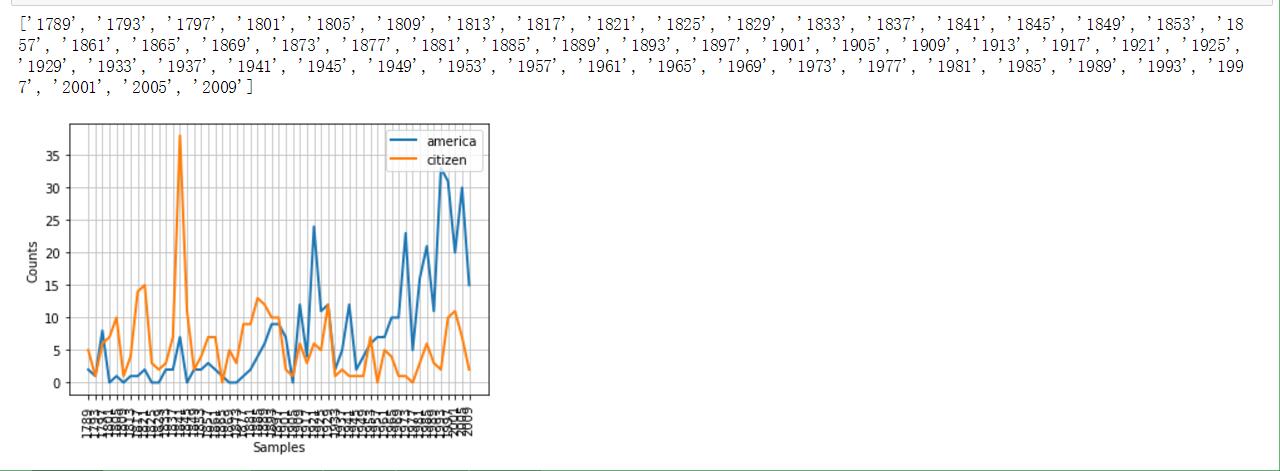
感觉这算是美国特色吧。因为命名采用'year-name.txt'的格式,我们可以提取出来时间维度,并且做个折线图来统计特定词汇的出现频率(不同年代中)
from nltk.corpus import inaugural

print(list(f[:4]for f in inaugural.fileids()))

#下面体现American和citizen随时间推移使用情况

cfd = nltk.ConditionalFreqDist(\

                              (target,fileid[:4])\

                              for fileid in inaugural.fileids()\

                              for w in inaugural.words(fileid)\

                              for target in ['america','citizen']\

                               if w.lower().startswith(target))

cfd.plot()
感受一下效果图(附截图)
载入自定义语料库
如果想操作自己的语料库,并且使用之前的方法,那么,需要
PlaintextCorpusReader函数来载入他们,这个函数参数有两个,第一个是根目录,第二个是子文件(可以使用正则表达式进行匹配)
from nltk.corpus import PlaintextCorpusReader

root = r'C:\Users\Asura-Dong\Desktop\tem\dict'

wordlist = PlaintextCorpusReader(root,'.*')#匹配所有文件

print(wordlist.fileids())

print(wordlist.words('tem1.txt'))
输出结果:

['README', 'tem1.txt']

['hello', 'world']
词典资源
词典:包括词性和注释信息。
停用词语料库
stopwords即是,遗憾的是没有中文停用词
from nltk.corpus import stopwords

#定义一个计算func计算不在停用词列表中的比例的函数

def content(text):

    stopwords_eng = stopwords.words('english')

    content = [w for w in text if w.lower() and w not in stopwords_eng]

    return len(content)/len(text)

print(content(nltk.corpus.reuters.words()))
名字词典
就两部分组成,男性和女性的英文名字。这里我们研究一下最后一个名字最后一个字母和性别的关系
names = nltk.corpus.names

print(names.fileids())

male = names.words('male.txt')

female = names.words('female.txt')

cfd = nltk.ConditionalFreqDist((fileid,name[-1]) for fileid in names.fileids() for name in names.words(fileid))

cfd.plot()
(附截图)

发音词典
这个更神奇,竟然是为了发音合成准备的。以后通读这本书后,也想想怎么迁移到中文上。
引入 nltk.corpus.cmudict 后,我们可以得到它音素的长度,由此可以找到押韵的词语。
s = ['N','IHO','K','S']

entries = nltk.corpus.cmudict.entries()

print('Example:',entries[0])

word_list = [word for word,pron in entries if pron[-4:]==s]

print(word_list)
在因素表中,我们会发现数字:1,2,0。分别代表着:主重音、次重音、无重音。
这里我们可以定义一个function,找到具有特定重音模式的词汇。
def func(pron):

    return [char for phone in pron for char in phone if char.isdigit()]

word_list = [w for w,pron in entries if func(pron)==['0','1','0','2','0']]

print(word_list)
WordNet面向语义的英语字典
最后必须说一下这个字典。WordNet是由Princeton 大学的心理学家,语言学家和计算机工程师联合设计的一种基于认知语言学的英语词典。它不是光把单词以字母顺序排列,而且按照单词的意义组成一个“单词的网络”。
引入和同义词
motorcar和automobile是同义词,可以借助wordnet来研究。
from nltk.corpus import wordnet as wn

wn.synsets('motorcar')
结果是:[Synset('car.n.01')]。说明motorcar 只有一个 可能的含义。car.n.01被称为“同义 词集 ”。我们可以通过wn.synset('car.n.01').lemma_names 来查看当前同义词集的其他词 (car这个单词就有很多个同义词集了) 。wn.synset('car.n.01').examples 和wn.synset('car.n.01').definition 可以分别查看定义和例子(但是Python3里面不可以。)
而类似car.n.01.car这样的处于下一级的称之为词条。
对于词条级别的obj,可以看下面的操作。
print(wn.synset('car.n.01').lemmas)

wn.lemma('car.n.01.automobile').name

wn.lemma('car.n.01.automobile').synset
上位词、下位词、反义词
上位词(hypernym),指概念上外延更广的主题词。 例如:”花”是”鲜花”的上位词,”植物”是”花”的上位词,”音乐”是”mp3”的上位词。反过来就是下位词了。
上位词和下位词通过hyponyms() 和 root_hypernyms() 来访问。
motorcar = wn.synset('car.n.01').hyponyms()#下位词

car = wn.synset('car.n.01').root_hypernyms()
反义词就通过antonyms() 来访问
其他词集关系
之前是从上->到下,或者反过来。更重要的是从整体->局部,或者反过来。如大树和树冠、树干的关系,这些是
part_meronyms()。而大树集合就成了森林,member_holonyms()。而树的实质是心材和边材组成,即substance_meronyms()。
语义相似度
当两个单词有相同的上位词(在词树中寻找),而若上位词恰好属于较低层,那么它们会有一定密切联系。
right = wn.synset('right_whale.n.01')

orca = wn.synset('orca.n.01')

print(right.lowest_common_hypernyms(orca))
当然,类似于树的结构中总是有神的,可以通过min_depth() 来查看一个synset的最小深度。基于这些,我们可以在0-1的范围内返回相似度。对于上面的代码,查看相似度:right.path_similarity(orca)。
这些数字大小意义不大。但是当鲸鱼和鲸鱼、鲸鱼和小说来比较时,数字是减小的。对比着看大小,还是有意义的。
NLTK学习笔记(二):文本、语料资源和WordNet汇总的更多相关文章
- NLTK学习笔记(七):文本信息提取
目录 实体识别:分块技术 分块语法的构建 树状图 IOB标记 开发和评估分块器 命名实体识别和信息提取 如何构建一个系统,用于从非结构化的文本中提取结构化的信息和数据?哪些方法使用这类行为?哪些语料库 ...
- Django学习笔记二
Django学习笔记二 模型类,字段,选项,查询,关联,聚合函数,管理器, 一 字段属性和选项 1.1 模型类属性命名限制 1)不能是python的保留关键字. 2)不允许使用连续的下划线,这是由dj ...
- qml学习笔记(二):可视化元素基类Item详解(上半场anchors等等)
原博主博客地址:http://blog.csdn.net/qq21497936本文章博客地址:http://blog.csdn.net/qq21497936/article/details/78516 ...
- amazeui学习笔记二(进阶开发4)--JavaScript规范Rules
amazeui学习笔记二(进阶开发4)--JavaScript规范Rules 一.总结 1.注释规范总原则: As short as possible(如无必要,勿增注释):尽量提高代码本身的清晰性. ...
- Html学习笔记(二) 简单标签
标签的重点 标签的用途 标签在浏览器中的默认样式 <body>标签: 在网页上显示的内容 <p>标签: 添加段落 <hx>标签: 添加标题 标签一共有6个,h1.h ...
- WPF的Binding学习笔记(二)
原文: http://www.cnblogs.com/pasoraku/archive/2012/10/25/2738428.htmlWPF的Binding学习笔记(二) 上次学了点点Binding的 ...
- AJax 学习笔记二(onreadystatechange的作用)
AJax 学习笔记二(onreadystatechange的作用) 当发送一个请求后,客户端无法确定什么时候会完成这个请求,所以需要用事件机制来捕获请求的状态XMLHttpRequest对象提供了on ...
- [Firefly引擎][学习笔记二][已完结]卡牌游戏开发模型的设计
源地址:http://bbs.9miao.com/thread-44603-1-1.html 在此补充一下Socket的验证机制:socket登陆验证.会采用session会话超时的机制做心跳接口验证 ...
- JMX学习笔记(二)-Notification
Notification通知,也可理解为消息,有通知,必然有发送通知的广播,JMX这里采用了一种订阅的方式,类似于观察者模式,注册一个观察者到广播里,当有通知时,广播通过调用观察者,逐一通知. 这里写 ...
随机推荐
- Web Service学习-CXF开发Web Service的权限控制(二)
Web Service怎样进行权限控制? 解决思路:server端要求input消息总是携带实username.password信息,假设没实username和password信息.直接拒绝调用 解决 ...
- [ACM] ZOJ 3819 Average Score (水题)
Average Score Time Limit: 2 Seconds Memory Limit: 65536 KB Bob is a freshman in Marjar Universi ...
- ExtJs 给grid某一单元格重新赋值
// 司机,搬运工提成 var commissionMoney = (waybillsFtQty * commissionMoneyRatio / personCount).toFixed(2); / ...
- 曼哈顿距离MST
https://www.cnblogs.com/xzxl/p/7237246.html 讲的不错 /* 曼哈顿距离最小生成树 poj 3241 Object Clustering 按照上面的假设我们先 ...
- oc52--autorelease1
// // main.m /* autorelease也是用于内存管理的,给对象发送autorelease消息就会把对象放入autoreleasepool这个池子中,当池子销毁的时候会对池子里面的所有 ...
- C# WinForm小程序(技术改变世界-cnblog)
WinForm小程序(技术改变世界-cnblog) 需求: 1.点击按钮 更新 当前时间 2.输入 身份证,必须身份证 排序(类似银行卡那样的空格),自动生成空格排序 3.实现 必须按 第一个按 ...
- Opencv保存摄像头视频&&各种编码器下视频文件占用空间对比
打开视频文件或摄像头视频需要使用Opencv中的VideoCapture类,保存视频或摄像头视频到本地磁盘,需要使用Opencv中的VideoWriter类,使用都很简单,这篇文章就记录一下Video ...
- python 11:range(起始索引,终止索引,步数)(默认情况下步数为1,生成从起始索引,每次增加(终止索引-起始索引)/步数,到终止索引前的数字串)
squares = [] for value in range(1,11): #第三参数默认为1,生成从1开始,每次增加1步数,到11前的10为止的数字串 square = value ** 2 sq ...
- POJ 3083 BFS+DFS 40行
题意:给你一个迷宫. 先输出当左转优先的时候走的路程长度,再输出当右转优先时走的路程长度,最后输出从起点到终点的最短路程长度. 嗯嗯 奴哥活跃气氛的题.随便写了写.. 此题 知道了思路以后就是水题了. ...
- Spring Boot (20) 拦截器
动态资源和静态资源 拦截器可以算是aop的一种实现,专门拦截对动态资源的后台请求,也就是拦截对控制层的请求,主要用于判断用户是否有权限请求后台.拦截器不会拦截静态资源,如spring boot默认静态 ...