
Spring3.0 AOP 详解
一、什么是 AOP。
AOP(Aspect Orient Programming),也就是面向切面编程。可以这样理解,面向对象编程(OOP)是从静态角度考虑程序结构,面向切面编程(AOP)是从动态角度考虑程序运行过程。
二、AOP 的作用。
常常通过 AOP 来处理一些具有横切性质的系统性服务,如事物管理、安全检查、缓存、对象池管理等,AOP 已经成为一种非常常用的解决方案。
三、AOP 的实现原理。

如图:AOP 实际上是由目标类的代理类实现的。AOP 代理其实是由 AOP 框架动态生成的一个对象,该对象可作为目标对象使用。AOP 代理包含了目标对象的全部方法,但 AOP 代理中的方法与目标对象的方法存在差异,AOP
方法在特定切入点添加了增强处理,并回调了目标对象的方法。
四、Spring 中对 AOP 的支持
Spring 中 AOP 代理由 Spring 的 IoC 容器负责生成、管理,其依赖关系也由 IoC 容器负责管理。因此,AOP 代理可以直接使用容器中的其他 Bean 实例作为目标,这种关系可由 IoC 容器的依赖注入提供。Spring 默认使用 Java
动态代理来创建 AOP 代理, 这样就可以为任何接口实例创建代理了。当需要代理的类不是代理接口的时候, Spring 自动会切换为使用 CGLIB 代理,也可强制使用 CGLIB。
AOP 编程其实是很简单的事情。纵观 AOP 编程, 其中需要程序员参与的只有三个部分:
- 定义普通业务组件。
- 定义切入点,一个切入点可能横切多个业务组件。
- 定义增强处理,增强处理就是在 AOP 框架为普通业务组件织入的处理动作。
所以进行 AOP 编程的关键就是定义切入点和定义增强处理。一旦定义了合适的切入点和增强处理,AOP 框架将会自动生成 AOP 代理,即:代理对象的方法 = 增强处理 + 被代理对象的方法。
五、Spring 中 AOP 的实现。
Spring 有如下两种选择来定义切入点和增强处理。
- 基于 Annotation 的“零配置”方式:使用@Aspect、@Pointcut等 Annotation 来标注切入点和增强处理。
- 基于 XML 配置文件的管理方式:使用 Spring 配置文件来定义切入点和增强点。
1、基于 Annotation 的“零配置”方式。
(1)、首先启用 Spring 对 @AspectJ 切面配置的支持。
- <?xml version="1.0" encoding="UTF-8"?>
- <beans xmlns="http://www.springframework.org/schema/beans"
- xmlns:xsi="http://www.w3.org/2001/XMLSchema-instance"
- xmlns:aop="http://www.springframework.org/schema/aop"
- xsi:schemaLocation="http://www.springframework.org/schema/beans
- http://www.springframework.org/schema/beans/spring-beans-3.0.xsd
- http://www.springframework.org/schema/aop
- http://www.springframework.org/schema/beans/spring-aop-3.0.xsd">
- <!-- 启动对@AspectJ注解的支持 -->
- <aop:aspectj-autoproxy/>
- </beans>
如果不打算使用 Spring 的 XML Schema 配置方式,则应该在 Spring 配置文件中增加如下片段来启用@AspectJ 支持。
- <!-- 启用@AspectJ 支持 -->
- <bean class="org.springframeword.aop.aspectj.annotation.AnnotationAwareAspectJAutoProxyCreator" />
(2)、定义切面 Bean。
当启动了@AspectJ 支持后,只要在 Spring 容器中配置一个带@Aspect 注释的 Bean, Spring 将会自动识别该 Bean 并作为切面处理。
- // 使用@Aspect 定义一个切面类
- @Aspect
- public class LogAspect {
- // 定义该类的其他内容
- ...
- }
(3)、定义 Before 增强处理。
- // 定义一个切面
- @Aspect
- public class BeforeAdviceTest {
- // 匹配 com.wicresoft.app.service.impl 包下所有类的所有方法作为切入点
- @Before("execution(* com.wicresoft.app.service.impl.*.*(..))")
- public void authorith(){
- System.out.println("模拟进行权限检查。");
- }
- }
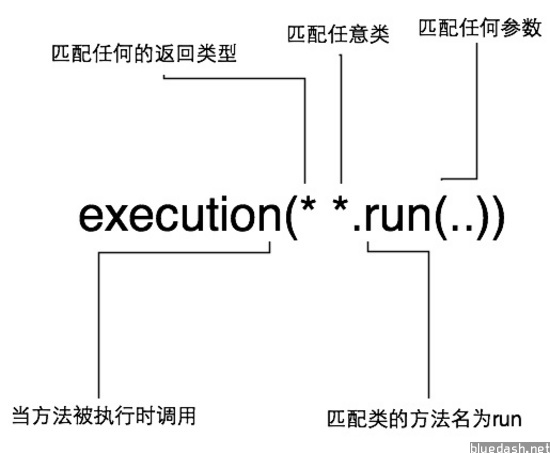
上面使用@Before Annotation 时,直接指定了切入点表达式,指定匹配 com.wicresoft.app.service.impl包下所有类的所有方法执行作为切入点。
关于这个表达式的规则如下图。
(4)、定义 AfterReturning 增强处理。
- // 定义一个切面
- @Aspect
- public class AfterReturningAdviceTest {
- // 匹配 com.wicresoft.app.service.impl 包下所有类的所有方法作为切入点
- @AfterReturning(returning="rvt", pointcut="execution(* com.wicresoft.app.service.impl.*.*(..))")
- public void log(Object rvt) {
- System.out.println("模拟目标方法返回值:" + rvt);
- System.out.println("模拟记录日志功能...");
- }
- }
(5)、定义 AfterThrowing 增强处理。
- // 定义一个切面
- @Aspect
- public class AfterThrowingAdviceTest {
- // 匹配 com.wicresoft.app.service.impl 包下所有类的所有方法作为切入点
- @AfterThrowing(throwing="ex", pointcut="execution(* com.wicresoft.app.service.impl.*.*(..))")
- public void doRecoverActions(Throwable ex) {
- System.out.println("目标方法中抛出的异常:" + ex);
- System.out.println("模拟抛出异常后的增强处理...");
- }
- }
(6)、定义 After 增强处理。
After 增强处理与AfterReturning 增强处理有点相似,但也有区别:
- AfterReturning 增强处理处理只有在目标方法成功完成后才会被织入。
- After 增强处理不管目标方法如何结束(保存成功完成和遇到异常中止两种情况),它都会被织入。
- // 定义一个切面
- @Aspect
- public class AfterAdviceTest {
- // 匹配 com.wicresoft.app.service.impl 包下所有类的所有方法作为切入点
- @After("execution(* com.wicresoft.app.service.impl.*.*(..))")
- public void release() {
- System.out.println("模拟方法结束后的释放资源...");
- }
- }
(7)、Around 增强处理
Around 增强处理近似等于 Before 增强处理和 AfterReturning 增强处理的总和。它可改变执行目标方法的参数值,也可改变目标方法之后的返回值。
- // 定义一个切面
- @Aspect
- public class AroundAdviceTest {
- // 匹配 com.wicresoft.app.service.impl 包下所有类的所有方法作为切入点
- @Around("execution(* com.wicresoft.app.service.impl.*.*(..))")
- public Object processTx(ProceedingJoinPoint jp) throws java.lang.Throwable {
- System.out.println("执行目标方法之前,模拟开始事物...");
- // 执行目标方法,并保存目标方法执行后的返回值
- Object rvt = jp.proceed(new String[]{"被改变的参数"});
- System.out.println("执行目标方法之前,模拟结束事物...");
- return rvt + "新增的内容";
- }
- }
(8)、访问目标方法的参数。
访问目标方法最简单的做法是定义增强处理方法时将第一个参数定义为 JoinPoint 类型,当该增强处理方法被调用时,该 JoinPoint 参数就代表了织入增强处理的连接点。JoinPoint 里包含了如下几个常用方法。
- Object[] getArgs(): 返回执行目标方法时的参数。
- Signature getSignature(): 返回被增强的方法的相关信息。
- Object getTarget(): 返回被织入增强处理的目标对象。
- Object getThis(): 返回 AOP 框架为目标对象生成的代理对象。
提示:当时使用 Around 处理时,我们需要将第一个参数定义为 ProceedingJoinPoint 类型,该类型是 JoinPoint 类型的子类。
(9)、定义切入点。
所谓切入点,其实质就是为一个切入点表达式起一个名称,从而允许在多个增强处理中重用该名称。
Spring 切入点定义包含两个部分:
- 一个切入点表达式。
- 一个包含名字和任意参数的方法签名。
- // 使用@Pointcut Annotation 时指定切入点表达式
- @pointcut("execution * transfer(..)")
- // 使用一个返回值为void,方法体为空的方法来命名切入点
- private void anyOldTransfer(){}
- // 使用上面定义的切入点
- @AfterReturning(pointcut="anyOldTransfer()", returning="reVal")
- public void writeLog(String msg, Object reVal){
- ...
- }
2、基于 XML 配置文件的管理方式。
- 不配置切入点
- <?xml version="1.0" encoding="UTF-8"?>
- <beans xmlns="http://www.springframework.org/schema/beans"
- xmlns:xsi="http://www.w3.org/2001/XMLSchema-instance"
- xmlns:aop="http://www.springframework.org/schema/aop"
- xsi:schemaLocation="http://www.springframework.org/schema/beans
- http://www.springframework.org/schema/beans/spring-beans-3.0.xsd
- http://www.springframework.org/schema/aop
- http://www.springframework.org/schema/beans/spring-aop-3.0.xsd">
- <aop:config>
- <!-- 将 fourAdviceBean 转换成切面 Bean, 切面 Bean 的新名称为:fourAdviceAspect,指定该切面的优先级为2 -->
- <aop:aspect id="fourAdviceAspect" ref="fourAdviceBean" order="2">
- <!-- 定义个After增强处理,直接指定切入点表达式,以切面 Bean 中的 Release() 方法作为增强处理方法 -->
- <aop:after pointcut="execution(* com.wicresoft.app.service.impl.*.*(..))" method="release" />
- <!-- 定义个Before增强处理,直接指定切入点表达式,以切面 Bean 中的 authority() 方法作为增强处理方法 -->
- <aop:before pointcut="execution(* com.wicresoft.app.service.impl.*.*(..))" method="authority" />
- <!-- 定义个AfterReturning增强处理,直接指定切入点表达式,以切面 Bean 中的 log() 方法作为增强处理方法 -->
- <aop:after-returning pointcut="execution(* com.wicresoft.app.service.impl.*.*(..))" method="log" />
- <!-- 定义个Around增强处理,直接指定切入点表达式,以切面 Bean 中的 processTx() 方法作为增强处理方法 -->
- <aop:around pointcut="execution(* com.wicresoft.app.service.impl.*.*(..))" method="processTx" />
- </aop:aspect>
- </aop:config>
- <!-- 省略各个Bean 的配置 -->
- <!-- ... -->
- </beans>
- 配置切入点
- <?xml version="1.0" encoding="UTF-8"?>
- <beans xmlns="http://www.springframework.org/schema/beans"
- xmlns:xsi="http://www.w3.org/2001/XMLSchema-instance"
- xmlns:aop="http://www.springframework.org/schema/aop"
- xsi:schemaLocation="http://www.springframework.org/schema/beans
- http://www.springframework.org/schema/beans/spring-beans-3.0.xsd
- http://www.springframework.org/schema/aop
- http://www.springframework.org/schema/beans/spring-aop-3.0.xsd">
- <aop:config>
- <!-- 定义一个切入点,myPointcut,直接知道它对应的切入点表达式 -->
- <aop:pointcut id="myPointcut" expression="execution(* com.wicresoft.app.service.impl.*.*(..))" method="release" />
- <aop:aspect id="afterThrowingAdviceAspect" ref="afterThrowingAdviceBean" order="1">
- <!-- 使用上面定于切入点定义增强处理 -->
- <!-- 定义一个AfterThrowing 增强处理,指定切入点以切面 Bean 中的 doRecovertyActions() 方法作为增强处理方法 -->
- <aop:after-throwing pointcut-ref="myPointcut" method="doRecovertyActions" throwing="ex" />
- </aop:aspect>
- </aop:config>
- <!-- 省略各个Bean 的配置 -->
- <!-- ... -->
- </beans>
参考:
《轻量级 Java EE 企业应用实战(第三版)》 李刚
Spring3.0 AOP 详解的更多相关文章
- Spring4 AOP详解
Spring4 AOP详解 第一章Spring 快速入门并没有对Spring4 的 AOP 做太多的描述,是因为AOP切面编程概念不好理解.所以这章主要从三个方面详解AOP:AOP简介(了解),基于注 ...
- 【转载】Spring AOP详解 、 JDK动态代理、CGLib动态代理
Spring AOP详解 . JDK动态代理.CGLib动态代理 原文地址:https://www.cnblogs.com/kukudelaomao/p/5897893.html AOP是Aspec ...
- Spring AOP详解及简单应用
Spring AOP详解 一.前言 在以前的项目中,很少去关注spring aop的具体实现与理论,只是简单了解了一下什么是aop具体怎么用,看到了一篇博文写得还不错,就转载来学习一下,博文地址: ...
- 转:Spring AOP详解
转:Spring AOP详解 一.前言 在以前的项目中,很少去关注spring aop的具体实现与理论,只是简单了解了一下什么是aop具体怎么用,看到了一篇博文写得还不错,就转载来学习一下,博文地址: ...
- Spring全家桶——SpringBoot之AOP详解
Spring全家桶--SpringBoot之AOP详解 面向方面编程(AOP)通过提供另一种思考程序结构的方式来补充面向对象编程(OOP). OOP中模块化的关键单元是类,而在AOP中,模块化单元是方 ...
- AOP详解之三-创建AOP代理后记,创建AOP代理
AOP详解之三-创建AOP代理后记,创建AOP代理. 上篇文章已经获取到了AOP的信息,接下来就是拿着这些AOP的信息去创建代理了. 首先我们看下创建AOP代理的入口处. //这个方法将返回代理类 p ...
- Android消息传递之EventBus 3.0使用详解
前言: 前面两篇不仅学习了子线程与UI主线程之间的通信方式,也学习了如何实现组件之间通信,基于前面的知识我们今天来分析一下EventBus是如何管理事件总线的,EventBus到底是不是最佳方案?学习 ...
- [转载]AxureRP 7.0部件详解(一)
本文为Axure RT7.0教程,本章主要介绍menu菜单.table表格.Tree Widget 树部件三个部件,后续将持续更新...... Menu 菜单 常用案例 网站导航菜单部件通常用于母板之 ...
- Cocos2d-x 3.0坐标系详解(转载)
Cocos2d-x 3.0坐标系详解 Cocos2d-x坐标系和OpenGL坐标系相同,都是起源于笛卡尔坐标系. 笛卡尔坐标系 笛卡尔坐标系中定义右手系原点在左下角,x向右,y向上,z向外,OpenG ...
随机推荐
- 求强连通分量模板(tarjan算法)
关于如何求强连通分量的知识请戳 https://www.byvoid.com/blog/scc-tarjan/ void DFS(int x) { dfn[x]=lowlink[x]=++dfn_cl ...
- apache开源项目--Synapse
Apache Synapse一个易于使用.轻量级的XML与Web Services管理和集成中间件.可用于搭建SOA和ESB的基础平台.Apache Synapse支持多种标准包括:XML.XSLT. ...
- Java [Leetcode 219]Contains Duplicate II
题目描述: Given an array of integers and an integer k, find out whether there are two distinct indices i ...
- Doubango ims 框架 分析之 多媒体部分
序言 RTP提供带有实时特性的端对端数据传输服务,传输的数据如:交互式的音频和视频.那些服务包括有效载荷类型定义,序列号,时间戳和传输监测控制.应用程序在UDP上运行RTP来使用它的多路技术和chec ...
- 【JSP】JSP向MySQL写入|读出中文数据——乱码问题
注意第14行
- 【转】 UIALertView的基本用法与UIAlertViewDelegate对对话框的事件处理方法
原文网址:http://blog.csdn.net/enuola/article/details/7900346 首先,视图控制器必须得实现协议UIAlertViewDelegate中的方法,并指定d ...
- DBCP连接池原理分析及配置用法
DBCP连接池介绍 ----------------------------- 目前 DBCP 有两个版本分别是 1.3 和 1.4. DBCP 1.3 版本需要运行于 JDK 1.4-1.5 ,支持 ...
- 我是面试官--"自我介绍"
工作10余年,经历过很多次面试,也面试了N多人.这些年来,已经有好些位朋友(或同事)与我聊起相关话题,涉及面试,更关乎职业生涯规划.感触颇多,就借助自媒体的浪潮,与更多的程序员一起共谈面试经历,希望可 ...
- wuzhicms 后台登录存留时间实现方式
在五指后台管理登录后,超过半小时不操作后台(不刷新页面或切换页面),就就会强制退出后台. 实现的思路是,在每次刷新页面都把当前时间存储下来,利用php的session机制来检测比对当前时间和数据库中存 ...
- (转载)OC学习篇之---概述
前言 终于开启了OC的学习篇了,之前由于工作上的事,学习就一直搁浅了,不过最近由于各种原因,感觉必须要开启iOS的开发旅程了,不然就老了.因为之前一直是做Android的,所以学习iOS来就没那么费劲 ...