
线性表java实现
顺序表
public class SequenceList {

    /*

    * content,节点内容

    * location,节点在表中的位置(序号)

    * */

    private String content;

    private int location;

    SequenceList(String content, int location){

        this.content = content;

        this.location = location;

    }

    SequenceList(){

        this.content = "-1";

        this.location = -1;

    }

    public String getContent() {

        return content;

    }

    public void setContent(String content) {

        this.content = content;

    }

    public int getLocation() {

        return location;

    }

    public void setLocation(int location) {

        this.location = location;

    }

}
顺序表的各个操作
遍历
/*

    * 遍历顺序表

    * */

    public static void showList(SequenceList[] list){

        for(SequenceList one:list){

            if(one!=null)

                System.out.println("location = "+one.getLocation()+",content = "+one.getContent());

            else

                break;

        }

    }
插入
/*

    * 插入节点

    * */

    public static void insertItem(SequenceList[] list, SequenceList item, int currentListLength, int insertLocation){

        list[currentListLength] = new SequenceList();

        if(currentListLength<insertLocation){

            System.out.println("插入位置不在线性表内");

        }else if(currentListLength==insertLocation+1){

            System.out.println("线性表已满");

        }else {

            for(int i = currentListLength;i>insertLocation;i--){

                list[i] = list[i-1];

                list[i].setLocation(i);//重新设置节点位置

            }

            list[insertLocation] = item;

            currentListLength++;

        }

    }
获得特定位置的节点
/*

    * 获得特定位置的节点

    * */

    public static SequenceList getSpecificItem(SequenceList[] list, int location){

        for(SequenceList one:list){

            if(one.getLocation()==location){

                return one;

            }

        }

        return null;

    }
获得某个节点的位置
/*

    * 获得某个节点的位置

    * */

    public static int getItemLocation(SequenceList[] list, String content){

        for(SequenceList one:list){

            if(one.getContent().equals(content)){

                return one.getLocation();

            }

        }

        return -1;

    }
删除某个位置的节点
 /*

    * 删除节点

    * */

    public static void deleteItem(SequenceList[] list, int location){

        for(int i = location;;i++){

            if(list[i+1]==null){

                list[i] = null;

                break;

            }

            list[i] = list[i+1];

            list[i].setLocation(i);//重新设置节点位置

        }

    }
测试
public static void main(String[] args) {

        SequenceList[] lists = new SequenceList[20];

        for(int i = 0;i < 6;i++){

            lists[i] = new SequenceList();

            lists[i].setContent(String.valueOf(i));

            lists[i].setLocation(i);

        }

        insertItem(lists,new SequenceList("a",5),6,5);

        showList(lists);

        deleteItem(lists,5);

        showList(lists);

        System.out.println("5号位的内容是"+getSpecificItem(lists,5).getContent());

        System.out.println("内容为2的位置是"+getItemLocation(lists,"2"));

    }
结果
location = 0,content = 0

location = 1,content = 1

location = 2,content = 2

location = 3,content = 3

location = 4,content = 4

location = 5,content = a

location = 6,content = 5

location = 0,content = 0

location = 1,content = 1

location = 2,content = 2

location = 3,content = 3

location = 4,content = 4

location = 5,content = 5

5号位的内容是5

内容为2的位置是2
链表
节点类
public class SingleLinkList {

    int data;//序号

    SingleLinkList next;

    SingleLinkList(){}

    SingleLinkList(int data){

        this.data = data;

    }

}
插入节点
/*

    * 插入节点到相应的位置

    * */

    public static void insertNode(SingleLinkList list,SingleLinkList item,int location){

        SingleLinkList tempList = list;

        while(tempList!=null){

            if(tempList.data==location){

                item.next = tempList.next;

                item.data = tempList.data+1;

                tempList.next = item;

                break;

            }else {

                tempList = tempList.next;

            }

        }

        item = item.next;

        while (item!=null){

            //重新编号排序

            item.data++;

            item = item.next;

        }

    }
删除节点
 /*

    * 删除相应节点

    * */

    public static void deleteNode(SingleLinkList list,int data){

        SingleLinkList tempList = list;

        while (tempList!=null){

            //System.out.println(tempList.data);

            if(tempList.data == data-1){

                if(tempList.next.next!=null){

                    tempList.next = tempList.next.next;

                    tempList = tempList.next;

                    break;

                }

                else

                    tempList.next = null;

                break;

            }

            tempList = tempList.next;

        }

        while (tempList!=null){

            //重新编号排序

            tempList.data--;

            tempList = tempList.next;

        }

    }
获得特定位置的节点
/*

    *获得特定位置的节点

    * */

    public static SingleLinkList getSpecificNode(SingleLinkList list,int location){

        while (list!=null){

            if(list.data==location){

                return list;

            }else {

                list = list.next;

            }

        }

        return null;

    }
遍历
/*

    * 遍历单链表

    * */

    public static void showList(SingleLinkList list){

        while (list!=null){

            System.out.println(list.data);

            list = list.next;

        }

    }
反转单链表
/*

    * 单链表反转

    * */

    public static SingleLinkList reserveList(SingleLinkList list){

        SingleLinkList prevNode = null;//前一个节点

        SingleLinkList currentNode = list;//当前节点

        SingleLinkList reserveHead = null;//反转后的头节点

        while (currentNode!=null){

            SingleLinkList nextNode = currentNode.next;

            if(nextNode==null){

                reserveHead = currentNode;

            }

            currentNode.next = prevNode;

            prevNode = currentNode;

            currentNode = nextNode;

        }

        return reserveHead;

    }
测试类
public static void main(String[] args) {

        SingleLinkList head = new SingleLinkList(-1);

        SingleLinkList list = head;

        for (int i = 0;i < 5;i++){

            list.next = new SingleLinkList(i);

            list = list.next;

        }

        showList(head.next);

        System.out.println("得到二号位置的节点");

        System.out.println(getSpecificNode(head.next,2).data);

        insertNode(head.next,new SingleLinkList(2),2);

        System.out.println("在二号位置插入节点后");

        showList(head.next);

        deleteNode(head.next,2);

        System.out.println("删除二号位置的节点");

        showList(head.next);

        System.out.println("反转链表后");

        showList(reserveList(head.next));

    }
结果
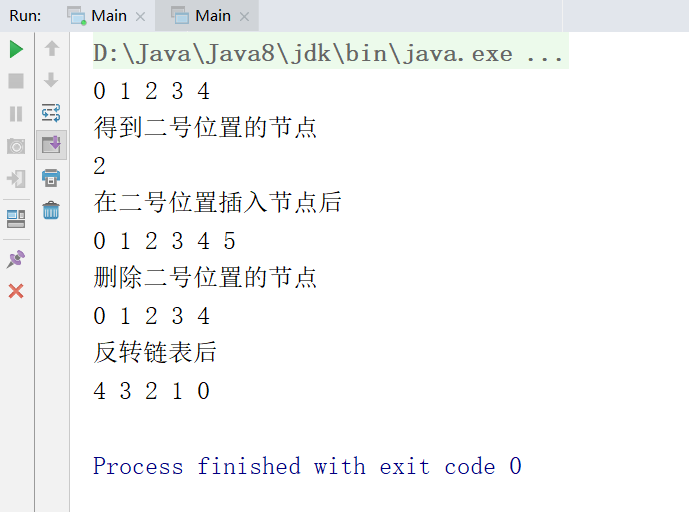
循环链表
循环链表是指收尾相接的链表
链表类
public class LoopList {

    int data;

    LoopList next;

    public LoopList(int data) {

        this.data = data;

    }

    public LoopList(){}

    public int getData() {

        return data;

    }

    public void setData(int data) {

        this.data = data;

    }

    public LoopList getNext() {

        return next;

    }

    public void setNext(LoopList next) {

        this.next = next;

    }

}
创建循环链表
/*

    * 传入各结点的数据,返回头结点

    * */

    public static LoopList createLoopList(int[] data){

        LoopList head = new LoopList(0);

        LoopList temp = head;

        for(int i=0;i<data.length;i++){

            LoopList node = new LoopList(data[i]);

            temp.setNext(node);

            temp = temp.getNext();

        }

        temp.setNext(head.getNext());

        return head.getNext();

    }
其余操作都跟单链表类似,不详细写了
双向链表
双向链表类
import java.util.DuplicateFormatFlagsException;

public class DoubleLinkList {

    int data;

    DoubleLinkList prev;

    DoubleLinkList next;

    public DoubleLinkList(){}

    public DoubleLinkList(int data){

        this.data = data;

    }

    public int getData() {

        return data;

    }

    public void setData(int data) {

        this.data = data;

    }

    public DoubleLinkList getPrev() {

        return prev;

    }

    public void setPrev(DoubleLinkList prev) {

        this.prev = prev;

    }

    public DoubleLinkList getNext() {

        return next;

    }

    public void setNext(DoubleLinkList next) {

        this.next = next;

    }

}
创建双向链表
/*

    * 创建双向链表

    * */

    public static DoubleLinkList createList(int[] data)

    {

        DoubleLinkList head = new DoubleLinkList(-1);

        DoubleLinkList alter = head;

        for(int i = 0;i < data.length;i++){

            DoubleLinkList node = new DoubleLinkList(data[i]);

            alter.setNext(node);

            node.setPrev(alter);

            alter = alter.getNext();

        }

        return head.getNext();

    }
向特定位置插入元素
/*

    * 插入元素

    * */

    public static boolean insert(DoubleLinkList head,int location,DoubleLinkList node){

        for(int i = 0;i < location-1;i++){

            head = head.getNext();

        }

        DoubleLinkList locationNode = head.getNext();

        head.setNext(node);

        node.setPrev(head);

        node.setNext(locationNode);

        locationNode.setPrev(node);

        return true;

    }
删除特定位置的元素
 /*

    * 删除元素

    * */

    public static boolean delete(DoubleLinkList head,int location){

        for(int i = 0;i < location-1;i++){

            head = head.getNext();

        }

        DoubleLinkList locationNode = head.getNext().getNext();

        head.setNext(locationNode);

        locationNode.setPrev(head);

        return true;

    }
好了 线性表这一章节的基本实现完了,下一篇轮到栈和队列了
线性表java实现的更多相关文章
- 数据结构(Java描述)之线性表
基础概念 数据结构:是相互之间存在一种或多种关系的数据元素的集合. 逻辑结构和物理结构 关于数据结构,我们可以从逻辑结构和物理结构这两个维度去描述 逻辑结构是数据对象中数据元素之间的关系,是从逻辑意义 ...
- Java Se :线性表
Java的集合框架分为两个系列,Collection和Map系列.在大学期间,学习数据结构时,好像学习了线性表.非线性表.树,哎,都给忘了.其实,在Collection系列内部又可以分为线性表.集合两 ...
- Java数据结构之线性表(2)
从这里开始将要进行Java数据结构的相关讲解,Are you ready?Let's go~~ java中的数据结构模型可以分为一下几部分: 1.线性结构 2.树形结构 3.图形或者网状结构 接下来的 ...
- Java数据结构之线性表
从这里开始将要进行Java数据结构的相关讲解,Are you ready?Let's go~~ java中的数据结构模型可以分为一下几部分: 1.线性结构 2.树形结构 3.图形或者网状结构 接下来的 ...
- 线性表 及Java实现 顺序表、链表、栈、队列
数据结构与算法是程序设计的两大基础,大型的IT企业面试时也会出数据结构和算法的题目, 它可以说明你是否有良好的逻辑思维,如果你具备良好的逻辑思维,即使技术存在某些缺陷,面试公司也会认为你很有培养价值, ...
- JAVA中的数据结构——集合类(线性表:Vector、Stack、LinkedList、set接口;键值对:Hashtable、Map接口<HashMap类、TreeMap类>)
Java的集合可以分为两种,第一种是以数组为代表的线性表,基类是Collection:第二种是以Hashtable为代表的键值对. ... 线性表,基类是Collection: 数组类: person ...
- Java线性表的排序
Java线性表的排序 ——@梁WP 前言:刚才在弄JDBC的时候,忽然觉得order-by用太多了没新鲜感,我的第六感告诉我java有对线性表排序的封装,然后在eclipse里随便按了一下“.” ,哈 ...
- 线性表的顺序存储结构——java
线性表的顺序存储结构:是指用一组地址连续的存储单元一次存放线性表的元素.为了使用顺序结构实现线性表,程序通常会采用数组来保存线性中的元素,是一种随机存储的数据结构,适合随机访问.java中ArrayL ...
- 线性表的Java实现
一.概念 对于常用的数据结构,可分为线性结构和非线性结构,线性结构主要是线性表,非线性结构主要是数和图.当n>0时,表可表示为:(a0,a1,a2,a3,…an) 1. 线性表的特征: 1.存在 ...
随机推荐
- Apache和nginx 域名配置
apache配置 一.hosts配置: 1.用编辑器打开hosts文件,位置:C:\Windows\System32\drivers\etc目录下 2.在hosts文件里添加自己的域名配置,配置规则如 ...
- 微信小程序设置全局字体
微信小程序设置全局css,需要在app.wxss文件中设置page的样式 page { font-family:"PingFangSC-Thin"; font-size:32rpx ...
- matlab 向量场线积分
syms t x y z F x=cos(t); y=sin(t); z=*sin(t)^-; F=[x^*y , (/)*x^,x*y ] ; %场函数 V=[diff(x,t),diff(y,t) ...
- boost-使用property_tree来解析xml、json
property_tree是一个保存了多个属性值的树形数据结构,可以用来解析xml.json.ini.info文件.要使用property_tree和xml解析组件的话需要包含"boost/ ...
- MFC连接MySQL数据库方法
MFC连接数据库的三种方法: 1.ODBC(开放式数据互联) 2.OLEDB与ADO 3.用mysql为C语言提供的接口
- VMware14 安装CentOS7及其配置;CentOS7配置网桥,做远程连接;
1.VMware14安装 进入百度链接,按照图形安装就好了.https://jingyan.baidu.com/article/9f7e7ec09da5906f281554d6.html ...
- IntelliJ IDEA使用心得之Maven项目篇
今天和大家分享下,在IDEA中打开Maven项目的方法. 对于新版的IDEA可以直接打开Maven项目,但是对于旧版的IDEA需要使用Maven命令生成项目的IDEA配置文件. 在项目的根目录(即po ...
- UVa 1610 Party Games(思维)
题意: 给出一系列字符串,构造出一个最短字符串(可以不在集合中)大于等于其中的一半,小于另一半. 析:首先找出中间的两个字符串,然后暴力找出最短的字符串,满足题意. 代码如下: #include &l ...
- php7注意事项
1. 不要使用 mysql_ 函数 这一天终于来了,从此你不仅仅“不应该”使用mysql_函数.PHP 7 已经把它们从核心中全部移除了,也就是说你需要迁移到好得多的mysqli_函数,或者更灵活的 ...
- 学以致用三----centos7.2基本环境补充
补充: 在上一篇里,加时间戳 echo ‘export HISTTIMEFORMAT ="%F %T `whoami`" ’ >> /etc/profile sourc ...