
20187101035 张玉晶《面向对象程序设计(java)》第八周学习总结
201871010135 张玉晶 《面向对象程序设计(java)》第八周学习总结》
|
项目 |
内容 |
|
这个作业属于哪个课程 |
<任课教师博客主页链接> https://www.cnblogs.com/nwnu-daizh/ |
|
这个作业的要求在哪里 |
<作业链接地址>https://www.cnblogs.com/nwnu-daizh/p/11703678.html |
|
作业学习目标 |
|
第一部分:总结第六章理论知识
一: 接口:
a. Java为了克股单继承的缺点。Java使用了接口,一个类可以实现一个或多个接口.
b. 在Java中。 接口不是类而是对类的一组需求描述。由常量和一组抽象方法组成.
c. 接口中不包括变量和有具体实现的方法。
d. 接口不能构造接口对象,但可以声明接口变量
e. 自定义接口的声明: public interface 接口名
f. 类实现某个接口: class 类 inplements 接口名
g. 接口可以扩展 public interface 接口1 extends 接口2
h. int compareTo(T other)
用这个对象与other进行比较,如果这个对象小于other则返回负值,如果相等则返回0,否则返回正值。
static void sort(Object[ ] a)
对数组a中的元素进行排序。要求数组中的元素必须属于实现了Comparable接口的类,并且元素之间必须是可比较的。
static int compare(int x,int y)7
如果x<y返回一个一个负整数,如果x和y相等,则返回0,否则返回一个负整数。
static int compare(double x,double y)1.4
如果x<y返回一个负数,如果x和y相等则返回一个0,否则返回一个负数。
i. 接口与抽象类的区别:
(1)接口不能实现任何方法,而抽象类可以;
(2)类可以实现很多接口,但只有一个父类;
(3)接口不是一个类分级结构中的一部分,无任何联系的类可以实现相同的接口。
二:接口示例:
1. 接口与回调:回调:一种程序设计模式,可以指出某个特定事件发生时应该采取的动作。java.swing包中Timer类,可以使用它在到达给定的时间间隔时触发一个事件。
2. 对象克隆: 当拷贝一个对象变量时,原始变量与拷贝变量引用同一个对象,这样,改变一个变量所引用的对象会对另一个变量产生影响;
如果要创建一个对象新的copy,它的最初状态与original一样,但以后可以各自改变状态,就需要使用0bject类的clone方法。
三:Lambda表达式:
(String first,String second) -> first.length() - second.length() 参数 箭头 表达式
1 .参数类型可推导时.不得要指定类型.如(a)> System.out.println(a)
2. 只有一个参数且类型可推导时。不强制写()
3. 参数指定类型时。必须有括号。
四:内部类:
1. 内部类可以直接访问外部类的成员保括private成员,但是内部类的成员却不能被外部类直接访问。
2. 在内部类对象保存了一个对外部类对象的引用,当内部类的成员方法中访问某一变量时, 如果在该方法和内部类中都未定义过这个变里,内部类中对变里的引用会被传递给外部类对象的引用。
3. 内部类并非只能在类内定义,也可以在程序块内定义局部内部类。例如,在方法中,甚至在for循环体内部。
4. 局部内部类不能用publi c或pr ivate访问修饰符进行声明,它的作用域被限定在声明这个局部类的块中。
匿名内部类
1. 若只创建类的一个对象,则不必为该类命名,这种类称为匿名内部类。
2. 由于匿名类没有类名,所以匿名类不能有构造器,取而代之的是将构造器参数传递给超类的构造器。若匿名内部类实现接口时,则匿名内部类不能有任何构造参数。
3. 如果构造参数的闭圆括号跟一个开花括号,表明正在定义的就是匿名内部类
静态内部类: 静态内部类不持有外部类的引用,只能访问外部类的静态成员变量和方法,而不能访问外部类的非静态成员属性和非静态方法,如果要调用和访问,必须实例化外部类对象。
当静态内部类拥有和外部类同名的成员变量或者方法时,会发生隐藏现象,即默认情况下访问的
是静态内部类的成员。如果要访问外部类的非静态同名成员,不能再使用外部类.this.成员的形式,而是要实例化外部类对象。如果要访问外部类的静态同名成员,可以通过外部类.成员的方式来访问。
与常规内部类不同,静态内部类可以有静态变量和静态方法。可以通过外部类.内部类.静态成员方式来访问。
第二部分
1、实验目的与要求
(1) 掌握接口定义方法;
(2) 掌握实现接口类的定义要求;
(3) 掌握实现了接口类的使用要求;
(4) 掌握程序回调设计模式;
(5) 掌握Comparator接口用法;
(6) 掌握对象浅层拷贝与深层拷贝方法;
(7) 掌握Lambda表达式语法;
(8) 了解内部类的用途及语法要求。
2、实验内容和步骤
实验1: 导入第6章示例程序,测试程序并进行代码注释。
测试程序1:
EmployeeSortTest.java
 package interfaces;

 import java.util.*;

 /**

  * This program demonstrates the use of the Comparable interface.

  * @version 1.30 2004-02-27

  * @author Cay Horstmann

  */

 public class EmployeeSortTest

 {

    public static void main(String[] args)

    {

       Employee[] staff = new Employee[];

       staff[] = new Employee("Harry Hacker", );

       staff[] = new Employee("Carl Cracker", );

       staff[] = new Employee("Tony Tester", );

       Arrays.sort(staff);//使用Arrays类的sort方法,对Employee 对象数组进行排序

       // 打印出关于 Employee 类的所有信息

       for (Employee e : staff)

          System.out.println("name=" + e.getName() + ",salary=" + e.getSalary());

    }

 }
运行结果如下:

a. Employee.java:
 package interfaces;

 public class Employee implements Comparable<Employee>//Employee类实现泛型Comparable接口

 {

    private String name;

    private double salary;

    public Employee(String name, double salary)

    {

       this.name = name;

       this.salary = salary;

    }

    public String getName()

    {

       return name;

    }

    public double getSalary()

    {

       return salary;

    }

    public void raiseSalary(double byPercent)

    {

       double raise = salary * byPercent / ;

       salary += raise;

    }

    /**

     * Compares employees by salary

     * @param other another Employee object

     * @return a negative value if this employee has a lower salary than

     * otherObject, 0 if the salaries are the same, a positive value otherwise

     */

    //实现compareTo方法

    public int compareTo(Employee other)

    {

       return Double.compare(salary, other.salary);

    }

 }
运行结果如下:

b.:
 package interfaces;

 public class Employee implements Comparable<Employee>//Employee类实现泛型Comparable接口

 {

    private String name;

    private double salary;

    public Employee(String name, double salary)

    {

       this.name = name;

       this.salary = salary;

    }

    public String getName()

    {

       return name;

    }

    public double getSalary()

    {

       return salary;

    }

    public void raiseSalary(double byPercent)

    {

       double raise = salary * byPercent / ;

       salary += raise;

    }

    /**

     * Compares employees by salary

     * @param other another Employee object

     * @return a negative value if this employee has a lower salary than

     * otherObject, 0 if the salaries are the same, a positive value otherwise

     */

    //实现compareTo方法

    public int compareTo(Employee other)

    {

       return name.compareTo(other.name);//按姓名排序

    }

 }
测试程序2:
编辑、编译、调试以下程序,结合程序运行结果理解程序;
|
interface A { double g=9.8; void show( ); } class C implements A { public void show( ) {System.out.println("g="+g);} }
class InterfaceTest { public static void main(String[ ] args) { A a=new C( ); a.show( ); System.out.println("g="+C.g); } } |
Interface Test.java:
 package interfaces;

 interface  A  //自定义一个接口A

 {

   double g=9.8;

   void show( );

 }

 class C implements A//类C 实现接口A

 {

   public void show( )

   {System.out.println("g="+g);}

 }

 class InterfaceTest

 {

   public static void main(String[ ] args)

   {

        A a=new C( );

        a.show( );

        System.out.println("g="+C.g);

   }

 }
运行结果如下:

测试程序3:
在elipse IDE中调试运行教材223页6-3,结合程序运行结果理解程序;
TimerTest.java:
 package timer;

 /**

    @version 1.02 2017-12-14

    @author Cay Horstmann

 */

 import java.awt.*;

 import java.awt.event.*;

 import java.time.*;

 import javax.swing.*;

 public class TimerTest

 {

    public static void main(String[] args)

    {

       ActionListener listener = new TimePrinter();

       // 构造一个listener的计时器

       // once every second

       Timer t = new Timer(, listener);

       t.start();

       // 保持程序运行,直到用户选择 "OK"

       JOptionPane.showMessageDialog(null, "Quit program?");

       System.exit();

    }

 }

 class TimePrinter implements ActionListener//类TimePrinter实现接口ActionListener

 {

    public void actionPerformed(ActionEvent event)

    {

       System.out.println("At the tone, the time is "

          + Instant.ofEpochMilli(event.getWhen()));

       Toolkit.getDefaultToolkit().beep();

    }

 }
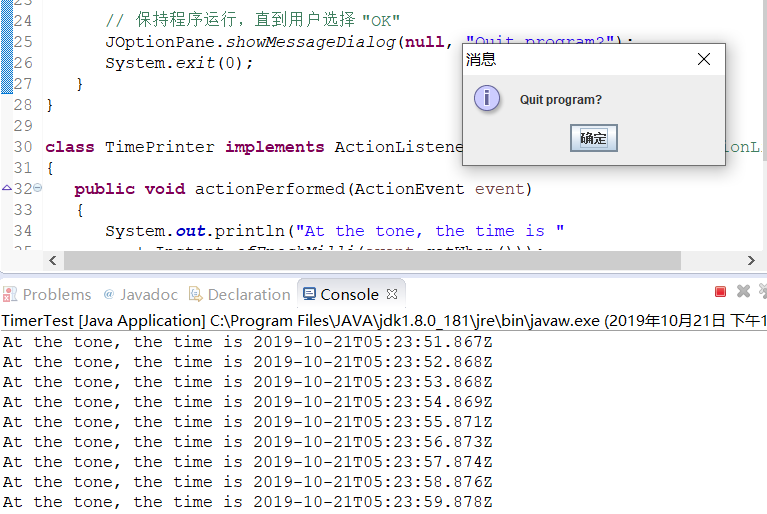
运行结果如下:
测试程序4:
调试运行教材229页-231页程序6-4、6-5,结合程序运行结果理解程序;
CloneTest.java:
 package clone;

 /**

  * This program demonstrates cloning.

  * @version 1.11 2018-03-16

  * @author Cay Horstmann

  */

 public class CloneTest

 {

    public static void main(String[] args) throws CloneNotSupportedException //如果在一个对象上调用clone,如果对象的类没有实现Cloneable的接口。clone方法就会抛出CloneNotSupportedException

    {

       Employee original = new Employee("John Q. Public", );

       original.setHireDay(, , );

       //clone方法创建新对象copy,初始状态与Original相同,之后有不同的状态

       Employee copy = original.clone();

       copy.raiseSalary();

       copy.setHireDay(, , );

       System.out.println("original=" + original);

       System.out.println("copy=" + copy);

    }

 }
运行结果如下:

Employee.java:
 package clone;

 import java.util.Date;

 import java.util.GregorianCalendar;

 public class Employee implements Cloneable// Employee类 实现Cloneable接口

 {

    private String name;

    private double salary;

    private Date hireDay;

    public Employee(String name, double salary)

    {

       this.name = name;

       this.salary = salary;

       hireDay = new Date();

    }

    public Employee clone() throws CloneNotSupportedException  //如果在一个对象上调用clone,如果对象的类没有实现Cloneable的接口。clone方法就会抛出CloneNotSupportedException

    {

       // call Object.clone()

       Employee cloned = (Employee) super.clone();

       // 克隆可变字段

       cloned.hireDay = (Date) hireDay.clone();

       return cloned;

    }

    /**

     * Set the hire day to a given date.

     * @param year the year of the hire day

     * @param month the month of the hire day

     * @param day the day of the hire day

     */

    public void setHireDay(int year, int month, int day)

    {

       Date newHireDay = new GregorianCalendar(year, month - , day).getTime();

       // example of instance field mutation

       hireDay.setTime(newHireDay.getTime());

    }

    public void raiseSalary(double byPercent)

    {

       double raise = salary * byPercent / ;

       salary += raise;

    }

    public String toString()

    {

       return "Employee[name=" + name + ",salary=" + salary + ",hireDay=" + hireDay + "]";

    }

 }
运行结果如下:

实验2: 导入第6章示例程序6-6,学习Lambda表达式用法。
LambdaTest.java:
 package lambda;

 import java.util.*;

 import javax.swing.*;

 import javax.swing.Timer;

 /**

  * This program demonstrates the use of lambda expressions.

  * @version 1.0 2015-05-12

  * @author Cay Horstmann

  */

 public class LambdaTest

 {

    public static void main(String[] args)

    {

       String[] planets = new String[] { "Mercury", "Venus", "Earth", "Mars",

          "Jupiter", "Saturn", "Uranus", "Neptune" };

       System.out.println(Arrays.toString(planets));//toString()方法输出planets

       System.out.println("Sorted in dictionary order:");

       Arrays.sort(planets);//Arrays.sort方法按字符顺序排序

       System.out.println(Arrays.toString(planets));

       System.out.println("Sorted by length:");

       //Arrays.sort方法按字符串长度排序

       Arrays.sort(planets, (first, second) -> first.length() - second.length());

       System.out.println(Arrays.toString(planets));

             //lambda表达式:(argument)->body

       Timer timer = new Timer(, event ->

          System.out.println("The time is " + new Date()));

       timer.start();

       // 程序保持运行,直到用户选择 "OK"

       JOptionPane.showMessageDialog(null, "Quit program?");

       System.exit();

    }

 }
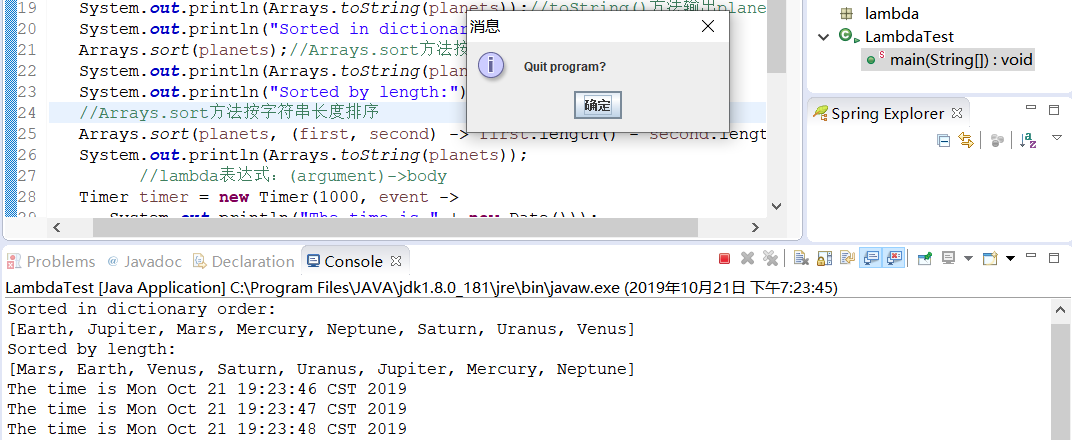
运行结果如下:
实验3: 编程练习
l 编制一个程序,将身份证号.txt 中的信息读入到内存中;
l 按姓名字典序输出人员信息;
l 查询最大年龄的人员信息;
l 查询最小年龄人员信息;
l 输入你的年龄,查询身份证号.txt中年龄与你最近人的姓名、身份证号、年龄、性别和出生地;
l 查询人员中是否有你的同乡。
程序代码如下:
 package ID;

 import java.io.BufferedReader;

 import java.io.File;

 import java.io.FileInputStream;

 import java.io.FileNotFoundException;

 import java.io.IOException;

 import java.io.InputStreamReader;

 import java.util.ArrayList;

 import java.util.Scanner;

 import java.util.Collections;

 public class Main {

     private static ArrayList<Citizen> citizenlist;

     public static void main(String[] args) {

         citizenlist = new ArrayList<>();

         Scanner scanner = new Scanner(System.in);

         File file = new File("D://身份证号.txt");

         try {

             FileInputStream fis = new FileInputStream(file);

             BufferedReader in = new BufferedReader(new InputStreamReader(fis));

             String temp = null;

             while ((temp = in.readLine()) != null) {

                 Scanner linescanner = new Scanner(temp);

                 linescanner.useDelimiter(" ");

                 String name = linescanner.next();

                 String id = linescanner.next();

                 String sex = linescanner.next();

                 String age = linescanner.next();

                 String birthplace = linescanner.nextLine();

                 Citizen citizen = new Citizen();

                 citizen.setName(name);

                 citizen.setId(id);

                 citizen.setSex(sex);

                 // 将字符串转换成10进制数

                 int ag = Integer.parseInt(age);

                 citizen.setage(ag);

                 citizen.setBirthplace(birthplace);

                 citizenlist.add(citizen);

             }

         } catch (FileNotFoundException e) {

             System.out.println("信息文件找不到");

             e.printStackTrace();

         } catch (IOException e) {

             System.out.println("信息文件读取错误");

             e.printStackTrace();

         }

         boolean isTrue = true;

         while (isTrue) {

             System.out.println("1.按姓名字典序输出人员信息");

             System.out.println("2.查询最大年龄的人员信息、查询最小年龄人员信息");

             System.out.println("3.查询人员中是否有你的同乡");

             System.out.println("4.输入你的年龄,查询文件中年龄与你最近人的姓名、身份证号、年龄、性别和出生地");

             System.out.println("5.退出");

             int nextInt = scanner.nextInt();

             switch (nextInt) {

             case :

                 Collections.sort(citizenlist);

                 System.out.println(citizenlist.toString());

                 break;

             case :

                 int max = , min = ;

                 int m, k1 = , k2 = ;

                 for (int i = ; i < citizenlist.size(); i++) {

                     m = citizenlist.get(i).getage();

                     if (m > max) {

                         max = m;

                         k1 = i;

                     }

                     if (m < min) {

                         min = m;

                         k2 = i;

                     }

                 }

                 System.out.println("年龄最大:" + citizenlist.get(k1));

                 System.out.println("年龄最小:" + citizenlist.get(k2));

                 break;

             case :

                 System.out.println("出生地:");

                 String find = scanner.next();

                 String place = find.substring(, );

                 for (int i = ; i < citizenlist.size(); i++) {

                     if (citizenlist.get(i).getBirthplace().substring(, ).equals(place))

                         System.out.println("出生地" + citizenlist.get(i));

                 }

                 break;

             case :

                 System.out.println("年龄:");

                 int yourage = scanner.nextInt();

                 int near = peer(yourage);

                 int j = yourage - citizenlist.get(near).getage();

                 System.out.println("" + citizenlist.get(near));

                 break;

             case :

                 isTrue = false;

                 System.out.println("程序已退出!");

                 break;

             default:

                 System.out.println("输入有误");

             }

         }

     }

     public static int peer(int age) {

         int flag = ;

         int min = , j = ;

         for (int i = ; i < citizenlist.size(); i++) {

             j = citizenlist.get(i).getage() - age;

             if (j < )

                 j = -j;

             if (j < min) {

                 min = j;

                 flag = i;

             }

         }

         return flag;

     }

 }
 package ID;

 public class Citizen implements Comparable<Citizen> {

     private String name;

     private String id;

     private String sex;

     private int age;

     private String birthplace;

     public String getName() {

         return name;

     }

     public void setName(String name) {

         this.name = name;

     }

     public String getId() {

         return id;

     }

     public void setId(String id) {

         this.id = id;

     }

     public String getSex() {

         return sex;

     }

     public void setSex(String sex) {

         this.sex = sex;

     }

     public int getage() {

         return age;

     }

     public void setage(int age) {

         this.age = age;

     }

     public String getBirthplace() {

         return birthplace;

     }

     public void setBirthplace(String birthplace) {

         this.birthplace = birthplace;

     }

     public int compareTo(Citizen other) {

         return this.name.compareTo(other.getName());

     }

     public String toString() {

         return name + "\t" + sex + "\t" + age + "\t" + id + "\t" + birthplace + "\n";

     }

 }
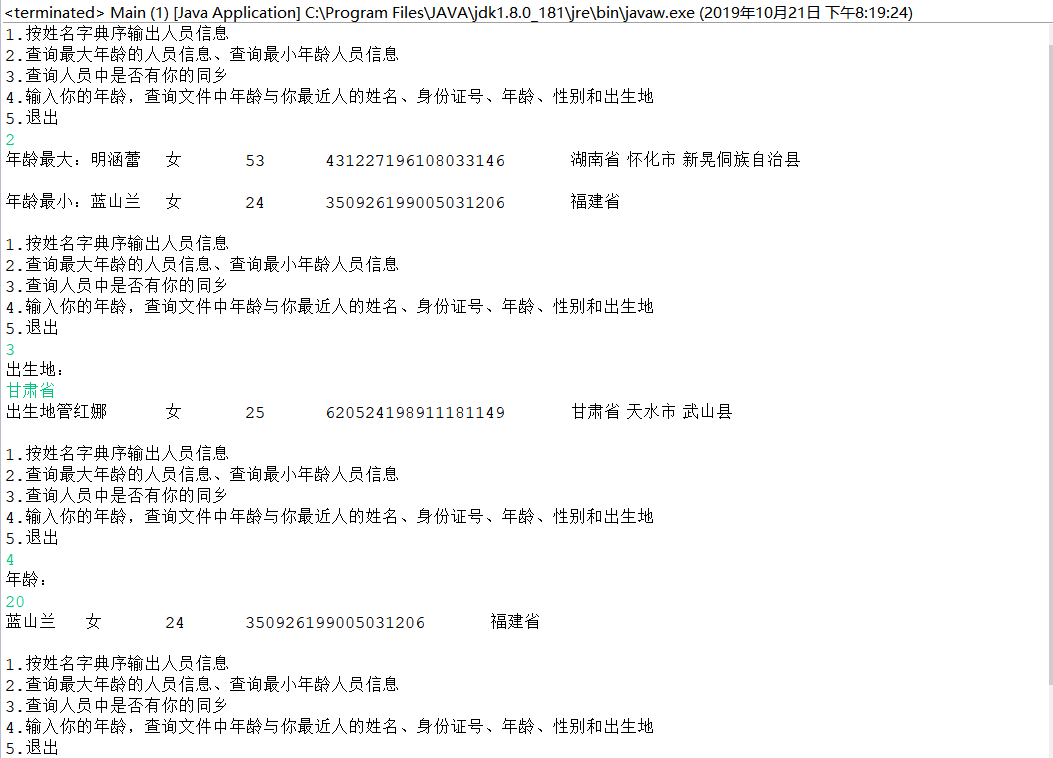
运行结果如下:
实验4:内部类语法验证实验
实验程序1:
l 编辑、调试运行教材246页-247页程序6-7,结合程序运行结果理解程序;
l 了解内部类的基本用法。
InnerClassTest.java:
 package innerClass;

 import java.awt.*;

 import java.awt.event.*;

 import java.time.*;

 import javax.swing.*;

 /**

  * This program demonstrates the use of inner classes.

  * @version 1.11 2017-12-14

  * @author Cay Horstmann

  */

 public class InnerClassTest

 {

    public static void main(String[] args)

    {

       TalkingClock clock = new TalkingClock(, true);

       clock.start();

       // 保持程序运行直到用户选择"OK"

       JOptionPane.showMessageDialog(null, "Quit program?");

       System.exit();

    }

 }

 /**

  * A clock that prints the time in regular intervals.

  */

 class TalkingClock

 {

    private int interval;

    private boolean beep;

    /**

     * Constructs a talking clock

     * @param interval the interval between messages (in milliseconds)

     * @param beep true if the clock should beep

     */

    public TalkingClock(int interval, boolean beep)

    {

       this.interval = interval;

       this.beep = beep;

    }

    /**

     * Starts the clock.

     */

    public void start()

    {

       TimePrinter listener = new TimePrinter();

       Timer timer = new Timer(interval, listener);

       timer.start();

    }

    public class TimePrinter implements ActionListener//类TimePrinter 实现接口 ActionListener

    {

       public void actionPerformed(ActionEvent event)

       {

          System.out.println("At the tone, the time is "

             + Instant.ofEpochMilli(event.getWhen()));

          if (beep) Toolkit.getDefaultToolkit().beep();

       }

    }

 }
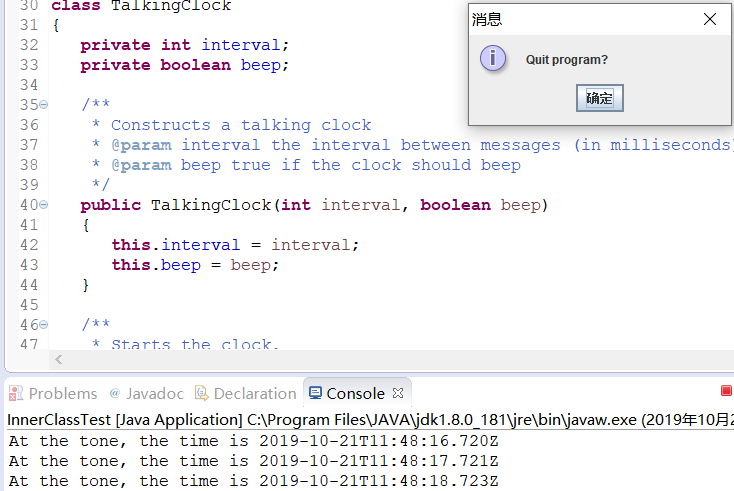
运行结果如下:
实验程序2:
l 编辑、调试运行教材254页程序6-8,结合程序运行结果理解程序;
l 掌握匿名内部类的用法。
程序代码如下:
 package AnonymouslnnerClass;

 import java.awt.*;

 import java.awt.event.*;

 import java.time.*;

 import javax.swing.*;

 /**

  * This program demonstrates anonymous inner classes.

  * @version 1.12 2017-12-14

  * @author Cay Horstmann

  */

 public class AnonymousInnerClassTest

 {

    public static void main(String[] args)

    {

       TalkingClock clock = new TalkingClock();

       clock.start(, true);

       // 保持程序运行直到用户选择"OK"

       JOptionPane.showMessageDialog(null, "Quit program?");

       System.exit();

    }

 }

 /**

  * A clock that prints the time in regular intervals.

  */

 class TalkingClock

 {

    /**

     * Starts the clock.

     * @param interval the interval between messages (in milliseconds)

     * @param beep true if the clock should beep

     */

    public void start(int interval, boolean beep)

    {

       ActionListener listener = new ActionListener()

          {

             public void actionPerformed(ActionEvent event)

             {

                System.out.println("At the tone, the time is "

                   + Instant.ofEpochMilli(event.getWhen()));

                if (beep) Toolkit.getDefaultToolkit().beep();

             }

          };

       Timer timer = new Timer(interval, listener);

       timer.start();

    }

 }
运行结果如下:
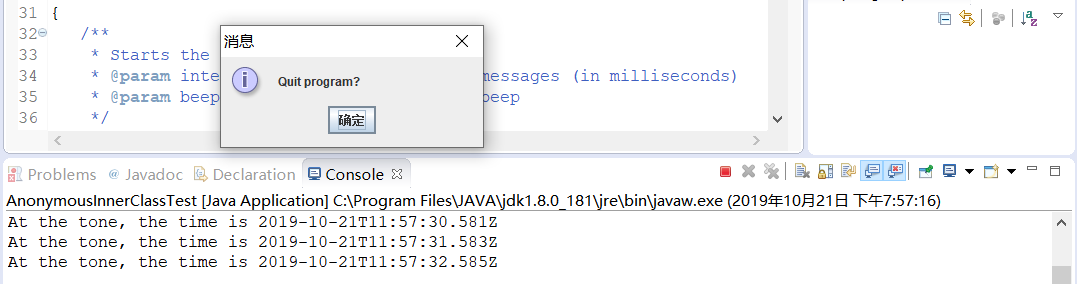
实验程序3:
l 在elipse IDE中调试运行教材257页-258页程序6-9,结合程序运行结果理解程序;
l 了解静态内部类的用法。
程序代码如下:
 /**

  * This program demonstrates the use of static inner classes.

  * @version 1.02 2015-05-12

  * @author Cay Horstmann

  */

 public class StaticInnerClassTest

 {

    public static void main(String[] args)

    {

       double[] values = new double[];

       for (int i = ; i < values.length; i++)

          values[i] =  * Math.random();

       ArrayAlg.Pair p = ArrayAlg.minmax(values);

       System.out.println("min = " + p.getFirst());

       System.out.println("max = " + p.getSecond());

    }

 }

 class ArrayAlg

 {

    /**

     * A pair of floating-point numbers

     */

    public static class Pair //在Pair对象中不需要引用任何其他的对象,所以将这个内部类声明为static

    {

       private double first;

       private double second;

       /**

        * Constructs a pair from two floating-point numbers

        * @param f the first number

        * @param s the second number

        */

       public Pair(double f, double s)

       {

          first = f;

          second = s;

       }

       /**

        * Returns the first number of the pair

        * @return the first number

        */

       public double getFirst()

       {

          return first;

       }

       /**

        * Returns the second number of the pair

        * @return the second number

        */

       public double getSecond()

       {

          return second;

       }

    }

    /**

     * Computes both the minimum and the maximum of an array

     * @param values an array of floating-point numbers

     * @return a pair whose first element is the minimum and whose second element

     * is the maximum

     */

    public static Pair minmax(double[] values)//必须使用静态内部类,因为内部类对象是在静态方法中定义的,如果没有将Pair声明为static,编译器会报错,没有可用的隐式ArrayAlg类型对象初始化内部对象

    {

       double min = Double.POSITIVE_INFINITY;

       double max = Double.NEGATIVE_INFINITY;

       for (double v : values)

       {

          if (min > v) min = v;

          if (max < v) max = v;

       }

       return new Pair(min, max);   //minmax必须返回返回一个Pair类型的对象

    }

 }
运行结果如下:

实验总结: 在本次实验中,我学习了接口,接口克服了java单继承的缺点,一个类可以实现一个或多个接口., 接口中不包括变量和有具体实现的方法,接口不能构造接口对象,但可以声明接口变量;
自定义接口的声明: public interface 接口名; 类实现某个接口: class 类 inplements 接口名 ; 接口可以扩展 public interface 接口1 extends 接口,以及接口的一些方法;
Lambda表达式: (String first,String second) -> first.length() - second.length() 参数 箭头 表达式 , 参数指定类型时,必须有括号, 只有一个参数且类型可推导时,不强制写();还有内部类,匿名内部类和静态内部类。 在实验过程中遇到了很多困难,尤其是编程练习的时候,在参考了其他代码以及问同学的情况下,还算有了一些进步。
20187101035 张玉晶《面向对象程序设计(java)》第八周学习总结的更多相关文章
- 201871010132——张潇潇《面向对象程序设计JAVA》第二周学习总结
项目 内容 这个作业属于哪个课程 https://www.cnblogs.com/nwnu-daizh/ 这个作业的要求在哪里 https://www.cnblogs.com/nwnu-daizh/p ...
- 201771010134杨其菊《面向对象程序设计java》第九周学习总结
第九周学习总结 第一部分:理论知识 异常.断言和调试.日志 1.捕获 ...
- 201871010132-张潇潇《面向对象程序设计(java)》第一周学习总结
面向对象程序设计(Java) 博文正文开头 项目 内容 这个作业属于哪个课程 https://www.cnblogs.com/nwnu-daizh/ 这个作业的要求在哪里 https://www.cn ...
- 扎西平措 201571030332《面向对象程序设计 Java 》第一周学习总结
<面向对象程序设计(java)>第一周学习总结 正文开头: 项目 内容 这个作业属于哪个课程 https://www.cnblogs.com/nwnu-daizh/ 这个作业的要求在哪里 ...
- 杨其菊201771010134《面向对象程序设计Java》第二周学习总结
第三章 Java基本程序设计结构 第一部分:(理论知识部分) 本章主要学习:基本内容:数据类型:变量:运算符:类型转换,字符串,输入输出,控制流程,大数值以及数组. 1.基本概念: 1)标识符:由字母 ...
- 201871010124 王生涛《面向对象程序设计JAVA》第一周学习总结
项目 内容 这个作业属于哪个课程 https://www.cnblogs.com/nwnu-daizh/ 这个作业的要求在哪里 https://edu.cnblogs.com/campus/xbsf/ ...
- 201871010115——马北《面向对象程序设计JAVA》第二周学习总结
项目 内容 这个作业属于哪个课程 https://www.cnblogs.com/nwnu-daizh/ 这个作业的要求在哪里 https://www.cnblogs.com/nwnu-daizh/p ...
- 201777010217-金云馨《面向对象程序设计(Java)》第二周学习总结
项目 内容 这个作业属于哪个课程 https://www.cnblogs.com/nwnu-daizh/ 这个作业的要求在哪里 https://www.cnblogs.com/nwnu-daizh/p ...
- 201771010123汪慧和《面向对象程序设计Java》第二周学习总结
一.理论知识部分 1.标识符由字母.下划线.美元符号和数字组成, 且第一个符号不能为数字.标识符可用作: 类名.变量名.方法名.数组名.文件名等.第二部分:理论知识学习部分 2.关键字就是Java语言 ...
- 20175204 张湲祯 2018-2019-2《Java程序设计》第八周学习总结
20175204 张湲祯 2018-2019-2<Java程序设计>第八周学习总结 教材学习内容总结 -第十五章泛型与集合框架要点: 一.泛型 1.泛型(Generics)的主要目的是可以 ...
随机推荐
- java中的字符串一
public class TestString2 { public static void main(String[] args) { //判断两字符串是否相等 String s1 = "H ...
- mysql high severity error 缺少根元素
high severity error 缺少根元素: C:\Users\cf.yu\AppData\Roaming\Oracle\MySQL Notifier里的settings.config.删除他 ...
- Python实现网络多人聊天室 - Windows
项目名称:多人聊天室项目结构: client.py server.py settings.py项目思路:服务端接收客户端连接,客户端发送信息给服务端,服务端将信息发送给所有客户端.项目实现:主进程负责 ...
- QBXT模拟赛1
总结 期望得分:\(100 + 80 + 10 = 190\) 实际得分:\(90 + 80 + 10 = 180\) 这是在清北的第一场考试,也是在清北考的最高的一次了吧..本来以为能拿\(190\ ...
- 深挖计算机基础:MySQL实战45讲学习笔记
参考极客时间专栏<MySQL实战45讲>学习笔记 一.基础篇(8讲) MySQL实战45讲学习笔记:第一讲 MySQL实战45讲学习笔记:第二讲 MySQL实战45讲学习笔记:第三讲 My ...
- 洛谷 P2656 (缩点 + DAG图上DP)
### 洛谷 P2656 题目链接 ### 题目大意: 小胖和ZYR要去ESQMS森林采蘑菇. ESQMS森林间有N个小树丛,M条小径,每条小径都是单向的,连接两个小树丛,上面都有一定数量的蘑菇.小胖 ...
- COMP222 - 2019
COMP222 - 2019 - Second CA AssignmentIndividual courseworkTrain Deep Learning AgentsAssessment Infor ...
- WPF 3D相机基本坐标简介
基本概念 WPF中3D空间基本坐标系是右手坐标系. WPF中3D空间的原点是(0,0,0) Position: 这个参数用来表示相机在空间内的坐标.参数是(X,Y,Z).当修改相机的这个参数时,这个坐 ...
- MySQL优化常见Extra分析——慢查询优化
数据准备: create table user ( id int primary key, name ), sex ), index(name) )engine=innodb; 数据说明:用户表:id ...
- 带你认识MySQL sys schema
前言: MySQL 5.7中引入了一个新的sys schema,sys是一个MySQL自带的系统库,在安装MySQL 5.7以后的版本,使用mysqld进行初始化时,会自动创建sys库. sys库里 ...