
SPFA + 链式前向星(详解)
求最短路是图论中最基础的算法,最短路算法挺多,本文介绍SPFA算法。 关于其他最短路算法,请看我另一篇博客最短路算法详解
链式前向星概念
简单的说,就是存储图的一个数据结构。它是按照边来存图,而邻接矩阵是按点来存图,故链式前向星又叫边集数组
为何用链式前向星
当图的边数不多,而节点数很多(稠密图)的时候,如果我们仍然用邻接矩阵来存的话,内存占用可能会很大,而这种情况在ACM竞赛中又是很常见的,此时链式前向星就显得尤为重要。
链式前向星详解
主要涉及到两个数组,一个是head[MAXE]数组,另一个是edge[MAXE]数组:
// edge数组是一个边集数组,存放一条边的信息

// to --- 该条边的终点

// next --- 下一条要访问的边(存的是edge数组的下标).

// 即:访问完了edge[i],下一条要访问的就是edge[edge[i].next],

// 如果next为0,表示now这个节点作为起点的边已经全部访问完.(下一步:Q.front())

// w --- 该条边的权值

struct Node {

int to,next,w;

};

Node edge[MAXE];

// idx --- edge数组的下标

// head[i] --- 表示以i节点为起点的所有出边在edge数组中的起始存储位置为head[i].

// (如果head[i]为0,表示结点i没有出边)

int idx,head[MAXV];
理解了这两个数组,那么链式前向星也就理解了。其实链式前向星主要还是理解head数组和edge数组中的next这两个东西是怎么相互作用的,简单的说,就是head数组指导next,next指导edge的下一个下标。即:head[i]存储的是节点i作为起始节点的出边在edge数组中的起始存储位置,next引导节点i的下一条出边在edge数组中的存储位置。
怎么实现图的存储的呢?
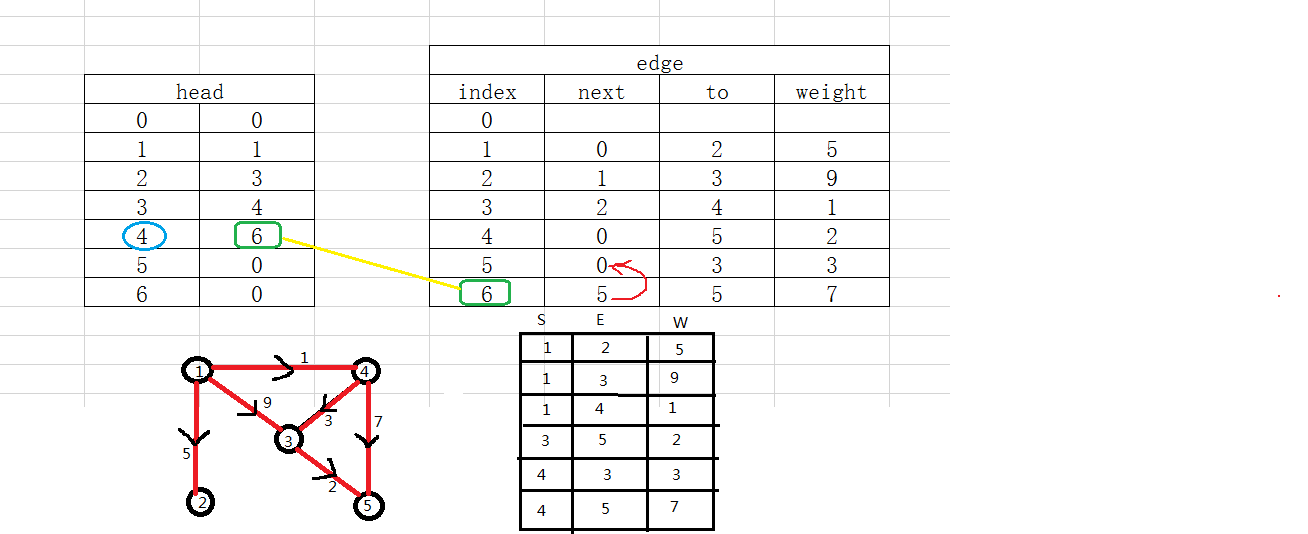
这张图看懂了,链式前向星也就搞懂了。
链式前向星代码实现
//Memory   Time

// 2556K    362MS

// by : Snarl_jsb

#include<algorithm>

#include<cstdio>

#include<cstring>

#include<cstdlib>

#include<iostream>

#include<vector>

#include<queue>

#include<stack>

#include<iomanip>

#include<string>

#include<climits>

#include<cmath>

#define MAXV 10010

#define MAXE 50010

#define LL long long

using namespace std;

int T,n,m,u,v,w;

int now,home,goal;

bool vis[MAXV];

LL dis[MAXV];

namespace Adj

{

        // edge数组是一个边集数组,存放一条边的信息

        // to --- 该条边的终点

        // next --- 下一条要访问的边(存的是edge数组的下标).

        // 即:访问完了edge[i],下一条要访问的就是edge[edge[i].next],

        // 如果next为0,表示now这个节点作为起点的边已经全部访问完.(下一步:Q.front())

        // w --- 该条边的权值

        struct Node

        {

                int to,next,w;

        };

        Node edge[MAXE];

        // idx --- edge数组的下标

        // head[i] --- 表示以i节点为起点的所有出边在edge数组中的起始存储位置为head[i].(如果head[i]为0,表示结点i没有出边)

        int idx,head[MAXV];

        // 初始化

        void init()

        {

                idx=;

                memset(head,,sizeof(head));

        }

        // 加边函数

        void addEdge(int u,int v,int w) // 起点,终点,权值

        {

                edge[idx].to=v;   // 该边的终点

                edge[idx].w=w;    // 权值

                edge[idx].next=head[u]; //  (指向head[u]后,head[u]又指向了自己)

                head[u]=idx;  // 以u结点为起点的边在edge数组中存储的下标

                idx++;

        }

}

using namespace Adj;

void visit(int sta)

{

    for(int i=;i<=n;i++)

    {

        vis[i]=;

        dis[i]=LLONG_MAX;

    }

    // 起点进队

    queue<int>Q;

    Q.push(sta);

    vis[sta]=;

    dis[sta]=;

    while(!Q.empty())

    {

        int now=Q.front();

        Q.pop();

        // 在spfa中这儿需要改为0,因为每个节点需要重复进队

        vis[now]=;

        //取出now结点在edge中的起始存储下标(当i=0,即edge[i].next为0,说明以now节点为起始点的边全部访问完)

        for(int i=head[now];i;i=edge[i].next)

        {

            int son=edge[i].to;

            printf("%d --> %d  , weight = %d\n",now,edge[i].to,edge[i].w);

            if(!vis[son])

            {

                Q.push(son); // 子节点未访问过

                vis[son]=; //  标记已访问

            }

        }

    }

}

int main()

{

    while()

    {

       Adj::init();

       scanf("%d",&n);

       scanf("%d",&m);

       while(m--) // 输入m条边

       {

               int s,e,w; // 起点 终点 权值

               scanf("%d %d %d",&s,&e,&w);

               addEdge(s,e,w);  //若是无向图,反过来再加一次

       }

       int start_point;   //访问的起点

       scanf("%d",&start_point);

       visit(start_point);

    }

    return ;

}
spfa概念
SPFA算法是求单源最短路径的一种算法,在Bellman-ford算法的基础上加上一个队列优化,减少了冗余的松弛操作,是一种高效的最短路算法。
SPFA的运用和分析
运用:
- 求单源最短路;
- 判断负环(某个点进队的次数超过了v次,则存在负环)
分析:
- 平均时间复杂度:O(kE),k<=2
- 最差时间复杂度:O(VE) (出题人可能设计卡spfa时间复杂度的数据)
SPFA代码实现
//Memory   Time

// 2556K    362MS

// by : Snarl_jsb

#include<algorithm>

#include<cstdio>

#inlude<cstring>

#include<cstdlib>

#include<iostream>

#include<vector>

#include<queue>

#include<stack>

#include<iomanip>

#include<string>

#include<climits>

#include<cmath>

#define MAXV 10010

#define MAXE 50010

#define LL long long

using namespace std;

int T,n,m,u,v,w;

int now,home,goal;

bool vis[MAXV];

LL dis[MAXV];

namespace Adj

{

        // edge数组是一个边集数组,存放一条边的信息

        // to --- 该条边的终点

        // next --- 下一条要访问的边(存的是edge数组的下标).即:访问完了edge[i],下一条要访问的就是edge[edge[i].next],如果next为0,表示now这个节点作为起点的边已经全部访问完.(下一步:Q.front())

        // w --- 该条边的权值

        struct Node

        {

                int to,next,w;

        };

        Node edge[MAXE];

        // idx --- edge数组的下标

        // head[i] --- 表示以i节点为起点的所有出边在edge数组中的起始存储位置为head[i].(如果head[i]为0,表示结点i没有出边)

        int idx,head[MAXV];

        // 初始化

        void init()

        {

                idx=;

                memset(head,,sizeof(head));

        }

        // 加边函数

        void addEdge(int u,int v,int w) // 起点,终点,权值

        {

                edge[idx].to=v;   // 该边的终点

                edge[idx].w=w;    // 权值

                edge[idx].next=head[u]; //  (指向head[u]后,head[u]又指向了自己)

                head[u]=idx;  // 以u结点为起点的边在edge数组中存储的下标

                idx++;

        }

}

using namespace Adj;

void visit(int sta)

{

    for(int i=;i<=n;i++)

    {

        vis[i]=;

        dis[i]=LLONG_MAX;

    }

    // 起点进队

    queue<int>Q;

    Q.push(sta);

    vis[sta]=;

    dis[sta]=;

    while(!Q.empty())

    {

        int now=Q.front();

        Q.pop();

        vis[now]=;  // 在spfa中这儿需要改为0,因为每个节点需要重复进队

        for(int i=head[now];i;i=edge[i].next)  //取出now结点在edge中的起始存储下标(当i=0,即edge[i].next为0,说明以now节点为起始点的边全部访问完)

        {

            int w=edge[i].w;

            int son=edge[i].to;

            printf("%d --> %d  , weight = %d\n",now,edge[i].to,edge[i].w);

            if(dis[now]+w<dis[son]) // 松弛操作

            {

                    dis[son]=dis[now]+w;

                    if(!vis[son])

                    {

                        Q.push(son); // 子节点未访问过

                        vis[son]=; //  标记已访问

                    }

            }

        }

    }

    puts("/*************************************** END ******************************************/");

    for(int i=;i<=n;++i)

    {

            printf("%d --> %d shortest distance is %d\n",sta,i,dis[i]);

    }

}

int main()

{

    while()

    {

       Adj::init();

       scanf("%d",&n);

       scanf("%d",&m);

       for(int i=;i<=m;++i) // 输入m条边

       {

               int s,e,w; // 起点 终点 权值

               scanf("%d %d %d",&s,&e,&w);

               addEdge(s,e,w);  //若是无向图,反过来再加一次

       }

       int start_point;   //访问的起点

       scanf("%d",&start_point);

       visit(start_point);

    }

    return ;

}

/*

5 6

1 2 5

1 3 9

1 4 1

3 5 2

4 3 3

4 5 7

1

*/
SPFA + 链式前向星(详解)的更多相关文章
- UESTC30-最短路-Floyd最短路、spfa+链式前向星建图
最短路 Time Limit: 3000/1000MS (Java/Others) Memory Limit: 65535/65535KB (Java/Others) 在每年的校赛里,所有进入决赛的同 ...
- UESTC 30.最短路-最短路(Floyd or Spfa(链式前向星存图))
最短路 Time Limit: 3000/1000MS (Java/Others) Memory Limit: 65535/65535KB (Java/Others) 在每年的校赛里,所有进入决赛的同 ...
- POJ 3159 Candies(差分约束+spfa+链式前向星)
题目链接:http://poj.org/problem?id=3159 题目大意:给n个人派糖果,给出m组数据,每组数据包含A,B,C三个数,意思是A的糖果数比B少的个数不多于C,即B的糖果数 - A ...
- SPFA+链式前向星
板子 #include <bits/stdc++.h> using namespace std; typedef long long ll; const ll inf=2<<3 ...
- spfa+链式前向星模板
#include<bits/stdc++.h> #define inf 1<<30 using namespace std; struct Edge{ int nex,to,w ...
- POJ 3169 Layout(差分约束+链式前向星+SPFA)
描述 Like everyone else, cows like to stand close to their friends when queuing for feed. FJ has N (2 ...
- 链式前向星+SPFA
今天听说vector不开o2是数组时间复杂度常数的1.5倍,瞬间吓傻.然后就问好的图表达方式,然后看到了链式前向星.于是就写了一段链式前向星+SPFA的,和普通的vector+SPFA的对拍了下,速度 ...
- 单元最短路径算法模板汇总(Dijkstra, BF,SPFA),附链式前向星模板
一:dijkstra算法时间复杂度,用优先级队列优化的话,O((M+N)logN)求单源最短路径,要求所有边的权值非负.若图中出现权值为负的边,Dijkstra算法就会失效,求出的最短路径就可能是错的 ...
- 【模板】链式前向星+spfa
洛谷传送门--分糖果 博客--链式前向星 团队中一道题,数据很大,只能用链式前向星存储,spfa求单源最短路. 可做模板. #include <cstdio> #include <q ...
随机推荐
- vue项目开发期间,配置webpack解决后台接口在不同服务器上的问题 之 二 ( node搭建服务 )
由于今天上午 后端人员把接口都整合都一个服务器了,所以就没有硬关注 上一篇文章的问题, 晚上回来,用node搭了一个简单服务器,测试了下,是没有问题的.代码如下: 一. 自己初始化项目, 1.pack ...
- MySQL的简单概念及软件安装
数据库的简介 一.数据库的基本概念:数据.数据库.数据库管理系统.数据库系统 数据:数据(Data)是用来记录信息的可识别符号,是信息的具体表现形式. 数据库:(1)数据库(Database,DB)是 ...
- Pandas模块 --- 字符与日期型数据的处理
1,pd.to_datetime( 要转换的日期, format= ), 2,pd.to_datetime.today( ).year ,pd.to_datetime.now( ).year 3,字 ...
- Xamarin.Android开发中遇到的问题
开发 1.Resource.Id未包含xxx的定义 打开了一个OK的Id,是位于\obj\Debug\90\designtime\Resource.designer.cs ,打开文件搜索xxx,果然没 ...
- uni-app 实现分享生成图片
<template> <view> <view class="personal_li" @click="shareClick"&g ...
- C# ctpclient networkstream 使用 BinaryReader的ReadString但是使用streamReader的Readtoend不行
BinaryReader.ReadString是和BinaryWriter.Write(string)使用详解链接:https://ask.csdn.net/questions/184965
- 使用analyze命令统计信息
① 搜集和删除索引.表和簇的统计信息② 验证表.索引和簇的结构③ 鉴定表和簇和行迁移和行链接针对analyze的搜集和删除统计信息功能而言Oracle推荐使用DBMS_STATS包来代替analyze ...
- SqlComparison
package com.ufo.leftjoin; import java.security.MessageDigest; import java.sql.Connection; import jav ...
- CentOS7下安装ELK(nginx 、elasticsearch-5.1.1、logstash-5.1.1、kibana-5.1.1)
nginx: #直接yum安装: [root@elk-node1 ~]# yum install nginx -y 官方文档:http://nginx.org/en/docs/http/ngx_htt ...
- 关于uboot中的属性"u-boot,dm-pre-reloc”的意义
"u-boot,dm-pre-reloc”属性:当设置了这个属性时,则表示这个设备在重定向之前就需要使用. 当dm_init_and_scan的参数为true时,只会对带有“u-boot,d ...