
初识Hibernate 缓存
生活就像一杯咖啡,让你我慢慢的品尝,品尝它的苦涩和甘甜......
一、什么是Hibernate缓存。
解析:白话来说就是缓存数据的容器
官方标准点缓存:是计算机领域的概念,它介于应用程序和永久性数据存储源之间。
作用:降低应用程序直接读写数据库的频率,从而提高程序的运行性能。缓存中的数据是数据存储源中数据的拷贝。缓存的物理介质通常是内存。
二、缓存一般分为三个类
一级缓存
二级缓存
查看缓存
三、一级缓存
场景一:使用同一个session连续查询两次同一个对象
/查询学生信息

    public static void select(){

        //由班级查询该班级学生信息

        Session session=HibernateUtil.currentSession();

        Grade grade=(Grade) session.get(Grade.class, );

        //输出班级信息

        System.out.println(grade.getGname());

        Grade grade2=(Grade) session.get(Grade.class, );

        //输出班级信息

        System.out.println(grade2.getGname());

    }
执行结果:

场景一:在第一次查询完毕后,关闭session对象,重新开启一个session然后继续查询同一个对象
//查询学生信息

    public static void select(){

        //由班级查询该班级学生信息

        Session session=HibernateUtil.currentSession();

        Grade grade=(Grade) session.get(Grade.class, );

        //输出班级信息

        System.out.println(grade.getGname());

        //关闭session

        HibernateUtil.closeSession();

        //重新获取session

        session=HibernateUtil.currentSession();

        Grade grade2=(Grade) session.get(Grade.class, );

        //输出班级信息

        System.out.println(grade2.getGname());

    }
执行结果:

解析:
1:当我没有关闭session时用的同一个session两次访问同一个对象时,只会向DB端发送一条sql语句
* 原因:因为我第一次访问数据库的时候Hibernate会自动的将我查询出来的结果保留一份查询出来的对象到一级缓存
并且这个额对象是根据OID唯一标识的,也可以理解为数据库中的主键值,然后当我再一次访问一个对象时,Hibernate
机制会自动的先去一级缓存中查找看有没有OID与我要查询的OID相同的对象,如果有的话,则直接从一级缓存中 拿数据
如果没有相同的OID则说明缓存中没有我要的记录,那么就会直接去访问DB端了,这样的话,又会重新发送一条sql
2:当我第一次查询完数据后立即关闭session,这时重新开启一个session来访问同一个对象,这时我们会发现它居然向数据库发送了两条Sql语句。这是为什么呢?
* 原因:其实原因很简单,因为我们虽然说是访问的同一个对象,但是我们随即就关闭了这个session而重新开启了一个session,
此时我们访问时的session是不一致的也就是说是两个不同的session发出的请求,这样理解的话,我们就不难理解了。
所以总结出,一级缓存是一个会话级别的缓存,当一次回话结束后该会话里的缓存则会全部的销毁,所有我们自然就只能重新发送一条sql啦。
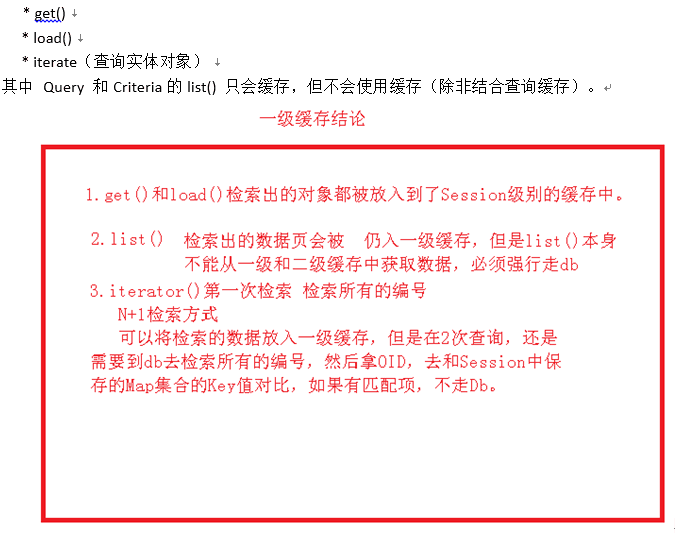
3补充以下方法支持一级缓存
四、二级缓存
(一)配置二级缓存
1.引入如下jar包。
ehcache-1.2.3.jar 核心库
backport-util-concurrent.jar
commons-logging.jar
2.配置Hibernate.cfg.xml开启二级缓存
<property name="hibernate.cache.use_second_level_cache">true</property>
3.配置二级缓存的供应商
<property name="hibernate.cache.provider_class">org.hibernate.cache.EhCacheProvider</property>
4.指定使用二级缓存的类
方案一:在*.hbm.xml中配置
在<class元素的子元素下添加chche子节点,但该配置仅会缓存对象的简单属性,若希望缓存集合属性中的元素,必须在set元素中添加<cache>子元素
<class name="Student" table="STUDENT">
<cache usage="read-write"/>
方案二:在大配置文件(hibernate.cfg.xml)中配置
<class-cache usage="read-write" class="cn.happy.entity.Student"/>
<collection-cache usage="read-write" collection=""/>--可注释如果配置不成功
注意大配置的书写位置
Multiple annotations found at this line:
- The content of element type "session-factory" must match "(property*,mapping*,(class-cache|collection-
cache)*,event*,listener*)".
- Start tag of element <session-factory>
*5.在src下添加ehcache.xml文件,从etc获取文件即可。
<ehcache>

    <!-- Sets the path to the directory where cache .data files are created.

         If the path is a Java System Property it is replaced by

         its value in the running VM.

         The following properties are translated:

         user.home - User's home directory

         user.dir - User's current working directory

         java.io.tmpdir - Default temp file path -->

    <diskStore path="d:/tmp"/>

    <!--Default Cache configuration. These will applied to caches programmatically created through

        the CacheManager.

        The following attributes are required for defaultCache:

        maxInMemory       - Sets the maximum number of objects that will be created in memory

        eternal           - Sets whether elements are eternal. If eternal,  timeouts are ignored and the element

                            is never expired.

        timeToIdleSeconds - Sets the time to idle for an element before it expires. Is only used

                            if the element is not eternal. Idle time is now - last accessed time

        timeToLiveSeconds - Sets the time to live for an element before it expires. Is only used

                            if the element is not eternal. TTL is now - creation time

        overflowToDisk    - Sets whether elements can overflow to disk when the in-memory cache

                            has reached the maxInMemory limit.

        -->

    <defaultCache

        maxElementsInMemory=""

        eternal="false"

        timeToIdleSeconds=""

        timeToLiveSeconds=""

        overflowToDisk="true"

        />

    <!--Predefined caches.  Add your cache configuration settings here.

        If you do not have a configuration for your cache a WARNING will be issued when the

        CacheManager starts

        The following attributes are required for defaultCache:

        name              - Sets the name of the cache. This is used to identify the cache. It must be unique.

        maxInMemory       - Sets the maximum number of objects that will be created in memory

        eternal           - Sets whether elements are eternal. If eternal,  timeouts are ignored and the element

                            is never expired.

        timeToIdleSeconds - Sets the time to idle for an element before it expires. Is only used

                            if the element is not eternal. Idle time is now - last accessed time

        timeToLiveSeconds - Sets the time to live for an element before it expires. Is only used

                            if the element is not eternal. TTL is now - creation time

        overflowToDisk    - Sets whether elements can overflow to disk when the in-memory cache

                            has reached the maxInMemory limit.

        -->

    <!-- Sample cache named sampleCache1

        This cache contains a maximum in memory of  elements, and will expire

        an element if it is idle for more than  minutes and lives for more than

         minutes.

        If there are more than  elements it will overflow to the

        disk cache, which in this configuration will go to wherever java.io.tmp is

        defined on your system. On a standard Linux system this will be /tmp"

        -->

    <cache name="sampleCache1"

        maxElementsInMemory=""

        eternal="false"

        timeToIdleSeconds=""

        timeToLiveSeconds=""

        overflowToDisk="true"

        />

    <!-- Sample cache named sampleCache2

        This cache contains  elements. Elements will always be held in memory.

        They are not expired. -->

    <cache name="sampleCache2"

        maxElementsInMemory=""

        eternal="true"

        timeToIdleSeconds=""

        timeToLiveSeconds=""

        overflowToDisk="false"

        /> -->

    <!-- Place configuration for your caches following -->

</ehcache>
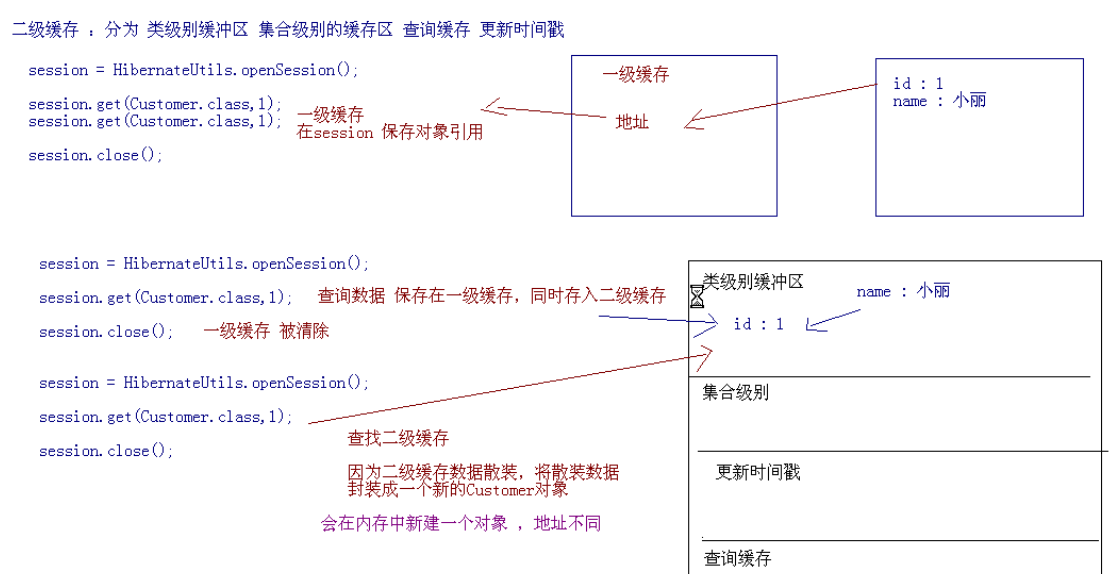
(二)二级缓存散装数据原理图
解析:每次从二级缓存中取出的对象,都是一个新的对象。
(三)什么样的数据适合放入二级缓存中?
1很少被修改的数据
2不是很重要的数据,允许出现偶尔并发的数据
3不会被并发访问的数据
4参考数据,指的是供应用参考的常量数据,它的实列数目有限,它的实列被许多其他类的实列引用,实列极少或者从来不会被修改。
讲述几乎结束了!!!
初识Hibernate 缓存的更多相关文章
- Hibernate 缓存机制浅析
1. 为什么要用 Hibernate 缓存? Hibernate是一个持久层框架,经常访问物理数据库. 为了降低应用程序对物理数据源访问的频次,从而提高应用程序的运行性能. 缓存内的数据是对物理数据源 ...
- hibernate缓存机制(转)
原文出处:http://www.cnblogs.com/wean/archive/2012/05/16/2502724.html 一.why(为什么要用Hibernate缓存?) Hibernate是 ...
- 【转】hibernate缓存:一级缓存和二级缓存
什么是缓存? 缓存是介于物理数据源与应用程序之间,是对数据库中的数据复制一份临时放在内存中的容器,其作用是为了减少应用程序对物理数据源访问的次数,从而提高了应用程序的运行性能.Hibernate在进行 ...
- Hibernate缓存(转)
来自:http://www.cnblogs.com/wean/archive/2012/05/16/2502724.html 一.why(为什么要用Hibernate缓存?) Hibernate是一个 ...
- Hibernate缓存原理与策略
Hibernate缓存原理: 对于Hibernate这类ORM而言,缓存显的尤为重要,它是持久层性能提升的关键.简单来讲Hibernate就是对JDBC进行封装,以实现内部状态的管理,OR关系的映射等 ...
- [原创]java WEB学习笔记93:Hibernate学习之路---Hibernate 缓存介绍,缓存级别,使用二级缓存的情况,二级缓存的架构集合缓存,二级缓存的并发策略,实现步骤,集合缓存,查询缓存,时间戳缓存
本博客的目的:①总结自己的学习过程,相当于学习笔记 ②将自己的经验分享给大家,相互学习,互相交流,不可商用 内容难免出现问题,欢迎指正,交流,探讨,可以留言,也可以通过以下方式联系. 本人互联网技术爱 ...
- Hibernate缓存原理与策略 Hibernate缓存原理:
Hibernate缓存原理: 对于Hibernate这类ORM而言,缓存显的尤为重要,它是持久层性能提升的关键.简单来讲Hibernate就是对JDBC进行封装,以实现内部状态的管理,OR关系的映射等 ...
- Hibernate 缓存机制
一.why(为什么要用Hibernate缓存?) Hibernate是一个持久层框架,经常访问物理数据库. 为了降低应用程序对物理数据源访问的频次,从而提高应用程序的运行性能. 缓存内的数据是对物理数 ...
- hibernate缓存说明
hibernate缓存说明: 1.一级缓存(session级别缓存) 一级缓存,不是用来提升性能,是用来处理事务的 2.二级缓存(sessionFactory级别缓存): 二级缓存,对 ...
随机推荐
- Java Annotation 总结
Annotation 被称为注解,在Java开发中是相当常见的,通过注解,我们可以简化代码提高开发效率.例如Override Annotation,这个应该算是在开发过程中使用最多的注解了.下面这个例 ...
- 每天一个linux命令(37):date命令
在linux环境中,不管是编程还是其他维护,时间是必不可少的,也经常会用到时间的运算,熟练运用date命令来表示自己想要表示的时间,肯定可以给自己的工作带来诸多方便. 1.命令格式: date [参数 ...
- Struts2--ONGL--值栈
ONGL:用来访问栈里对象属性的语言,通常由Struts标签来解析, 注意:要在接续OGNL的页面加入<%@ taglib prefix="s" uri="/str ...
- java 显示透明背景png图片
首先理由ps生成一个背景透明的png图片,然后设置JPanel面板的透明属性,也就是panel.setOpaque(false);设置为透明 class MyPanel extends JLayere ...
- Cocos2d-x 3.2 学习笔记(十四)保卫萝卜之界面UI
保卫萝卜~上一篇说了使用CocoStudio制作主界面,这里来完善主界面动画及后续界面(主题界面ThemeUI.场景选择界面SelectMapUI),主要涉及的控件PageView. 学习要 ...
- JAVA编程“性能说”(java编程需要做的26件事)
转载于 http://www.csdn.net/article/2012-06-01/2806249 最近的机器内存又爆满了,除了新增机器内存外,还应该好好review一下我们的代码,有很多代码编写过 ...
- [logstash-input-log4j]插件使用详解
Log4j插件可以通过log4j.jar获取Java日志,搭配Log4j的SocketAppender和SocketHubAppender使用,常用于简单的集群日志汇总. 最小化的配置 input { ...
- 基于HTML5树组件延迟加载技术实现
HT for Web的HTML5树组件有延迟加载的功能,这个功能对于那些需要从服务器读取具有层级依赖关系数据时非常有用,需要获取数据的时候再向服务器发起请求,这样可减轻服务器压力,同时也减少了浏览器的 ...
- Chrome开发者工具详解(4)-Profiles面板
Chrome开发者工具详解(4)-Profiles面板 如果上篇中的Timeline面板所提供的信息不能满足你的要求,你可以使用Profiles面板,利用这个面板你可以追踪网页程序的内存泄漏问题,进一 ...
- 交换排序---快速排序算法(Javascript版)
快速排序是对冒泡排序的一种改进.通过一趟排序将要排序的数据分割成独立的两部分,其中一部分的所有数据都比另外一部分的所有数据都要小,然后再按此方法对这两部分数据分别进行快速排序,整个排序过程可以递归进行 ...