
SGU 204. Little Jumper
204. Little Jumper
time limit per test: 0.5 sec.

memory limit per test: 65536 KB

input: standard

output: standard
Little frog Georgie likes to jump. Recently he have discovered the new playground that seems the perfect place to jump.
Recently the new jumping exercise has become very popular. Two vertical walls are placed on the playground, each of which has a hole.
The lower sides of the holes in the walls are on heights b1 and b2 respectively, and upper sides on heights t1 and t2. Walls are parallel and placed on distance l from each other.
The jumper starts at the distance ds from the first wall. It jumps through the first hole and lands between the walls. After that from that point he jumps through the second hole. The goal is to land exactly at the distance df from the second wall.
Let us describe the jump. The jumper starts from the specified point and starts moving in some chosen direction with the speed not exceeding some maximal speed v, determined by the strength of the jumper. The gravity of g forces him down, thus he moves along the parabolic trajectory.
The jumper can choose different starting speeds and different directions for his first and second jump.
Of course, The jumper must not attempt to pass through the wall, although it is allowed to touch it passing through the hole, this does not change the trajectory of the jump. The jumper is not allowed to pass through both holes in a single jump.
Find out, what must be the maximal starting speed of the jumper so that he could fulfil the excersise.
Input
Input file contains one or more lines, each of which contains eight real numbers, separated by spaces and/or line feeds. They designate b1, t1, b2, t2, l, ds, df and g. All numbers are in range from 10-2 to 103, t1≥ b1 + 10-2, t2≥ b2 + 10-2.
Output
For each line of the input file output the smallest possible maximal speed the jumper must have to fulfil the exercise. If it is impossible to fulfil it, output -1. Your answer must be accurate up to 10-4.
Sample test(s)
Input
0.3 1.0 0.5 0.9 1.7 1.2 2.3 9.8

0.6 0.8 0.6 0.8 2.4 0.3 1.5 0.7
Output
5.2883

1.3127
附送中文题意
题意
有只小青蛙要从两个竖起来的间隔为\(l\)的,各自有两个洞,分别以上部离地高度和下部离地高度描述,\(t_1,\ b_1,\ t_2,\ b_2\)的隔板跳过去。要求跳两次,一次从离第一块隔板\(d_s\)距离处以初速度\(v_1\),方向自定,跳进隔板间,落脚点自定,一次以速度\(v_2\),方向自定,从另外一边跳出来落在离第二块隔板\(d_t\)处,要你求最小的速度,即\(\min(\ max(\ v_1,\ \ v_2\ )\ )\)。
参见此图:

考虑一次跳跃,从\((0,\ 0)\)跳到\((x_2,\ 0)\),以高度\(y_1\)越过在\(x_1\)处的障碍,求最小速度\(v\)。
设x方向上的速度为\(v_x\),y为\(v_y\),那么高y和远x成方程。设时间$t=\frac{x}{v_x} \(,那么\)y = \frac{v_y + v_y - t \times g}{2}\times t=t\times v_y - \frac{t^2}{2}\times g=\frac{x\times v_y}{v_x} - \frac{x^2\times g}{2\times v_x^2}\(;
用\)v_x, v_y$表示得:
\]
对于两组点:\((x_1,y_1)\),\((x_2,y_2)\),可以通过解方程得出\((v_x,v_y)\),那么初始速度即为\(\sqrt{v_x^2+v_y^2}\)。
\]
\]
然后没了。。
notice
如果出射角为45度为最优,但是考虑到“洞”的限制,发现,如果45度可以通过,则取45度作为出射角,否则如果45度的抛物线交于洞顶上方时,取通过上方端点的点在抛物线上,否则取下方点,见下图(引用自Vergissmeinnicht):
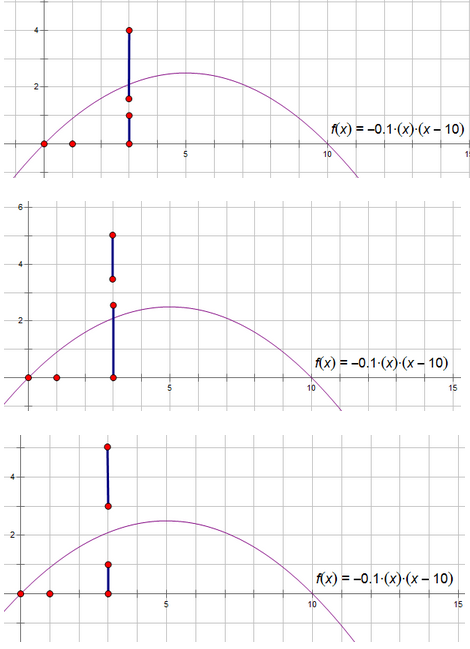
其他没啥了。。。1A的。。
#include <cstdio>

#include <cstring>

#include <cmath>

#define max(x, y) ((x) < (y) ? (y) : (x))

typedef double DB;

const DB eps = 1e-12;

DB ds, df, t1, t2, b1, b2, dist, g;

#define sqr(x) ((x) * (x))

DB calc(DB s, DB y2, DB y1, DB x1, DB x2) {

	DB jud = x1 - x1 * x1 / x2;

	if(y1 <= jud && jud <= y2) return x2 * g;

	if(jud < y1) {

		y2 = 0.0;

	} else {

		y1 = y2;

		y2 = 0.0;

	}

	DB vx2 = (sqr(x1) * x2 * g - x1 * sqr(x2) * g) / 2 / (x1 * y2 - x2 * y1);

	DB vy2 = (sqr(2 * y1 * vx2 + sqr(x1) * g) / vx2 / sqr(x1) / 4);

	//printf("%lf %lf\n", vx2, vy2);

	return vx2 + vy2;

}

DB calc(DB pos) {

	return max(calc(0.0, t1, b1, ds, pos + ds), calc(0.0, t2, b2, dist - pos, dist - pos + df));

}

int main() {

#ifndef ONLINE_JUDGE

	freopen("204.in", "r", stdin);

	freopen("204.out", "w", stdout);

#endif

	while(scanf("%lf%lf%lf%lf%lf%lf%lf%lf", &b1, &t1, &b2, &t2, &dist, &ds, &df, &g) != EOF) {

		DB l = 0, r = dist;

		while(eps < r - l) {

			DB m1, m2;

			m1 = l + (r - l) / 3;

			m2 = l + (r - l) / 3 * 2;

			DB a1, a2;

			a1 = calc(m1);

			a2 = calc(m2);

			if(a1 < a2) r = m2;

			else l = m1;

		}

		DB ans = sqrt(calc((l + r) / 2));

		printf("%.4lf\n", ans);

	}

	return 0;

}
SGU 204. Little Jumper的更多相关文章
- PIC10F200/202/204/206/220/222/320/322芯片解密程序复制多少钱?
PIC10F200/202/204/206/220/222/320/322芯片解密程序复制多少钱? PIC10F单片机芯片解密型号: PIC10F200解密 | PIC10F202解密 | PIC10 ...
- PHP build notes - WARNING: This bison version is not supported for regeneration of the Zend/PHP parsers (found: 3.0, min: 204, excluded: 3.0).
WARNING: This bison version is not supported for regeneration of the Zend/PHP parsers (found: 3.0, ...
- ShareSDK 集成 Google+ 登录 400. Error:redirect_uri_mismatch 和 Error Domain=ShareSDKErrorDomain Code=204
最近在集成ShareSDK中 Google+ 登录授权时候 出现了如下几个问题 1. 400. Error:redirect_uri_mismatch 出现这种情况, redirectUri应 ...
- SGU 495. Kids and Prizes
水概率....SGU里难得的水题.... 495. Kids and Prizes Time limit per test: 0.5 second(s)Memory limit: 262144 kil ...
- ACM: SGU 101 Domino- 欧拉回路-并查集
sgu 101 - Domino Time Limit:250MS Memory Limit:4096KB 64bit IO Format:%I64d & %I64u Desc ...
- 【SGU】495. Kids and Prizes
http://acm.sgu.ru/problem.php?contest=0&problem=495 题意:N个箱子M个人,初始N个箱子都有一个礼物,M个人依次等概率取一个箱子,如果有礼物则 ...
- SGU 455 Sequence analysis(Cycle detection,floyd判圈算法)
题目链接:http://acm.sgu.ru/problem.php?contest=0&problem=455 Due to the slow 'mod' and 'div' operati ...
- SGU 422 Fast Typing(概率DP)
题目大意 某人在打字机上打一个字符串,给出了他打每个字符出错的概率 q[i]. 打一个字符需要单位1的时间,删除一个字符也需要单位1的时间.在任意时刻,他可以花 t 的时间检查整个打出来的字符串,并且 ...
- sgu 104 Little shop of flowers 解题报告及测试数据
104. Little shop of flowers time limit per test: 0.25 sec. memory limit per test: 4096 KB 问题: 你想要将你的 ...
随机推荐
- golang字符串常用函数
package utils import "fmt" import "strconv" import "strings" var str s ...
- 题解【bzoj2301 [HAOI2011]Problem b】
Description 求有多少个数对 \((x,y)\) ,满足$ a \leq x \leq b$ ,\(c \leq y \leq d\) ,且 \(\gcd(x,y) = k\),\(\gcd ...
- 【Web】Struts之namespace
ZZ:struts2学习:配置篇之namespace 在struts1中是没有命名空间这个概念的,通过命名空间我们可以将所有的action配置划分为一个个逻辑单元,每个单元都有它自己的标识前缀.命名控 ...
- CS46 C 枚举二分
给你n*2个数其中n个数是原数减去了X值的数.问你满足条件的X值和原来的n个数.注意X为正整数. X should be positive,没0的 思路很简单,一个数必定会对应一个数,那么枚举一个数和 ...
- 重构改善既有代码设计--重构手法01:Extract Method (提炼函数)
背景: 你有一段代码可以被组织在一起并独立出来.将这段代码放进一个独立函数,并让函数名称解释该函数的用途. void PrintOwing(double amount) { PrintBanner() ...
- 如何用jQuery封装插件
引子 现在网上关于js和jquery封装的插件很多,我刚刚接触前端的时候,就很敬佩那些自己写插件的大牛们!因为是他们给网站开发更多的便利,很多网页效果,网上很多现成的插件!那么这些插件是如何写的呢?首 ...
- Node.js的开源博客系统Ghost搭建教程
准备工作 Node.js版本:0.10.x.0.12.x.4.2.x.安装步骤可参考:Node.js环境搭建 Ghost版本:0.7.4:中文集成版(33.6M),中文标准版(3.39M),英文原版( ...
- SaltStack 使用笔记
centos 7安装yum -y install epel-releaseyum clean allyum makecacheyum -y install salt-minionsed -i 's/# ...
- react-native关于ios的启动图标设置
1.首先我们需要使用xcode打开项目,选择项目中的images.xcassets这个文件夹 2.点击AppIcon可以看到右边出现针对不同设备的图标尺寸 3.在左边空白处右击,选择Import... ...
- LOW逼三人组(二)----选择排序算法
选择排序思路: 算法程序: def cal_time(func): # 装饰器 ,用来检测算法所执行的时间 def wrapper(*args,**kwargs): t1=time.time() re ...