
poj 2287(贪心)
| Time Limit: 5000MS | Memory Limit: 65536K | |
| Total Submissions: 12490 | Accepted: 3858 |
Description
That was about 2300 years ago. General Tian Ji was a
high official in the country Qi. He likes to play horse racing with the
king and others.Both of Tian and the king have three horses in different classes,
namely, regular, plus, and super. The rule is to have three rounds in a
match; each of the horses must be used in one round. The winner of a
single round takes two hundred silver dollars from the loser.Being the most powerful man in the country, the king has so nice
horses that in each class his horse is better than Tian's. As a result,
each time the king takes six hundred silver dollars from Tian.Tian Ji was not happy about that, until he met Sun Bin, one of the
most famous generals in Chinese history. Using a little trick due to
Sun, Tian Ji brought home two hundred silver dollars and such a grace in
the next match.It was a rather simple trick. Using his regular class horse race
against the super class from the king, they will certainly lose that
round. But then his plus beat the king's regular, and his super beat the
king's plus. What a simple trick. And how do you think of Tian Ji, the
high ranked official in China?
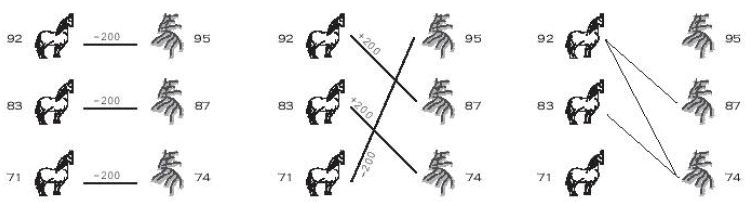
Were Tian Ji lives in nowadays, he will certainly laugh at himself.
Even more, were he sitting in the ACM contest right now, he may discover
that the horse racing problem can be simply viewed as finding the
maximum matching in a bipartite graph. Draw Tian's horses on one side,
and the king's horses on the other. Whenever one of Tian's horses can
beat one from the king, we draw an edge between them, meaning we wish to
establish this pair. Then, the problem of winning as many rounds as
possible is just to find the maximum matching in this graph. If there
are ties, the problem becomes more complicated, he needs to assign
weights 0, 1, or -1 to all the possible edges, and find a maximum
weighted perfect matching...
However, the horse racing problem is a very special case of
bipartite matching. The graph is decided by the speed of the horses -- a
vertex of higher speed always beat a vertex of lower speed. In this
case, the weighted bipartite matching algorithm is a too advanced tool
to deal with the problem.
In this problem, you are asked to write a program to solve this special case of matching problem.
Input
input consists of up to 50 test cases. Each case starts with a positive
integer n ( n<=1000) on the first line, which is the number of
horses on each side. The next n integers on the second line are the
speeds of Tian's horses. Then the next n integers on the third line are
the speeds of the king's horses. The input ends with a line that has a
single `0' after the last test case.
Output
Sample Input
3

92 83 71

95 87 74

2

20 20

20 20

2

20 19

22 18

0
Sample Output
200

0

0
Source
 #include<iostream>

 #include<cstdio>

 #include<algorithm>

 #include<cstring>

 #include<cstdlib>

 #include<iomanip>

 #include<cmath>

 #include<vector>

 #include<queue>

 #include<stack>

 using namespace std;

 #define PI 3.141592653589792128462643383279502

 int main(){

     //#ifdef CDZSC_June

     //freopen("in.txt","r",stdin);

     //#endif

     //std::ios::sync_with_stdio(false);

     int n;

     int tian[],qi[];

     while(scanf("%d",&n),n){

         for(int i=;i<=n;i++)

             cin>>tian[i];

         for(int i=;i<=n;i++)

             cin>>qi[i];

         sort(tian+,tian+n+);

         sort(qi+,qi+n+);

         int t1=,tn=n,q1=,qn=n;

         int sum=;

         while(t1<=tn){

             if(tian[t1]>qi[q1]){

                 t1++;q1++;sum+=;

             }

             else if(tian[t1]==qi[q1]){

                 while(t1<=tn&&q1<=qn){

                     if(tian[tn]>qi[qn]){

                         tn--;qn--;sum+=;

                     }

                     else {

                         if(tian[t1]<qi[qn]) sum-=;

                         t1++;qn--;break;

                     }

                 }

             }

             else{

                 t1++;qn--;sum-=;

             }

         }

         cout<<sum<<endl;

     }

     return ;

 }
poj 2287(贪心)的更多相关文章
- POJ 2287 田忌赛马 贪心算法
田忌赛马,大致题意是田忌和国王赛马,赢一局得200元,输一局输掉200元,平局则财产不动. 先输入一个整数N,接下来一行是田忌的N匹马,下一行是国王的N匹马.当N为0时结束. 此题为贪心算法解答,有两 ...
- POJ 2287 Tian Ji -- The Horse Racing(贪心)
题意:田忌和齐王有n匹马,进行n局比赛,每局比赛输者给胜者200,问田忌最多能得多少钱. 分析:如果田忌最下等的马比齐王最下等的马好,是没必要拿最下等的马和齐王最好的马比的.(最上等马同理) 因此,如 ...
- (贪心5.1.2)POJ 2287 Tian Ji -- The Horse Racing
/* * POJ_2287.cpp * * Created on: 2013年10月9日 * Author: Administrator */ #include <iostream> #i ...
- POJ - 1017 贪心训练
Packets Time Limit: 1000MS Memory Limit: 10000K Total Submissions: 59725 Accepted: 20273 Descrip ...
- POJ 2376 贪心
题意:FJ希望它的牛做一些清洁工作.有N只牛和T个时间段,每只牛可以承担一段时间内的工作.FJ希望让最小数量的牛覆盖整个T,求出其数量.若无法覆盖整个T,则输出-1. 分析:首先要注意T表示T个时间段 ...
- poj 1328 贪心
/* 贪心.... 处理处每个点按照最大距离在x轴上的映射 然后我们就有了一些线段 目的是选取尽量少的点 使得每个线段内都有点出现 我们按照左端点排序 然后逐一处理 假设第一个雷达安在第一个线段的右端 ...
- poj 2287 动态规划
用贪心简单证明之后就是一个从两头取的动态规划 #include <iostream> #include <cstring> #include <cstdio> #i ...
- Yogurt factory(POJ 2393 贪心 or DP)
Yogurt factory Time Limit: 1000MS Memory Limit: 65536K Total Submissions: 8205 Accepted: 4197 De ...
- Cleaning Shifts(POJ 2376 贪心)
Cleaning Shifts Time Limit: 1000MS Memory Limit: 65536K Total Submissions: 15143 Accepted: 3875 ...
随机推荐
- Vue.js -- 过滤器
VueJs中的过滤器基础 过滤器是一个通过输入数据,能够及时对数据进行处理并返回一个数据结果的简单函数.Vue有很多很便利的过滤器,可以参考官方文档, http://cn.vuejs.org/api/ ...
- SpringBoot jar包不支持jsp
官方原文如下: When running a Spring Boot application that uses an embedded servlet container (and is packa ...
- 【51NOD】1096 距离之和最小
[算法]数学 [题解] 其实就是求中位数,奇数个点就是最中间的点,偶数个点就是最中间两个点和它们之间的区域皆可(所以偶数不必取到两点正中央,取两点任意一点即可). 我们可以想象现在x轴上有n个点,我们 ...
- Linux中关机,重启,注销命令
关机: shutdown -h now #立刻关机重启,工作中常用 shutdown -h +1 #1分钟后关机 init 0 halt #立即停 ...
- POJ 3279 Fliptile ( 开关问题)
题目链接 Description Farmer John knows that an intellectually satisfied cow is a happy cow who will give ...
- mybatis 插入语句name no find
1.可参考连接:https://www.cnblogs.com/thomas12112406/p/6217211.html 2.dao层的配置 void addUser(@Param("un ...
- window对象的方法和属性汇总
window对象有以下方法: open close alert confirm prompt setTimeout clearTimeout setInterval clearInterval mov ...
- mysql cast函数
CAST函数语法规则是:Cast(字段名 as 转换的类型 ),其中类型可以为: CHAR[(N)] 字符型 DATE 日期型DATETIME 日期和时间型DECIMAL float型SIGNED i ...
- devinet_ioctl
Kernel: 4.12.6 deinet_ioctl:获取或者设置接口的地址,掩码,标记等信息: 注意,使用SIOCSIFFLAGS关闭设备,如果使用了别名,则删除对应ip,如果其为主ip,并且从i ...
- JDBC原生数据库连接
我们在开发JavaWeb项目时,常会需要连接数据库.我们以MySQL数据库为例,IDE工具为eclipse,讲述数据库连接与基本操作. 第一步,我们在Web项目的WebContent中建一个简单的前端 ...