
LeetCode: 60. Permutation Sequence(Medium)
1. 原题链接
https://leetcode.com/problems/permutation-sequence/description/
2. 题目要求
给出整数 n和 k ,k代表从1到n的整数所有排列序列中的第k个序列,返回String类型的第k个序列
3. 解题思路
首先我们要知道这个序列是按照什么规律排列下去的,假如此时n=4,k= 21,n=4时所有的排列如下:
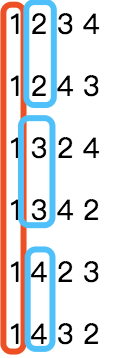
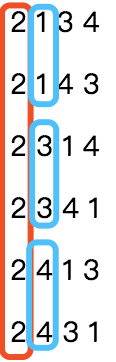
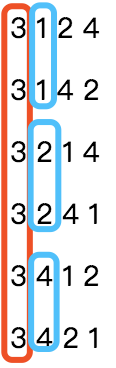
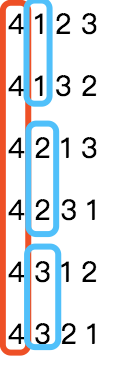
可以看出 n=4 时,一共有 4!=24种排列组合。
每一个数字开头各有 6 种排列组合,因此我们可以把同一数字开头的排列看作同一组,一共 4 组。
我们进一步探寻排列的规律。
(1) 第一步: 确定第一个数字
k=21,也就是要我们找到第19个排列组合,这个组合的第一个数字我们使用 (21-1)/(4-1)! = 3 ,3对应未使用数字中的第四位数字“4”,所以第一位数字为4。
将 4 从未使用数字中去除,还剩:1 2 3
解释一下为什么要 21-1:因为java进行整出运算时不会进行四舍五入,只保留整数不分。18/6 和 21/6 的结果都是3,按照每一个数字开头有 6 种排列方式,第 18和第 21 都是以 4开头。但实际上第 18 个排列以 “3” 开头,第 21 个以 “4” 开头。所以使用k-1来避免这个问题。
(2)第二步:确定第二个数字
我们已经确定了第一位数字,也就是第一位数字是 4 ,第4组。从上面的排列组合可以看出,第二位存在三种数字,每一个数字都存在两次(蓝框圈出),因此第二位数字相同的又可以看成同一组。
k= 20%(4-1)! =20%6 =2, 2/(4-2)! = 2/2 =1, 1对应未使用数字中的第二位数字 “1”,因此第二位数字为2。
将2从未使用数字中去掉,还剩:1 3
(3)第三步:确定第三个数字
第三个数字只存在两种可能了,k= 2%(4-2)! =2%2 =0,0/(4-3)!= 0/1 =0,0对应未使用数字中的第一位数字 “1”,因此第三位数字为1
将1从未使用数字中去掉,还剩:3
(4)第四步:确定第四个数字
k=0%(4-4)! = 0%1 = 0,0/(4-4)!=0/1 =0 ,0对应第一位数字,此时未使用数字中的第一位数字“3”,因此第四位数字为3.
所以第 21 个排列组合为:4213
4. 代码实现
import java.util.ArrayList;

import java.util.List;

public class PermutationSequence60 {

    public static void main(String[] args) {

        System.out.println(getPermutation(4,21));

        System.out.println(19/6);

    }

    public static String getPermutation(int n,int k){

        int pos = 0;

        List<Integer> numbers = new ArrayList<>();

        int[] factorial = new int[n+1];

        StringBuilder sb = new StringBuilder();

        int sum = 1;

        factorial[0] = 1;

        // 保存不同整数的阶乘

        for(int i=1; i<=n; i++){

            sum *= i;

            factorial[i] = sum;

        }

        // factorial[] = {1, 1, 2, 6, 24, ... n!}

        // 未使用数字列表

        for(int i=1; i<=n; i++){

            numbers.add(i);

        }

        k--;

        for(int i = 1; i <= n; i++){

            System.out.println(factorial[n-i]);

            int index = k/factorial[n-i];

            sb.append(String.valueOf(numbers.get(index)));

            numbers.remove(index);

            k =k%factorial[n-i];

        }

        return String.valueOf(sb);

    }

}
LeetCode: 60. Permutation Sequence(Medium)的更多相关文章
- leetCode 60.Permutation Sequence (排列序列) 解题思路和方法
The set [1,2,3,-,n] contains a total of n! unique permutations. By listing and labeling all of the p ...
- LeetCode:60. Permutation Sequence,n全排列的第k个子列
LeetCode:60. Permutation Sequence,n全排列的第k个子列 : 题目: LeetCode:60. Permutation Sequence 描述: The set [1, ...
- 60. Permutation Sequence(求全排列的第k个排列)
The set [1,2,3,…,n] contains a total of n! unique permutations. By listing and labeling all of the p ...
- LeetCode: 61. Rotate List(Medium)
1. 原题链接 https://leetcode.com/problems/rotate-list/description/ 2. 题目要求 给出一个链表的第一个结点head和正整数k,然后将从右侧开 ...
- LeetCode:11. ContainerWithWater(Medium)
原题链接:https://leetcode.com/problems/container-with-most-water/description/ 题目要求:给定n个非负整数a1,a2,...,an ...
- [LeetCode] 60. Permutation Sequence 序列排序
The set [1,2,3,…,n] contains a total of n! unique permutations. By listing and labeling all of the p ...
- Leetcode 60. Permutation Sequence
The set [1,2,3,-,n] contains a total of n! unique permutations. By listing and labeling all of the p ...
- leetcode 60. Permutation Sequence(康托展开)
描述: The set [1,2,3,…,n] contains a total of n! unique permutations. By listing and labeling all of t ...
- [LeetCode]60. Permutation Sequence求全排列第k个
/* n个数有n!个排列,第k个排列,是以第(k-1)/(n-1)!个数开头的集合中第(k-1)%(n-1)!个数 */ public String getPermutation(int n, int ...
随机推荐
- GPU CUDA之——深入理解threadIdx
http://blog.csdn.net/canhui_wang/article/details/51730264 摘要 本文主要讲述CUDA的threadIdx. 1. Grid,Block和Thr ...
- 如何设置活动监视器中的可见作业数能显示更长范围之内的作业(如何让bpdbjobs/Active Monitor显示更多作业信息)
一.问题: 如何设置可以使得活动监视器中的可见作业数能显示更长范围之内的作业(即NBU软件不要自动删除活动监视器中短时间内(如8天)内的作业记录)? 二.解决方法: 默认情况下在Ac ...
- js递归错误
错误信息:Uncaught RangeError: Maximum call stack size exceeded 问题代码: js代码:$(function(){ selectTog ...
- iOS 帧动画之翻转和旋转动画
记录两个比较简单的动画,一个是翻转的动画,一个是旋转的动画. 旋转动画: 1 [UIView animateWithDuration:3 animations:^{ if (formView) { f ...
- react系列教程
这个系列将从基础语法讲起,把react全家桶都讲到,然后到具体的使用,最后完成后,会写一个完整的demo. 前置要求: 基本的CSS,JS要熟练. 部分ES6语法需要了解.可以参考下面提到的阮一峰老师 ...
- dva框架使用详解及Demo教程
dva框架的使用详解及Demo教程 在前段时间,我们也学习讲解过Redux框架的基本使用,但是有很多同学在交流群里给我的反馈信息说,redux框架理解上有难度,看了之后还是一脸懵逼不知道如何下手,很多 ...
- 开发类似"音速启动"的原创工具简码"万能助手"的过程中对ztree.js与win标准控件treeview、HTMLayout树形框等优缺点的比较
在开发类似"音速启动"的桌面快捷方式管理软件简码"万能助手"的早期规划中,曾经考虑过几种树形框方案: ztree.js.win标准控件treeview.HTML ...
- TCP/IP协议族之链路层(二)
TCP/IP学习记录,如有错误请指正,谢谢!!! TCP/IP协议族之链路层(二) 链路层是最底层协议,主要有三个目的: 1. 为IP模块发送和接收IP数据报 2. 为ARP模块发送ARP请求和接收A ...
- C++ ACM基础
一.C++结构体 #include <iostream> using namespace std; struct Point{ int x; int y; Point(int x=0,in ...
- .Net 上传文件到ftp服务器和下载文件
突然发现又很久没有写博客了,想起哎呦,还是写一篇博客记录一下吧,虽然自己还是那个渣渣猿. 最近在做上传文件的功能,上传到ftp文件服务器有利于管理上传文件. 前面的博客有写到layui如何上传文件,然 ...