
Keras实现CIFAR-10分类
仅仅为了学习Keras的使用,使用一个四层的全连接网络对MNIST数据集进行分类,网络模型各层结点数为:3072: : 1024 : 512:10;
使用50000张图片进行训练,10000张测试:
              precision    recall  f1-score   support

    airplane       0.61      0.69      0.65      1000

  automobile       0.69      0.67      0.68      1000

        bird       0.43      0.49      0.45      1000

         cat       0.40      0.32      0.36      1000

        dear       0.49      0.50      0.50      1000

         dog       0.45      0.48      0.47      1000

        frog       0.58      0.65      0.61      1000

       horse       0.63      0.60      0.62      1000

        ship       0.72      0.66      0.69      1000

       truck       0.63      0.58      0.60      1000

   micro avg       0.56      0.56      0.56     10000

   macro avg       0.56      0.56      0.56     10000

weighted avg       0.56      0.56      0.56     10000
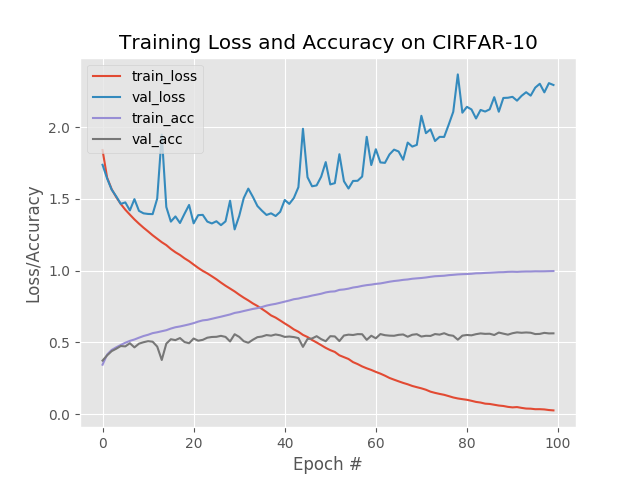
训练过程中,损失和正确率曲线:
可以看到,训练集的损失在一直降低,而测试集的损失出现大范围波动,并趋于上升,说明在一些epoch之后,出现过拟合;
训练集的正确率也在一直上升,并接近100%;而测试集的正确率达到50%就趋于平稳了;
代码:
#!/usr/bin/env python

# -*- coding: utf-8 -*-

# @Time : 19-5-9

"""

implement classification for CIFAR-10 with Keras

"""

__author__ = 'Zhen Chen'

# import the necessary packages

from sklearn.preprocessing import LabelBinarizer

from sklearn.metrics import classification_report

from keras.models import Sequential

from keras.layers import Dense

from keras.optimizers import SGD

from keras.datasets import cifar10

import matplotlib.pyplot as plt

import numpy as np

import argparse

# construct the argument parse and parse the arguments

parser = argparse.ArgumentParser()

parser.add_argument("-o", "--output", default="./Training Loss and Accuracy_CIFAR10.png")

args = parser.parse_args()

# load the training and testing data, scale it into the range [0, 1],

# then reshape the design matrix

print("[INFO] loading CIFAR-10 data...")

((trainX, trainY), (testX, testY)) = cifar10.load_data()

trainX = trainX.astype("float") / 255.0

testX = testX.astype("float") / 255.0

trainX = trainX.reshape((trainX.shape[0], 3072))

testX = testX.reshape((testX.shape[0], 3072))

# convert the labels from integers to vectors

lb = LabelBinarizer()

trainY = lb.fit_transform(trainY)

testY = lb.fit_transform(testY)

# initialize the label names for the CIFAR-10 dataset

labelNames = ["airplane", "automobile", "bird", "cat", "dear", "dog", "frog", "horse", "ship", "truck"]

# define the 2072-1024-512-10 architecture Keras

model = Sequential()

model.add(Dense(1024, input_shape=(3072,), activation="relu"))

model.add(Dense(512, activation="relu"))

model.add(Dense(10, activation="softmax"))

# train the model using SGD

print("[INFO] training network...")

sgd = SGD(0.01)

model.compile(loss="categorical_crossentropy", optimizer=sgd, metrics=["accuracy"])

H = model.fit(trainX, trainY, validation_data=(testX, testY), epochs=100, batch_size=32)

model.save_weights('SGD_100_32.h5')

# evaluate the network

print("[INFO] evaluating network...")

predictions = model.predict(testX, batch_size=32)

print(classification_report(testY.argmax(axis=1), predictions.argmax(axis=1), target_names=labelNames))

# plot the training losss and accuracy

plt.style.use("ggplot")

plt.figure()

plt.plot(np.arange(0, 100), H.history["loss"], label="train_loss")

plt.plot(np.arange(0, 100), H.history["val_loss"], label="val_loss")

plt.plot(np.arange(0, 100), H.history["acc"], label="train_acc")

plt.plot(np.arange(0, 100), H.history["val_acc"], label="val_acc")

plt.title("Training Loss and Accuracy on CIRFAR-10")

plt.xlabel("Epoch #")

plt.ylabel("Loss/Accuracy")

plt.legend()

plt.savefig(args.output)
Keras实现CIFAR-10分类的更多相关文章
- DL Practice:Cifar 10分类
Step 1:数据加载和处理 一般使用深度学习框架会经过下面几个流程: 模型定义(包括损失函数的选择)——>数据处理和加载——>训练(可能包括训练过程可视化)——>测试 所以自己写代 ...
- keras系列︱图像多分类训练与利用bottleneck features进行微调(三)
引自:http://blog.csdn.net/sinat_26917383/article/details/72861152 中文文档:http://keras-cn.readthedocs.io/ ...
- 【翻译】TensorFlow卷积神经网络识别CIFAR 10Convolutional Neural Network (CNN)| CIFAR 10 TensorFlow
原网址:https://data-flair.training/blogs/cnn-tensorflow-cifar-10/ by DataFlair Team · Published May 21, ...
- keras系列︱人脸表情分类与识别:opencv人脸检测+Keras情绪分类(四)
引自:http://blog.csdn.net/sinat_26917383/article/details/72885715 人脸识别热门,表情识别更加.但是表情识别很难,因为人脸的微表情很多,本节 ...
- [深度应用]·Keras实现Self-Attention文本分类(机器如何读懂人心)
[深度应用]·Keras实现Self-Attention文本分类(机器如何读懂人心) 配合阅读: [深度概念]·Attention机制概念学习笔记 [TensorFlow深度学习深入]实战三·分别使用 ...
- 【Python与机器学习】:利用Keras进行多类分类
多类分类问题本质上可以分解为多个二分类问题,而解决二分类问题的方法有很多.这里我们利用Keras机器学习框架中的ANN(artificial neural network)来解决多分类问题.这里我们采 ...
- Keras人工神经网络多分类(SGD)
import numpy as np import pandas as pd from keras.models import Sequential from keras.layers import ...
- keras 的svm做分类
SVC继承了父类BaseSVC SVC类主要方法: ★__init__() 主要参数: C: float参数 默认值为1.0 错误项的惩罚系数.C越大,即对分错样本的惩罚程度越大,因此在训练样本中准确 ...
- 【神经网络与深度学习】基于Windows+Caffe的Minst和CIFAR—10训练过程说明
Minst训练 我的路径:G:\Caffe\Caffe For Windows\examples\mnist 对于新手来说,初步完成环境的配置后,一脸茫然.不知如何跑Demo,有么有!那么接下来的教 ...
- keras调用预训练模型分类
在网上看到一篇博客,地址https://www.pyimagesearch.com/2017/03/20/imagenet-vggnet-resnet-inception-xception-keras ...
随机推荐
- iOS Dev (53) 修复UIImagePickerController偷换StatusBar颜色的问题
版权声明:本文为 CSDN 博主 大锐哥(ID 为 prevention)原创文章,未经博主同意不得转载. https://blog.csdn.net/prevention/article/detai ...
- Java for LeetCode 133 Clone Graph
Clone an undirected graph. Each node in the graph contains a label and a list of its neighbors. OJ's ...
- 微信小程序开发:学习笔记[3]——WXSS样式
微信小程序开发:学习笔记[3]——WXSS样式 快速开始 介绍 WXSS(WeiXin Style Sheets)是一套用于小程序的样式语言,用于描述WXML的组件样式,也就是视觉上的效果. WXSS ...
- Eclipse的.properties文件输出中文成unicode编码
今天添加log4j.properties时,无法输入中文,输入的中文直接变成了unicode的编码形式.原因是Eclipse的.properties文件的默认编码为iso-8859-1. 选择Wind ...
- 51nod 1610
题目 神犇题解 所以说鄙人的姿势水平完全不够啊OTZ. 很naive的想法是O(T*v*m)的,据说卡一卡可以过去.题目要求的东西其实是这个: $ \sum\limits_{i = 1}^v {\mu ...
- XML文件的特点
1.这个东西的规则比较简单,并且人眼看起来也比较容易理解,结构上也比较好操作,并且并无与任何编程语言绑定. 所以,很多编程语言就都为XML这个东西编写了读写XML的库,所以XML看起来所谓的通用,其实 ...
- html5实现进度条功能效果非常和谐
1. [图片] html5.jpg 2. [代码][HTML]代码 <script type="text/javascript"> var i = 0; ...
- iOS审核策略重磅更新:Guideline 2.1批量拒审
自从进入了2018年,大量应用在AppStore提交审核后,都直接给大家回复了个新春大礼包 Guideline 2.1 - Information Needed. 而大部分的应用,特别是金融类相关AP ...
- BZOJ 1637 [Usaco2007 Mar]Balanced Lineup:前缀和 + 差分
题目链接:http://www.lydsy.com/JudgeOnline/problem.php?id=1637 题意: Farmer John 决定给他的奶牛们照一张合影,他让 N (1 ≤ N ...
- BZOJ 1650 [Usaco2006 Dec]River Hopscotch 跳石子:二分
题目链接:http://www.lydsy.com/JudgeOnline/problem.php?id=1650 题意: 数轴上有n个石子,第i个石头的坐标为Di,现在要从0跳到L,每次条都从一个石 ...