
DeepLearning.ai-Week4-Deep Learning & Art: Neural Style Transfer
1 - Task
- Implement the neural style transfer algorithm
- Generate novel artistic images using your algorithm
2 - Import Packages
import os

import sys

import scipy.io

import scipy.misc

import matplotlib.pyplot as plt

from matplotlib.pyplot import imshow

from PIL import Image

from nst_utils import *

import numpy as np

import tensorflow as tf

%matplotlib inline
3 - Problem Statement
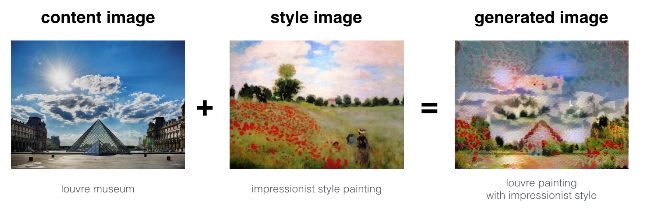
4 - Transfer Learning
加载已经在ImageNet数据集上训练好的VGG网络。
model = load_vgg_model("pretrained-model/imagenet-vgg-verydeep-19.mat")

print(model)
Result:

{'conv5_3': <tf.Tensor 'Relu_14:0' shape=(1, 19, 25, 512) dtype=float32>, 'avgpool1': <tf.Tensor 'AvgPool:0' shape=(1, 150, 200, 64) dtype=float32>, 'conv5_2': <tf.Tensor 'Relu_13:0' shape=(1, 19, 25, 512) dtype=float32>, 'conv3_3': <tf.Tensor 'Relu_6:0' shape=(1, 75, 100, 256) dtype=float32>, 'conv3_2': <tf.Tensor 'Relu_5:0' shape=(1, 75, 100, 256) dtype=float32>, 'conv4_2': <tf.Tensor 'Relu_9:0' shape=(1, 38, 50, 512) dtype=float32>, 'avgpool3': <tf.Tensor 'AvgPool_2:0' shape=(1, 38, 50, 256) dtype=float32>, 'conv4_3': <tf.Tensor 'Relu_10:0' shape=(1, 38, 50, 512) dtype=float32>, 'avgpool5': <tf.Tensor 'AvgPool_4:0' shape=(1, 10, 13, 512) dtype=float32>, 'conv3_1': <tf.Tensor 'Relu_4:0' shape=(1, 75, 100, 256) dtype=float32>, 'conv5_1': <tf.Tensor 'Relu_12:0' shape=(1, 19, 25, 512) dtype=float32>, 'conv2_2': <tf.Tensor 'Relu_3:0' shape=(1, 150, 200, 128) dtype=float32>, 'conv5_4': <tf.Tensor 'Relu_15:0' shape=(1, 19, 25, 512) dtype=float32>, 'input': <tf.Variable 'Variable:0' shape=(1, 300, 400, 3) dtype=float32_ref>, 'conv3_4': <tf.Tensor 'Relu_7:0' shape=(1, 75, 100, 256) dtype=float32>, 'conv4_1': <tf.Tensor 'Relu_8:0' shape=(1, 38, 50, 512) dtype=float32>, 'conv4_4': <tf.Tensor 'Relu_11:0' shape=(1, 38, 50, 512) dtype=float32>, 'avgpool2': <tf.Tensor 'AvgPool_1:0' shape=(1, 75, 100, 128) dtype=float32>, 'avgpool4': <tf.Tensor 'AvgPool_3:0' shape=(1, 19, 25, 512) dtype=float32>, 'conv1_1': <tf.Tensor 'Relu:0' shape=(1, 300, 400, 64) dtype=float32>, 'conv2_1': <tf.Tensor 'Relu_2:0' shape=(1, 150, 200, 128) dtype=float32>, 'conv1_2': <tf.Tensor 'Relu_1:0' shape=(1, 300, 400, 64) dtype=float32>}
5 - Neural Style Transfer
实现NST算法有如下几个步骤:
- Build the content cost function J_{content}(C,G)
- Build the style cost function J_{style}(S,G)$
- Put it together to get J(G)=α J_{content}(C,G)+β J_{style}(S,G)
5.1 - Computing the content cost
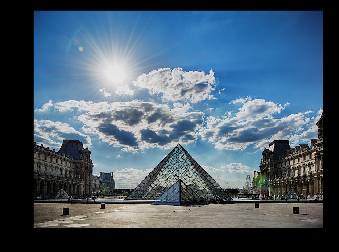
浏览浏览图片。
content_image = scipy.misc.imread("images/louvre.jpg")

imshow(content_image)
Result:

<matplotlib.image.AxesImage at 0x21eca6026d8>
5.1.1 - How do you ensure the generated image G matches the content of the image C?
内容损失函数如下:

实现compute_content_cost()方法有如下步骤:
- Retrieve dimensions from a_G:
- To retrieve dimensions from a tensor X, use:
X.get_shape().as_list()
- To retrieve dimensions from a tensor X, use:
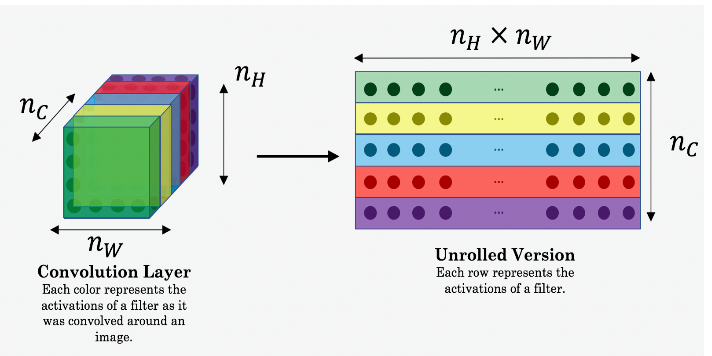
- Unroll a_C and a_G as explained in the picture above
- Compute the content cost:
# GRADED FUNCTION: compute_content_cost

def compute_content_cost(a_C, a_G):

    """

    Computes the content cost

    Arguments:

    a_C -- tensor of dimension (1, n_H, n_W, n_C), hidden layer activations representing content of the image C

    a_G -- tensor of dimension (1, n_H, n_W, n_C), hidden layer activations representing content of the image G

    Returns:

    J_content -- scalar that you compute using equation 1 above.

    """

    ### START CODE HERE ###

    # Retrieve dimensions from a_G (≈1 line)

    m, n_H, n_W, n_C = a_G.get_shape().as_list()

    # Reshape a_C and a_G (≈2 lines)
    a_C_unrolled = tf.reshape(a_C, (n_H*n_W, n_C))
    a_G_unrolled = tf.reshape(a_G, (n_H*n_W, n_C))# compute the cost with tensorflow (≈1 line)

    J_content = 1 / (4*n_H*n_W*n_C) * tf.reduce_sum(tf.square(tf.subtract(a_C_unrolled, a_G_unrolled)))

    ### END CODE HERE ###

    return J_content
tf.reset_default_graph()

with tf.Session() as test:

    tf.set_random_seed(1)

    a_C = tf.random_normal([1, 4, 4, 3], mean=1, stddev=4)

    a_G = tf.random_normal([1, 4, 4, 3], mean=1, stddev=4)

    J_content = compute_content_cost(a_C, a_G)

    print("J_content = " + str(J_content.eval()))
Result:

J_content = 6.76559
5.2 - Computing the style cost
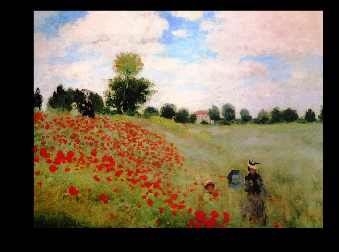
预览图片。
style_image = scipy.misc.imread("images/monet_800600.jpg")

imshow(style_image)
Result:
<matplotlib.image.AxesImage at 0x21eccaeff28>
5.2.1 - Style matrix
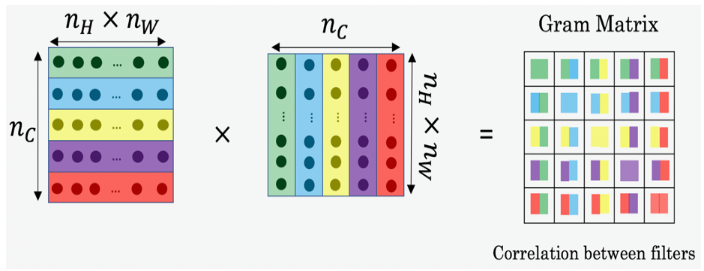
# GRADED FUNCTION: gram_matrix
# G_A = AA^T

def gram_matrix(A):

    """

    Argument:

    A -- matrix of shape (n_C, n_H*n_W)

    Returns:

    GA -- Gram matrix of A, of shape (n_C, n_C)

    """

    ### START CODE HERE ### (≈1 line)

    GA = tf.matmul(A, tf.transpose(A))

    ### END CODE HERE ###

    return GA
tf.reset_default_graph()

with tf.Session() as test:

    tf.set_random_seed(1)

    A = tf.random_normal([3, 2*1], mean=1, stddev=4)

    GA = gram_matrix(A)

    print("GA = " + str(GA.eval()))
Result:

GA = [[  6.42230511  -4.42912197  -2.09668207]

 [ -4.42912197  19.46583748  19.56387138]

 [ -2.09668207  19.56387138  20.6864624 ]]
5.2.2 - Style cost
风格损失函数如下:

实现compute_layer_style_cost()方法有如下步骤:
- Retrieve dimensions from the hidden layer activations a_G:
- To retrieve dimensions from a tensor X, use:
X.get_shape().as_list()
- To retrieve dimensions from a tensor X, use:
- Unroll the hidden layer activations a_S and a_G into 2D matrices, as explained in the picture above.
- Compute the Style matrix of the images S and G. (Use the function you had previously written.)
- Compute the Style cost:
# GRADED FUNCTION: compute_layer_style_cost

def compute_layer_style_cost(a_S, a_G):

    """

    Arguments:

    a_S -- tensor of dimension (1, n_H, n_W, n_C), hidden layer activations representing style of the image S

    a_G -- tensor of dimension (1, n_H, n_W, n_C), hidden layer activations representing style of the image G

    Returns:

    J_style_layer -- tensor representing a scalar value, style cost defined above by equation (2)

    """

    ### START CODE HERE ###

    # Retrieve dimensions from a_G (≈1 line)

    m, n_H, n_W, n_C = a_G.get_shape().as_list()

    # Reshape the images to have them of shape (n_C, n_H*n_W) (≈2 lines)

    a_S = tf.reshape(a_S, [n_H*n_W, n_C])

    a_G = tf.reshape(a_G, [n_H*n_W, n_C])

    # Computing gram_matrices for both images S and G (≈2 lines)

    GS = gram_matrix(tf.transpose(a_S))

    GG = gram_matrix(tf.transpose(a_G))

    # Computing the loss (≈1 line)

    J_style_layer = tf.reduce_sum(tf.square(tf.subtract(GS, GG))) / (4*tf.square(tf.to_float(n_H*n_W*n_C)))

    ### END CODE HERE ###

    return J_style_layer
tf.reset_default_graph()

with tf.Session() as test:

    tf.set_random_seed(1)

    a_S = tf.random_normal([1, 4, 4, 3], mean=1, stddev=4)

    a_G = tf.random_normal([1, 4, 4, 3], mean=1, stddev=4)

    J_style_layer = compute_layer_style_cost(a_S, a_G)

    print("J_style_layer = " + str(J_style_layer.eval()))
Result:

J_style_layer = 9.19028
5.2.3 - Style Weights
STYLE_LAYERS = [

    ('conv1_1', 0.2),

    ('conv2_1', 0.2),

    ('conv3_1', 0.2),

    ('conv4_1', 0.2),

    ('conv5_1', 0.2)]
通过如下公式综合不同层的style costs:

def compute_style_cost(model, STYLE_LAYERS):

    """

    Computes the overall style cost from several chosen layers

    Arguments:

    model -- our tensorflow model

    STYLE_LAYERS -- A python list containing:

                        - the names of the layers we would like to extract style from

                        - a coefficient for each of them

    Returns:

    J_style -- tensor representing a scalar value, style cost defined above by equation (2)

    """

    # initialize the overall style cost

    J_style = 0

    for layer_name, coeff in STYLE_LAYERS:

        # Select the output tensor of the currently selected layer

        out = model[layer_name]

        # Set a_S to be the hidden layer activation from the layer we have selected, by running the session on out

        a_S = sess.run(out)

        # Set a_G to be the hidden layer activation from same layer. Here, a_G references model[layer_name]

        # and isn't evaluated yet. Later in the code, we'll assign the image G as the model input, so that

        # when we run the session, this will be the activations drawn from the appropriate layer, with G as input.

        a_G = out

        # Compute style_cost for the current layer

        J_style_layer = compute_layer_style_cost(a_S, a_G)

        # Add coeff * J_style_layer of this layer to overall style cost

        J_style += coeff * J_style_layer

    return J_style
5.3 - Defining the total cost to optimize
总的损失函数表示如下:

# GRADED FUNCTION: total_cost

def total_cost(J_content, J_style, alpha = 10, beta = 40):

    """

    Computes the total cost function

    Arguments:

    J_content -- content cost coded above

    J_style -- style cost coded above

    alpha -- hyperparameter weighting the importance of the content cost

    beta -- hyperparameter weighting the importance of the style cost

    Returns:

    J -- total cost as defined by the formula above.

    """

    ### START CODE HERE ### (≈1 line)

    J = alpha * J_content + beta * J_style

    ### END CODE HERE ###

    return J
tf.reset_default_graph()

with tf.Session() as test:

    np.random.seed(3)

    J_content = np.random.randn()

    J_style = np.random.randn()

    J = total_cost(J_content, J_style)

    print("J = " + str(J))
Result:

J = 35.34667875478276
6 - Solving the optimization problem
实现神经风格迁移需要实现以下内容:
- Create an Interactive Session
- Load the content image
- Load the style image
- Randomly initialize the image to be generated
- Load the VGG16 model
- Build the TensorFlow graph:
- Run the content image through the VGG16 model and compute the content cost
- Run the style image through the VGG16 model and compute the style cost
- Compute the total cost
- Define the optimizer and the learning rate
- Initialize the TensorFlow graph and run it for a large number of iterations, updating the generated image at every step.
# Reset the graph

tf.reset_default_graph()

# Start interactive session

sess = tf.InteractiveSession()
# load, reshape, and normalize "content" image

content_image = scipy.misc.imread("images/louvre_small.jpg")

content_image = reshape_and_normalize_image(content_image)
# load, reshape, and normalize "style" image

style_image = scipy.misc.imread("images/monet.jpg")

style_image = reshape_and_normalize_image(style_image)
# initialize the "generated" Image as a noisy image created from the content_image

generated_image = generate_noise_image(content_image)

imshow(generated_image[0])
# load the VGG16 model

model = load_vgg_model("pretrained-model/imagenet-vgg-verydeep-19.mat")
- Assign the content image to be the input to the VGG model.
- Set a_C to be the tensor giving the hidden layer activation for layer "conv4_2".
- Set a_G to be the tensor giving the hidden layer activation for the same layer.
- Compute the content cost using a_C and a_G.
# Assign the content image to be the input of the VGG model.

sess.run(model['input'].assign(content_image))

# Select the output tensor of layer conv4_2

out = model['conv4_2']

# Set a_C to be the hidden layer activation from the layer we have selected

a_C = sess.run(out)

# Set a_G to be the hidden layer activation from same layer. Here, a_G references model['conv4_2']

# and isn't evaluated yet. Later in the code, we'll assign the image G as the model input, so that

# when we run the session, this will be the activations drawn from the appropriate layer, with G as input.

a_G = out

# Compute the content cost

J_content = compute_content_cost(a_C, a_G)
# Assign the input of the model to be the "style" image

sess.run(model['input'].assign(style_image))

# Compute the style cost

J_style = compute_style_cost(model, STYLE_LAYERS)
### START CODE HERE ### (1 line)

J = total_cost(J_content, J_style, alpha=10, beta=40)

### END CODE HERE ###
# define optimizer (1 line)

optimizer = tf.train.AdamOptimizer(2.0)

# define train_step (1 line)

train_step = optimizer.minimize(J)
def model_nn(sess, input_image, num_iterations = 200):

    # Initialize global variables (you need to run the session on the initializer)

    ### START CODE HERE ### (1 line)

    sess.run(tf.global_variables_initializer())

    ### END CODE HERE ###

    # Run the noisy input image (initial generated image) through the model. Use assign().

    ### START CODE HERE ### (1 line)

    sess.run(model["input"].assign(input_image))

    ### END CODE HERE ###

    for i in range(num_iterations):

        # Run the session on the train_step to minimize the total cost

        ### START CODE HERE ### (1 line)

        sess.run(train_step)

        ### END CODE HERE ###

        # Compute the generated image by running the session on the current model['input']

        ### START CODE HERE ### (1 line)

        generated_image = sess.run(model["input"])

        ### END CODE HERE ###

        # Print every 20 iteration.

        if i%20 == 0:

            Jt, Jc, Js = sess.run([J, J_content, J_style])

            print("Iteration " + str(i) + " :")

            print("total cost = " + str(Jt))

            print("content cost = " + str(Jc))

            print("style cost = " + str(Js))

            # save current generated image in the "/output" directory

            save_image("output/" + str(i) + ".png", generated_image)

    # save last generated image

    save_image('output/generated_image.jpg', generated_image)

    return generated_image
model_nn(sess, generated_image)
Result:
Iteration 0 :
total cost = 5.04752e+09
content cost = 7865.72
style cost = 1.26186e+08
Iteration 20 :
total cost = 9.44841e+08
content cost = 15236.9
style cost = 2.36172e+07
Iteration 40 :
total cost = 4.80354e+08
content cost = 16712.4
style cost = 1.20047e+07
Iteration 60 :
total cost = 3.10203e+08
content cost = 17443.6
style cost = 7.75072e+06
(略)
Result:
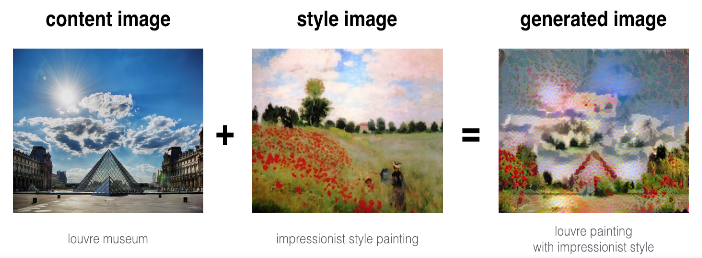
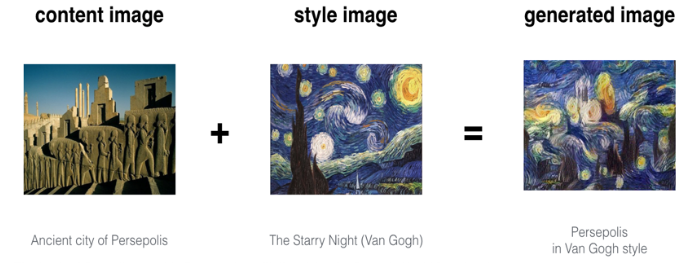
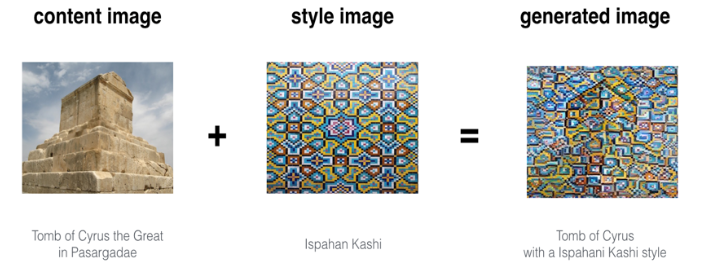
7 - Summary
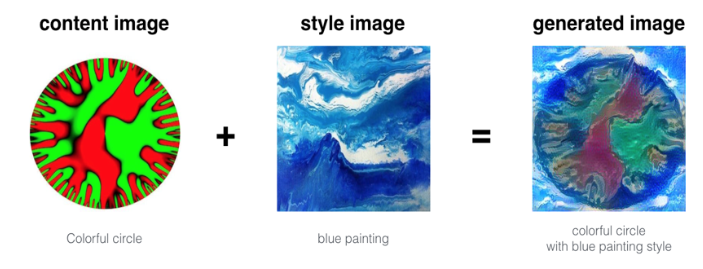
- Neural Style Transfer is an algorithm that given a content image C and a style image S can generate an artistic image
- It uses representations (hidden layer activations) based on a pretrained ConvNet.
- The content cost function is computed using one hidden layer's activations.
- The style cost function for one layer is computed using the Gram matrix of that layer's activations. The overall style cost function is obtained using several hidden layers.
- Optimizing the total cost function results in synthesizing new images.
8 - References
https://web.stanford.edu/class/cs230/
DeepLearning.ai-Week4-Deep Learning & Art: Neural Style Transfer的更多相关文章
- Art: Neural Style Transfer
Andrew Ng deeplearning courese-4:Convolutional Neural Network Convolutional Neural Networks: Step by ...
- 课程四(Convolutional Neural Networks),第四 周(Special applications: Face recognition & Neural style transfer) —— 2.Programming assignments:Art generation with Neural Style Transfer
Deep Learning & Art: Neural Style Transfer Welcome to the second assignment of this week. In thi ...
- Spark MLlib Deep Learning Convolution Neural Network (深度学习-卷积神经网络)3.1
3.Spark MLlib Deep Learning Convolution Neural Network (深度学习-卷积神经网络)3.1 http://blog.csdn.net/sunbow0 ...
- Spark MLlib Deep Learning Convolution Neural Network (深度学习-卷积神经网络)3.2
3.Spark MLlib Deep Learning Convolution Neural Network(深度学习-卷积神经网络)3.2 http://blog.csdn.net/sunbow0 ...
- Spark MLlib Deep Learning Convolution Neural Network (深度学习-卷积神经网络)3.3
3.Spark MLlib Deep Learning Convolution Neural Network(深度学习-卷积神经网络)3.3 http://blog.csdn.net/sunbow0 ...
- 项目总结四:神经风格迁移项目(Art generation with Neural Style Transfer)
1.项目介绍 神经风格转换 (NST) 是深部学习中最有趣的技术之一.它合并两个图像, 即 内容图像 C(content image) 和 样式图像S(style image), 以生成图像 G(ge ...
- [C4W4] Convolutional Neural Networks - Special applications: Face recognition & Neural style transfer
第四周:Special applications: Face recognition & Neural style transfer 什么是人脸识别?(What is face recogni ...
- fast neural style transfer图像风格迁移基于tensorflow实现
引自:深度学习实践:使用Tensorflow实现快速风格迁移 一.风格迁移简介 风格迁移(Style Transfer)是深度学习众多应用中非常有趣的一种,如图,我们可以使用这种方法把一张图片的风格“ ...
- 神经风格转换Neural Style Transfer a review
原文:http://mp.weixin.qq.com/s/t_jknoYuyAM9fu6CI8OdNw 作者:Yongcheng Jing 等 机器之心编译 风格迁移是近来人工智能领域内的一个热门研究 ...
随机推荐
- jquery 前端 跨域 jsonp
1.jsonp 支持get:可以跨域: 2.java 在controller中增加header: /** * 获取用户信息 */ @ResponseBody @RequestMapping(value ...
- (数论 最大公约数 最小公倍数) codeVs 1012 最大公约数和最小公倍数问题
题目描述 Description 输入二个正整数x0,y0(2<=x0<100000,2<=y0<=1000000),求出满足下列条件的P,Q的个数 条件: 1.P,Q是正整 ...
- php-resque 轻量级队列
一:简介 github地址:https://github.com/chrisboulton/php-resque 这个轻量级队列是由 Ruby 开发的 Resque 启发而来的. 注意:1. php- ...
- python自动化开发-[第十三天]-javascript
今日概要 1.javascript简单语法 1.javascript的历史 1992年Nombas开发出C-minus-minus(C--)的嵌入式脚本语言(最初绑定在CEnvi软件中).后将其改名S ...
- bzoj2049 线段树 + 可撤销并查集
https://www.lydsy.com/JudgeOnline/problem.php?id=2049 线段树真神奇 题意:给出一波操作,拆边加边以及询问两点是否联通. 听说常规方法是在线LCT, ...
- python要点简要-一日精通python
Python2.x是历史,Python3.x是这门语言的现在和未来.Python2和3大约90%的地方都很相似的. 1.注释 单行注释:在注释的前面输入#号,如下: # 这是一条注释 多行注释:使用三 ...
- GlusterFS分布式文件系统部署及基本使用(CentOS 7.6)
GlusterFS分布式文件系统部署及基本使用(CentOS 7.6) 作者:尹正杰 版权声明:原创作品,谢绝转载!否则将追究法律责任. Gluster File System 是一款自由软件,主要由 ...
- Python中的格式化输出
百分号格式化输出 百分号默认右对齐 %s 字符串 (采用str()的显示) %r 字符串 (采用repr()的显示) %c 单个字符 %b 二进制整数 %d 十进制整数 %i 十进制整数 %o 八进制 ...
- Java 读取propertoes文件
我一直不懂,Java里面的路径是咋样的,怎么找到我的资源文件? 直到我看到了这篇文件,写的是真棒.这篇文章 看完之后,豁然开朗的感觉 下面做些笔记,首先,Java有一个targer文件,下面有一个c ...
- JAVA核心技术I---JAVA基础知识(文本文件读写)
一:java IO包概述 (一)Java读写文件,只能以(数据)流的形式进行读写 (二)java IO 包 –节点类:直接对文件进行读写 –包装类 • 转化类:字节/字符/数据类型的转化类 • 装饰类 ...