
udev example -- detect usb and write test file
之前学习了下Udev,就随便做了个测试小程序.....设计什么的也没考虑,就实现了一个基本功能,插入U盘,识别,循环检测到有特定文件后,就然后往U盘里面写数据,插拔多次,都能正常工作。
里面的warning和不规范的写法请自己修改。
#include <unistd.h>

#include <stdio.h>

#include <stdlib.h>

#include <stddef.h>

#include <string.h>

#include <errno.h>

#include <getopt.h>

#include <fcntl.h>

#include <errno.h>

#include <signal.h>

#include <getopt.h>

#include <sys/time.h>

#include <sys/socket.h>

#include <sys/un.h>

#include <sys/select.h>

#include <linux/types.h>

#include <linux/netlink.h>

#include <sys/types.h>

#include <libudev.h>

#include <iostream>

#include <pthread.h>

#include <sys/mount.h>

#include <sys/stat.h>

#include <dirent.h>

#include <time.h>

using namespace std;

static std::string record_path="";

static bool FindRecord=false;

void File_Opreation();

void GetUsbFolderLocation(char *basePath);

void MountTheSystem(char *basePath);

static bool NeedToCheck=false;

int ListDevice()

{

    udev *udev;

    struct udev_enumerate *enumerate;

    struct udev_list_entry *devices, *dev_list_entry;

    struct udev_device *dev;

    /* Create the udev object */

    udev = udev_new();

    if (!udev)

    {

        printf("Can't create udev\n");

        exit();

    }

    /* Create a list of the devices in the 'hidraw' subsystem. */

    enumerate = udev_enumerate_new(udev);

    udev_enumerate_add_match_subsystem(enumerate, "block");

    udev_enumerate_scan_devices(enumerate);

    devices = udev_enumerate_get_list_entry(enumerate);

    /* For each item enumerated, print out its information.

       udev_list_entry_foreach is a macro which expands to

       a loop. The loop will be executed for each member in

       devices, setting dev_list_entry to a list entry

       which contains the device's path in /sys. */

    udev_list_entry_foreach(dev_list_entry, devices)

    {

        const char *path;

        /* Get the filename of the /sys entry for the device

           and create a udev_device object (dev) representing it */

        path = udev_list_entry_get_name(dev_list_entry);

        dev = udev_device_new_from_syspath(udev, path);

        /* usb_device_get_devnode() returns the path to the device node

           itself in /dev. */

        printf("Device Node Path: %s\n", udev_device_get_devnode(dev));

        /* The device pointed to by dev contains information about

           the hidraw device. In order to get information about the

           USB device, get the parent device with the

           subsystem/devtype pair of "usb"/"usb_device". This will

           be several levels up the tree, but the function will find

           it.*/

        dev = udev_device_get_parent_with_subsystem_devtype(

               dev,

               "usb",

               "usb_device");

        if (!dev)

        {

            cout<<"Unable to find parent usb device"<<endl;

            exit();

        }

        /* From here, we can call get_sysattr_value() for each file

           in the device's /sys entry. The strings passed into these

           functions (idProduct, idVendor, serial, etc.) correspond

           directly to the files in the directory which represents

           the USB device. Note that USB strings are Unicode, UCS2

           encoded, but the strings returned from

           udev_device_get_sysattr_value() are UTF-8 encoded. */

        printf("  VID/PID: %s %s\n",

                udev_device_get_sysattr_value(dev,"idVendor"),

                udev_device_get_sysattr_value(dev, "idProduct"));

        printf("  %s\n  %s\n",

                udev_device_get_sysattr_value(dev,"manufacturer"),

                udev_device_get_sysattr_value(dev,"product"));

        printf("  serial: %s\n",

                 udev_device_get_sysattr_value(dev, "serial"));

        udev_device_unref(dev);

    }

    /* Free the enumerator object */

    udev_enumerate_unref(enumerate);

    udev_unref(udev);

    return ;

}

void Udev_Enumrate()

{

    struct udev* udev_ancestor=NULL;

    struct udev_enumerate* udev_enum=NULL;

    struct udev_list_entry* device_fistentry=NULL;

    struct udev_list_entry *dev_list_entry=NULL; //entry to store the current position

    struct udev_device *dev=NULL;

    udev_ancestor=udev_new();

    udev_enum=udev_enumerate_new(udev_ancestor);

    if(udev_enumerate_add_match_subsystem (udev_enum, "block")==)

    {

        cout<<"add block device to match subsystem successful"<<endl;

    }

    if(udev_enumerate_add_match_subsystem (udev_enum, "usb")==)

    {

        cout<<"add usb device to match subsystem successful"<<endl;

    }

    if(udev_enumerate_add_match_subsystem (udev_enum, "scsi")==)

    {

        cout<<"add scsi device to match subsystem successful"<<endl;

    }

    //Scan the system under /sys/

    udev_enumerate_scan_devices(udev_enum);

    //get the first entry of the device list

    device_fistentry=udev_enumerate_get_list_entry(udev_enum);

    /* For each item enumerated, print out its information.

       udev_list_entry_foreach is a macro which expands to

       a loop. The loop will be executed for each member in

       devices, setting dev_list_entry to a list entry

       which contains the device's path in /sys. */

    udev_list_entry_foreach(dev_list_entry, device_fistentry)

    {

        const char *path;

        /* Get the filename of the /sys entry for the device

           and create a udev_device object (dev) representing it */

        path = udev_list_entry_get_name(dev_list_entry);

        dev = udev_device_new_from_syspath(udev_ancestor, path);

        /* usb_device_get_devnode() returns the path to the device node

           itself in /dev. */

        printf("Test Device Node Path: %s\n", udev_device_get_devnode(dev));

        /* The device pointed to by dev contains information about

        the hidraw device. In order to get information about the

        USB device, get the parent device with the

        subsystem/devtype pair of "usb"/"usb_device". This will

        be several levels up the tree, but the function will find

        it.*/

        dev = udev_device_get_parent_with_subsystem_devtype(

                                dev,

                                "usb",

                                "usb_device");

        if (!dev)

        {

            cout<<"Test Unable to find parent usb device"<<endl;

            //exit(1);

        }

        else

        {

            printf("  VID/PID: %s %s\n",udev_device_get_sysattr_value(dev,"idVendor"), udev_device_get_sysattr_value(dev, "idProduct"));

            printf("  %s\n  %s\n",udev_device_get_sysattr_value(dev,"manufacturer"), udev_device_get_sysattr_value(dev,"product"));

            printf("  serial: %s\n",udev_device_get_sysattr_value(dev, "serial"));

        }

        udev_device_unref(dev);

    }

    udev_enumerate_unref(udev_enum);

    udev_unref(udev_ancestor);

}

void* udev_Monitor(void*)

{

    struct udev* udev=NULL;

    struct udev_monitor * mon=NULL;

    struct udev_device *dev;

    int fd;

    fd_set fds;

    struct timeval tv;

    static int flag=;

    udev=udev_new();

    mon=udev_monitor_new_from_netlink(udev,"udev");

    udev_monitor_filter_add_match_subsystem_devtype(mon, "sound", "usb_device");

    udev_monitor_filter_add_match_subsystem_devtype(mon, "usb", "usb_device");

    udev_monitor_filter_add_match_subsystem_devtype(mon, "block", "disk");

    udev_monitor_filter_add_match_subsystem_devtype(mon, "block", "partition");

    udev_monitor_filter_add_match_subsystem_devtype(mon, "usb", "usb_interface");

    udev_monitor_enable_receiving(mon);

    fd = udev_monitor_get_fd(mon);

    while()

    {

        fd_set fds;

        struct timeval tv;

        int ret;

        FD_ZERO(&fds);

        FD_SET(fd, &fds);

        tv.tv_sec = ;

        tv.tv_usec = ;

        ret = select(fd+, &fds, NULL, NULL, &tv);

        //ret means there's an event fd_isset means fd is readable

        if(ret> & FD_ISSET(fd,&fds))

        {

            //cout<<"There's a change with Num="<<flag<<endl;

            //flag++;

            /* Make the call to receive the device.

               select() ensured that this will not block. */

            dev = udev_monitor_receive_device(mon);

            if (dev)

            {

                const char* sysPath        = udev_device_get_syspath(dev);

                const char* action        = udev_device_get_action(dev);

                const char* subsystem        = udev_device_get_subsystem(dev);

                const char* devType        = udev_device_get_devtype(dev);

                if ( == strncmp(action, "add", strlen("add")))

                {

                    const char* devClass         = udev_device_get_sysattr_value(dev, "bDeviceClass");

                    const char* devInterfaceClass     = udev_device_get_sysattr_value(dev, "bInterfaceClass");

                    cout<<"The  devClass: "<<devClass<<endl;

                    cout<<"The   devInterfaceClass:"<<devInterfaceClass<<endl;

                    NeedToCheck=true;

                }

                printf("Got Device\n");

                printf("   Node: %s\n", udev_device_get_devnode(dev));

                printf("   Subsystem: %s\n", udev_device_get_subsystem(dev));

                printf("   Devtype: %s\n", udev_device_get_devtype(dev));

                printf("   Action: %s\n",udev_device_get_action(dev));

                printf("   Path: %s\n",udev_device_get_syspath(dev));

                udev_device_unref(dev);

            }

            else

            {

                printf("No Device from receive_device(). An error occured.\n");

            }

        }

    }

}

int LoopileList(char *basePath)

{

    DIR *dir;

    struct dirent *ptr;

    char base[];

    if ((dir=opendir(basePath)) == NULL)

    {

        perror("Open dir error...");

        exit();

    }

    while ((ptr=readdir(dir)) != NULL)

    {

        if(strcmp(ptr->d_name,".")== || strcmp(ptr->d_name,"..")==)    ///current dir OR parrent dir

        {

            continue;

        }

        else if(ptr->d_type == )    ///file

        {

            printf("d_name:%s/%s\n",basePath,ptr->d_name);

        }

        else if(ptr->d_type == )    ///link file

        {

            printf("d_name:%s/%s\n",basePath,ptr->d_name);

    }

        else if(ptr->d_type == )    ///dir

        {

            memset(base,'\0',sizeof(base));

            strcpy(base,basePath);

            strcat(base,"/");

            strcat(base,ptr->d_name);

            LoopileList(base);

        }

    }

    closedir(dir);

    return ;

}

static bool stopLoopflag=false;

void GetUsbFolderLocation(char *basePath)

{

    bool ret=false;

    DIR *dir;

    struct dirent *ptr;

    char base[];

    MountTheSystem(basePath);

    //cout<<"Loop check  file "<<basePath<<endl;

    if ((dir=opendir(basePath)) == NULL)

    {

        //perror("Open dir error...");

        //exit(1);

    }

    else

    {

        while ((ptr=readdir(dir)) != NULL && !stopLoopflag)

            {

            if(strcmp(ptr->d_name,".")== || strcmp(ptr->d_name,"..")==)    ///current dir OR parrent dir

            {

                continue;

            }

            else if(ptr->d_type == )    ///file

            {

                if(strcmp(ptr->d_name,"Record_HFC")==)

                {

                    record_path=basePath;

                    printf("File :%s/%s\n",basePath,ptr->d_name);

                    strcat(basePath,"/");

                    record_path=basePath;

                    cout<<"Record Path is="<<record_path<<endl;

                    FindRecord=true;

                    stopLoopflag=true;

                    break;

                }

            }

            else if(ptr->d_type == )    ///link file

            {

                printf("Link:%s/%s\n",basePath,ptr->d_name);

            }

            else if(ptr->d_type == )    ///dir

            {

                memset(base,'\0',sizeof(base));

                strcpy(base,basePath);

                strcat(base,"/");

                strcat(base,ptr->d_name);

                GetUsbFolderLocation(base);

            }

            }

           if(dir!=NULL)

           {

               closedir(dir);

           }

    }

}

string GetLocalTime()

{

    //string str="/usr/bin/sgm/Conn/tmp/out_";

    string str="";

    time_t rawtime;

    struct tm* timeinfo;

    char timE[];

    time(&rawtime);

    timeinfo=localtime(&rawtime);

    strftime(timE,sizeof(timE),"%Y_%m_%d_%I_%M_%S",timeinfo);

    printf("%s",timE);

    str=str+timE;

    return str;

}

void MountTheSystem(char *basePath)

{

    //cout<<"mount"<<record_path<<endl;

    //mount(NULL, record_path.c_str(), NULL, MS_REMOUNT, "-o, rw");

    //cout<<"mount"<<record_path<<endl;

    mount(NULL, basePath, NULL, MS_REMOUNT, "-o, rw");

}

void WriteFileToUSB()

{

    record_path=record_path+"test.txt";

    FILE* fusb_Ubuntu=NULL;

    fusb_Ubuntu=fopen(record_path.c_str(),"w+");

    cout<<"path is="<<record_path<<endl;

    if(fusb_Ubuntu==NULL)

    {

        cout<<"cant't write"<<endl;

    }

    else

    {

        cout<<"start write"<<endl;

        std::string str_Ubuntu="This is test";

        str_Ubuntu=str_Ubuntu+GetLocalTime();

        char* arr_Ubuntu=new char[str_Ubuntu.length()+];

        for(int i=;i<str_Ubuntu.length();i++)

        {

            arr_Ubuntu[i]=str_Ubuntu[i];

        }

        cout<<str_Ubuntu<<endl;

        fwrite(arr_Ubuntu,str_Ubuntu.length(),sizeof(char),fusb_Ubuntu);

        fclose(fusb_Ubuntu);

        record_path="";

        NeedToCheck=false;

        stopLoopflag=false;

        delete []arr_Ubuntu;

        arr_Ubuntu=NULL;

    }

}

void File_Opreation()

{

    cout<<"start to do file operation"<<endl;

}

void* writeFile(void*)

{

    while()

    {

        if(NeedToCheck)

        {

            char* path="/media";

            GetUsbFolderLocation(path);

            if(FindRecord)

            {

                WriteFileToUSB();

            }

        }

        else

        {

            cout<<"sleep for 5s"<<endl;

            usleep(*);

        }

    }

}

//int main(int argc, char *argv[])

int main()

{

    #if 0

    char* path="/media";

    GetUsbFolderLocation(path);

    if(FindRecord)

    {

        File_Opreation();

    }

    #endif

    pthread_t monitor_thread=;

    pthread_t write_thread=;

    int err=;

    err=pthread_create(&monitor_thread, NULL,udev_Monitor, NULL);

    if(err!=)

    {

        cout<<"create thread error"<<endl;

    }

    else

    {

        cout<<"create thread monitor success "<<endl;

    }

    err=pthread_create(&write_thread, NULL,writeFile, NULL);

    if(err!=)

    {

        cout<<"create thread error"<<endl;

    }

    else

    {

        cout<<"create thread writeFile success "<<endl;

    }

    if(monitor_thread!=)

    {

        pthread_join(monitor_thread,NULL);

    }

    if(write_thread!=)

    {

        pthread_join(write_thread,NULL);

    }

    return ;

}
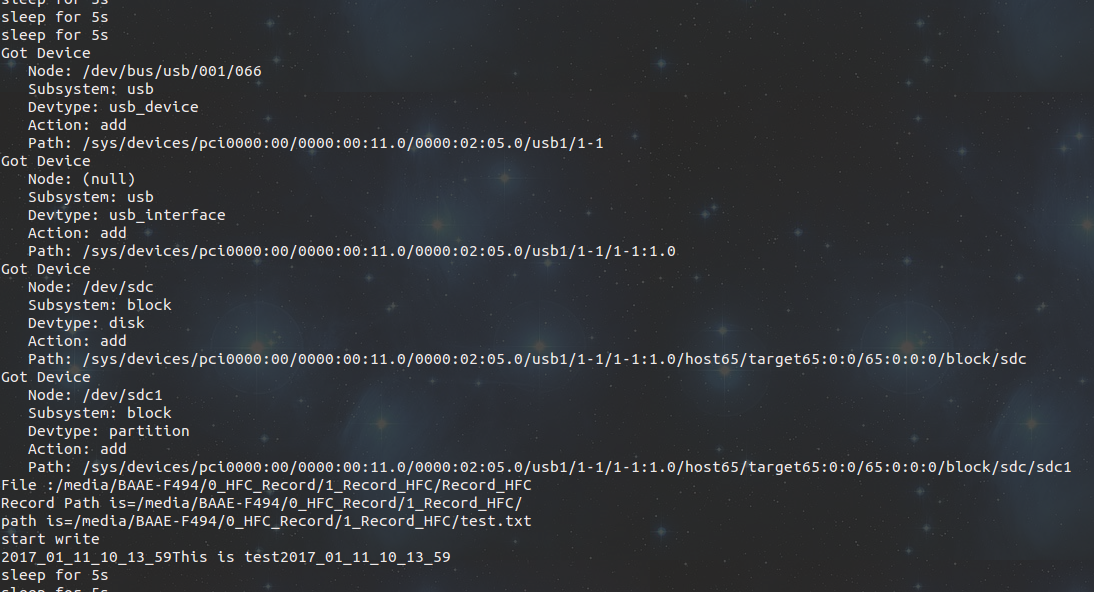
Linux 下运行,如果要在ARM下运行就编一个arm版本的。
Makefile
# specify the compiler

CC=/usr/bin/g++

# specify library

INCFLAGS=-I ./

# specify library

LIBFLAGS=-l pthread -l udev

# specify additional compile flags

FLAGS= -lm -g -Wall -Wextra

# List of files specific

SRC:= Udev_Monitor.cpp

testapp:

    ${CC} -o Udev_Monitor ${SRC} ${LIBFLAGS} ${INCFLAGS}  ${FLAGS}

clean:

    rm -f Udev_Monitor
只是基本的识别插拔U盘,检测特定的文件,检测到后往U盘里面写数据,可以用来帮助cp或者记录log文件。
虽然我的blog也没人会看,但是还是希望能帮到和我一样的菜鸟。
udev example -- detect usb and write test file的更多相关文章
- cannot open /proc/bus/usb/devices, No such file or directory
由于kernel config中没有打开对应的配置. make menuconfig 选择: Device Drivers ---> [*] USB support ---> [*] US ...
- Linux自动共享USB设备:udev+Samba
一.概述 公司最近要我实现USB设备插入Ubuntu后,自动共享到网络上,能像Windows共享一样(如\\192.168.1.10)访问里面的内容,不需要写入权限.当时听完这需求,我这新人表示惊呆了 ...
- 转://UDEV简介及配置过程
在Linux环境下安装Oracle11g RAC时,OS层面配置好多路径软件后(multipath),下一步就需要配置udev或asmlib来处理共享分区(Lun),以便Orace ASM能够看到这些 ...
- udev规则以及编写
主要内容: udev简介 如何配置和使用udev 如何编写udev规则 字符串替换和匹配 udev主要作用 编写udev规则实例 难点解析 1. udev简介 1.1 什么是udev? udev是Li ...
- Security arrangements for extended USB protocol stack of a USB host system
Security arrangements for a universal serial bus (USB) protocol stack of a USB host system are provi ...
- 嵌入式Linux驱动学习之路(二十)USB设备驱动
USB在接入系统的时候,以0的设备ID和主机通信,然后由主机为其分配新的ID. 在主机端,D+和D-都是下拉接地的.而设备端的D-接上拉时,表明此设备为高速设备:12M/s. D+接上拉时则是全速设备 ...
- [OrangePi] Booting from USB drive
You can also boot from USB drive partition. The file named cmdline.txt must exist on BOOT (fat) part ...
- Qt 获取usb设备信息 hacking
/************************************************************************** * Qt 获取usb设备信息 hacking * ...
- 如何忽略usb host 模式设备连接确认对话框
<li class="alt"><span><span>package android.hardware.usb; </span> ...
随机推荐
- zzw_rsync命令中的/的作用
[root@sv0379 rsync]# rsync -vzrtopg --password-file=/usr/local/rsync/rsync.passwd /opt/aspire/prod ...
- 5、Angular的一些其他核心特性,学习的主要模块
Angular应用程序的八个主要构造块: 模块 组件 模板 元数据 数据绑定 指令 服务 依赖注入 其他重要的Angular特性和服务: 动画 表单 HTTP 组件生命周期 管道过滤器 路由 测试
- 【转】.Net Core中的Api版本控制
原文链接:API Versioning in .Net Core 作者:Neel Bhatt 简介 Api的版本控制是Api开发中经常遇到的问题, 在大部分中大型项目都需要使用到Api的版本控制 在本 ...
- redis 版的 hello world
为 redis 添加一个命令,效果如下图: 在 Server.h 中加入命令处理函数的声明: void meCommand(client *c); 在 Server.c 的命令表中加入: struct ...
- 如何解析超长的protobuf zhuan
在调用protobuf的ParseFromString(str)方法时,默认情况下,如果str的长度>64MB,会返回失败. 这里给出了解释,主要是出于安全因素的考虑. 可以通过SetTotal ...
- 曾经觉得学习晦涩难懂的我是如何爱上linux的
2016年冬天,我已经是一名学习计算机科学与技术专业的大三的“老腊肉”了,但是当时的水平依旧平平.就在2016年快要结束的时候,我周围的同学们被一股考研和工作的压力炸开了锅,我也在默默思考着我的人生, ...
- 新一代的json--fetch
fetch( "http://jsontest.bceapp.com/hi", { method:"POST", mode:"core", ...
- vue项目目录结构
VUE项目目录结构 如上图所示,我们的目录结构就是这样的了. 目录/文件 说明 build 这个是我们最终发布的时候会把代码发布在这里,在开发阶段,我们基本不用管. config 配置目录,默认配置没 ...
- JVM配置参数详解
记录一下jvm中的一些配置参数,这些肯定不全的,希望你们能留个言,补全一下,谢谢啦! -XX: MaxDirectMemorySize--->设置直接内存,不设置与Java堆内存最大值一致 -X ...
- 关于SUID SGID
pattern 模式 permission 权限 The problem 问题 .-exec 找到的所有文件 variable 变量 一.1.grep sed awk 正则表达式 三大平台 #ifco ...