
Tree - Information Theory
This will be a series of post about Tree model and relevant ensemble method, including but not limited to Random Forest, AdaBoost, Gradient Boosting and xgboost.
So I will start with some basic of Information Theory, which is an importance piece in Tree Model. For relevant topic I highly recommend the tutorial slide from Andrew moore
What is information?
Andrew use communication system to explain information. If we want to transmit a series of 4 characters ( ABCDADCB... ) using binary code ( 0&1 ). How many bits do we need to encode the above character?
The take away here is the more bit you need, the more information it contains.
I think the first encoding coming to your mind will be following:
A = 00, B=01, C =10, D=11. So on average 2 bits needed for each character.
Can we use less bit on average?
Yes! As long as these 4 characters are not uniformally distributed.
Really? Let's formulate the problem using expectation.
\[ E( N ) = \sum_{k \in {A,B,C,D}}{n_k * p(x=k)} \]
where P( x=k ) is the probability of character k in the whole series, and n_k is the number of bits needed to encode k. For example: P( x=A ) = 1/2, P( x=B ) = 1/4, P( x=c ) = 1/8, P( x=D ) = 1/8, can be encoded in following way: A=0, B=01, C=110, D=111.
Basically we can take advantage of the probability and assign shorter encoding to higher probability variable. And now our average bit is 1.75 < 2 !
Do you find any other pattern here?
the number of bits needed for each character is related to itsprobability : bits = -log( p )
Here log has 2 as base, due to binary encoding
We can understand this from 2 angles:
- How many value can n bits represent? \(2^n\), where each value has probability \(1/2^n\), leading to n = log(1/p).
- Transmiting 2 characters independently: P( x1=A, x2 =B ) = P( x1=A ) * P( x2=B ), N( x1, x2 ) = N( x1 ) + N( x2 ), where N(x) is the number of bits. So we can see that probability and information is linked via log.
In summary, let's use H( X ) to represent information of X, which is also known as Entropy
when X is discrete, \(H(X) = -\sum_i{p_i \cdot log_2{p_i}}\)
when X is continuous, \(H(X) = -\int_x{p(x) \cdot log_2{p(x)}} dx\)
Deeper Dive into Entropy
1. Intuition of Entropy
I like the way Bishop describe Entropy in the book Pattern Recognition and Machine Learning. Entropy is 'How big the surprise is'. In the following post- tree model, people prefer to use 'impurity'.
Therefore if X is a random variable, then the more spread out X is, the higher Entropy X has. See following:
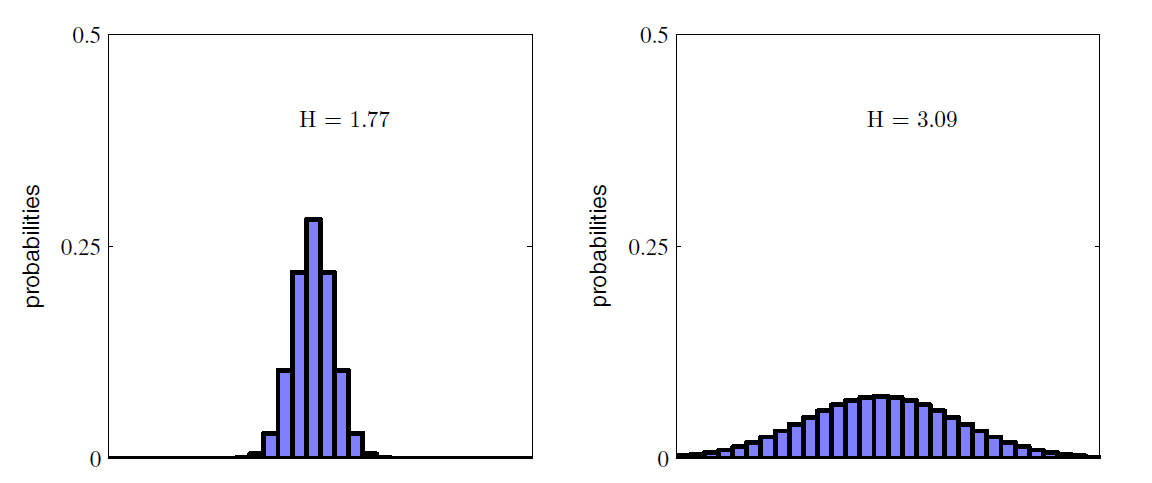
2. Conditional Entropy
Like the way we learn probability, after learning how to calculate probability and joint probability, we come to conditional probability. Let's discuss conditional Entropy.
H( Y | X ) is given X, how surprising Y is now? If X and Y are independent then H( Y | X ) = H( Y ) (no reduce in surprising). From the relationship between probability and Entropy, we can get following:
\[P(X,Y) = P(Y|X) * P(X)\]
\[H(X,Y) = H(Y|X) + H(X)\]
Above equation can also be proved by entropy. Give it a try! Here let's go through an example from Andrew's tutorial to see what is conditional entropy exactly.
X = college Major, Y = Like 'Gladiator'
| X | Y |
|---|---|
| Math | YES |
| History | NO |
| CS | YES |
| Math | NO |
| Math | NO |
| CS | YES |
| History | NO |
| Math | YES |
Let's compute Entropy using above formula:
H( Y ) = -0.5 * log(0.5) - 0.5 * log(0.5) = 1
H( X ) = -0.5 * log(0.5) - 0.25 * log(0.25) - 0.25 * log(0.25) = 1.5
H( Y | X=Math ) = 1
H( Y | X=CS ) = 0
H( Y | X=History ) = 0
H( Y | X ) = H( Y | X=Math ) * P( X=Math ) + H( Y | X=History ) * P( X=History ) + H( Y | X =CS ) * P( X=CS ) = 0.5
Here we see H( Y | X ) < H( Y ), meaning knowing X helps us know more about Y.
When X is continuous, conditional entropy can be deducted in following way:
we draw ( x , y ) from joint distribution P( x , y ). Given x, the additional information on y becomes -log( P( y | x ) ). Then using entropy formula we get:
\[H(Y|X) = \int_y\int_x{ - p(y,x)\log{p(y|x)} dx dy} =\int_x{H(Y|x)p(x) dx} \]
In summary
When X is discrete, \(H(Y|X) = \sum_j{ H(Y|x=v_j) p(x=v_j)}\)
When X is continuous, \(H(Y|X) = \int_x{ H(Y|x)p(x) dx}\)
3. Information Gain
If we follow above logic, then information Gain is the reduction of surpise in Y given X. So can you guess how IG is defined now?
IG = H( Y ) - H( Y | X )
In our above example IG = 0.5. And Information Gain will be frequently used in the following topic - Tree Model. Because each tree splitting aims at lowering the 'surprising' in Y, where the ideal case is that in each leaf Y is constant. Therefore split with higher information is preferred
So far most of the stuff needed for the Tree Model is covered. If you are still with me, let's talk a about a few other interesting topics related to information theory.
Other Interesting topics
Maximum Entropy
It is easy to know that when Y is constant, we have the smallest entropy, where H( Y ) = 0. No surprise at all!
Then how can we achieve biggest entropy. When Y is discrete, the best guess will be uniform distribution. Knowing nothing about Y brings the biggest surprise. Can we prove this ?
All we need to do is solving a optimization with Lagrange multiplier as following:
\[ H(x) = -\sum_i{p_i \cdot \log_2{p_i}} + \lambda(\sum_i{p_i}-1)\]
Where we can solve hat p are equal for each value, leading to a uniform distribution.
What about Y is continuous? It is still an optimization problem like following:
\[
\begin{align}
&\int { p(x) } =1 \\
&\int { p(x) x} = \mu \\
&\int { p(x) (x-\mu)^2} = \sigma^2
\end{align}
\]
\[ -\int_x{p(x) \cdot \log_2{p(x)}dx} +\lambda_1(\int { p(x) dx} - 1) +\lambda_2(\int { p(x) x dx} - \mu) + \lambda_3(\int { p(x) (x-\mu)^2 dx} - \sigma^2)
\]
We will get Gaussian distribution! You want to give it a try?!
Relative Entropy
Do you still recall our character transmitting example at the very beginning? That we can take advantage of the distribution to use less bit to transmit same amount of information. What if the distribution we use is not exactly the real distribution? Then extra bits will be needed to send same amount of character.
If the real distribution is p(x) and the distribution we use for encoding character is q(x), how many additional bits will be needed? Using what we learned before, we will get following
\[ - \int{p(x)\log q(x) dx } + \int{p(x)\log p(x)dx} \]
Does this looks familiar to you? This is also know as Kullback-Leibler divergence, which is used to measure the difference between 2 distribution.
\[
\begin{align}
KL(p||q) &= \int{ -p(x)logq(x) dx } + \int{p(x)logp(x)dx}\\
& = -\int{ p(x) log(\frac{ q(x) }{ p(x) } })dx
\end{align}
\]
And a few features can be easily understood in terms of information theory:
- KL( p || q ) >= 0, unless p = q, additional bits are always needed.
- KL( p || q) != KL( q || p ), because data originally follows 2 different distribution.
To be continued.
reference
- Andrew Moore Tutorial http://www.cs.cmu.edu/~./awm/tutorials/dtree.html
- Bishop, Pattern Recognition and Machine Learning 2006
- T. Hastie, R. Tibshirani and J. Friedman. “Elements of Statistical Learning”, Springer, 2009.
Tree - Information Theory的更多相关文章
- CCJ PRML Study Note - Chapter 1.6 : Information Theory
Chapter 1.6 : Information Theory Chapter 1.6 : Information Theory Christopher M. Bishop, PRML, C ...
- 信息熵 Information Theory
信息论(Information Theory)是概率论与数理统计的一个分枝.用于信息处理.信息熵.通信系统.数据传输.率失真理论.密码学.信噪比.数据压缩和相关课题.本文主要罗列一些基于熵的概念及其意 ...
- information entropy as a measure of the uncertainty in a message while essentially inventing the field of information theory
https://en.wikipedia.org/wiki/Claude_Shannon In 1948, the promised memorandum appeared as "A Ma ...
- Better intuition for information theory
Better intuition for information theory 2019-12-01 21:21:33 Source: https://www.blackhc.net/blog/201 ...
- 信息论 | information theory | 信息度量 | information measures | R代码(一)
这个时代已经是多学科相互渗透的时代,纯粹的传统学科在没落,新兴的交叉学科在不断兴起. life science neurosciences statistics computer science in ...
- 【PRML读书笔记-Chapter1-Introduction】1.6 Information Theory
熵 给定一个离散变量,我们观察它的每一个取值所包含的信息量的大小,因此,我们用来表示信息量的大小,概率分布为.当p(x)=1时,说明这个事件一定会发生,因此,它带给我的信息为0.(因为一定会发生,毫无 ...
- 决策论 | 信息论 | decision theory | information theory
参考: 模式识别与机器学习(一):概率论.决策论.信息论 Decision Theory - Principles and Approaches 英文图书 What are the best begi ...
- The basic concept of information theory.
Deep Learning中会接触到的关于Info Theory的一些基本概念.
- [Basic Information Theory] Writen Notes
随机推荐
- Fluent Terminal
特性: PowerShell,CMD,WSL或自定义shell的终端 支持选项卡和多个窗口 主题和外观配置 导入/导出主题 导入iTerm主题 全屏模式 可编辑的键绑定 搜索功能 配置shell配置文 ...
- 将Tensor输出到文件
) local file = io.open('/home/xbwang/Desktop/part2original','a') ,length do number = part2[j] file:w ...
- SD卡受损,千万不要再格式化了
1.手机提示SD卡受损; 2.把内卡插入电脑后,提示格式化,点取消.然后查看一下属性; 3.点电脑上的“开始菜单”--“运行”- chkdsk H:/F (H:就是你的SD卡盘符,/F是修复参数); ...
- webpack初起步
webpack 用于编译 JavaScript 模块.一旦完成安装,就可以通过 webpack 的 CLI 或 API 与其配合交互. 首先创建一个目录,进入目录中,初始化npm 然后本地安装webp ...
- Gobelieve 架构(转载)
Gobelieve 架构 Gobelieve github地址 im 客户连接服务器 (可分布式部署,暂无负载均衡模块) imr 路由查询服务器(主要解决im分布式部署的问题) ims 存储服务器 ( ...
- Kotlin基础篇(一)
写在前面: 因为工作需要,目前转安卓开发,用的IDE是AS3.2版本,语言的话,用的是Kotlin.由于之前是做.NET的,没接触过这方面的东西,所以完全是小白一枚.所以想着开个博客,以此来记录自己的 ...
- 2017-2018-1 20155330 《信息安全系统设计基础》第10周课堂测试&课下作业
2017-2018-1 20155330 <信息安全系统设计基础>第10周课堂测试&课下作业 stat命令的实现-mysate 学习使用stat(1),并用C语言实现 提交学习st ...
- 使用Random随机生成[min,max]之间的整数:
如下代码是生成范围在min到max之间的随机整数(包括min和max): import java.util.Random; /** * 生成[min,max]的随机整数 * @author mei ...
- 2-8 字典dict
1.如何在一个变量里存储公司每个员工的个人信息? 2.字典的定义与特性 字典是Python语言中唯一的映射类型. 定义:{key1:value1,key2:value2} 1.键与值用冒号“:”分开: ...
- 11 stark组件之delete按钮、filter过滤
1.构建批量删除按钮 1.admin中每个页面默认都有 2.stark之构建批量删除 3.coding {% extends 'base.html' %} {% block title %} < ...