
2023年人工智能发展现状报告:State of AI Report 2023
链接:
================================
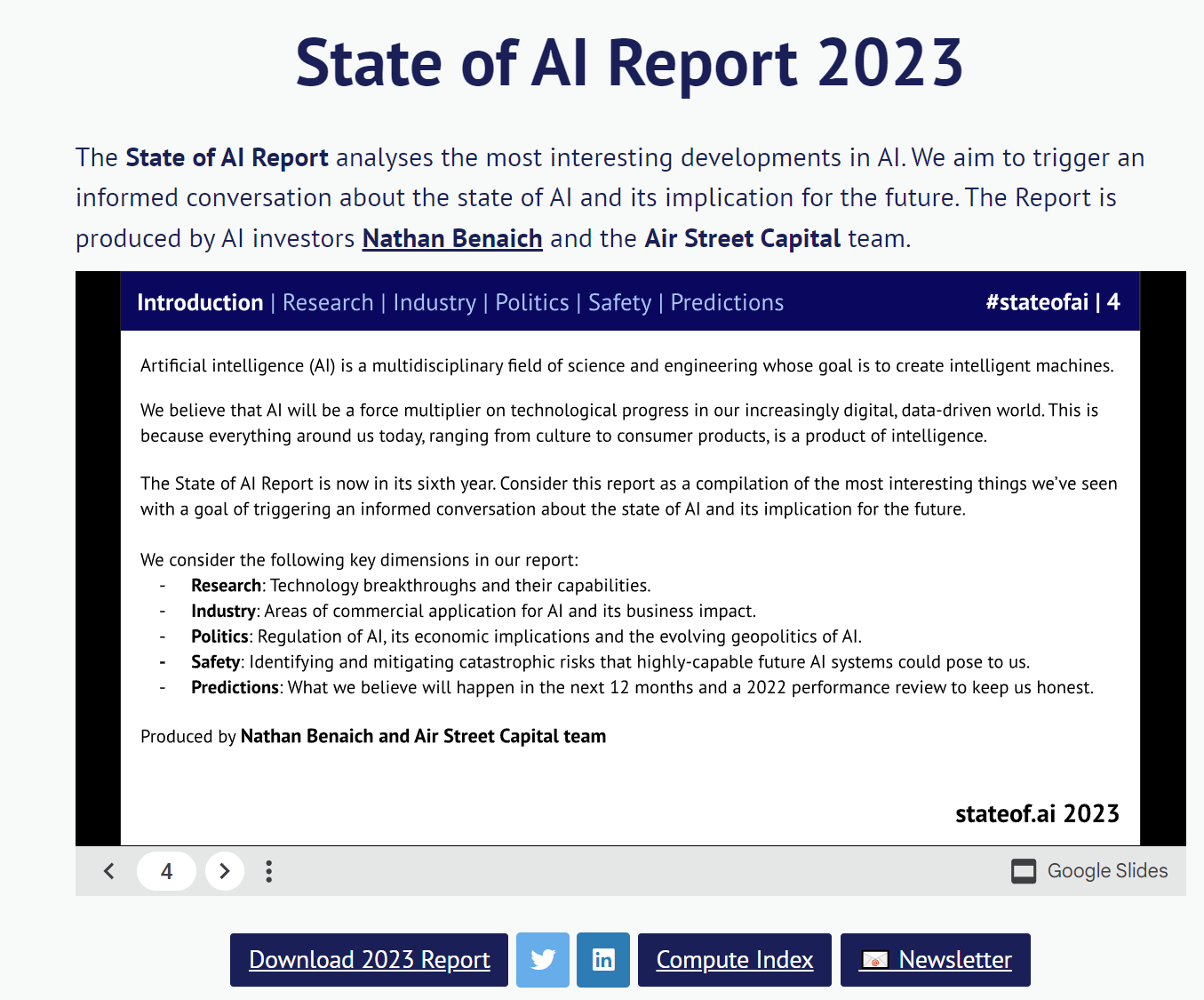
Now in its sixth year, the State of AI Report 2023 is reviewed by leading AI practioners in industry and research. It considers the following key dimensions, including a new Safety section:
- Research: Technology breakthroughs and their capabilities.
- Industry: Areas of commercial application for AI and its business impact.
- Politics: Regulation of AI, its economic implications and the evolving geopolitics of AI.
- Safety: Identifying and mitigating catastrophic risks that highly-capable future AI systems could pose to us.
- Predictions: What we believe will happen and a performance review to keep us honest.
- Key themes in the 2023 Report include::
- GPT-4 is the master of all it surveys (for now), beating every other LLM on both classic benchmarks and exams designed to evaluate humans, validating the power of proprietary architectures and reinforcement learning from human feedback.
- Efforts are growing to try to clone or surpass proprietary performance, through smaller models, better datasets, and longer context. These could gain new urgency, amid concerns that human-generated data may only be able to sustain AI scaling trends for a few more years.
- LLMs and diffusion models continue to drive real-world breakthroughs, especially in the life sciences, with meaningful steps forward in both molecular biology and drug discovery.
- Compute is the new oil, with NVIDIA printing record earnings and startups wielding their GPUs as a competitive edge. As the US tightens its restrictions on trade restrictions on China and mobilizes its allies in the chip wars, NVIDIA, Intel, and AMD have started to sell export-control proof chips at scale.
- GenAI saves the VC world, as amid a slump in tech valuations, AI startups focused on generative AI applications (including video, text, and coding), raised over $18 billion from VC and corporate investors.
- The safety debate has exploded into the mainstream, prompting action from governments and regulators around the world. However, this flurry of activity conceals profound divisions within the AI community and a lack of concrete progress towards global governance, as governments around the world pursue conflicting approaches.
- Challenges mount in evaluating state of the art models, as standard LLMs often struggle with robustness. Considering the stakes, as “vibes-based” approach isn’t good enough.
================================
For much of the last year, it’s felt like Large Language Models (LLMs) have been the only game in town. While the State of AI Report predicted that transformers were emerging as a general purpose system back in 2021, significant advances in capabilities caught both the AI community and wider world by surprise, with implications for research, industry dynamics, and geopolitics.
Last year’s State of AI report outlined the rise of decentralization in AI research, but OpenAI’s GPT-4 stunned observers as big tech returned with a vengeance. Amid the scrabble for ever more compute power, challengers have found themselves increasingly reliant on its war chest. At the same time, the open source community continues to thrive, as the number of releases continues to rocket.
It has also led the drawing of new fault lines, with traditional community norms around openness under pressure from both commercial imperatives and safety fears.
We’ve seen technical reports on state-of-the-art LLMs published that contain no useful information for AI researchers, while some labs have simply stopped producing them at all. One of the co-founders of OpenAI went as far as describing their original open source philosophy as “flat out … wrong”. In contrast, Meta AI has emerged as the champion of open(ish) AI, with their LLaMa model family acting as the most powerful publicly accessible alternative…for now.
The discussion around openness is taking place against the backdrop of an impassioned debate about how we navigate governance and (existential) risk. As we forecast in last year’s report, safety has shed its status as the unloved cousin of the AI research world and took center-stage for the first time. As a result, governments and regulators around the world are beginning to sit up and take notice. This has been all the more challenging as the many of the mooted models of global governance require long-standing geopolitical rivals, currently locked in the chip wars, to cooperate. Indeed, State of AI Report co-author Ian Hogarth has been seconded to chair the UK Government’s Frontier AI Taskforce, so has therefore stepped back from writing this year.
However, this is the State of AI, not the state of LLMs, and the report dives into progress in other areas of the field - from breakthroughs in navigation and weather predictions through to self-driving cars and music generation. This has been one of the most exciting years to produce this report and we believe that it will have something for everyone - from AI research through to politics.
- Key takeaways:
- GPT-4 is the master of all it surveys (for now), beating every other LLM on both classic benchmarks and exams designed to evaluate humans, validating the power of proprietary architectures and reinforcement learning from human feedback.
- Efforts are growing to try to clone or surpass proprietary performance, through smaller models, better datasets, and longer context. These could gain new urgency, amid concerns that human-generated data may only be able to sustain AI scaling trends for a few more years.
- LLMs and diffusion models continue to drive real-world breakthroughs, especially in the life sciences, with meaningful steps forward in both molecular biology and drug discovery.
- Compute is the new oil, with NVIDIA printing record earnings and startups wielding their GPUs as a competitive edge. As the US tightens its restrictions on trade restrictions on China and mobilizes its allies in the chip wars, NVIDIA, Intel, and AMD have started to sell export-control proof chips at scale.
- GenAI saves the VC world, as amid a slump in tech valuations, AI startups focused on generative AI applications (including video, text, and coding), raised over $18 billion from VC and corporate investors.
- The safety debate has exploded into the mainstream, prompting action from governments and regulators around the world. However, this flurry of activity conceals profound divisions within the AI community and a lack of concrete progress towards global governance, as governments around the world pursue conflicting approaches.
- Challenges mount in evaluating state of the art models, as standard LLMs often struggle with robustness. Considering the stakes, as “vibes-based” approach isn’t good enough.
The report is a team effort and we’re incredibly grateful to Othmane Sebbouh, Corina Gurau, and Alex Chalmers from Air Street Capital without whom the report wouldn’t have been possible this year. Thank you to our reviewers who kept us honest and to the AI community who continue to create the breakthroughs that power this report.
We write this report to compile the most interesting things we’ve seen, with the aim of provoking an informed conversation about the state of AI. So, we would love to hear any thoughts on the report, your take on our predictions, or any contribution suggestions for next year’s edition.
Enjoy reading!
Nathan and the Air Street Capital team
================================
2023年人工智能发展现状报告:State of AI Report 2023的更多相关文章
- 清华大学&中国人工智能学会:2019人工智能发展报告
2019年11月30日,2019中国人工智能产业年会重磅发布<2019人工智能发展报告>(Report of Artificial Intelligence Development 201 ...
- 均有商业公司支持!2023再看数据湖 hudi iceberg delta2 社区发展现状!
开源数据湖三剑客 Apache hudi.Apache iceberg .Databricks delta 近年来大动作不断. 2021年8月,Apache Iceberg 的创始人 Ryan Blu ...
- 43%非常看好TypeScript…解读“2022前端开发者现状报告”
摘要:近日,The Software House 发布了"2022前端开发者现状报告",笔者在此对报告内容进行解读,供大家参考. 本文分享自华为云社区<"2022前 ...
- 【转帖】2019年中国5G行业细分市场发展现状和市场前景分析 通信基站数量快速增长
2019年中国5G行业细分市场发展现状和市场前景分析 通信基站数量快速增长 中国有 600多万个基站 平均每200个人 一个基站.. 一个基站十万块钱的话 相当于 每个人 需要分摊 500块钱. ht ...
- 2015年p2p网络借贷平台的发展现状
2015年春暖花开,莺飞草长,股市大涨大跌起起落落,P2P网络借贷收到越来越多的人关注,P2P网络借贷平台是p2p借贷与网络借贷相结合的金 融服务网站,这么多P2P网络借贷平台排我们应该如何选择呢?小 ...
- [转] 2016 JavaScript 发展现状大调查
有人认为JavaScript是最好的语言,有人认为它一团糟.可按照C++之父的话来讲: 世界上只有两种编程语言:一种是天天被人喷的,另一种是没人用的. 不论你喜欢承认与否,JavaScript已经一天 ...
- SLAM技术在国内的发展现状
近年来,由于扫地机的出现使得SLAM技术名声大噪,如今,已在机器人.无人机.AVG等领域相继出现它的身影,今天就来跟大家聊一聊国内SLAM的发展现状. SLAM的多领域应用 SLAM应用领域广泛,按其 ...
- Go将统治下一个10年?Go语言发展现状分析
“本文是国内Go语言大中华区首席布道师——许式伟,在QCon2015上海站上的分享.他预测Go语言10年内一定会超过C和java,并且统治这一个10年. Go语言语法及标准库变化 Go从1.0版本到现 ...
- 2018年JavaScript现状报告
前言 JavaScript(后面统称JS)在过去五年得到飞速地增长,早期JS实现类似微博的“点赞”这样的功能都需要刷新一次页面. 后来开发者通过JS来制作SPA(单页面应用程序),在浏览器加载一次,后 ...
- Spark发展现状与战线
前言 现今Spark正是风头正劲时,Spark本是UCBerkeley的AMPLab诞生的项目,后来捐赠给了Apache来管理源码和后续发展.今年从Apache孵化器终于孵化出了1.0版本.其对大数据 ...
随机推荐
- mysql报错 a foreign key constraint fails(外键约束错误)
报错信息如下: (pymysql.err.IntegrityError) (1452, u'Cannot add or update a child row: a foreign key constr ...
- AWS Ubuntu22.04安装Mysql及配置远程连接、SCP上传文件
一.升级apt资源包 sudo apt update 二.安装MySQL sudo apt install mysql-server 三.启动MySQL服务 sudo service mysql st ...
- StringUtils.join()方法使用
* StringUtils.join()方法使用 打印输出: * 使用 StringBuilder 进行拼接:张三,李四,王五 * 使用 StringUtils.join 进行拼接:张三,李四,王五 ...
- debian使用桌面管理器管理多个桌面系统
环境:debian12.x 前言:我安装了debian12版本的操作系统在虚拟机中,在安装的时候选择的是KDE桌面,便于以后日常使用linux操作系统 在安装KDE桌面后,会自动安装一个sddm,sd ...
- This app has crashed because it attempted to access privacy-sensitive data without a usage descripti
运行环境 XCode 8.2.1 问题描述 当调取相册的时候APP崩溃并显示标题的错误:This app has crashed because it attempted to access priv ...
- Typora行内公式识别不了
Typora行内公式识别不了,主要是因为行内公式属于LaTeX扩展语法,并非Markdown的通用标准 需要在Typora的"文件"-"偏好设置"-" ...
- js脚本化css
脚本化CSS 我们刚讲过如何获取和设置行内样式的值,但是我们开发不会所有样式都写在行内,同时js没法获取内嵌样式表和外部样式表中的值. 事实上DOM提供了可靠的API,得到计算后的样式. 1. 获取计 ...
- lumen、laravel 环境问题汇总
框架报500 1.chmod 777 -R storage 将日志目录权限设置下. 2.修改fastcgi,将代码目录包含进去. fastcgi_param PHP_ADMIN_VALUE " ...
- InfluxDB 常用基本配置,启用账号密码登录,配置指定端口登录
打开安装目录下的 influxdb.conf 找到 http 节点 配置完成后再安装目录下使用命令启动 influxdb influxd --config influxdb.conf 启动完成后,基本 ...
- Java进阶:HashMap底层原理(通俗易懂篇)
1.底层结构 Java 7及之前版本 在Java 7及之前的版本中,HashMap的底层数据结构主要是数组加链表.具体实现如下: 数组:HashMap的核心是一个Entry数组(Entry<K, ...