
Core Java Volume I — 4.5. Method Parameters
4.5. Method Parameters
Let us review the computer science terms that describe how parameters can be passed to a method (or a function) in a programming language. The term call by value(值调用) means that the method gets just the value that the caller provides(方法获得调用者的变量值). In contrast, call by reference(引用调用) means that the method gets the location of the variable that the caller provides(方法获得调用者的变量地址). Thus, a method can modify the value stored in a variable passed by reference but not in one passed by value. These "call by . . ." terms are standard computer science terminology describing the behavior of method parameters in various programming languages, not just Java. (There is also a call by name that is mainly of historical interest, being employed in the Algol programming language, one of the oldest high-level languages.)
The Java programming language always uses call by value. That means that the method gets a copy of all parameter values. In particular, the method cannot modify the contents of any parameter variables passed to it.
For example, consider the following call:
double percent = 10;

harry.raiseSalary(percent);
No matter how the method is implemented, we know that after the method call, the value of percent is still 10(无论raiseSalary如何实现,调用该方法后,percent的值仍是10).
Let us look a little more closely at this situation. Suppose a method tried to triple the value of a method parameter:
public static void tripleValue(double x) // doesn't work

{

    x = 3 * x;

}
Let's call this method:
double percent = 10;

tripleValue(percent);
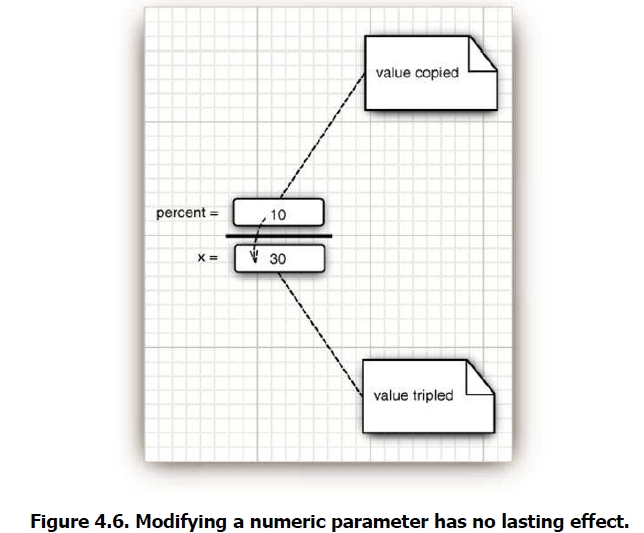
However, this does not work. After the method call, the value of percent is still 10(调用tripleValue方法后,percent的值仍是10).
Here is what happens:
- x is initialized with a copy of the value of percent (that is, 10).
- x is tripled—it is now 30. But percent is still 10 (see Figure 4.6).
- The method ends, and the parameter variable x is no longer in use.
There are, however, two kinds of method parameters(方法的参数有两种):
- Primitive types (numbers, boolean values)
- Object references
You have seen that it is impossible for a method to change a primitive type parameter(一个方法不可能改变原始类型的参数值). The situation is different for object parameters(这与对象参数不同). You can easily implement a method that triples the salary of an employee:
public static void tripleSalary(Employee x) // works

{

    x.raiseSalary(200);

}
When you call
harry = new Employee(. . .);

tripleSalary(harry);
then the following happens:
- x is initialized with a copy of the value of harry, that is, an object reference.
- The raiseSalary method is applied to that object reference. The Employee object to which both x and harry refer gets its salary raised by 200 percent.
- The method ends, and the parameter variable x is no longer in use. Of course, the object variable harry continues to refer to the object whose salary was tripled (see Figure 4.7).
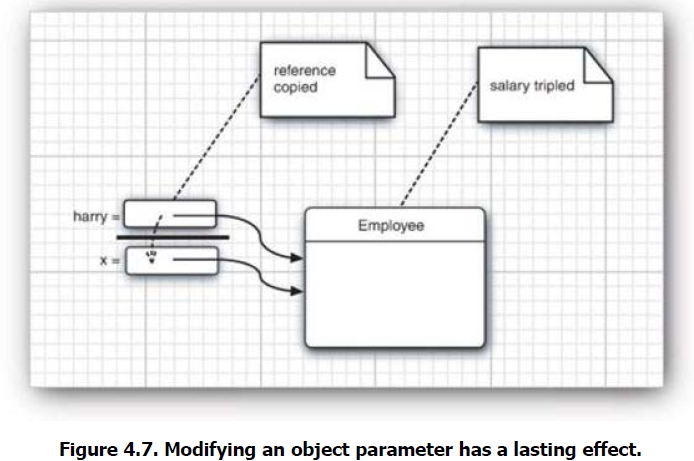
As you have seen, it is easily possible—and in fact very common—to implement methods that change the state of an object parameter. The reason is simple. The method gets a copy of the object reference, and both the original and the copy refer to the same object(方法取得对象引用的一份拷贝,原始引用和拷贝引用都指向同一个对象).
Many programming languages (in particular, C++ and Pascal) have two mechanisms for parameter passing: call by value and call by reference. Some programmers (and unfortunately even some book authors) claim that Java uses call by reference for objects. That is false. As this is such a common misunderstanding, it is worth examining a counterexample in detail.
Let's try to write a method that swaps two employee objects:
public static void swap(Employee x, Employee y) // doesn't work

{

    Employee temp = x;

    x = y;

    y = temp;

}
If the Java programming language used call by reference for objects, this method would work:
Employee a = new Employee("Alice", . . .);

Employee b = new Employee("Bob", . . .);

swap(a, b);

// does a now refer to Bob, b to Alice?
However, the method does not actually change the object references that are stored in the variables a and b. The x and y parameters of the swap method are initialized with copies of these references. The method then proceeds to swap these copies.
// x refers to Alice, y to Bob

Employee temp = x;

x = y;

y = temp;

// now x refers to Bob, y to Alice
But ultimately, this is a wasted effort. When the method ends, the parameter variables x and y are abandoned. The original variables a and b still refer to the same objects as they did before the method call (see Figure 4.8).
This demonstrates that the Java programming language does not use call by reference for objects. Instead, object references are passed by value(对象的引用通过值传递).
Here is a summary of what you can and cannot do with method parameters in Java:
- A method cannot modify a parameter of a primitive type (that is, numbers or boolean values).
- A method can change the state of an object parameter.
- A method cannot make an object parameter refer to a new object.
The program in Listing 4.4 demonstrates these facts. The program first tries to triple the value of a number parameter and does not succeed:
Testing tripleValue:

Before: percent=10.0

End of method: x=30.0

After: percent=10.0
It then successfully triples the salary of an employee:
Testing tripleSalary:

Before: salary=50000.0

End of method: salary=150000.0

After: salary=150000.0
After the method, the state of the object to which harry refers has changed. This is possible because the method modified the state through a copy of the object reference.
Finally, the program demonstrates the failure of the swap method:
Testing swap:

Before: a=Alice

Before: b=Bob

End of method: x=Bob

End of method: y=Alice

After: a=Alice

After: b=Bob
As you can see, the parameter variables x and y are swapped, but the variables a and b are not affected.
C++ Note
C++ has both call by value and call by reference. You tag reference parameters with &. For example, you can easily implement methods void tripleValue(double& x) or void swap(Employee& x, Employee& y) that modify their reference parameters.
Listing 4.4. ParamTest/ParamTest.java
 public class ParamTest

 {

     public static void main(String[] args)

     {

         // TODO: 1 Methods can't modify numeric parameters

         System.out.println("Testing tripleValue:");

         double percent = 10;

         System.out.println("Before: percent = " + percent);

         tripleValue(percent);

         System.out.println("After: percent = " + percent);

         // TODO: 2 Methods can change the state of object parameters

         System.out.println("\nTesting tripleSalary:");

         Employee harry = new Employee("Harry", 5000);

         System.out.println("Before: salary = " + harry.getSalary());

         tripleSalary(harry);

         System.out.println("After: salary = " + harry.getSalary());

         // TODO: 3 Methods can't attach new object to object parameters

         System.out.println("\nTesting swap:");

         Employee a = new Employee("Alice", 7000);

         Employee b = new Employee("Bob", 6000);

         System.out.println("Before: a = " + a.getName());

         System.out.println("Before: b = " + b.getName());

         swap(a, b);

         System.out.println("After: a = " + a.getName());

         System.out.println("After: b = " + b.getName());

     }

     public static void tripleValue(double x)

     {

         x = x * 3;

         System.out.println("End of method: x = " + x);

     }

     public static void tripleSalary(Employee x)

     {

         x.raiseSalary(200);

         System.out.println("End of method: salary = " + x.getSalary());

     }

     public static void swap(Employee x, Employee y)

     {

         Employee temp = x;

         x = y;

         y = temp;

         System.out.println("End of method: x = " + x.getName());

         System.out.println("End of method: y = " + y.getName());

     }

 }

 class Employee

 {

     private String name;

     private double salary;

     public Employee(String n, double s)

     {

         name = n;

         salary = s;

     }

     public String getName()

     {

         return name;

     }

     public double getSalary()

     {

         return salary;

     }

     public void raiseSalary(double byPercent)

     {

         double raise = salary * byPercent / 100;

         salary += raise;

     }

 }
Core Java Volume I — 4.5. Method Parameters的更多相关文章
- Core Java Volume I — 1.2. The Java "White Paper" Buzzwords
1.2. The Java "White Paper" BuzzwordsThe authors of Java have written an influential White ...
- Core Java Volume I — 3.10. Arrays
3.10. ArraysAn array is a data structure that stores a collection of values of the same type. You ac ...
- Core Java Volume I — 5.1. Classes, Superclasses, and Subclasses
5.1. Classes, Superclasses, and SubclassesLet's return to the Employee class that we discussed in th ...
- Core Java Volume I — 4.7. Packages
4.7. PackagesJava allows you to group classes in a collection called a package. Packages are conveni ...
- Core Java Volume I — 4.6. Object Construction
4.6. Object ConstructionYou have seen how to write simple constructors that define the initial state ...
- Core Java Volume I — 4.4. Static Fields and Methods
4.4. Static Fields and MethodsIn all sample programs that you have seen, the main method is tagged w ...
- Core Java Volume I — 3.1. A Simple Java Program
Let’s look more closely at one of the simplest Java programs you can have—one that simply prints a m ...
- Core Java Volume I — 3.8. Control Flow
3.8. Control FlowJava, like any programming language, supports both conditional statements and loops ...
- Core Java Volume I — 3.6. Strings
3.6. StringsConceptually, Java strings are sequences of Unicode characters(Java的字符串是一个Unicode序列). Fo ...
随机推荐
- php验证用户名是否以字母开头与验证密码
验证用户名是否以字母开头与验证密码只能为数字和字母的组合代码三款三种常用验证函数 验证邮箱地址格式 验证密码只能为数字和字母的组合 验证用户名是否以字母开头代码哦,这是用户注册时或提交表单时会用的哦 ...
- 使用HTTP访问网络------使用HTTPURLConnection
HTTPURLConnection继承了URLConnection,因此也可用于向指定网站发送GET请求.POST请求.它在URLConnection的基础上提供了如下便捷的方法: 1.int ge ...
- 使用BroadcastReceiver实现开机自动运行的Service
为了让Service随应用系统启动自动运行,可以让BroadcastReceiver监听Action为ACTION_BOOT_COMPLETED常量的Intent,然后在BroadcastReceiv ...
- JSON.NET 教程(一)
下载地址:http://www.newtonsoft.com/json 参考官网文档:http://www.newtonsoft.com/json/help/html/SerializingJSON. ...
- Java对象的序列化和反序列化实践
2013-12-20 14:58 对象序列化的目标是将对象保存在磁盘中,或者允许在网络中直接传输对象.对象序列化机制允许把内存中的Java对象转换成平台无关的二进制流,从而允许把这种二进制流持久的保存 ...
- pl/sql乱码
环境变量增加NLS_LANG=SIMPLIFIED CHINESE_CHINA.ZHS16GBK
- Spring学习笔记之模块简介
1.Core Container(Application context) module 这个是Spring最基本的模块,它提供了spring框架最基本的功能.BeanFactory 是任何基于Spr ...
- PowerShell工具脚本---按行数切割大文本文件
我编写的PowerShell工具脚本,[按行数切割大(文本)文件],生成n个小文件. 主要目的是为了能够让excel快速处理.或用脚本并发处理文本. 注意: 1 如果有必要,你可以先用其他工具,把大文 ...
- checkbox的全选、反选、删除(适配器)
package com.example.adapter; import java.util.List; import com.example.ay.R;import com.example.vo.Fl ...
- eclipse 提交作业到JobTracker Hadoop的数据类型要求必须实现Writable接口
问:在eclipse中的写的代码如何提交作业到JobTracker中的哪?答:(1)在eclipse中调用的job.waitForCompletion(true)实际上执行如下方法 connect() ...