
C语言实现任务调度与定时器
代码实现是在xl2tpd的源码中get到的,感觉很有意思的一段代码。基本功能就是实现定时器,时间到后从定时队列中取出,然后完成指定的任务。
1. schedule.c代码(自己添加了main函数,用来调试)
/*

 * Layer Two Tunnelling Protocol Daemon

 * Copyright (C) 1998 Adtran, Inc.

 * Copyright (C) 2002 Jeff McAdams

 *

 * Mark Spencer

 *

 * This software is distributed under the terms

 * of the GPL, which you should have received

 * along with this source.

 *

 * Scheduler code for time based functionality

 *

 */

#include <stdio.h>

#include <stdlib.h>

#include <signal.h>

#include <string.h>

#include "scheduler.h"

struct schedule_entry *events;

static struct timeval zero;

static sigset_t alarm;

/*

	init_scheduler配合schedule_lock,schedule_unlock使用,用来屏蔽当前进程中特定协议的处理

*/

void init_scheduler (void)/*初始化了两个不同的信号集*/

{

    struct sigaction act;

    act.sa_handler = alarm_handler;/*alarm信号执行体*/

#if defined (LINUX) && (__i386__)

    act.sa_restorer = NULL;

#endif

    act.sa_flags = 0;

    sigemptyset (&act.sa_mask);

    sigaddset (&act.sa_mask, SIGALRM);/*将SIGALRM信号添加到信号集sa_mask中,SIGALRM信号会阻塞*/

    sigaction (SIGALRM, &act, NULL);/*安装登记信号*/

    events = NULL;

    zero.tv_usec = 0;

    zero.tv_sec = 0;

    sigemptyset (&alarm);

    sigaddset (&alarm, SIGALRM);/*将SIGALRM信号添加到信号集alarm中,SIGALRM信号会阻塞*/

}

void alarm_handler (int signal)

{

    /* Check queue for events which should be

       executed right now.  Execute them, then

       see how long we should set the next timer

     */

    struct schedule_entry *p = events;

    struct timeval now;

    struct timeval then;

    struct itimerval itv;

    static int cnt = 0;

    cnt++;

    if (cnt != 1)

    {

        /* Whoa, we got called from within ourselves! */

        //log (LOG_DEBUG, "%s : Whoa... cnt = %d\n", __FUNCTION__, cnt);

        return;

    }

    while (events)

    {

        gettimeofday (&now, NULL);

        p = events;

        if (TVLESSEQ (p->tv, now))

        {

            events = events->next;

            /* This needs to be executed, as it has expired.

               It is expected that p->func will free p->data

               if it is necessary */

            (*p->func) (p->data);

            free (p);

        }

        else

            break;

    }

    /* When we get here, either there are no more events

       in the queue, or the remaining events need to happen

       in the future, so we should schedule another alarm */

    if (events)

    {

        then.tv_sec = events->tv.tv_sec - now.tv_sec;

        then.tv_usec = events->tv.tv_usec - now.tv_usec;

        if (then.tv_usec < 0)

        {

            then.tv_sec -= 1;

            then.tv_usec += 1000000;

        }

        if ((then.tv_sec <= 0) && (then.tv_usec <= 0))

        {

            //log (LOG_WARN, "%s: Whoa...  Scheduling for <=0 time???\n",__FUNCTION__);

        }

        else

        {

            itv.it_interval = zero;

            itv.it_value = then;

            setitimer (ITIMER_REAL, &itv, NULL);/*重新定时,时间到后发送SIGALRM信号*/

        }

    }

    cnt--;

}

void schedule_lock ()/*将alarm添加到当前进程阻塞信号集中,信号来时会被阻塞,暂时捕获不到,移除后会捕获?/

{

    while (sigprocmask (SIG_BLOCK, &alarm, NULL));

};

void schedule_unlock ()/*将alarm从当前进程阻塞信号集中移除*/

{

    /* See if we missed any events */

/*	alarm_handler(0); */

    while (sigprocmask (SIG_UNBLOCK, &alarm, NULL));

    raise (SIGALRM);/*用来向本进程发送信号*/

};

struct schedule_entry *schedule (struct timeval tv, void (*func) (void *),

                                 void *data)

{

    /* Schedule func to be run at relative time tv with data

       as arguments.  If it has already expired, run it

       immediately.  The queue should be in order of

       increasing time */

    struct schedule_entry *p = events, *q = NULL;  /*时间间隔递增的队列*/

    int need_timer = 0;

    struct timeval diff;

    struct itimerval itv;							/*队列中越靠前,越早发生*/

    diff = tv;

    gettimeofday (&tv, NULL);

    tv.tv_sec += diff.tv_sec;  /*转换为本地系统时间*/

    tv.tv_usec += diff.tv_usec;

    if (tv.tv_usec > 1000000)

    {

        tv.tv_sec++;

        tv.tv_usec -= 1000000;/*进制转换*/

    }

    while (p)

    {

        if (TVLESS (tv, p->tv)) /*tv < p->tv*/

            break;

        q = p;

        p = p->next;

    };

    if (q)

    {

        q->next =

            (struct schedule_entry *) malloc (sizeof (struct schedule_entry));

        q = q->next;

    }

    else

    {	/*时间比队列中的第一个时间还小*/

        q = (struct schedule_entry *) malloc (sizeof (struct schedule_entry));

        events = q;

        need_timer = -1;

    }

    q->tv = tv;

    q->func = func;

    q->data = data;

    q->next = p;

    if (need_timer)

    {

        itv.it_interval = zero;

        itv.it_value = diff;

        setitimer (ITIMER_REAL, &itv, NULL); /*重新修改定时*/

    }

    return q;

}

inline struct schedule_entry *aschedule (struct timeval tv,/*tv传递的为绝对时间*/

                                         void (*func) (void *), void *data)

{

    /* Schedule func to be run at absolute time tv in the future with data

       as arguments */

    struct timeval now;

    gettimeofday (&now, NULL);

    tv.tv_usec -= now.tv_usec;

    if (tv.tv_usec < 0)

    {

        tv.tv_usec += 1000000;

        tv.tv_sec--;

    }

    tv.tv_sec -= now.tv_sec;

    return schedule (tv, func, data);

}

void deschedule (struct schedule_entry *s)/*取消任务*/

{

    struct schedule_entry *p = events, *q = NULL;

    if (!s)

        return;

    while (p)

    {

        if (p == s)

        {

            if (q)

            {

                q->next = p->next;

            }

            else

            {

                events = events->next;

            }

            free (p);

            break;

        }

        q = p;

        p = p->next;

    }

}

/*****************************************************************/

void func_test(void *data)

{

	struct timeval tv;

	tv.tv_sec = 5;

	tv.tv_usec = 0;

	printf("落霞与孤鹜齐飞,秋水共长天一色\n");

	schedule(tv, func_test, NULL);

}

void main(int argc, char *argv[])

{

	struct timeval tv;

	struct timeval timeout;

	printf("------scheduler-------\n");

	init_scheduler ();

	tv.tv_sec = 5;

	tv.tv_usec = 0;

	schedule(tv, func_test, NULL);

	timeout.tv_sec = 1;

	timeout.tv_usec = 0;

	while(1){

		select(0,NULL,NULL,NULL, &timeout);

	}

}
2. schedule.h
/*

 * Layer Two Tunnelling Protocol Daemon

 * Copyright (C) 1998 Adtran, Inc.

 * Copyright (C) 2002 Jeff McAdams

 *

 * Mark Spencer

 *

 * This software is distributed under the terms

 * of the GPL, which you should have received

 * along with this source.

 *

 * Scheduler structures and functions

 *

 */

#ifndef _SCHEDULER_H

#define _SCHEDULER_H

#include <sys/time.h>

/*

 * The idea is to provide a general scheduler which can schedule

 * events to be run periodically

 */

struct schedule_entry

{

    struct timeval tv;          /* Scheduled time to execute */

    void (*func) (void *);      /* Function to execute */

    void *data;                 /* Data to be passed to func */

    struct schedule_entry *next;        /* Next entry in queue */

};

extern struct schedule_entry *events;

/* Schedule func to be executed with argument data sometime

   tv in the future. */

struct schedule_entry *schedule (struct timeval tv, void (*func) (void *),

                                 void *data);

/* Like schedule() but tv represents an absolute time in the future */

struct schedule_entry *aschedule (struct timeval tv, void (*func) (void *),

                                  void *data);

/* Remove a scheduled event from the queue */

void deschedule (struct schedule_entry *);

/* The alarm handler */

void alarm_handler (int);

/* Initialization function */

void init_scheduler (void);

/* Prevent the scheduler from running */

void schedule_lock ();

/* Restore normal scheduling functions */

void schedule_unlock ();

/* Compare two timeval functions and see if a <= b */

#define TVLESS(a,b) ((a).tv_sec == (b).tv_sec ? \

				((a).tv_usec < (b).tv_usec) : \

				((a).tv_sec < (b).tv_sec))

#define TVLESSEQ(a,b) ((a).tv_sec == (b).tv_sec ? \

				((a).tv_usec <= (b).tv_usec) : \

				((a).tv_sec <= (b).tv_sec))

#define TVGT(a,b) ((a).tv_sec == (b).tv_sec ? \

				((a).tv_usec > (b).tv_usec) : \

				((a).tv_sec > (b).tv_sec))

#endif
3. 最简单的Makefile
CC = gcc
CFLAGS = -g
LFLAGS =
OBJS = scheduler.o
all : scheduler
scheduler : $(OBJS)
$(CC) $^ -o $@ $(LFLAGS)
%*.o:%*.c
$(CC) $(CFLAGS) $< -o $@
.PHNOY: clean
clean:
rm *.o scheduler
4. demo结果
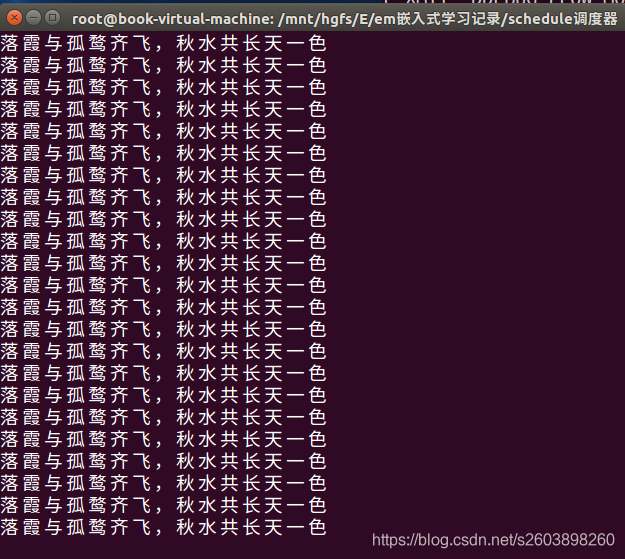
调度时,每隔5秒钟,执行一次func_tesr()。
C语言实现任务调度与定时器的更多相关文章
- Spring Task 任务调度(定时器)
1.任务调度SpringTask 1.1什么是任务调度 在企业级应用中,经常会制定一些“计划任务”,即在某个时间点做某件事情,核心是以时间为关注点,即在一个特定的时间点,系统执行指定的一个操作.常见的 ...
- C语言实现的多线程定时器
目录 1. 大致功能介绍 2. API库介绍 3. 一个例子 4. 库文件源码 注意事项 1. 大致功能介绍 实现任务列表,定时器会间隔一段时间遍历列表发现要执行的任务 任务列表中的所有任务并行执行 ...
- go语言之进阶篇定时器重置
1.定时器重置 示例: package main import ( "fmt" "time" ) func main() { timer := time.New ...
- go语言之进阶篇定时器停止
1.定时器停止 示例: package main import ( "fmt" "time" ) func main() { timer := time.New ...
- go语言之进阶篇定时器Timer的使用
1.Timer的使用 示例: #创建一个定时器,设置时间为2s,2s后,往time通道写内容(当前时间) package main import ( "fmt" "tim ...
- ESP8266 LUA脚本语言开发: 外设篇-定时器,延时,看门狗
https://nodemcu.readthedocs.io/en/master/modules/tmr/ local mytimer1 = tmr.create() function TimeFun ...
- 分布式任务调度平台XXL-JOB
<分布式任务调度平台XXL-JOB> 一.简介 1.1 概述 XXL-JOB是一个轻量级分布式任务调度框架,其核心设计目标是开发迅速.学习简单.轻量级.易扩展.现已开放源代码并 ...
- 原生js简单调用百度翻译API实现的翻译工具
先来个在线demo: js翻译工具 或者百度搜索js简单调用百度翻译API工具(不过有个小小的界面显示bug,我想细心的人应该会发现) 或者直接前往该网址:js翻译工具 或者前往我的github:gi ...
- JavaWeb学习笔记八 监听器
监听器Listener jservlet规范包括三个技术点:servlet :listener :filter:监听器就是监听某个对象的的状态变化的组件.监听器的相关概念事件源: 被监听的对象(三个域 ...
随机推荐
- 洛谷P2858题解
这是一道裸的第二类区间DP(由已知区间向外扩展)题. 首先定义 \(f_{i,j}\) 为最后 \(j-i+1\) 个数取 \([i,j]\) 这个区间时,\([i,j]\) 这个区间可以产生的最大价 ...
- 剑指 Offer 32 - II. 从上到下打印二叉树 II
剑指 Offer 32 - II. 从上到下打印二叉树 II 从上到下按层打印二叉树,同一层的节点按从左到右的顺序打印,每一层打印到一行. 例如: 给定二叉树: [3,9,20,null,null,1 ...
- Java注解如何对属性动态赋值
学而不思则罔,思而不学则殆 前言 大家都用过Spring的@Value("xxx")注解,如果没有debug过源码的同学对这个操作还是一知半解,工作一年了学了反射学了注解,还是不会 ...
- 连通图与Tarjan算法
引言 Tarjan算法是一个基于深度优先搜索的处理树上连通性问题的算法,可以解决,割边,割点,双连通,强连通等问题. 首先要明白Tarjan算法,首先要知道它能解决的问题的定义. 连通图 无向图 由双 ...
- 《Python Cookbook v3.0.0》Chapter1 数据结构和算法
感谢: https://github.com/yidao620c/python3-cookbook 如有侵权,请联系我整改. 本文章节会严格按照原书(以便和原书对照,章节标题可能会略有修改),内容会有 ...
- tomcat 配置http跳转https
web.xml增加配置 <security-constraint> <web-resource-collection > <web-resource-name >S ...
- SpringBoot开发十六-帖子详情
需求介绍 实现帖子详情,在帖子标题上增加访问详情页面的链接. 代码实现 开发流程: 首先在数据访问层新增一个方法 实现查看帖子的方法 业务层同理增加查询方法 最后在表现层处理查询请求 数据访问层增加根 ...
- golang web框架 kratos中的日志框架
kratos是bilibili开源的一个web框架. 日志用法: logger.go package kratoslog import ( "flag" "github. ...
- MATLAB批量存储图像和显示算法处理的图像不留空白
一 前言 最近收到审稿人的修改意见,其中一条为<RC: There were only five images evaluated in the experiment, and I recomm ...
- 08-SpringCloud Consul
Consul简介 官网 Consul下载地址 What is Consul? Consul is a service mesh solution providing a full featured c ...