
servlet中ServletContainerInitializer的简单说明
根据官方文档到的说明
public interface ServletContainerInitializer

Interface which allows a library/runtime to be notified of a web application's startup phase and perform any required programmatic
registration of servlets, filters, and listeners in response to it.

Implementations of this interface may be annotated with HandlesTypes, in order to receive (at their onStartup(java.util.Set>,
javax.servlet.ServletContext) method) the Set of application classes that implement, extend, or have been annotated with the class types specified by the annotation.

If an implementation of this interface does not use this annotation, or none of the application classes match the ones specified
by the annotation, the container must pass a null Set of classes to onStartup(java.util.Set>, javax.servlet.ServletContext).

When examining the classes of an application to see if they match any of the criteria specified by the HandlesTypes annotation
of a ServletContainerInitializer, the container may run into classloading problems if any of the application's optional JAR files
are missing. Because the container is not in a position to decide whether these types of classloading failures will prevent the
application from working correctly, it must ignore them, while at the same time providing a configuration option that would log them.

Implementations of this interface must be declared by a JAR file resource located inside the META-INF/services directory
and named for the fully qualified class name of this interface, and will be discovered using the runtime's service provider lookup
mechanism or a container specific mechanism that is semantically equivalent to it. In either case, ServletContainerInitializer
services from web fragment JAR files excluded from an absolute ordering must be ignored, and the order in which these services
are discovered must follow the application's classloading delegation model.
在容器启动的时候,他会去加载META-INF/services/javax.servlet.ServletContainerInitializer文件下指定的实现类
demo:
创建文件
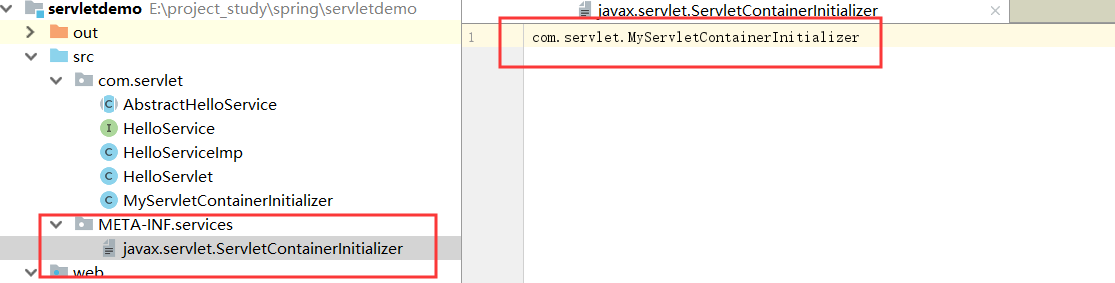
里面的内容是实现了javax.servlet.ServletContainerInitializer的自定义类,并重写它的方法
@HandlesTypes(value = {HelloService.class})

public class MyServletContainerInitializer implements ServletContainerInitializer {

    @Override

    public void onStartup(Set<Class<?>> set, ServletContext servletContext) throws ServletException {

            for(Class clazz : set){

                System.out.println("获取的class..."+clazz);

            }

    }

}
@HandlesTypes 可以获取到指定类型的所有子
Set<Class<?>> set获取到的class
servletContext servlet上下文
创建HelloService一个子类型:
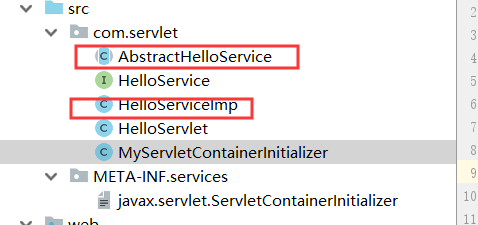
启动程序,看打印结果:
获取的class...class com.servlet.HelloServiceImp

获取的class...class com.servlet.AbstractHelloService
在加载的时候,onStartup()方法执行时,我们也可以加入自定义的servlet,filter,listener
        servletContext.addServlet("userServlet",UserServlet.class).addMapping("/user");

            servletContext.addListener(Mylistener.class);

            servletContext.addFilter("userFilter",userFilter.class).addMappingForUrlPatterns(EnumSet.of(DispatcherType.REQUEST),true,"/*");
在springmvc中,web容器启动到的时候也会去加载META-INF/services/javax.servlet.ServletContainerInitializer,加载指定的类
SpringServletContainerInitializer
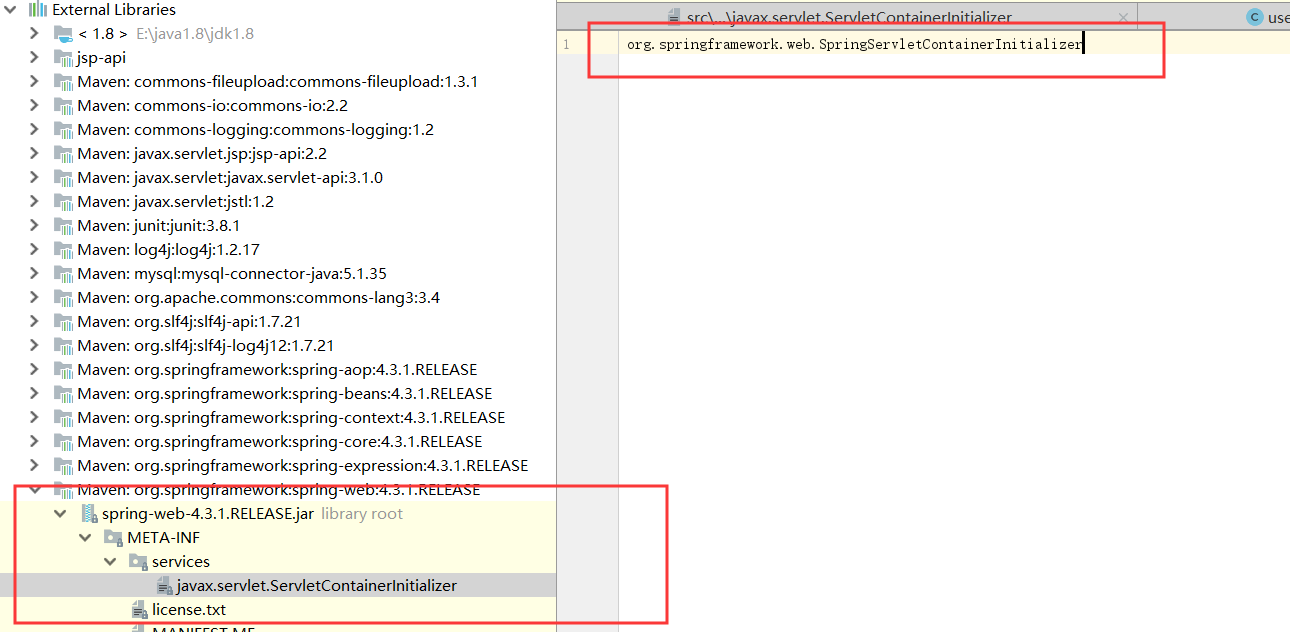
来看看SpringServletContainerInitializer这个类
@HandlesTypes(WebApplicationInitializer.class)

public class SpringServletContainerInitializer implements ServletContainerInitializer {

    @Override

    public void onStartup(Set<Class<?>> webAppInitializerClasses, ServletContext servletContext)

            throws ServletException {

        List<WebApplicationInitializer> initializers = new LinkedList<WebApplicationInitializer>();

        if (webAppInitializerClasses != null) {

            for (Class<?> waiClass : webAppInitializerClasses) {

                // Be defensive: Some servlet containers provide us with invalid classes,

                // no matter what @HandlesTypes says...

                if (!waiClass.isInterface() && !Modifier.isAbstract(waiClass.getModifiers()) &&

                        WebApplicationInitializer.class.isAssignableFrom(waiClass)) {

                    try {

                        initializers.add((WebApplicationInitializer) waiClass.newInstance());

                    }

                    catch (Throwable ex) {

                        throw new ServletException("Failed to instantiate WebApplicationInitializer class", ex);

                    }

                }

            }

        }

        if (initializers.isEmpty()) {

            servletContext.log("No Spring WebApplicationInitializer types detected on classpath");

            return;

        }

        servletContext.log(initializers.size() + " Spring WebApplicationInitializers detected on classpath");

        AnnotationAwareOrderComparator.sort(initializers);

        for (WebApplicationInitializer initializer : initializers) {

            initializer.onStartup(servletContext);

        }

    }

}
@HandlesTypes(WebApplicationInitializer.class)这和servlet中的操作一样,他会去获取到WebApplicationInitializer的子类型
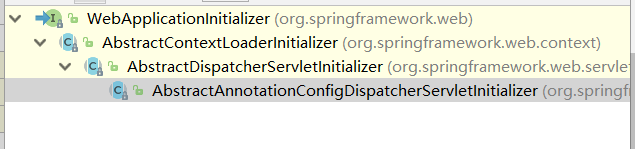
WebApplicationInitializer下三个抽象类:
AbstractContextLoaderInitializer:创建根容器createRootApplicationContext()
@Override

    public void onStartup(ServletContext servletContext) throws ServletException {

        registerContextLoaderListener(servletContext);

    }

    protected void registerContextLoaderListener(ServletContext servletContext) {

        WebApplicationContext rootAppContext = createRootApplicationContext();

        if (rootAppContext != null) {

            ContextLoaderListener listener = new ContextLoaderListener(rootAppContext);

            listener.setContextInitializers(getRootApplicationContextInitializers());

            servletContext.addListener(listener);

        }

        else {

            logger.debug("No ContextLoaderListener registered, as " +

                    "createRootApplicationContext() did not return an application context");

        }

    }
AbstractDispatcherServletInitializer:
  1、创建web的ioc容器createServletApplicationContext()
  2、创建DispatcherServlet:createDispatcherServlet(servletAppContext)
    添加到ServletContext中:servletContext.addServlet(servletName, dispatcherServlet)
@Override

    public void onStartup(ServletContext servletContext) throws ServletException {

        super.onStartup(servletContext);

        registerDispatcherServlet(servletContext);

    }

    protected void registerDispatcherServlet(ServletContext servletContext) {

        String servletName = getServletName();

        Assert.hasLength(servletName, "getServletName() must not return empty or null");

        WebApplicationContext servletAppContext = createServletApplicationContext();

        Assert.notNull(servletAppContext,

                "createServletApplicationContext() did not return an application " +

                "context for servlet [" + servletName + "]");

        FrameworkServlet dispatcherServlet = createDispatcherServlet(servletAppContext);

        dispatcherServlet.setContextInitializers(getServletApplicationContextInitializers());

        ServletRegistration.Dynamic registration = servletContext.addServlet(servletName, dispatcherServlet);

        Assert.notNull(registration,

                "Failed to register servlet with name '" + servletName + "'." +

                "Check if there is another servlet registered under the same name.");

        registration.setLoadOnStartup();

        registration.addMapping(getServletMappings());

        registration.setAsyncSupported(isAsyncSupported());

        Filter[] filters = getServletFilters();

        if (!ObjectUtils.isEmpty(filters)) {

            for (Filter filter : filters) {

                registerServletFilter(servletContext, filter);

            }

        }

        customizeRegistration(registration);

    }
AbstractAnnotationConfigDispatcherServletInitializer:

    创建根容器:createRootApplicationContext(),它覆写了上面的方法,获取RootConfigClasses类的配置
创建web的ioc容器:createServletApplicationContext() ,它覆写了上面的方法,获取ServletConfigClasses类的配置
@Override

    protected WebApplicationContext createRootApplicationContext() {

        Class<?>[] configClasses = getRootConfigClasses();

        if (!ObjectUtils.isEmpty(configClasses)) {

            AnnotationConfigWebApplicationContext rootAppContext = new AnnotationConfigWebApplicationContext();

            rootAppContext.register(configClasses);

            return rootAppContext;

        }

        else {

            return null;

        }

    }

    @Override

    protected WebApplicationContext createServletApplicationContext() {

        AnnotationConfigWebApplicationContext servletAppContext = new AnnotationConfigWebApplicationContext();

        Class<?>[] configClasses = getServletConfigClasses();

        if (!ObjectUtils.isEmpty(configClasses)) {

            servletAppContext.register(configClasses);

        }

        return servletAppContext;

    }
写一个类MyWebAppInitializer来继承AbstractAnnotationConfigDispatcherServletInitializer
public class MyWebAppInitializer extends AbstractAnnotationConfigDispatcherServletInitializer {

    @Override

    protected Class<?>[] getRootConfigClasses() {

        return new Class<?>[] { RootConfig.class };

    }

    @Override

    protected Class<?>[] getServletConfigClasses() {

        return new Class<?>[] { App1Config.class };

    }

    @Override

    protected String[] getServletMappings() {

        return new String[] { "/app1/*" };

    }

}
写配置类RootConfig:它不去扫描controller,controller交给App1Config扫描
@ComponentScan(value = "com.springmvc",excludeFilters = {@ComponentScan.Filter(type = FilterType.ANNOTATION,classes = {Controller.class})})

public class RootConfig {

}
写配置类App1Config:
@ComponentScan(value = "com.springmvc",includeFilters = {@ComponentScan.Filter(type= FilterType.ANNOTATION,classes = {Controller.class})})

public class App1Config {

}
这是使用注解来实现配置,用web.xml文件来配置:
<web-app>

    <listener>

        <listener-class>org.springframework.web.context.ContextLoaderListener</listener-class>

    </listener>

    <context-param>

        <param-name>contextConfigLocation</param-name>

        <param-value>/WEB-INF/root-context.xml</param-value>

    </context-param>

    <servlet>

        <servlet-name>app1</servlet-name>

        <servlet-class>org.springframework.web.servlet.DispatcherServlet</servlet-class>

        <init-param>

            <param-name>contextConfigLocation</param-name>

            <param-value>/WEB-INF/app1-context.xml</param-value>

        </init-param>

        <load-on-startup>1</load-on-startup>

    </servlet>

    <servlet-mapping>

        <servlet-name>app1</servlet-name>

        <url-pattern>/app1/*</url-pattern>

    </servlet-mapping>

</web-app>
servlet中ServletContainerInitializer的简单说明的更多相关文章
- servlet中cookie的使用
---恢复内容开始--- Cookie是存储在客户端计算机上的文本文件,并保留了它们的各种信息跟踪的目的. Java Servlet透明支持HTTP Cookie. 涉及标识返回用户有三个步骤: 服务 ...
- JSP Servlet中的Request和Response的简单研究
本文参考了几篇文章所得,参考目录如下: 1.http://www.cnblogs.com/guangshan/p/4198418.html 2.http://www.iteye.com/problem ...
- servlet中的相对路径和绝对路径 及/, ./, ../的区别
./ 当前目录../ 父级目录/ 根目录资源寻找都是依靠路径,资源存储方式是按照哈希表运算的,所以路径的计算其实就是哈希值的计算. servlet中,所有路径的配置都要用绝对路径. 什么是绝对路径,就 ...
- JSP+Servlet中使用cos.jar进行图片上传(文件上传亦然)
链接:JSP+Servlet中使用jspsmartupload.jar进行图片上传下载 关于cos.jar,百度百科只有这么几句话(http://baike.baidu.com/subview/406 ...
- JSP/Servlet 中的汉字编码问题
JSP/Servlet 中的汉字编码问题 1.问题的起源 每个国家(或区域)都规定了计算机信息交换用的字符编码集,如美国的 ASCII,中国的 GB2312 -80,日本的 JIS 等,作为该国家/区 ...
- Servlet复习1: 一个简单的Servlet的使用
Servlet学习 1. Servlet与JSP的关系 2. Servlet的声明周期 3. 一个简单的Servlet的使用方法 什么是Servlet? 什么又是JSP? 继承了javax.servl ...
- servlet中filter(过滤器)的学习使用
servlet过滤器是小型的web组件,它能够处理传入的请求和传出的响应.Filter 不是一个servlet,它不能产生一个response,它能够在一个request到达servlet之前预处理r ...
- servlet中的过滤器 国际化
1. 过滤器 基本概念 过滤器是需要在xml中配置的. 为什么需用到过滤器? 项目开发中,经常会涉及到重复代码的实现! 注册 ----à Servlet [1. 设置编码] ----à JSP 修改 ...
- JavaWeb(一)Servlet中的ServletConfig与ServletContext
前言 前面我介绍了一下什么是servlet,它的生命周期,执行过程和它的原理.这里我们做一个简单的回顾! 什么是Servlet? servlet 是运行在 Web 服务器中的小型 Java 程序(即: ...
随机推荐
- P4921 【情侣?给我烧了!】
加强前这道题还是比较友好的 首先我们设\(g_x\)为x对情侣没有一对坐在一起的数量 然后答案就可以表示成:\(C_n^k*A_n^k*2^k*g_{n-k}\) 这里的复杂度是\(O(T*N)\), ...
- 33、shuffle性能优化
一.shuffle性能优化 1.没有开启consolidation机制的性能低下的原理剖析 2.开启consolidation机制之后对磁盘io性能的提升的原理 spark.shuffle.conso ...
- AtCoder Grand Contest 009 题解
传送门 为啥这场题目少一点啊-- \(A\) 易知增加的数前面肯定比后面大,那么我们倒着做,然后维护一下最小要加多少就可以了 typedef long long ll; const int N=1e5 ...
- Java与设计模式之单例模式(下) 安全的单例模式
关于单例设计模式,<Java与设计模式之单例模式(上)六种实现方式>介绍了6种不同的单例模式,线程安全,本文介绍该如何保证单例模式最核心的作用——“实现该模式的类有且只有一个实 ...
- Leetcode44. 通配符匹配(动态规划)
44. 通配符匹配 动态规划 \(f_{i,j}\)为\(s\)匹配\(i\),\(t\)匹配\(j\)是否成功 贪心 相比之下这个思维性更强 考虑两个*,两个星号间的过渡,只需要过渡完到第二个星号, ...
- MySQL之级联删除、级联更新、级联置空
1. 准备测试表 # 专业表major ))engine=innodb default charset=utf8; # 学生表mstudent ), major int)engine=innodb d ...
- K8S Kubernetes 架构
Kubernetes最初源于谷歌内部的Borg,提供了面向应用的容器集群部署和管理系统. Kubernetes架构 Kubernetes借鉴了Borg的设计理念,比如Pod.Service.Label ...
- Unity3D地下守护神ARPG开发三部曲 视频教程+素材+源码
通过大型教学项目“MMOARPG地下守护神”项目的学习,掌握常用设计模式.架构设计.各种重要算法与设计模式在项目中的灵活运用,学后达到中高级游戏研发人员水平,做主程必备. 适用人群 学习Unit ...
- 在mac中安装tmux
在mac 中安装Tmux: 在终端输入如下命令: brew install tmux Tmux 的快捷键前缀(Prefix) 为了使自身的快捷键和其他软件的快捷键互不干扰,Tmux 提供了一个快捷键 ...
- ImageSwitcher 图片切换器
<?xml version="1.0" encoding="utf-8"?> <LinearLayout xmlns:android=&quo ...