
spark源码分析, 任务提交及序列化
简易基本流程图如下
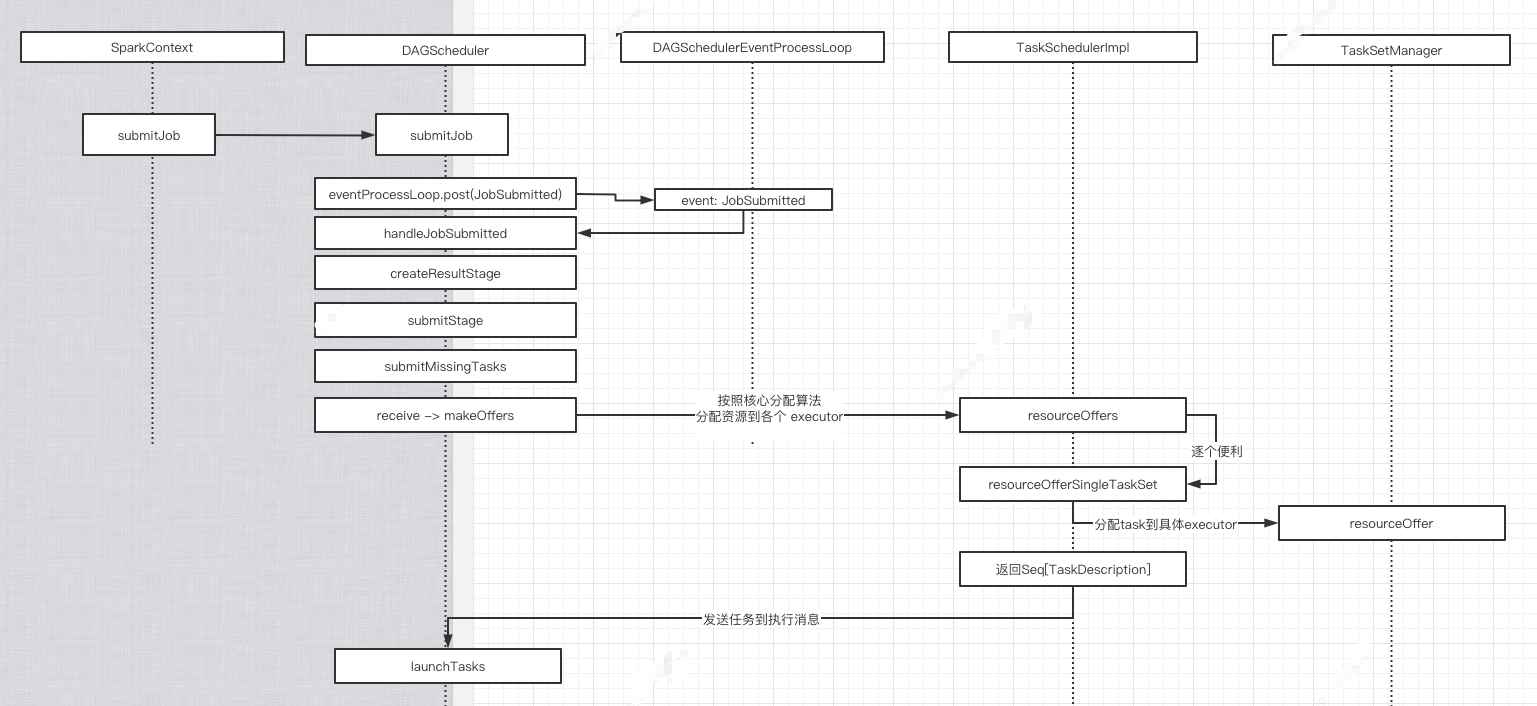
1. org.apache.spark.scheduler.DAGScheduler#submitMissingTasks
2. => org.apache.spark.scheduler.TaskSchedulerImpl#submitTasks
   // First figure out the indexes of partition ids to compute.

    val partitionsToCompute: Seq[Int] = stage.findMissingPartitions()

    // Use the scheduling pool, job group, description, etc. from an ActiveJob associated

    // with this Stage

    val properties = jobIdToActiveJob(jobId).properties

    runningStages += stage

    // SparkListenerStageSubmitted should be posted before testing whether tasks are

    // serializable. If tasks are not serializable, a SparkListenerStageCompleted event

    // will be posted, which should always come after a corresponding SparkListenerStageSubmitted

    // event.

    stage match {

      case s: ShuffleMapStage =>

        outputCommitCoordinator.stageStart(stage = s.id, maxPartitionId = s.numPartitions - 1)

      case s: ResultStage =>

        outputCommitCoordinator.stageStart(

          stage = s.id, maxPartitionId = s.rdd.partitions.length - 1)

    }

    val taskIdToLocations: Map[Int, Seq[TaskLocation]] = try {

      stage match {

        case s: ShuffleMapStage =>

          partitionsToCompute.map { id => (id, getPreferredLocs(stage.rdd, id))}.toMap

        case s: ResultStage =>

          partitionsToCompute.map { id =>

            val p = s.partitions(id)

            (id, getPreferredLocs(stage.rdd, p))

          }.toMap

      }

    }

//序列化 RDD

    // TODO: Maybe we can keep the taskBinary in Stage to avoid serializing it multiple times.

    // Broadcasted binary for the task, used to dispatch tasks to executors. Note that we broadcast

    // the serialized copy of the RDD and for each task we will deserialize it, which means each

    // task gets a different copy of the RDD. This provides stronger isolation between tasks that

    // might modify state of objects referenced in their closures. This is necessary in Hadoop

    // where the JobConf/Configuration object is not thread-safe.

    var taskBinary: Broadcast[Array[Byte]] = null

    var partitions: Array[Partition] = null

    try {

      // For ShuffleMapTask, serialize and broadcast (rdd, shuffleDep).

      // For ResultTask, serialize and broadcast (rdd, func).

      var taskBinaryBytes: Array[Byte] = null

      // taskBinaryBytes and partitions are both effected by the checkpoint status. We need

      // this synchronization in case another concurrent job is checkpointing this RDD, so we get a

      // consistent view of both variables.

      RDDCheckpointData.synchronized {

        taskBinaryBytes = stage match {

          case stage: ShuffleMapStage =>

            JavaUtils.bufferToArray(

              closureSerializer.serialize((stage.rdd, stage.shuffleDep): AnyRef))

          case stage: ResultStage =>

            JavaUtils.bufferToArray(closureSerializer.serialize((stage.rdd, stage.func): AnyRef))

        }

        partitions = stage.rdd.partitions

      }

      taskBinary = sc.broadcast(taskBinaryBytes)

    }

//生成 taskset

    val tasks: Seq[Task[_]] = try {

      val serializedTaskMetrics = closureSerializer.serialize(stage.latestInfo.taskMetrics).array()

      stage match {

        case stage: ShuffleMapStage =>

          stage.pendingPartitions.clear()

          partitionsToCompute.map { id =>

            val locs = taskIdToLocations(id)

            val part = partitions(id)

            stage.pendingPartitions += id

            new ShuffleMapTask(stage.id, stage.latestInfo.attemptNumber,

              taskBinary, part, locs, properties, serializedTaskMetrics, Option(jobId),

              Option(sc.applicationId), sc.applicationAttemptId, stage.rdd.isBarrier())

          }

        case stage: ResultStage =>

          partitionsToCompute.map { id =>

            val p: Int = stage.partitions(id)

            val part = partitions(p)

            val locs = taskIdToLocations(id)

            new ResultTask(stage.id, stage.latestInfo.attemptNumber,

              taskBinary, part, locs, id, properties, serializedTaskMetrics,

              Option(jobId), Option(sc.applicationId), sc.applicationAttemptId,

              stage.rdd.isBarrier())

          }

      }

    }

//最终提交 taskset

  if (tasks.size > 0) {

      logInfo(s"Submitting ${tasks.size} missing tasks from $stage (${stage.rdd}) (first 15 " +

        s"tasks are for partitions ${tasks.take(15).map(_.partitionId)})")

      taskScheduler.submitTasks(new TaskSet(

        tasks.toArray, stage.id, stage.latestInfo.attemptNumber, jobId, properties))

    }
3. => org.apache.spark.scheduler.cluster.CoarseGrainedSchedulerBackend#reviveOffers ,发送消息
def reviveOffers() {
// 类型 CoarseGrainedClusterMessage
driverEndpoint.send(ReviveOffers) }
4. => 自己处理消息org.apache.spark.scheduler.cluster.CoarseGrainedSchedulerBackend.DriverEndpoint#receive
    override def receive: PartialFunction[Any, Unit] = {

      case StatusUpdate(executorId, taskId, state, data) =>

       .....

      case ReviveOffers =>

        makeOffers()

      case KillTask(taskId, executorId, interruptThread, reason) =>

        ....

      case KillExecutorsOnHost(host) =>

      .....

      case UpdateDelegationTokens(newDelegationTokens) =>

     .....

      case RemoveExecutor(executorId, reason) =>

     ...

        removeExecutor(executorId, reason)

    }
5.=> org.apache.spark.scheduler.cluster.CoarseGrainedSchedulerBackend.DriverEndpoint#makeOffers
   // Make fake resource offers on all executors

    private def makeOffers() {

      // Make sure no executor is killed while some task is launching on it

      val taskDescs = withLock {

        // Filter out executors under killing

        val activeExecutors = executorDataMap.filterKeys(executorIsAlive)

        val workOffers = activeExecutors.map {

          case (id, executorData) =>

            new WorkerOffer(id, executorData.executorHost, executorData.freeCores,

              Some(executorData.executorAddress.hostPort))

        }.toIndexedSeq

        scheduler.resourceOffers(workOffers)

      }

      if (!taskDescs.isEmpty) {

        launchTasks(taskDescs)

      }

    }
6.=> org.apache.spark.scheduler.TaskSchedulerImpl#resourceOffers. 按照核心分配算法分配各 task 到 executor 上.
    // Take each TaskSet in our scheduling order, and then offer it each node in increasing order

    // of locality levels so that it gets a chance to launch local tasks on all of them.

    // NOTE: the preferredLocality order: PROCESS_LOCAL, NODE_LOCAL, NO_PREF, RACK_LOCAL, ANY

    for (taskSet <- sortedTaskSets) {

        var launchedAnyTask = false

        // Record all the executor IDs assigned barrier tasks on.

        val addressesWithDescs = ArrayBuffer[(String, TaskDescription)]()

        for (currentMaxLocality <- taskSet.myLocalityLevels) {

          var launchedTaskAtCurrentMaxLocality = false

          do {

            launchedTaskAtCurrentMaxLocality = resourceOfferSingleTaskSet(taskSet,

              currentMaxLocality, shuffledOffers, availableCpus, tasks, addressesWithDescs)

            launchedAnyTask |= launchedTaskAtCurrentMaxLocality

          } while (launchedTaskAtCurrentMaxLocality)

        }

    }
=>org.apache.spark.scheduler.TaskSchedulerImpl#resourceOfferSingleTaskSet
=>org.apache.spark.scheduler.TaskSchedulerImpl#resourceOfferSingleTaskSet

  private def resourceOfferSingleTaskSet(

      taskSet: TaskSetManager,

      maxLocality: TaskLocality,

      shuffledOffers: Seq[WorkerOffer],

      availableCpus: Array[Int],

      tasks: IndexedSeq[ArrayBuffer[TaskDescription]],

      addressesWithDescs: ArrayBuffer[(String, TaskDescription)]) : Boolean = {

    var launchedTask = false

  //分配任务

    for (i <- 0 until shuffledOffers.size) {

      val execId = shuffledOffers(i).executorId

      val host = shuffledOffers(i).host

      if (availableCpus(i) >= CPUS_PER_TASK) {

          for (task <- taskSet.resourceOffer(execId, host, maxLocality)) {

            tasks(i) += task

            val tid = task.taskId

            taskIdToTaskSetManager.put(tid, taskSet)

            taskIdToExecutorId(tid) = execId

            executorIdToRunningTaskIds(execId).add(tid)

            availableCpus(i) -= CPUS_PER_TASK

            launchedTask = true

          }

      }

    }

    return launchedTask

  }

==> org.apache.spark.scheduler.TaskSetManager#resourceOffer

 @throws[TaskNotSerializableException]

  def resourceOffer(

      execId: String,

      host: String,

      maxLocality: TaskLocality.TaskLocality)

    : Option[TaskDescription] =

  {

    val offerBlacklisted = taskSetBlacklistHelperOpt.exists { blacklist =>

      blacklist.isNodeBlacklistedForTaskSet(host) ||

        blacklist.isExecutorBlacklistedForTaskSet(execId)

    }

    if (!isZombie && !offerBlacklisted) {

      val curTime = clock.getTimeMillis()

      var allowedLocality = maxLocality

      if (maxLocality != TaskLocality.NO_PREF) {

        allowedLocality = getAllowedLocalityLevel(curTime)

        if (allowedLocality > maxLocality) {

          // We're not allowed to search for farther-away tasks

          allowedLocality = maxLocality

        }

      }

      dequeueTask(execId, host, allowedLocality).map { case ((index, taskLocality, speculative)) =>

        // Found a task; do some bookkeeping and return a task description

        //找到一个任务,然后封装task的信息,包括序列化

        val task = tasks(index)

        //原子自增

        val taskId = sched.newTaskId()

        // Do various bookkeeping

        copiesRunning(index) += 1

        val attemptNum = taskAttempts(index).size

        val info = new TaskInfo(taskId, index, attemptNum, curTime,

          execId, host, taskLocality, speculative)

        taskInfos(taskId) = info

        taskAttempts(index) = info :: taskAttempts(index)

        // Serialize and return the task

        val serializedTask: ByteBuffer = try {

          ser.serialize(task)

        }

        //添加到运行Map中

        addRunningTask(taskId)

        sched.dagScheduler.taskStarted(task, info)

        new TaskDescription(

          taskId,

          attemptNum,

          execId,

          taskName,

          index,

          task.partitionId,

          addedFiles,

          addedJars,

          task.localProperties,

          serializedTask)

      }

    } else {

      None

    }

  }
7.=> org.apache.spark.scheduler.cluster.CoarseGrainedSchedulerBackend.DriverEndpoint#launchTasks
  // Launch tasks returned by a set of resource offers

    private def launchTasks(tasks: Seq[Seq[TaskDescription]]) {

      for (task <- tasks.flatten) {

        val serializedTask = TaskDescription.encode(task)

        ...

          executorData.executorEndpoint.send(LaunchTask(new SerializableBuffer(serializedTask)))

    }
8. => org.apache.spark.scheduler.TaskDescription#encode TaskDescription作为 message 发送给 executor
 def encode(taskDescription: TaskDescription): ByteBuffer = {

    val bytesOut = new ByteBufferOutputStream(4096)

    val dataOut = new DataOutputStream(bytesOut)

    dataOut.writeLong(taskDescription.taskId)

    dataOut.writeInt(taskDescription.attemptNumber)

    dataOut.writeUTF(taskDescription.executorId)

    dataOut.writeUTF(taskDescription.name)

    dataOut.writeInt(taskDescription.index)

    dataOut.writeInt(taskDescription.partitionId)

    // Write files.

    serializeStringLongMap(taskDescription.addedFiles, dataOut)

    // Write jars.

    serializeStringLongMap(taskDescription.addedJars, dataOut)

    // Write properties.

    dataOut.writeInt(taskDescription.properties.size())

    taskDescription.properties.asScala.foreach { case (key, value) =>

      dataOut.writeUTF(key)

      // SPARK-19796 -- writeUTF doesn't work for long strings, which can happen for property values

      val bytes = value.getBytes(StandardCharsets.UTF_8)

      dataOut.writeInt(bytes.length)

      dataOut.write(bytes)

    }

    // Write the task. The task is already serialized, so write it directly to the byte buffer.

    Utils.writeByteBuffer(taskDescription.serializedTask, bytesOut)

    dataOut.close()

    bytesOut.close()

    bytesOut.toByteBuffer

  }
spark源码分析, 任务提交及序列化的更多相关文章
- Spark源码分析之四:Stage提交
各位看官,上一篇<Spark源码分析之Stage划分>详细讲述了Spark中Stage的划分,下面,我们进入第三个阶段--Stage提交. Stage提交阶段的主要目的就一个,就是将每个S ...
- spark 源码分析之十九 -- Stage的提交
引言 上篇 spark 源码分析之十九 -- DAG的生成和Stage的划分 中,主要介绍了下图中的前两个阶段DAG的构建和Stage的划分. 本篇文章主要剖析,Stage是如何提交的. rdd的依赖 ...
- Spark源码分析之七:Task运行(一)
在Task调度相关的两篇文章<Spark源码分析之五:Task调度(一)>与<Spark源码分析之六:Task调度(二)>中,我们大致了解了Task调度相关的主要逻辑,并且在T ...
- Spark源码分析之六:Task调度(二)
话说在<Spark源码分析之五:Task调度(一)>一文中,我们对Task调度分析到了DriverEndpoint的makeOffers()方法.这个方法针对接收到的ReviveOffer ...
- Spark源码分析之三:Stage划分
继上篇<Spark源码分析之Job的调度模型与运行反馈>之后,我们继续来看第二阶段--Stage划分. Stage划分的大体流程如下图所示: 前面提到,对于JobSubmitted事件,我 ...
- spark 源码分析之二十一 -- Task的执行流程
引言 在上两篇文章 spark 源码分析之十九 -- DAG的生成和Stage的划分 和 spark 源码分析之二十 -- Stage的提交 中剖析了Spark的DAG的生成,Stage的划分以及St ...
- spark源码分析以及优化
第一章.spark源码分析之RDD四种依赖关系 一.RDD四种依赖关系 RDD四种依赖关系,分别是 ShuffleDependency.PrunDependency.RangeDependency和O ...
- 【转】Spark源码分析之-deploy模块
原文地址:http://jerryshao.me/architecture/2013/04/30/Spark%E6%BA%90%E7%A0%81%E5%88%86%E6%9E%90%E4%B9%8B- ...
- Spark源码分析:多种部署方式之间的区别与联系(转)
原文链接:Spark源码分析:多种部署方式之间的区别与联系(1) 从官方的文档我们可以知道,Spark的部署方式有很多种:local.Standalone.Mesos.YARN.....不同部署方式的 ...
随机推荐
- 牛客网数据库SQL实战解析(21-30题)
牛客网SQL刷题地址: https://www.nowcoder.com/ta/sql?page=0 牛客网数据库SQL实战解析(01-10题): https://blog.csdn.net/u010 ...
- day38:MySQL数据库之约束&索引&外键&存储引擎
目录 part1:数据类型 part2:约束 part3:主键索引 PRI &唯一索引 UNI &普通索引 MUL part4:外键:foreign key part5:在外键中设置联 ...
- Linux磁盘分区、挂载、查看文件大小
快速查看系统文件大小命令 du -ah --max-depth=1 后面可以添加文件目录 ,如果不添加默认当前目录. 下面进入正题~~ 磁盘分区.挂载 引言: ①.分区的方式 a)mbr分区: 最多支 ...
- 8.深入k8s:资源控制Qos和eviction及其源码分析
转载请声明出处哦~,本篇文章发布于luozhiyun的博客:https://www.luozhiyun.com,源码版本是1.19 又是一个周末,可以愉快的坐下来静静的品味一段源码,这一篇涉及到资源的 ...
- nginx配置过程中出现的问题
在安装nginx时我们先创建用户useradd -s /sbin/nologin -M nginx 不然会报nginx: [emerg] getpwnam("nginx") fai ...
- 解决Oracle12cr2自创建用户无法登录的问题
说明: 下面创建是创建CDB本地用户,不是PDB应用程序用户,如果是PDB应用程序创建语法会不一样.下面介绍创建CDB本地用户. 创建表空空间 CREATE TABLESPACE YH datafil ...
- Android开发之SDCardUtils工具类。java工具详细代码,附源代码。判断SD卡是否挂载等功能
package com.xiaobing.zhbj.utils; import java.io.BufferedInputStream; import java.io.BufferedOutputSt ...
- LoadRunner回放脚本遇到的问题(遇到就补上)
问题一:Error-26612:HTTP Status-code=500(Internal Server Error) 解决过程:google找到了关于这个错误有多种解决的方法,但是都不是我要的,最重 ...
- 【python】装饰器听了N次也没印象,读完这篇你就懂了
装饰器其实一直是我的一个"老大难".这个知识点就放在那,但是拖延症... 其实在平常写写脚本的过程中,这个知识点你可能用到不多 但在面试的时候,这可是一个高频问题. 一.什么是装饰 ...
- MyBatis动态SQL(使用)整理
MyBatis 令人喜欢的一大特性就是动态 SQL.在使用 JDBC 的过程中, 根据条件进行 SQL 的拼接是很麻烦且很容易出错的.MyBatis 动态 SQL 的出现, 解决了这个麻烦. MyBa ...