
Java 注解 初探 (一)
自JDK1.5之后,就开始出现注解。想要了解注解的来源和注解的用法,通过搜索引擎大都是针对某一个注解的解释,很难找到关于注解系列的文章,便自己看下。
基于Annotation的注释,说明Annotaion是所有注解类型扩展的公共接口。当自定义为@inferface便实现该接口。可用 instanceof去校验@interface是否属于Annotation.而上面的Target属于注解其它的注解的元注解。元注解有四个:Target、Retention、Documented、
Inherited。
Target
TYPE: 类
FIELD: 字段
METHOD: 方法
PARAMETER: 参数
CONSTRUCTOR: 构造函数
LOCAL_VARIABLE:本地变量
ANNOTATION_TYPE:注解
PACKAGE:包
现在演示一下Target
自定一个注解,作用于FIELD的:
@Target(ElementType.FIELD)

@Retention(RetentionPolicy.RUNTIME)

@Documented

public @interface AnnotationTarget {

    String[] value() default "iamsb";

}
被标记的字段拥有了超能力,是的,其它的字段仍然很傻,以下是被标记的字段赋予超能力的过程
public class AnnotationTargetProcessor {

    public static void process(Class clazz, Object obj) {

        Field[] fields = clazz.getDeclaredFields();

        for(Field field : fields) {

            if(field.isAnnotationPresent(AnnotationTarget.class)){

                try {

                    field.setAccessible(true);   // 被注解的字段是private ,所以设置true

                    field.set(obj, "now,i am still sb");

                } catch (IllegalArgumentException e) {

                    // TODO Auto-generated catch block

                    e.printStackTrace();

                } catch (IllegalAccessException e) {

                    // TODO Auto-generated catch block

                    e.printStackTrace();

                }

            }

        }

    }

}
最后的测试类
public class SBVO {

    private String a;

    private String b;

    @AnnotationTarget("zz")

    private String c;

    private Integer d;

    private Boolean  bool = false;

    public static void main(String[] args) {

        SBVO sv = new SBVO();

        AnnotationTargetProcessor.process(SBVO.class,sv);

        String c = sv.c;

        String b = sv.b;

        System.out.println( "c ==== " + c);  //  c ==== now,i am still sb

        System.out.println( "b ==== " + b); //   b ==== null

    }

}
说明:1.@AnnotationTarget声明的是@Target(ElementType.FIELD),所以在用注解的时候,只能作用于字段上,而当你把@AnnotationTarget("zz")想放在类上面时,编译都不让你过,提示:The annotation @AnnotationTarget is disallowed for this location
   2.注解本身不具备超能力,它本身属于被动的。而是我们的规则处理类发现某个元素有某种注解,就按照某种规则来给这个元素赋予某种能力。比如我上面的AnnotationTargetProcessor扫描到字段c 有个AnnotationTarget注解,那我就给与你什么能力。同理,springboot的
    某个类(目前不知道是哪个)发现有个类被标记了@Service,那我就把它来赋予Service能力。
   3.@interface里面只能定义返回类型为 所有基本类型、String、enum、Annotation、Class和 它们的数组。
   4.用注解的时候,跟我们调用方法一样 注解名(元素名=元素值),比如我们springboot的启动类 @SpringBootApplication(scanBasePackages = "xxxx",exclude={xxx.class,yyy.class}) ,可以查到SpringBootApplication注解下scanBasePackages和exclude
    元素。
   5.@AnnotationTarget("zz")这里要说一下,这个原本是这样:@AnnotationTarget("value=zz"),如果声明的注解里只对value赋值,那么在引用的时候value=可以省略。
接着再看下元注解
Documented
它没有元素,所以也被称为标记注解,我在SBVO中添加一行代码:
@AnnotationTarget("nc")

public static final String e = "SPRING SUMMER";
然后用javadoc -encoding UTF-8 AnnotationTarget.java SBVO.java 生成文档,这里我的类里面有中文,所以添加了utf8方式,生成的doc文档,入口是index.html,见下图:
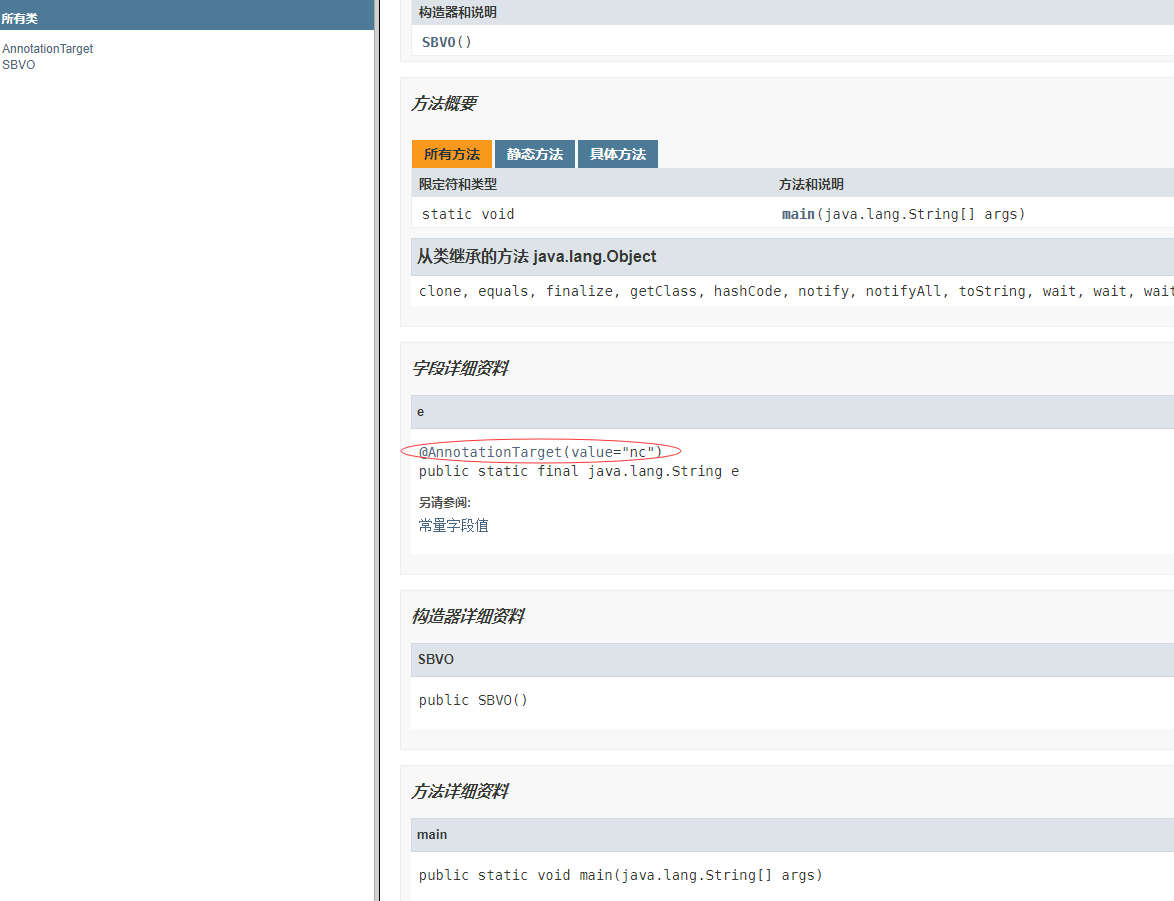
就是标红椭圆的注解是否被添加到doc文档的差别。如果没有添加元注解Documented,这里是没有红色椭圆的文本信息的。所以定义了Documented的自定义注解,在生成javadoc文档时,就会添加该注解文本信息。
接着看
Retention
public enum RetentionPolicy {

    /**

     * Annotations are to be discarded by the compiler.

     */

    SOURCE,

    /**

     * Annotations are to be recorded in the class file by the compiler

     * but need not be retained by the VM at run time.  This is the default

     * behavior.

     */

    CLASS,

    /**

     * Annotations are to be recorded in the class file by the compiler and

     * retained by the VM at run time, so they may be read reflectively.

     *

     * @see java.lang.reflect.AnnotatedElement

     */

    RUNTIME

}
1. SOURCE ,编译器将丢弃注解
2. CLASS,编译器将在类文件中记录注解,但是不需要在运行时被VM保留。这是默认值的行为。
3. RUNTIME,编译器将在类文件中记录注解,并且在运行时被VM保留。因此在反射时可以读取得到它们。
作何解释呢?我先把我自定义注解AnnotationTarget的保留策略改成RetentionPolicy.SOURCE
@Target(ElementType.FIELD)

@Retention(RetentionPolicy.SOURCE)

public @interface AnnotationTarget {

    String[] value() default "iamsb";

}
仍然用下面这个类来引用它
public class SBVO {

    private String a;

    private String b;

    @AnnotationTarget("zz")

    private String c;

    private Integer d;

    private Boolean  bool = false;

    @AnnotationTarget("nc")

    public static final String e = "SPRING SUMMER";

    @AnnotationTarget("")

    private String f = "i do not want to be a sb.";

    public static void main(String[] args) {

        SBVO sv = new SBVO();

        AnnotationTargetProcessor.process(SBVO.class,sv);

        String c = sv.c;

        String b = sv.b;

        String f = sv.f;

        System.out.println( "c ==== " + c);

        System.out.println( "b ==== " + b);

        System.out.println( "e ==== " + e);

        System.out.println( "f ==== " + f);

    }

}
经过编译后,把引用的SBVO.class反编译,可以看到
public class SBVO

{

  private String a;

  private String b;

  private String c;                                   // 未保留

  private Integer d;

  private Boolean bool = Boolean.valueOf(false);

  public static final String e = "SPRING SUMMER";     // 未保留

  private String f = "i do not want to be a sb.";     // 未保留

  public static void main(String[] args)

  {

    SBVO sv = new SBVO();

    AnnotationTargetProcessor.process(SBVO.class, sv);

    String c = sv.c;

    String b = sv.b;

    String f = sv.f;

    System.out.println("c ==== " + c);

    System.out.println("b ==== " + b);

    System.out.println("e ==== SPRING SUMMER");

    System.out.println("f ==== " + f);

  }

}
这里就解释了策略为SOURCE时,编译后就把注解丢弃了。
当我把策略改成RetentionPolicy.CLASS,编译后再来看SBVO.class
public class SBVO

{

  private String a;

  private String b;

  @AnnotationTarget({"zz"})

  private String c;                                  // 保留了注解

  private Integer d;

  private Boolean bool = Boolean.valueOf(false);

  @AnnotationTarget({"nc"})

  public static final String e = "SPRING SUMMER";    // 保留了注解

  @AnnotationTarget({""})

  private String f = "i do not want to be a sb.";    // 保留了注解

  public static void main(String[] args)

  {

    SBVO sv = new SBVO();

    AnnotationTargetProcessor.process(SBVO.class, sv);

    String c = sv.c;

    String b = sv.b;

    String f = sv.f;

    System.out.println("c ==== " + c);

    System.out.println("b ==== " + b);

    System.out.println("e ==== SPRING SUMMER");

    System.out.println("f ==== " + f);

  }

}
此时我来运行SBVO的main 方法,得到结果:
c ==== null
b ==== null
e ==== SPRING SUMMER
f ==== i do not want to be a sb.
此时main方法里面的AnnotationTargetProcessor.process(SBVO.class, sv); 其中process方法if(field.isAnnotationPresent(AnnotationTarget.class)) 判断始终是false,反射取不到,说明注解没在虚拟机中驻留。所以,c、b、e、f都是原值,那我在把自定义注解
AnnotationTarget策略更改成RetentionPolicy.RUNTIME,首先注解时保留在SBVO.class文件中的
  @AnnotationTarget({"zz"})

  private String c;                                 // 保留

  private Integer d;

  private Boolean bool = Boolean.valueOf(false);

  @AnnotationTarget({"nc"})

  public static final String e = "SPRING SUMMER";   // 保留

  @AnnotationTarget({""})

  private String f = "i do not want to be a sb.";   // 保留
然后,运行SBVO中的main方法,结果为:
java.lang.IllegalAccessException: Can not set static final java.lang.String field studiii.zlsj_test.annotation.target.SBVO.e to java.lang.String
at sun.reflect.UnsafeFieldAccessorImpl.throwFinalFieldIllegalAccessException(Unknown Source)
at sun.reflect.UnsafeFieldAccessorImpl.throwFinalFieldIllegalAccessException(Unknown Source)
at sun.reflect.UnsafeQualifiedStaticObjectFieldAccessorImpl.set(Unknown Source)
at java.lang.reflect.Field.set(Unknown Source)
at studiii.zlsj_test.annotation.target.AnnotationTargetProcessor.process(AnnotationTargetProcessor.java:19)
at studiii.zlsj_test.annotation.target.SBVO.main(SBVO.java:30)
c ==== now,i am still sb // c 由空值改成当前值
b ==== null // b 未添加注解
e ==== SPRING SUMMER // final 改不了,上面也抛异常了
f ==== now,i am still sb // f 值由 i do not want to be a sb.改成 now,i am still sb
此时看到AnnotationTargetProcessor.process通过反射把标记了注解的字段都更改了,e标记了注解,但e是final变量,所以当想要更改它时,是不允许的。

接着看最后一个
  Inherited
  从它的源码可以看到,它没有定义任何元素,所以它和Documented一样,属于标记注解。再来看一下它的注释:
/**

 * Indicates that an annotation type is automatically inherited.  If

 * an Inherited meta-annotation is present on an annotation type

 * declaration, and the user queries the annotation type on a class

 * declaration, and the class declaration has no annotation for this type,

 * then the class's superclass will automatically be queried for the

 * annotation type.  This process will be repeated until an annotation for this

 * type is found, or the top of the class hierarchy (Object)

 * is reached.  If no superclass has an annotation for this type, then

 * the query will indicate that the class in question has no such annotation.

 *

 * <p>Note that this meta-annotation type has no effect if the annotated

 * type is used to annotate anything other than a class.  Note also

 * that this meta-annotation only causes annotations to be inherited

 * from superclasses; annotations on implemented interfaces have no

 * effect.

 *

 * @author  Joshua Bloch

 * @since 1.5

 * @jls 9.6.3.3 @Inherited

 */
翻译一下:表明它是一个自动继承的注解类。如果一个声明的注解类(自定义注解)上存在这个继承元注解,并且用户去查找某个声明类上的自定义注解,并且这个声明类没有这个自定义注解,那么将自动去搜索这个类的父类的自定义注解。这个过程将
重复,直到这个自定义注解被找到,或者搜索直到这个声明类的最顶层Object类。如果没有父类(这里指父、祖父、曾祖父直到Object)含有自定义注解,那么就表明这个声明类没有这个自定义注解。
注意,如果自定义注解不是注释在一个类上的话,这个元注解(指Inherited)是没有效果的。还注意,这个元注解只会导致注解被继承自超类,实现接口上的注解是无效的。
再翻译一下:1.这是一个自动继承的元注解,它是注解自定义注解的注解。
2.如果某个类的父类、或者祖父类等有@Inherited注解或含有@Inherited的自定义注解,那么子类便可继承父类的注解。
3.该注解只对类有效,对接口实现是无效的。
例子:
创建一个注解,标记Inherited
@Retention(RetentionPolicy.RUNTIME)

@Inherited

public @interface InheAnnoTest {

    String value() default "ni da ye";

}
创建一个父类
@InheAnnoTest("Just Parent")

public class ParentClass {

    private String name ;

    @AnnotationTarget("yes, i am 15")

    String age;

    @MethodTestAnno("yeah")

    public void attack() {

    }

    @InheAnnoTest("ojbk")

    protected String plus() {

        return "";

    }

}
创建一个子类
public class ChildClass extends ParentClass {

    private String name ;

    String age;

    public void attack() {

    }

    protected String plus() {

        return "plus";

    }

}
测试类
public class Test {

    /**

     * @param args

     */

    public static void main(String[] args) {

        // TODO Auto-generated method stub

        Class<ChildClass> cc = ChildClass.class;

        Class<ParentClass> pc = ParentClass.class;

        System.out.println(pc.isAnnotationPresent(InheAnnoTest.class));        // true

        System.out.println(cc.isAnnotationPresent(InheAnnoTest.class));        // true

        Annotation[]  annos = cc.getAnnotations();

        for(Annotation anno : annos) {

            System.out.println(anno.annotationType().getName());               // studiii.zlsj_test.annotation.inheritedTest.InheAnnoTest

        }

    }

}
如果ChildClass和ParentClass 无继承关系,那么
    System.out.println(cc.isAnnotationPresent(InheAnnoTest.class));         // false
 并且 annos 就为空了。
再来验证接口,创建一个接口:
@InheAnnoTest("")                                                            // 打上了标记

public interface ParentInterface {

    public static final String name = "daye";

    void atack();

}
实现类:
public class ChildInterface implements ParentInterface{

    @Override

    public void atack() {

    }

}
得到结果:
Class<ChildInterface> ci = ChildInterface.class;

System.out.println(ci.isAnnotationPresent(InheAnnoTest.class));                      // false
  因此,就印证了Inherited注释里得说明。
  总结一下:注解Annotation 从JDK1.5之后被引入。它包含了4个元注解:Tagert、Documented、 Retention、 Inherited,元注解的意思就是可以注解其它注解的注解。就好比我们拼音有6个元音 a、o、e、i、u、u(..),可以组成很多双韵母,比如ai、ei、ui、ao、ou等等,进而拼出
        中华上下五千年沉淀的各种汉字。同理,4个元注解也可衍生出各种功能的注解。
       Tagert注解指明你定义的注解的作用域,是Field、Method还是Type等。
       Documented注解表示通过javadoc后,会再doc中显示出来。
        Retention注解,表示注解的保留策略,仅有三种,1.编译时就把注解丢弃。2.编译时保留,但再JVM中不保留。3.编译时保留,JVM中也保留,反射可从JVM中取到该注解。
        Inherited注解,表示子类可以取到父类中定义了该注解的注解。
Java 注解 初探 (一)的更多相关文章
- Java注解
Java注解其实是代码里的特殊标记,使用其他工具可以对其进行处理.注解是一种元数据,起到了描述.配置的作用,生成文档,所有的注解都隐式地扩展自java.lang.annotation.Annotati ...
- 19.Java 注解
19.Java注解 1.Java内置注解----注解代码 @Deprecated //不推荐使用的过时方法 @Deprecated ...
- Java注解入门
注解的分类 按运行机制分: 源码注解:只在源码中存在,编译后不存在 编译时注解:源码和编译后的class文件都存在(如@Override,@Deprecated,@SuppressWarnin ...
- java注解(Annotation)解析
注解(Annotation)在java中应用非常广泛.它既能帮助我们在编码中减少错误,(比如最常见的Override注解),还可以帮助我们减少各种xml文件的配置,比如定义AOP切面用@AspectJ ...
- JAVA 注解的几大作用及使用方法详解
JAVA 注解的几大作用及使用方法详解 (2013-01-22 15:13:04) 转载▼ 标签: java 注解 杂谈 分类: Java java 注解,从名字上看是注释,解释.但功能却不仅仅是注释 ...
- attilax.java 注解的本质and 使用最佳实践(3)O7
attilax.java 注解的本质and 使用最佳实践(3)O7 1. 定义pojo 1 2. 建立注解By eclipse tps 1 3. 注解参数的可支持数据类型: 2 4. 注解处理器 2 ...
- paip.java 注解的详细使用代码
paip.java 注解的详细使用代码 作者Attilax 艾龙, EMAIL:1466519819@qq.com 来源:attilax的专栏 地址:http://blog.csdn.net/att ...
- JAVA 注解的几大作用及使用方法详解【转】
java 注解,从名字上看是注释,解释.但功能却不仅仅是注释那么简单.注解(Annotation) 为我们在代码中添加信息提供了一种形式化的方法,是我们可以在稍后 某个时刻方便地使用这些数据(通过 解 ...
- 框架基础——全面解析Java注解
为什么学习注解? 学习注解有什么好处? 学完能做什么? 答:1. 能够读懂别人写的代码,特别是框架相关的代码: 2. 让编程更加简洁,代码更加清晰: 3. 让别人高看一眼. spring.mybati ...
随机推荐
- [Python WEB开发] 使用WSGI开发类Flask框架 (二)
WSGI Web服务器网关接口 WSGI主要规定了Web服务器如何与Web应用程序进行通信,以及如何将Web应用程序链接在一起来处理一个请求. wsgiref Python中的WSGI参考模块 ...
- pgAdmin4 重置布局
pgAdmin4 是网页版客户端,而且在其网页上可以通过拖拽改变布局.当布局混乱时可以通过 菜单File--Reset Layout功能来重置. 如果这篇随笔只是为了说以上这句话就没必要了,而且你根据 ...
- HDU 3695 Computer Virus on Planet Pandora (AC自己主动机)
题意:有n种病毒序列(字符串),一个模式串,问这个字符串包括几种病毒. 包括相反的病毒也算.字符串中[qx]表示有q个x字符.具体见案列. 0 < q <= 5,000,000尽然不会超, ...
- BUAA OO 2019 第二单元作业总结
目录 总 架构 controller model view 优化算法 Look 算法 多种算法取优 预测未来 多线程 第五次作业 第六次作业 第七次作业 代码静态分析 UML 类图 类复杂度 类总代码 ...
- JQuery中ajaxSubmit,在ie或360兼容,提交后台不能获得参数
问题描述:360兼容模式.IE浏览器,通过ajaxSubmit提交,后台不能获得参数值 解决办法:把options.semantic这个参数改成true 代码: var ajax_option={ s ...
- javascript编写的一个完整全方位轮播图效果
1 <!DOCTYPE html> <html lang="en"> <head> <meta charset="UTF-8&q ...
- TP5.0中多图上传文件名重复问题
最近在做项目的时候出现了一个问题,这里记录一下: 问题: 使用TP5.0框架自带的文件上传方法后,发现多图上传可能会出现文件名重复的问题. 问题代码: 找到TP5框架上传文件命名方法,/thinkph ...
- PHP 好用第三方库
PHP 好用第三方库 whoops 更好的php错误报告库 [github]:https://github.com/filp/whoops Whoops是一个易于处理和调试错误的PHP库 .它提供基于 ...
- Delphi Android USB声明文件
自己转的比较全面的USB声明文件: unit Androidapi.JNI.USB; interface uses AndroidAPI.JNIBridge, Androidapi.JNI.JavaT ...
- mysql 日志log
my.ini log-error=D:/phpStudy/PHPTutorial/MySQL/log/error.loglog=D:/phpStudy/PHPTutorial/MySQL/log/my ...