
Redis之Hash数据结构
0.前言
redis是KV型的内存数据库, 数据库存储的核心就是Hash表, 我们执行select命令选择一个存储的db之后, 所有的操作都是以hash表为基础的, 下面会分析下redis的hash数据结构和实现.
1.hash数据结构
/*Hash表一个节点包含Key,Value数据对 */

typedef struct dictEntry {

    void *key;

    union {

        void *val;

        uint64_t u64;

        int64_t s64;

        double d;

    } v;

    struct dictEntry *next; /* 指向下一个节点, 链接表的方式解决Hash冲突 */

} dictEntry;

/* 存储不同数据类型对应不同操作的回调函数 */

typedef struct dictType {

    unsigned int (*hashFunction)(const void *key);

    void *(*keyDup)(void *privdata, const void *key);

    void *(*valDup)(void *privdata, const void *obj);

    int (*keyCompare)(void *privdata, const void *key1, const void *key2);

    void (*keyDestructor)(void *privdata, void *key);

    void (*valDestructor)(void *privdata, void *obj);

} dictType;

typedef struct dictht {

    dictEntry **table; /* dictEntry*数组,Hash表 */

    unsigned long size; /* Hash表总大小 */

    unsigned long sizemask; /* 计算在table中索引的掩码, 值是size-1 */

    unsigned long used; /* Hash表已使用的大小 */

} dictht;

typedef struct dict {

    dictType *type;

    void *privdata;

    dictht ht[2]; /* 两个hash表,rehash时使用*/

    long rehashidx; /* rehash的索引, -1表示没有进行rehash */

    int iterators; /*  */

} dict;
2.hash数据结构图
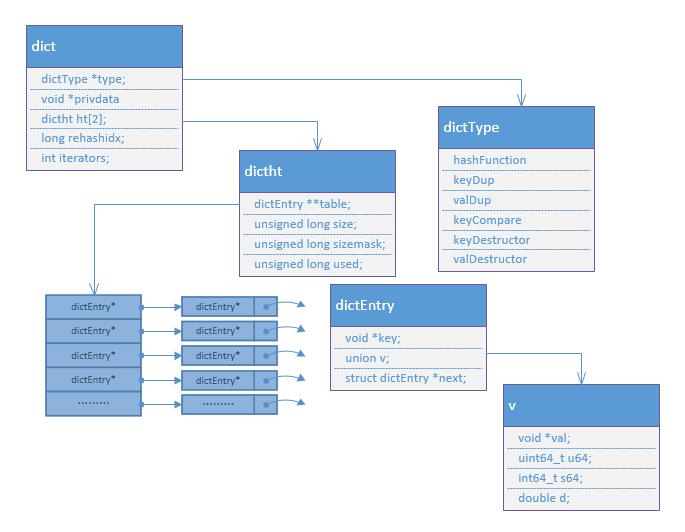
3.渐进式hash说明
dict中ht[2]中有两个hash表, 我们第一次存储数据的数据时, ht[0]会创建一个最小为4的hash表, 一旦ht[0]中的size和used相等, 则dict中会在ht[1]创建一个size*2大小的hash表, 此时并不会直接将ht[0]中的数据copy进ht[0]中, 执行的是渐进式rehash, 即在以后的操作(find, set, get等)中慢慢的copy进去, 以后新添加的元素会添加进ht[0], 因此在ht[1]被占满的时候定能确保ht[0]中所有的数据全部copy到ht[1]中.
4.创建hash表
创建hash表过程非常简单,直接调用dictCreate函数, 分配一块内存,初始化中间变量即可.
dict *dictCreate(dictType *type, void *privDataPtr)

{

     /*分配内存*/

    dict *d = zmalloc(sizeof(*d));

     /*初始化操作*/

    _dictInit(d,type,privDataPtr);

    return d;

}
5.添加元素
hash表中添加元素,首先判断空间是否足够, 然后计算key对应的hash值, 然后将需要添加的key和value放入表中.
int dictAdd(dict *d, void *key, void *val)

{

     /*添加入hash表中, 返回新添加元素的实体结构体*/

    dictEntry *entry = dictAddRaw(d,key);

    if (!entry) return DICT_ERR;

     /*元素val值放入元素实体结构中*/

    dictSetVal(d, entry, val);

    return DICT_OK;

}

/*

*添加元素实体函数

*/

dictEntry *dictAddRaw(dict *d, void *key)

{

    int index;

    dictEntry *entry;

    dictht *ht;

    if (dictIsRehashing(d)) _dictRehashStep(d);

    /*根据key值计算新元素在hash表中的索引, 返回-1则表示元素已存在, 直接返回NULL*/

    if ((index = _dictKeyIndex(d, key)) == -1)

        return NULL;

    /*如果在进行rehash过程,则新元素添加到ht[1]中, 否则添加到ht[0]中 */

    ht = dictIsRehashing(d) ? &d->ht[1] : &d->ht[0];

    entry = zmalloc(sizeof(*entry));

    entry->next = ht->table[index];

    ht->table[index] = entry;

    ht->used++;

    /*设置元素key*/

    dictSetKey(d, entry, key);

    return entry;

}

/*

*计算索引的函数

*/

static int _dictKeyIndex(dict *d, const void *key)

{

    unsigned int h, idx, table;

    dictEntry *he;

    /* 判断hash表是否空间足够, 不足则需要扩展 */

    if (_dictExpandIfNeeded(d) == DICT_ERR)

        return -1;

    /* 计算key对应的hash值 */

    h = dictHashKey(d, key);

    for (table = 0; table <= 1; table++) {

          /*计算索引*/

        idx = h & d->ht[table].sizemask;

        /*遍历冲突列表, 判断需要查找的key是否已经在冲突列表中*/

        he = d->ht[table].table[idx];

        while(he) {

            if (dictCompareKeys(d, key, he->key))

                return -1;

            he = he->next;

        }

        if (!dictIsRehashing(d)) break;

    }

    return idx;

}

/*

*判断hash表是否需要扩展空间

*/

static int _dictExpandIfNeeded(dict *d)

{

    /*redis的rehash采用的渐进式hash, rehash时分配了原来两倍的内存空间, 在rehash阶段空间必定够用*/

    if (dictIsRehashing(d)) return DICT_OK;

    /* hash表是空的需要初始化空间, 默认是4*/

    if (d->ht[0].size == 0) return dictExpand(d, DICT_HT_INITIAL_SIZE);

    /* 已使用空间满足不了设置的条件*/

    if (d->ht[0].used >= d->ht[0].size &&

        (dict_can_resize ||

         d->ht[0].used/d->ht[0].size > dict_force_resize_ratio))

    {

          /*扩展空间, 使用空间的两倍*/

        return dictExpand(d, d->ht[0].used*2);

    }

    return DICT_OK;

}

/*

*扩展空间或者初始化hash表空间

*/

int dictExpand(dict *d, unsigned long size)

{

    dictht n;

     /* 对需要分配大小圆整为2的倍数 */

    unsigned long realsize = _dictNextPower(size);

    /* 如果空间足够则表明调用错误 */

    if (dictIsRehashing(d) || d->ht[0].used > size)

        return DICT_ERR;

    n.size = realsize;

    n.sizemask = realsize-1;

    n.table = zcalloc(realsize*sizeof(dictEntry*));

    n.used = 0;

     /*hash表为空初始化hash表*/

    if (d->ht[0].table == NULL) {

        d->ht[0] = n;

        return DICT_OK;

    }

    /*新分配的空间放入ht[1], 后面一步一步进行rehash*/

    d->ht[1] = n;

    d->rehashidx = 0;

    return DICT_OK;

}
6.查找元素
查找元素过程,首先计算hash值, 然后计算在ht[0]和ht[1]中索引位置, 进行查找.
dictEntry *dictFind(dict *d, const void *key)

{

    dictEntry *he;

    unsigned int h, idx, table;

    if (d->ht[0].size == 0) return NULL;

     /*如果正在进行rehash, 执行一次rehash*/

    if (dictIsRehashing(d)) _dictRehashStep(d);

    h = dictHashKey(d, key);

     /*由于可能正在rehash, 因此要从ht[0]和ht[1]中分别进行查找, 找不到返回NULL*/

    for (table = 0; table <= 1; table++) {

        idx = h & d->ht[table].sizemask;

        he = d->ht[table].table[idx];

          /*遍历冲突列表查找元素*/

        while(he) {

            if (dictCompareKeys(d, key, he->key))

                return he;

            he = he->next;

        }

        if (!dictIsRehashing(d)) return NULL;

    }

    return NULL;

}
7.删除元素
删除元素首先查找元素, 然后将元素从hash表中移除即可, 调用dictDelete删除元素, 会同时删除元素所占空间
int dictDelete(dict *ht, const void *key) {

    return dictGenericDelete(ht,key,0);

}

static int dictGenericDelete(dict *d, const void *key, int nofree)

{

    unsigned int h, idx;

    dictEntry *he, *prevHe;

    int table;

    if (d->ht[0].size == 0) return DICT_ERR;

    if (dictIsRehashing(d)) _dictRehashStep(d);

    h = dictHashKey(d, key);

    for (table = 0; table <= 1; table++) {

        idx = h & d->ht[table].sizemask;

        he = d->ht[table].table[idx];

        prevHe = NULL;

          /*查找元素到元素,进行删除操作, 并释放占用的内存*/

        while(he) {

            if (dictCompareKeys(d, key, he->key)) {

                /* Unlink the element from the list */

                if (prevHe)

                    prevHe->next = he->next;

                else

                    d->ht[table].table[idx] = he->next;

                if (!nofree) {

                    dictFreeKey(d, he);

                    dictFreeVal(d, he);

                }

                zfree(he);

                d->ht[table].used--;

                return DICT_OK;

            }

            prevHe = he;

            he = he->next;

        }

        if (!dictIsRehashing(d)) break;

    }

    return DICT_ERR; /* not found */

}
hash命令
hash命令操作都比较简单,需要注意的是当我们创建hash表示默认存储结构,并不是dict,而是ziplist结构,可以参考redis之Ziplist数据结构,hash_max_ziplist_entries和hash_max_ziplist_value值作为阀值,hash_max_ziplist_entries表示一旦ziplist中元素数量超过该值,则需要转换为dict结构;hash_max_ziplist_value表示一旦ziplist中数据长度大于该值,则需要转换为dict结构。
Redis之Hash数据结构的更多相关文章
- Redis之hash数据结构实现
参考 https://www.cnblogs.com/ourroad/p/4891648.html https://blog.csdn.net/hjkl950217/article/details/7 ...
- redis 五种数据结构详解(string,list,set,zset,hash)
redis 五种数据结构详解(string,list,set,zset,hash) Redis不仅仅支持简单的key-value类型的数据,同时还提供list,set,zset,hash等数据结构的存 ...
- redis 五种数据结构详解(string,list,set,zset,hash),各种问题综合
redis 五种数据结构详解(string,list,set,zset,hash) https://www.cnblogs.com/sdgf/p/6244937.html redis 与 spring ...
- 【Redis】redis 五种数据结构详解(string,list,set,zset,hash)
redis 五种数据结构详解(string,list,set,zset,hash) Redis不仅仅支持简单的key-value类型的数据,同时还提供list,set,zset,hash等数据结构的存 ...
- Redis 五种数据结构详解(string,hash,list,set,zset)
一.五种数据结构: 1. String--字符串 String 数据结构是简单的 key-value 类型,value 不仅可以是 String,也可以是数字(当数字类型用 Long 可以表示的时候e ...
- Redis 5种数据结构使用及注意事项
1优缺点 非常非常的快,有测评说比Memcached还快(当大家都是单CPU的时候),而且是无短板的快,读写都一般的快,所有API都差不多快,也没有MySQL Cluster.MongoDB那样更新同 ...
- (2)redis的基本数据结构是动态数组
redis的基本数据结构是动态数组 一.c语言动态数组 先看下一般的动态数组结构 struct MyData { int nLen; ]; }; 这是个广泛使用的常见技巧,常用来构成缓冲区.比起指针, ...
- Redis五种数据结构(Windows Server)
1.Redis的五种数据结构 这里推荐大家在命名redis的key的时候最好的加上前缀,并且使用 :来分割前缀 ,这里在使用可视化工具查看的时候就比较好区分,比如我的的前缀是 Demo:test:(一 ...
- Redis指令与数据结构(二)
0.Redis目录结构 1)Redis介绍及部署在CentOS7上(一) 2)Redis指令与数据结构(二) 3)Redis客户端连接以及持久化数据(三) 4)Redis高可用之主从复制实践(四) 5 ...
随机推荐
- ( 转 ) 优秀REST风格 API的设计原则
设计优秀的REST风格API非常困难!API是服务提供方和使用方之间的契约,打破该契约将会给服务端开发人员招来非常大的麻烦,这些麻烦来自于使用API的开发人员,因为对API的改动会导致他们的移动app ...
- ( 转 ) .net 操作 JWT
GitHub: https://github.com/jwt-dotnet/jwt 1.JWT定义 JWT(Json Web Token)是一种用于双方之间传递安全信息的简洁的.URL安全的表述性声明 ...
- 【计算几何】 Codeforces Beta Round #67 (Div. 2) E. Ship's Shortest Path
读懂题意其实是模板题.就是细节略多. #include<cstdio> #include<cmath> #include<algorithm> using name ...
- 【Python笔记】Python语言基础
Python是一种解释性(没有编译).交互式.面向对象的语言 1.安装python编译器 版本:Python2.7比较普遍,Python不是向下兼容的软件,因此Python3.x有些东西不好找资料 2 ...
- Python的编码注释# -*- coding:utf-8 -*-
# -*- coding:utf-8 -*-的主要作用是指定文件编码为utf-8, 因为一般默认的是ASCII码,如果要在文件里面写中文,运行时会出现乱码,加上这句之后会把文件编码强制转换为utf-8 ...
- mysql-connector-java-6日期存储时差的问题解决方法
在my.ini文件中的[mysqld]下面加入 default-time_zone = '+8:00' 重启mysql 修改driver连接路径 这样日期保存到mysql就是正确的了,但是mysql- ...
- CSS3:box-sizing 怪异盒模型
<!DOCTYPE html> <html lang="en"> <head> <meta charset="UTF-8&quo ...
- css字体font-family
1."Arial" 2."Microsoft YaHei" 3."黑体" 4."宋体" 5.sans-serif 6.T ...
- easyUI中datagrid控制获取指定行数的数据
直接上代码: var rows=$('#detail').datagrid('getRows');//获取所有当前加载的数据行 var row=rows[0];// 行数从 0 开始 项目中代码: v ...
- linux sudo使用学习记录
sudo在linux中非常重要,它能够使普通的用户临时拥有root权限.但是如果让用户滥用sudo命令的话可能会造成严重的影响. 例如:修改root的密码,切换到root用户等等. 所以我们虽然需要赋 ...