
Caffe参数交换源码分析
对境准备:对于多个GPU而言,一台机器2个GPU,参数交换的流程图:
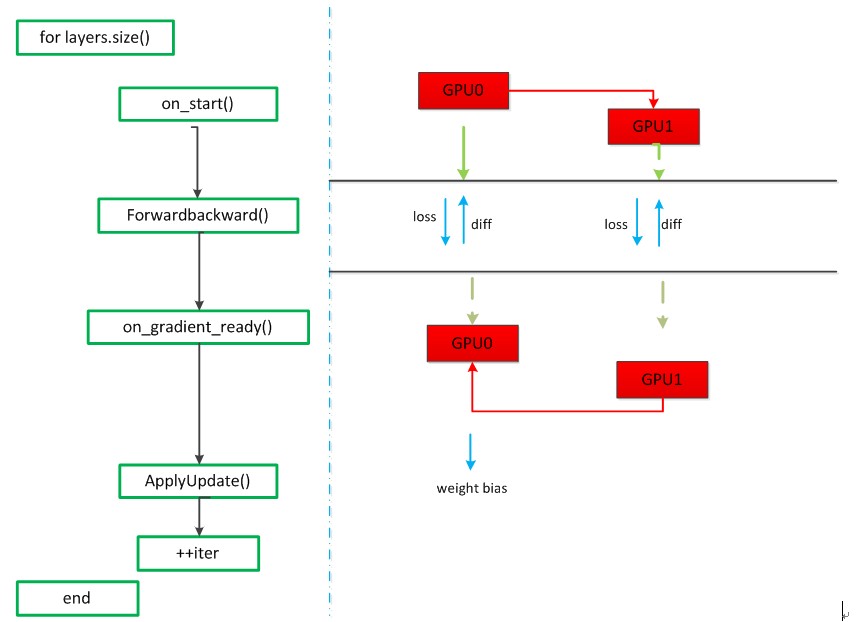
参数交换从main()进入train()函数,在train函数中找到对应源码为:
 . . . . .

 if (gpus.size() > ) {

     caffe::P2PSync<float> sync(solver, NULL, solver->param());

     sync.run(gpus);

   } else {

     LOG(INFO) << "Starting Optimization";

     solver->Solve();

   }
因为GPU的个数>1,所以执行sync(solver, NULL, solver->param())和run()函数,首先会执行P2PSync类的构造函数,然后执行run()函数,run函数的代码如下:
 void P2PSync<Dtype>::run(const vector<int>& gpus) {

   vector<DevicePair> pairs;

   DevicePair::compute(gpus, &pairs);

   SolverParameter param(solver_->param());

   vector<shared_ptr<P2PSync<Dtype> > > syncs(gpus.size());

   // Build the GPU tree by finding the parent for each solver

   for (int attempts = ; attempts < pairs.size(); ++attempts) {. . . . . . .

   }

   for (int i = ; i < syncs.size(); ++i) {

 syncs[i]->StartInternalThread();

   }

   solver_->Solve();

   for (int i = ; i < syncs.size(); ++i) {

     syncs[i]->StopInternalThread();

   }

 }
在run()函数中,首先会执行compute()函数,该函数的作用是产生GPU Pairs,GPU Pairs的含义是[parent:child],对于2个GPU而言,GPU Pairs为[-1:0],[0:1],默认根GPU的parent是其本身。然后通过一个for循环构建GPU树,对于2个GPU而言,GPU树如下图所示:

接下来调用一个for循环为每个GPU开启一个线程,值得注意的是for循环是从i=1开始的,即为每个子GPU单独开启一个线程(这里为GPU1开启一个线程),也就是调用StartInternalThread()函数,该函数的代码如下:
 void InternalThread::StartInternalThread() {. . . . .

   try {

     thread_.reset(new boost::thread(&InternalThread::entry, this, device, mode,

           rand_seed, solver_count, root_solver));

   }. . . . . . .

 }
该函数接着会执行entry()函数,该函数代码如下:
 void InternalThread::entry(int device, Caffe::Brew mode, int rand_seed,

 int solver_count, bool root_solver) {

 . . . . . .

   InternalThreadEntry();

 }
该函数又会去调用InternalThreadEntry()函数,该函数是正式进入迭代运算的入口,代码如下:
 void P2PSync<Dtype>::InternalThreadEntry() {

   Caffe::SetDevice(solver_->param().device_id());

   CHECK(Caffe::root_solver());

   Caffe::set_root_solver(false);

   // See if there is a defined seed and reset random state if so

   if (solver_->param().random_seed() >= ) {

     Caffe::set_random_seed(

         solver_->param().random_seed() + solver_->param().device_id());

   }

   solver_->Step(solver_->param().max_iter() - initial_iter_);

 }
GPU1调用Step()函数,进入迭代过程,见如下源码:
 void Solver<Dtype>::Step(int iters) {

   . . . . . . . . . .

   while (iter_ < stop_iter) {

 . . . . . . . . . .

 for (int i = ; i < callbacks_.size(); ++i) {

       0_[i]->on_start();

     }

     const bool display = param_.display() && iter_ % param_.display() == ;

     net_->set_debug_info(display && param_.debug_info());

     // accumulate the loss and gradient

     Dtype loss = ;

     for (int i = ; i < param_.iter_size(); ++i) {

       loss += net_->ForwardBackward(bottom_vec);//计算loss,一次前后向

     }

     loss /= param_.iter_size();//loss归一化

     . . . . . . .

     for (int i = ; i < callbacks_.size(); ++i) {

       callbacks_[i]->on_gradients_ready();

     }

     ApplyUpdate();

     . . . . . . . . . .

     ++iter_;

   }

 }
整个Step函数的运行如上所示,首先根GPU(GPU0)有整个网络的网络参数,callbacks_.size()指的是GPU树的parent的个数(在这里是1),on_start()函数的作用就是把根GPU(GPU0)的网络参数分发到每一个子GPU(GPU1),GPU1会先进入这个函数,on_start()函数的部分代码如下:
 void P2PSync<Dtype>::on_start() {

   . . . . . . .

   // Wait for update from parent

   if (parent_) {

     P2PSync<Dtype> *parent = queue_.pop();//取队列中的第一个gpu节点为根gpu

     CHECK(parent == parent_);

   }

   . . . . . .
当执行到queue_.pop()时,会调用blocking_queue.cpp的pop()方法,pop()方法的内容如下:
 T BlockingQueue<T>::pop(const string& log_on_wait) {

   boost::mutex::scoped_lock lock(sync_->mutex_);

   while (queue_.empty()) {

     if (!log_on_wait.empty()) {

       LOG_EVERY_N(INFO, )<< log_on_wait;

     }

     sync_->condition_.wait(lock);//如果queue_为空,就一直阻塞。

   }
该方法内部有wait()函数,因为此时queue_为空,所以GPU1就会被堵塞,因为GPU0和GPU1是两个线程并行运行,所以GPU0会执行run()函数中的下一步,也就是solver_->Solve(),Solve()函数的代码如下:
 void Solver<Dtype>::Solve(const char* resume_file) {

   int start_iter = iter_;

 . . . . .

   //LOG(INFO) <<"This is the sign of the train begin?********Ni****Jian*********";  //test for nijian

   Step(param_.max_iter() - iter_);

   . . . . .

 }
Solve()函数会调用Step()函数进入迭代过程,当GPU0进入on_start()函数后,会把队列中的GPU0出队列,同时会激活被堵塞的GPU1,接下来的on_start()函数代码如下:
  . . . . .

 // Update children

   for (int i = children_.size() - ; i >= ; i--) {

     Dtype* src = data_;

     Dtype* dst = children_[i]->data_;

 #ifdef DEBUG

    . . . .

 #endif

     CUDA_CHECK(cudaMemcpyAsync(dst, src, size_ * sizeof(Dtype),

         cudaMemcpyDeviceToDevice, cudaStreamDefault));//每个子GPU把信息传入到根GPU,异步操作

     CUDA_CHECK(cudaStreamSynchronize(cudaStreamDefault));//根GPU把信息同步传到各个子GPU

     children_[i]->queue_.push(this);

   }

 #endif

 }
在该部分代码中,src指的是GPU0的data(网络参数),dst指的是GPU1的data(网络参数),通过调用cudaMemcpyAsync()函数来放置一个请求,表示在cudaStreamDefault流中执行一次内存复制操作,然后调用cudaStreamSynchronize()等待cudaStreamDefault流中的操作完成后实现流的同步。经过这两个函数后,GPU0完成了把网络参数分发给GPU1,然后children_[i]->queue_.push(this)被执行后,会调用block_queue.cpp文件中的push函数激活GPU0的子GPU,即GPU1,同时把GPU1压入队列,此时队列中只有GPU1。
 void BlockingQueue<T>::push(const T& t) {

   boost::mutex::scoped_lock lock(sync_->mutex_);

   queue_.push(t);

   lock.unlock();

   sync_->condition_.notify_one();

 }
此时,多个GPU的参数分发过程已经完成,接下来GPU0和GPU1并行执行Step()函数的下一步,即:ForwardBackward(),该函数的代码如下:
 Dtype ForwardBackward(const vector<Blob<Dtype>* > & bottom) {

     Dtype loss;

     Forward(bottom, &loss);

     Backward();

     return loss;

   }
该函数的主要作用就是就是计算出loss和梯度diff,然后再接着执行Step()函数中的下一步,即:on_gradients_ready()函数,该函数分为两个部分,第一部分是多个GPU的梯度加和,第二部分是将计算后的梯度传给根GPU(GPU0)。第一部分的代码如下:
 void P2PSync<Dtype>::on_gradients_ready() {. . . . . . . .

   // Sum children gradients as they appear in the queue

   for (int i = ; i < children_.size(); ++i) {

     P2PSync<Dtype> *child = queue_.pop();

     Dtype* src = child->parent_grads_;

     Dtype* dst = diff_;

 #ifdef DEBUG

     cudaPointerAttributes attributes;

     CUDA_CHECK(cudaPointerGetAttributes(&attributes, src));

     CHECK(attributes.device == device);

     CUDA_CHECK(cudaPointerGetAttributes(&attributes, dst));

     CHECK(attributes.device == device);

 #endif

     caffe_gpu_add(size_, src, dst, dst);

   }
第一部分是多个GPU的梯度加和,因为GPU0和GPU1是并行计算的,如果GPU0执行到这里时,会使队列中仅有的GPU1出队列,然后通过调用caffe_gpu_add()函数,将一个GPU的梯度diff直接传给另一个GPU,不需要经过CPU通信,即GPU1把其计算的diff传给GPU0。如果是GPU1执行到这里时,因为GPU1没有子GPU,所以会直接跳过这一部分。第二部分的代码如下:
   if (parent_) {

     Dtype* src = diff_;

     Dtype* dst = parent_grads_;

 #ifdef DEBUG

 #endif

     CUDA_CHECK(cudaMemcpyAsync(dst, src, size_ * sizeof(Dtype),  //

         cudaMemcpyDeviceToDevice, cudaStreamDefault));

     CUDA_CHECK(cudaStreamSynchronize(cudaStreamDefault));

     parent_->queue_.push(this);

   } else {

     // Loss functions divide gradients by the batch size, so to compensate

     // for split batch, the root solver divides by number of solvers.

     caffe_gpu_scal(size_, Dtype(1.0 / Caffe::solver_count()), diff_);

   }
如果是GPU0的话,会执行else,即caffe_gpu_scal(),该函数把得到的之前计算的梯度diff_和除以GPU的个数,来更新梯度。如果是GPU1的话,会执行if的语句,此时和on_start()函数分析类似,经过cudaMemcpyAsync()和cudaStreamSynchronize()函数操作之后,将GPU1中的梯度传送给GPU0,第二部分完成。
接下来根GPU(GPU0)会得到所有的参数信息,会执行Step()函数的下一步,即执行ApplyUpdate()函数,该函数中有一个程序:CHECK(Caffe::root_solver()),会在根GPU中利用梯度下降法更新权重,计算参数,到此为止一次迭代完成,再进入下一次迭代时,根GPU已经保存了所有的网络参数,再继续迭代循环,直至结束。
Caffe参数交换源码分析的更多相关文章
- 认识 Redis client-output-buffer-limit 参数与源码分析
概述 Redis 的 client-output-buffer-limit 可以用来强制断开无法足够快从 redis 服务器端读取数据的客户端.保护机制规则如下: [hard limit] 大小限制, ...
- caffe web demo运行+源码分析
caffe web demo学习 1.运行 安装好caffe后,进入/opt/caffe/examples/web_demo/的caffe web demo项目目录,查看一下app.py文件,这是一个 ...
- 详解SpringMVC中Controller的方法中参数的工作原理[附带源码分析]
目录 前言 现象 源码分析 HandlerMethodArgumentResolver与HandlerMethodReturnValueHandler接口介绍 HandlerMethodArgumen ...
- 性能测试分享: Jmeter的源码分析main函数参数
性能测试分享: Jmeter的源码分析main函数参数 poptest是国内唯一一家培养测试开发工程师的培训机构,以学员能胜任自动化测试,性能测试,测试工具开发等工作为目标.如果对课程感兴趣,请大 ...
- springMVC源码分析--RequestParamMethodArgumentResolver参数解析器(三)
之前两篇博客springMVC源码分析--HandlerMethodArgumentResolver参数解析器(一)和springMVC源码解析--HandlerMethodArgumentResol ...
- 【Spark篇】---Spark中资源和任务调度源码分析与资源配置参数应用
一.前述 Spark中资源调度是一个非常核心的模块,尤其对于我们提交参数来说,需要具体到某些配置,所以提交配置的参数于源码一一对应,掌握此节对于Spark在任务执行过程中的资源分配会更上一层楼.由于源 ...
- 开源网站流量统计系统Piwik源码分析——参数统计(一)
Piwik现已改名为Matomo,这是一套国外著名的开源网站统计系统,类似于百度统计.Google Analytics等系统.最大的区别就是可以看到其中的源码,这正合我意.因为我一直对统计的系统很好奇 ...
- springMVC源码分析--HttpMessageConverter参数read操作(二)
上一篇博客springMVC源码分析--HttpMessageConverter数据转化(一)中我们简单介绍了一下HttpMessageConverter接口提供的几个方法,主要有以下几个方法: (1 ...
- 【MVC - 参数原理】详解SpringMVC中Controller的方法中参数的工作原理[附带源码分析]
前言 SpringMVC是目前主流的Web MVC框架之一. 如果有同学对它不熟悉,那么请参考它的入门blog:http://www.cnblogs.com/fangjian0423/p/spring ...
随机推荐
- 前端开发HTML&css入门——HTML
HTML究竟为何物?其实HTML就是一种标记语言,英文全称为Hypertext Markup Language,翻译过来就叫超文本标记语言.它的作用就是负责负责网页的三个要素之中的结构. HTML使用 ...
- Kali Linux安装及中文指南
Kali Linux安装及中文指南 Kali Linux安装教程:https://blog.csdn.net/u012318074/article/details/71601382 Kali Linu ...
- window下lamp环境搭建
软件: apache_2.2.25.msi php-5.4.30-Win32-VC9-x86.zip mysql-5.6.11-win32.msi下载地址:http://download.csdn.n ...
- windows上的QT发布
1. 生成exe 1.1 release 条件下编译 1.2 将QT bin路径加入到path中去 1.3 将1.1生成的exe拷贝到单独的目录,然后cmd到这个目录,使用windeployqt编译 ...
- 使用vim打造python-ide
一.前言 一直希望在linux下进行python开发,但是linux不想启动图形化界面,所以干脆直接用上了万能的VIM,用VIM打造了属于自己的python-IDE 二.插件 标签导航(tagbar和 ...
- Linux系统安装使用实录--传送门(持续更新)
1.安装Linux系统 经过两种系统对比,发现ubuntu的资源依赖更方便更全, centos安装时可以配置开发环境,默认有安装的jdk,这一点比Ubuntu方便一点. win10+centos ...
- CSS初识
CSS:层叠样式表,控制网页数据样式显示,使得数据的表现和内容分离 CSS的引入方式 使用元素内嵌样式表:例<a style=”font-size:40px”></a>表示在a ...
- 2019 计蒜之道 复赛 D. “星云系统”(单调栈)
VIPKID 是在线少儿英语教育平台,网络稳定是在线教育课程质量的红线,VIPKID 为此推出了全球最稳定的教育网络系统 -- "星云系统".星云系统目前建立了覆盖全球 3535 ...
- 为什么我选择用 flutter
1. flutter 生成的是机器代码,他既不是 hybrid 也不是transpiler, 因此有很高的执行效率. 2. declarative ui,这不是什么新的概念,在 react vue ...
- java Class类使用
1.forName public static Class<?> forName(String className) throws ClassNotFoundException 返回与带有 ...