
poj2528
| Time Limit: 1000MS | Memory Limit: 65536K | |
| Total Submissions: 56864 | Accepted: 16445 |
Description
- Every candidate can place exactly one poster on the wall.
- All posters are of the same height equal to the height of the wall; the
width of a poster can be any integer number of bytes (byte is the unit of length
in Bytetown). - The wall is divided into segments and the width of each segment is one byte.
- Each poster must completely cover a contiguous number of wall segments.
They have built a wall 10000000 bytes long (such that there is
enough place for all candidates). When the electoral campaign was restarted, the
candidates were placing their posters on the wall and their posters differed
widely in width. Moreover, the candidates started placing their posters on wall
segments already occupied by other posters. Everyone in Bytetown was curious
whose posters will be visible (entirely or in part) on the last day before
elections.
Your task is to find the number of visible posters when all the
posters are placed given the information about posters' size, their place and
order of placement on the electoral wall.
Input
number of cases that follow. The first line of data for a single case contains
number 1 <= n <= 10000. The subsequent n lines describe the posters in the
order in which they were placed. The i-th line among the n lines contains two
integer numbers li and ri which are the number of the wall segment
occupied by the left end and the right end of the i-th poster, respectively. We
know that for each 1 <= i <= n, 1 <= li <= ri <=
10000000. After the i-th poster is placed, it entirely covers all wall segments
numbered li, li+1 ,... , ri.
Output
posters after all the posters are placed.
The picture below illustrates
the case of the sample input. 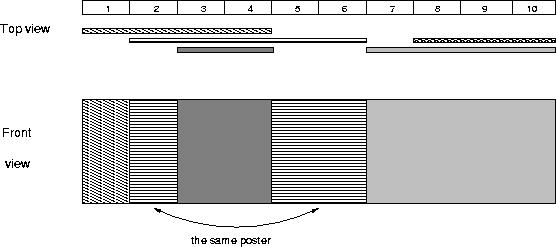
Sample Input
1

5

1 4

2 6

8 10

3 4

7 10
Sample Output
4
Source
#include<cstdio>

#include<cstring>

#include<algorithm>

#include<iostream>

using namespace std;

#define N 1005

int m,ans,li[N],ri[N];

int x[N<<],col[N<<],hash[N];

void pushdown(int rt){

    col[rt<<]=col[rt<<|]=col[rt];

    col[rt]=-;

}

void updata(int rt,int l,int r,int val,int x,int y){

    if(x>=l&&y<=r){

        col[rt]=val;return ;

    }

    if(col[rt]!=-) pushdown(rt);

    int mid=(x+y)>>;

    if(mid>=l) updata(rt<<,l,r,val,x,mid);

    if(mid<r) updata(rt<<|,l,r,val,mid+,y);

}

void query(int rt,int l,int r){

    if(l==r){

        if(!hash[col[rt]]){

            hash[col[rt]]=;

            ans++;

        }

        return ;

    }

    if(col[rt]!=-) pushdown(rt);

    int mid=(l+r)>>;

    query(rt<<,l,mid);

    query(rt<<|,mid+,r);

}

int search(int ll,int hh,int xx){

    while(ll<=hh){

        int mid=(ll+hh)>>;

        if(x[mid]==xx) return mid;

        else if(x[mid]>xx) hh=mid-;

        else ll=mid+;

    }

    return -;

}

int main(){

    int t,n;

    scanf("%d",&t);

    while(t--){

        memset(col,-,sizeof col);

        memset(hash,,sizeof hash);

        int tot();

        scanf("%d",&n);

        for(int i=;i<=n;i++){

            scanf("%d%d",&li[i],&ri[i]);

            x[++tot]=li[i];

            x[++tot]=ri[i];

        }

        sort(x+,x+tot+);

        m=;

        for(int i=;i<=tot;i++){

            if(x[i]!=x[i-]) x[++m]=x[i];

        }

        for(int i=m;i>;i--){

            if(x[i]-x[i-]>) x[++m]=x[i]-;

        }

        sort(x+,x+m+);

        for(int i=;i<=n;i++){

            int l=search(,m,li[i]);

            int r=search(,m,ri[i]);

            updata(,l,r,i,,m);

        }

        ans=;

        query(,,m);

        printf("%d\n",ans);

    }

    return ;

}
题意:在墙上贴海报,海报可以互相覆盖,问最后可以看见几张海报
思路:这题数据范围很大,直接搞超时+超内存:
需要:线段树2的板子+离散化
离散化,如下面的例子(题目的样例),因为单位1是一个单位长度,将下面的
1 2 3 4 6 7 8 10
— — — — — — — —
1 2 3 4 5 6 7 8
离散化 X[1] = 1; X[2] = 2; X[3] = 3; X[4] = 4; X[5] = 6; X[7] = 8; X[8] = 10
于是将一个很大的区间映射到一个较小的区间之中了,然后再对每一张海报依次更新在宽度为1~8的墙上(用线段树),最后统计不同颜色的段数。
但是只是这样简单的离散化是错误的,
如三张海报为:1~10 1~4 6~10
离散化时 X[ 1 ] = 1, X[ 2 ] = 4, X[ 3 ] = 6, X[ 4 ] = 10
第一张海报时:墙的1~4被染为1;
第二张海报时:墙的1~2被染为2,3~4仍为1;
第三张海报时:墙的3~4被染为3,1~2仍为2。
最终,第一张海报就显示被完全覆盖了,于是输出2,但实际上明显不是这样,正确输出为3。
新的离散方法为:在相差大于1的数间加一个数,例如在上面1 4 6 10中间加5(算法中实际上1,4之间,6,10之间都新增了数的)
X[ 1 ] = 1, X[ 2 ] = 4, X[ 3 ] = 5, X[ 4 ] = 6, X[ 5 ] = 10
这样之后,第一次是1~5被染成1;第二次1~2被染成2;第三次4~5被染成3
最终,1~2为2,3为1,4~5为3,于是输出正确结果3。
所以离散化要保存所有需要用到的值,排序后,分别映射到1~n,这样复杂度就会小很多很多
而这题的难点在于每个数字其实表示的是一个单位长度(并且一个点),这样普通的离散化会造成许多错误(包括我以前的代码,poj这题数据奇弱)
给出下面两个简单的例子应该能体现普通离散化的缺陷:
1-10 1-4 5-10
1-10 1-4 6-10
为了解决这种缺陷,我们可以在排序后的数组上加些处理,比如说[1,2,6,10]
如果相邻数字间距大于1的话,在其中加上任意一个数字,比如加成[1,2,3,6,7,10],然后再做线段树就好了.
线段树功能:update:成段替换 query:简单hash
AC代码:
#include<iostream>

#include<cstring>

#include<cstdio>

#include<algorithm>

using namespace std;

#define N 10005

int m,li[N],ri[N];

int x[N<<],col[N<<],ans;

bool hash[N];

void pushdown(int rt) {

     col[rt<<]=col[rt<<|]=col[rt];

     col[rt]=-;

}

void updata(int rt,int L,int R,int c,int l,int r){

     if(l>=L&&r<=R){

         col[rt]=c;return ;

     }

     if(col[rt]!=-) pushdown(rt);

     int mid=(l+r)>>;

     if(mid>=L) updata(rt<<,L,R,c,l,mid);

     if(mid<R)  updata(rt<<|,L,R,c,mid+,r);

}

void query(int rt,int l,int r){

    if(l==r){

        if(!hash[col[rt]]){

            hash[col[rt]]=;

            ans++;

        }

       return;

    }

    if(col[rt]!=-) pushdown(rt);

    int mid=(l+r)>>;

    query(rt<<,l,mid);

    query(rt<<|,mid+,r);

}

int search(int ll,int hh,int xx){

    int mid;

    while (ll<=hh){

        mid=(ll+hh)>>;

        if(x[mid]==xx) return mid;

        else if(x[mid]>xx)  hh=mid-;

        else ll=mid+;

    }

    return -;

}

int main(){

    int t,n,i;

    scanf("%d",&t);

    while(t--){

        memset(col,-,sizeof(col));

        memset(hash,,sizeof(hash));

        int tot=;

        scanf("%d",&n);

        for(i=;i<=n;i++){

             scanf ("%d %d",&li[i],&ri[i]);

             x[++tot]=li[i];

             x[++tot]=ri[i];

        }

        sort(x+,x+tot+);

        m=;

        for(i=;i<=tot;i++){

             if(x[i]!=x[i-]) x[++m]=x[i];

        }

        for(i=m;i>;i--){

            if(x[i]-x[i-]>) x[++m]=x[i]-;

        }

        sort(x+,x+m+);

        for(i=; i<=n; i++){

            int l=search(,m,li[i]);

            int r=search(,m,ri[i]);

            updata(,l,r,i,,m);

        }

        ans=;

        query(,,m);

        printf("%d\n",ans);

    }

    return ;

}
poj2528的更多相关文章
- poj3468,poj2528
其实这两题都是基础的线段树,但对于我这个线段树的初学者来说,总结一下还是很有用的: poj3468显然是线段树区间求和,区间更改的问题,而poj2528是对区间染色,问有多少种颜色的问题: 线段树的建 ...
- poj2528(线段树+离散化)
题目链接:https://vjudge.net/problem/POJ-2528 题意:在区间[1,1e7]内染色,依次染n(<=1e4)中颜色,给出每种颜色染色的范围,可重叠,求最终有多少种颜 ...
- poj-2528线段树练习
title: poj-2528线段树练习 date: 2018-10-13 13:45:09 tags: acm 刷题 categories: ACM-线段树 概述 这道题坑了我好久啊啊啊啊,,,, ...
- 线段树---poj2528 Mayor’s posters【成段替换|离散化】
poj2528 Mayor's posters 题意:在墙上贴海报,海报可以互相覆盖,问最后可以看见几张海报 思路:这题数据范围很大,直接搞超时+超内存,需要离散化: 离散化简单的来说就是只取我们需要 ...
- POJ2528 Mayor's posters —— 线段树染色 + 离散化
题目链接:https://vjudge.net/problem/POJ-2528 The citizens of Bytetown, AB, could not stand that the cand ...
- POJ-2528 Mayor's posters (离散化, 线段树)
题目传送门: POJ-2528 题意就是在一个高度固定的墙面上贴高度相同宽度不同的海报,问贴到最后还能看到几张?本质上是线段树区间更新问题,但是要注意的是题中所给数据范围庞大,直接搞肯定会搞出问题,所 ...
- ACM/ICPC 之 数据结构-线段树+区间离散化(POJ2528)
这道题用线段树做更方便更新和查询,但是其数据范围很大,因此要将离散化和线段树结合起来,算是一道比较经典的线段树+离散化的例题. 线段树的离散化有很多方法,在这里,我先用一次结点离散化,间接将源左右端点 ...
- Mayor's posters(线段树+离散化POJ2528)
Mayor's posters Time Limit: 1000MS Memory Limit: 65536K Total Submissions: 51175 Accepted: 14820 Des ...
- [poj2528] Mayor's posters (线段树+离散化)
线段树 + 离散化 Description The citizens of Bytetown, AB, could not stand that the candidates in the mayor ...
- poj2528 Mayor's posters(线段树之成段更新)
Mayor's posters Time Limit: 1000MSMemory Limit: 65536K Total Submissions: 37346Accepted: 10864 Descr ...
随机推荐
- 倍福TwinCAT(贝福Beckhoff)常见问题(FAQ)-T_AmsNetID是什么
该参数是包含六个数字类似于IP地址的字符串形式,例如"1.1.1.2.7.1",如果为空字符串,则默认使用本机的AmsNetID 你可以右击贝福的图标,然后点击About查看当前本 ...
- 微信小程序 如何定义全局函数?
微信小程序 定义全局数据.函数复用.模版等 微信小程序定义全局数据.函数复用.模版等问题总结: 1.如何定义全局数据 在app.js的App({})中定义的数据或函数都是全局的,在页面中可以通过var ...
- 帮朋友转发招聘信息 南京知名互联网公司招聘java、测试、前端,具体私聊
一.java开发 1.5年及以上J2EE方向开发经验 2.精通spring等开源框架 3.熟悉html.javascript.css.jsp/freemarker.jquery的使用 4.熟悉使用my ...
- Python 实现的猫脸识别、人脸识别器。
代码地址如下:http://www.demodashi.com/demo/13071.html 前言: OpenCV是开源的跨平台计算机视觉库,提供了Python等语言的接口,实现了图像处理和计算机视 ...
- Oracle学习笔记(5)——查询
基本查询语句 SELECT [DISTINCT] column_name1,...|* FROM table_name [WHERE conditions] 在SQL*PLUS中设置格式 更改显示字段 ...
- linux小技巧(1)
1.避免文件夹拼写错误 shopt命令: 演示一下: 我想进入/home文件夹可是不小心拼写错了: [fulinux@ubuntu ~]$ cd /hoem-bash: cd: /hoem: No s ...
- iOS开发-XCode常用快捷键整理
前言:如果我们能够掌握并巧妙地使用快捷键,可以大大加快我们的工作效率,这个对经常使用快捷键的人们来说,应该很容易理解.因此我们需要做的是,针对于自己经常使用的快捷键去进行记忆.我不会推荐你们去把所有的 ...
- EPH接收Event Hub Message
简介: 使用Python SDK,基于EPH方式接收Azure Event Hub中存储的message,EventProcessorHost()中使用Azure Storage存储offerset等 ...
- vc2010, fatal error LNK1123: failure during conversion to COFF: file invalid or corrupt解决办法
是因为安其它软件的时候更新了.net framework,导致vc2010出了问题. 解决办法是在系统里搜索cvtres.exe,会搜到很多,把其中 Microsoft Visual Studio 1 ...
- 在CentOS 6.3中安装拼音输入法
安装:su root yum install "@Chinese Support" // 安装中文输入法 exit安装完毕,在“系统-->首选项”会看到“输入法”一 ...