
机器学习作业(二)逻辑回归——Python(numpy)实现
题目太长啦!文档下载【传送门】
第1题
简述:实现逻辑回归。
此处使用了minimize函数代替Matlab的fminunc函数,参考了该博客【传送门】。
 import numpy as np

 import matplotlib.pyplot as plt

 import scipy.optimize as op

 #S函数

 def sigmoid(z):

     g = 1/(1+np.exp(-z))

     return g

 #cost计算函数

 def costFunction(theta, X, y):

     theta = np.array(theta).reshape((np.size(theta),1))

     m = np.size(y)

     h = sigmoid(np.dot(X, theta))

     J = 1/m*(-np.dot(y.T, np.log(h)) - np.dot((1-y.T), np.log(1-h)))

     return J.flatten()

 def gradient(theta, X, y):

     theta = np.array(theta).reshape((np.size(theta), 1))

     m = np.size(y)

     h = sigmoid(np.dot(X, theta))

     grad = 1/m*np.dot(X.T, h - y)

     return grad.flatten()

 #读取数据,第一列是成绩1,第二列是成绩2,第三列是yes/no

 data = np.loadtxt('ex2data1.txt', delimiter=',', dtype='float')

 m = np.size(data[:, 0])

 # print(data)

 #绘制样本点

 X = data[:, 0:2]

 y = data[:, 2:3]

 pos = np.where(y == 1)[0]

 neg = np.where(y == 0)[0]

 X1 = X[pos, 0:2]

 X0 = X[neg, 0:2]

 plt.plot(X1[:, 0], X1[:, 1], 'k+')

 plt.plot(X0[:, 0], X0[:, 1], 'yo')

 plt.xlabel('Exam 1 score')

 plt.ylabel('Exam 2 score')

 #求解最优解

 one = np.ones(m)

 X = np.insert(X, 0, values=one, axis=1)

 initial_theta = np.zeros(np.size(X, 1))

 result = op.minimize(fun=costFunction, x0=initial_theta, args=(X, y), method='TNC', jac=gradient)

 # print(result)

 theta = result.x

 cost = result.fun

 print('theta:', theta)

 print('cost:', cost)

 #绘制决策边界

 plot_x = np.array([np.min(X[:, 1]), np.max(X[:, 2])])

 # print(plot_x)

 plot_y = (-1/theta[2])*(theta[1]*plot_x+theta[0])

 # print(plot_y)

 plt.plot(plot_x,plot_y)

 plt.legend(labels=['Admitted', 'Not admitted'])

 plt.axis([30, 100, 30, 100])

 plt.show()

 #预测[45 85]成绩的学生,并计算准确率

 theta = np.array(theta).reshape((np.size(theta),1))

 z = np.dot([1, 45, 85], theta)

 prob = sigmoid(z)

 print('For a student with scores 45 and 85, we predict an admission probability of ', prob)

 p = np.round(sigmoid(np.dot(X,theta)))

 acc = np.mean(p==y)*100

 print('Train Accuracy: ',acc,'%')
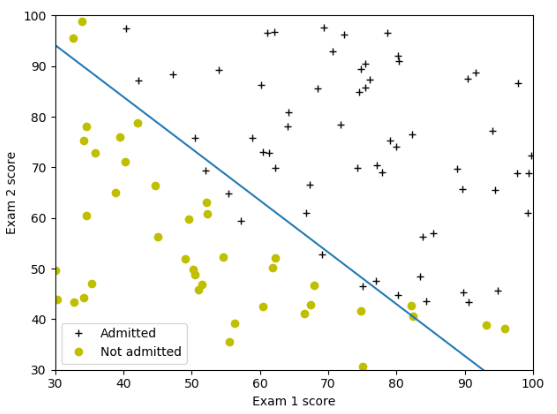
运行结果:

第2题
简述:通过正规化实现逻辑回归。
 import numpy as np

 import matplotlib.pyplot as plt

 import scipy.optimize as op

 #S函数

 def sigmoid(z):

     g = 1/(1+np.exp(-z))

     return g

 #cost计算函数

 def costFunction(theta, X, y, lamb):

     theta = np.array(theta).reshape((np.size(theta), 1))

     m = np.size(y)

     h = sigmoid(np.dot(X, theta))

     J = 1/m*(-np.dot(y.T, np.log(h)) - np.dot((1-y.T), np.log(1-h)))

     # 添加项

     theta2 = theta[1:, 0]

     Jadd = lamb/(2*m)*np.sum(theta2**2)

     J = J + Jadd

     return J.flatten()

 #求梯度

 def gradient(theta, X, y, lamb):

     theta = np.array(theta).reshape((np.size(theta), 1))

     m = np.size(y)

     h = sigmoid(np.dot(X, theta))

     grad = 1/m*np.dot(X.T, h - y)

     #添加项

     theta[0,0] = 0

     gradadd = lamb/m*theta

     grad = grad + gradadd

     return grad.flatten()

 #求特征矩阵

 def mapFeature(X1, X2):

     degree = 6

     out = np.ones((np.size(X1),1))

     for i in range(1, degree+1):

         for j in range(0, i+1):

             res = np.multiply(np.power(X1, i-j), np.power(X2, j))

             out = np.insert(out, np.size(out[0, :]), values=res, axis=1)

     return out

 #读取数据,第一列是成绩1,第二列是成绩2,第三列是yes/no

 data = np.loadtxt('ex2data2.txt', delimiter=',', dtype='float')

 m = np.size(data[:, 0])

 #绘制样本点

 X = data[:, 0:2]

 y = data[:, 2:3]

 pos = np.where(y == 1)[0]

 neg = np.where(y == 0)[0]

 X1 = X[pos, 0:2]

 X0 = X[neg, 0:2]

 plt.plot(X1[:, 0], X1[:, 1], 'k+')

 plt.plot(X0[:, 0], X0[:, 1], 'yo')

 plt.xlabel('Microchip Test 1')

 plt.ylabel('Microchip Test 2')

 plt.legend(labels=['y = 1', 'y = 0'])

 #数据初始化

 X = mapFeature(X[:, 0], X[:, 1])

 # print(X)

 lamb = 1

 initial_theta = np.zeros(np.size(X, 1))

 #求解最优解

 result = op.minimize(fun=costFunction, x0=initial_theta, args=(X, y, lamb), method='TNC', jac=gradient)

 # print(result)

 cost = result.fun

 theta = result.x

 print('theta:', theta)

 print('cost:', cost)

 #绘制决策边界

 u = np.linspace(-1, 1.5, 50)

 v = np.linspace(-1, 1.5, 50)

 z = np.zeros((np.size(u),np.size(v)))

 theta = np.array(theta).reshape((np.size(theta), 1))

 for i in range(0, np.size(u)):

     for j in range(0, np.size(v)):

         z[i, j] = np.dot(mapFeature(u[i], v[j]), theta)

 # print(z)

 plt.contour(u, v, z.T, [0])

 plt.show()

 #计算准确率

 p = np.round(sigmoid(np.dot(X,theta)))

 acc = np.mean(p==y)*100

 print('Train Accuracy: ',acc,'%')
运行结果:


机器学习作业(二)逻辑回归——Python(numpy)实现的更多相关文章
- 机器学习二 逻辑回归作业、逻辑回归(Logistic Regression)
机器学习二 逻辑回归作业 作业在这,http://speech.ee.ntu.edu.tw/~tlkagk/courses/ML_2016/Lecture/hw2.pdf 是区分spam的. 57 ...
- 机器学习总结之逻辑回归Logistic Regression
机器学习总结之逻辑回归Logistic Regression 逻辑回归logistic regression,虽然名字是回归,但是实际上它是处理分类问题的算法.简单的说回归问题和分类问题如下: 回归问 ...
- 机器学习算法整理(二)梯度下降求解逻辑回归 python实现
逻辑回归(Logistic regression) 以下均为自己看视频做的笔记,自用,侵删! 还参考了:http://www.ai-start.com/ml2014/ 用梯度下降求解逻辑回归 Logi ...
- scikit-learn机器学习(二)逻辑回归进行二分类(垃圾邮件分类),二分类性能指标,画ROC曲线,计算acc,recall,presicion,f1
数据来自UCI机器学习仓库中的垃圾信息数据集 数据可从http://archive.ics.uci.edu/ml/datasets/sms+spam+collection下载 转成csv载入数据 im ...
- Coursera-AndrewNg(吴恩达)机器学习笔记——第三周编程作业(逻辑回归)
一. 逻辑回归 1.背景:使用逻辑回归预测学生是否会被大学录取. 2.首先对数据进行可视化,代码如下: pos = find(y==); %找到通过学生的序号向量 neg = find(y==); % ...
- 【机器学习基础】逻辑回归——LogisticRegression
LR算法作为一种比较经典的分类算法,在实际应用和面试中经常受到青睐,虽然在理论方面不是特别复杂,但LR所牵涉的知识点还是比较多的,同时与概率生成模型.神经网络都有着一定的联系,本节就针对这一算法及其所 ...
- Stanford机器学习---第三讲. 逻辑回归和过拟合问题的解决 logistic Regression & Regularization
原文:http://blog.csdn.net/abcjennifer/article/details/7716281 本栏目(Machine learning)包括单参数的线性回归.多参数的线性回归 ...
- 机器学习入门11 - 逻辑回归 (Logistic Regression)
原文链接:https://developers.google.com/machine-learning/crash-course/logistic-regression/ 逻辑回归会生成一个介于 0 ...
- Spark机器学习(2):逻辑回归算法
逻辑回归本质上也是一种线性回归,和普通线性回归不同的是,普通线性回归特征到结果输出的是连续值,而逻辑回归增加了一个函数g(z),能够把连续值映射到0或者1. MLLib的逻辑回归类有两个:Logist ...
随机推荐
- Android布局管理器-使用FrameLayout帧布局管理器显示层叠的正方形以及前景照片
场景 Android布局管理器-使用LinearLayout实现简单的登录窗口布局: https://blog.csdn.net/BADAO_LIUMANG_QIZHI/article/details ...
- [20200129]子光标不共享BIND_EQUIV_FAILURE.txt
[20200129]子光标不共享BIND_EQUIV_FAILURE.txt --//生产系统再次遇到大量BIND_EQUIV_FAILURE原因导致子光标的情况.我看了我以前测试遇到的情况.--// ...
- MFC/QT 学习笔记(一)——认识windows基础库
MFC (微软基础类库),Windows系统平台做GUI尚且OK,但不支持跨平台. //Windows消息机制: //1.SDK与API Software Development Kit,为特定软件框 ...
- vue搭建手顺
1.环境准备:node.js vue-cli: $ npm install vue-cli -g 2.建立项目目录:vuedemo,并cd到该目录下 3.$ vue init webpack vu ...
- datagridview 如何显示记载中
要实现如下效果,有何思路?
- 二维数组的生成-new的使用
相关的思路来自于下面这个博客:https://blog.csdn.net/samuelcoulee/article/details/8674388 我们对于其中的一个方案进行了实现与测试——借助new ...
- POJ 2556 (判断线段相交 + 最短路)
题目: 传送门 题意:在一个左小角坐标为(0, 0),右上角坐标为(10, 10)的房间里,有 n 堵墙,每堵墙都有两个门.每堵墙的输入方式为 x, y1, y2, y3, y4,x 是墙的横坐标,第 ...
- 重写了下Ajax请求Webservice,顺便复习一下Javascript的闭包概念
var AjaxRequest = function(){ //返回处理结果的回调函数 this.agentCallBack = {}; //javascript 调用domino代理的方法. thi ...
- opencv —— copyMakeBorder 扩充图像边界
扩充图像边界:copyMakeBorder 函数 在图像处理过程中,因为卷积算子有一定大小,所以就会导致图像一定范围的边界不能被处理,这时就需要将边界进行适当扩充. void copyMakeBord ...
- 数据库MySQL中关于“多表关联更新”的那些事
在常见的sql中,我们经常在查询中进行多表关联查询,用的比较熟练.今天在开发中遇到一个实际业务场景是多表关联更新,一时不知所措.本着多学习的态度,没有直接写java代码去实现,终于把多表关联更新的sq ...