
Autoencoders and Sparsity(一)
An autoencoder neural network is an unsupervised learning algorithm that applies backpropagation, setting the target values to be equal to the inputs. I.e., it uses  .
.
Here is an autoencoder:
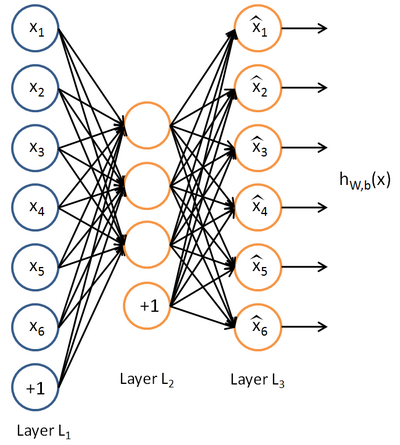
The autoencoder tries to learn a function  . In other words, it is trying to learn an approximation to the identity function, so as to output
  that is similar to
  . The identity function seems a particularly trivial function to be trying to learn; but by placing constraints on the network, such as by limiting the number of hidden units, we can discover interesting structure about the data.
例子&用途
As a concrete example, suppose the inputs
image (100 pixels) so
, and there are
hidden units in layer
. Note that we also have
. Since there are only 50 hidden units, the network is forced to learn a compressed representation of the input. I.e., given only the vector of hidden unit activations
, it must try to reconstruct the 100-pixel input
comes from an IID Gaussian independent of the other features---then this compression task would be very difficult. But if there is structure in the data, for example, if some of the input features are correlated, then this algorithm will be able to discover some of those correlations. In fact, this simple autoencoder often ends up learning a low-dimensional representation very similar to PCAs
约束
Our argument above relied on the number of hidden units
being small. But even when the number of hidden units is large (perhaps even greater than the number of input pixels), we can still discover interesting structure, by imposing other constraints on the network. In particular, if we impose a sparsity constraint on the hidden units, then the autoencoder will still discover interesting structure in the data, even if the number of hidden units is large.
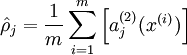
Recall that
denotes the activation of hidden unit
in the autoencoder. However, this notation doesn't make explicit what was the input
to denote the activation of this hidden unit when the network is given a specific input
be the average activation of hidden unit
where
is a sparsity parameter, typically a small value close to zero (say
). In other words, we would like the average activation of each hidden neuron

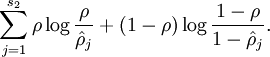
To achieve this, we will add an extra penalty term to our optimization objective that penalizes
deviating significantly from
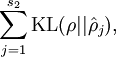
Here,
where
is the Kullback-Leibler (KL) divergence between a Bernoulli random variable with mean
偏离,惩罚
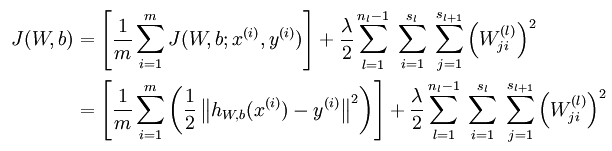
损失函数
无稀疏约束时网络的损失函数表达式如下:
带稀疏约束的损失函数如下:
where
is as defined previously, and
controls the weight of the sparsity penalty term. The term
also, because it is the average activation of hidden unit

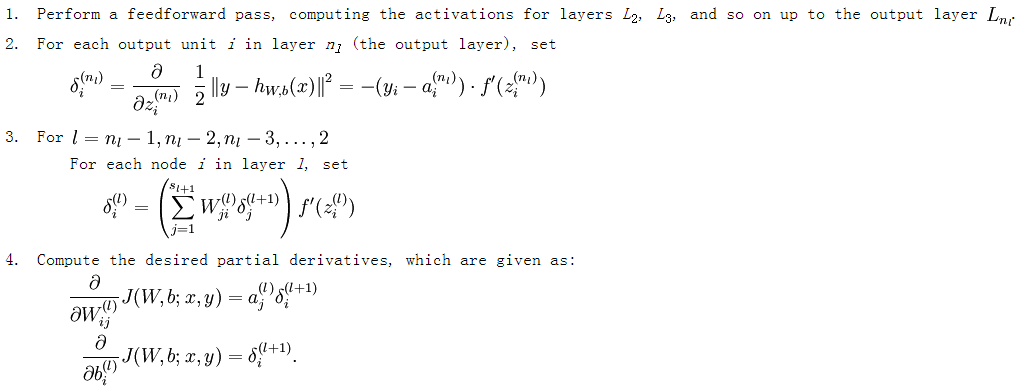
损失函数的偏导数的求法
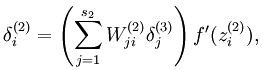
而加入了稀疏性后,神经元节点的误差表达式由公式:
变成公式:

梯度下降法求解
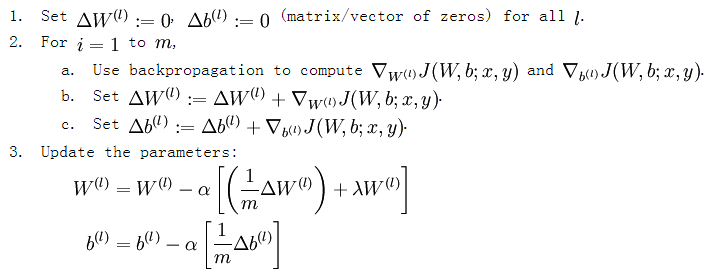
有了损失函数及其偏导数后就可以采用梯度下降法来求网络最优化的参数了,整个流程如下所示:
从上面的公式可以看出,损失函数的偏导其实是个累加过程,每来一个样本数据就累加一次。这是因为损失函数本身就是由每个训练样本的损失叠加而成的,而按照加法的求导法则,损失函数的偏导也应该是由各个训练样本所损失的偏导叠加而成。从这里可以看出,训练样本输入网络的顺序并不重要,因为每个训练样本所进行的操作是等价的,后面样本的输入所产生的结果并不依靠前一次输入结果(只是简单的累加而已,而这里的累加是顺序无关的)。
转自:http://www.cnblogs.com/tornadomeet/archive/2013/03/19/2970101.html
Autoencoders and Sparsity(一)的更多相关文章
- (六)6.4 Neurons Networks Autoencoders and Sparsity
BP算法是适合监督学习的,因为要计算损失函数,计算时y值又是必不可少的,现在假设有一系列的无标签train data: ,其中 ,autoencoders是一种无监督学习算法,它使用了本身作为标签以 ...
- CS229 6.4 Neurons Networks Autoencoders and Sparsity
BP算法是适合监督学习的,因为要计算损失函数,计算时y值又是必不可少的,现在假设有一系列的无标签train data: ,其中 ,autoencoders是一种无监督学习算法,它使用了本身作为标签以 ...
- Autoencoders and Sparsity(二)
In this problem set, you will implement the sparse autoencoder algorithm, and show how it discovers ...
- 【DeepLearning】UFLDL tutorial错误记录
(一)Autoencoders and Sparsity章节公式错误: s2 应为 s3. 意为从第2层(隐藏层)i节点到输出层j节点的误差加权和. (二)Support functions for ...
- Deep Learning 教程翻译
Deep Learning 教程翻译 非常激动地宣告,Stanford 教授 Andrew Ng 的 Deep Learning 教程,于今日,2013年4月8日,全部翻译成中文.这是中国屌丝军团,从 ...
- 三层神经网络自编码算法推导和MATLAB实现 (转载)
转载自:http://www.cnblogs.com/tornadomeet/archive/2013/03/20/2970724.html 前言: 现在来进入sparse autoencoder的一 ...
- DL二(稀疏自编码器 Sparse Autoencoder)
稀疏自编码器 Sparse Autoencoder 一神经网络(Neural Networks) 1.1 基本术语 神经网络(neural networks) 激活函数(activation func ...
- Sparse Autoencoder(二)
Gradient checking and advanced optimization In this section, we describe a method for numerically ch ...
- 【DeepLearning】Exercise:Learning color features with Sparse Autoencoders
Exercise:Learning color features with Sparse Autoencoders 习题链接:Exercise:Learning color features with ...
随机推荐
- 初学者指南:ZFS 是什么,为什么要使用 ZFS?
作者: John Paul 译者: LCTT Lv Feng 今天,我们来谈论一下 ZFS,一个先进的文件系统.我们将讨论 ZFS 从何而来,它是什么,以及为什么它在科技界和企业界如此受欢迎. 虽然我 ...
- kubernetes学习与实践篇(二) kubernetes1.5 的安装和集群环境部署
kubernetes 1.5 的安装和集群环境部署 文章转载自:http://www.cnblogs.com/tynia/p/k8s-cluster.html 简介: Docker:是一个开源的应用容 ...
- 学习《深度学习入门:基于Python的理论与实现》高清中文版PDF+源代码
入门神经网络深度学习,推荐学习<深度学习入门:基于Python的理论与实现>,这本书不来虚的,一上来就是手把手教你一步步搭建出一个神经网络,还能把每一步的出处讲明白.理解神经网络,很容易就 ...
- 洛谷 P2839 畅通工程
P2839 畅通工程 题目描述 某省调查城镇交通状况,得到现有城镇道路统计表,表中列出了每条道路直接连通的城镇.省政府“畅通工程”的目标是使全省任何两个城镇间都可以实现交通(但不一定有直接的道路相连, ...
- [Python] Normalize the data with Pandas
import os import pandas as pd import matplotlib.pyplot as plt def test_run(): start_date='2017-01-01 ...
- Invalid command 'WSGIScriptAlias', perhaps misspelled or defined by a module not included in the ser
没有Include wsgi,执行: sudo a2enmod wsgi 可能出现以下的错误 ERROR: Module mod-wsgi does not exist! 安装 libapache2- ...
- codeforces 558E A Simple Task 线段树
题目链接 题意较为简单. 思路: 由于仅仅有26个字母,所以用26棵线段树维护就好了,比較easy. #include <iostream> #include <string> ...
- jfinal文件上传与下载
import com.alibaba.fastjson.JSONObject; import com.jfinal.core.Controller; import com.jfinal.ext.kit ...
- vue14 自定义过滤器
<!DOCTYPE html> <html lang="en"> <head> <meta charset="UTF-8&quo ...
- FPGA设计中的电源管理(转载)
过去,FPGA设计者主要关心时序和面积使用率问题.但随着FPGA不断取代ASSP和ASIC器件,设计者们现正期望能够开发低功耗设计,在设计流程早期就能对功耗进行正确估算,以及管理和对与FPGA相关的各 ...