
Handling Class Imbalance with R and Caret - An Introduction
When faced with classification tasks in the real world, it can be challenging to deal with an outcome where one class heavily outweighs the other (a.k.a., imbalanced classes). The following will be a two-part post on some of the techniques that can help to improve prediction performance in the case of imbalanced classes using R and caret. This first post provides a general overview of how these techniques can be implemented in practice, and the second post highlights some caveats to keep in mind when using these methods.
Evaluation metrics for classifiers
After building a classifier, you need to decide how to tell if it is doing a good job or not. Many evaluation metrics for classifiers exist, and can generally be divided into two main groups:
Threshold-dependent: This includes metrics like accuracy, precision, recall, and F1 score, which all require a confusion matrix to be calculated using a hard cutoff on predicted probabilities. These metrics are typically quite poor in the case of imbalanced classes, as statistical software inappropriately uses a default threshold of 0.50 resulting in the model predicting that all observations belong in the majority class.
Threshold-invariant: This includes metrics like area under the ROC curve (AUC), which quantifies true positive rate as a function of false positive rate for a variety of classification thresholds. Another way to interpret this metric is the probability that a random positive instance will have a higher estimated probability than a random negative instance.
Methods to improve performance on imbalanced data
A few of the more popular techniques to deal with class imbalance will be covered below, but the following list is nowhere near exhaustive. For brevity, a quick overview is provided. For a more substantial overview, I highly recommend this Silicon Valley Data Science blog post.
Class weights: impose a heavier cost when errors are made in the minority class
Down-sampling: randomly remove instances in the majority class
Up-sampling: randomly replicate instances in the minority class
Synthetic minority sampling technique (SMOTE): down samples the majority class and synthesizes new minority instances by interpolating between existing ones
It is important to note that these weighting and sampling techniques have the biggest impact on threshold-dependent metrics like accuracy, because they artificially move the threshold to be closer to what might be considered as the “optimal” location on a ROC curve. Threshold-invariant metrics can still be improved using these methods, but the effect will not be as pronounced.
Simulation set-up
To simulate class imbalance, the twoClassSim function from caret is used. Here, we simulate a separate training set and test set, each with 5000 observations. Additionally, we include 20 meaningful variables and 10 noise variables. The intercept argument controls the overall level of class imbalance and has been selected to yield a class imbalance of around 50:1.
library(dplyr) # for data manipulation

library(caret) # for model-building

library(DMwR) # for smote implementation

library(purrr) # for functional programming (map)

library(pROC) # for AUC calculations

set.seed(2969)

imbal_train <- twoClassSim(5000,

                           intercept = -25,

                           linearVars = 20,

                           noiseVars = 10)

imbal_test  <- twoClassSim(5000,

                           intercept = -25,

                           linearVars = 20,

                           noiseVars = 10)

prop.table(table(imbal_train$Class))
##
## Class1 Class2
## 0.9796 0.0204Initial results
To model these data, a gradient boosting machine (gbm) is used as it can easily handle potential interactions and non-linearities that have been simulated above. Model hyperparameters are tuned using repeated cross-validation on the training set, repeating five times with ten folds used in each repeat. The AUC is used to evaluate the classifier to avoid having to make decisions about the classification threshold. Note that this code takes a little while to run due to the repeated cross-validation, so reduce the number of repeats to speed things up and/or use the verboseIter = TRUE argument in the trainControl function to keep track of the progress.
# Set up control function for training

ctrl <- trainControl(method = "repeatedcv",

                     number = 10,

                     repeats = 5,

                     summaryFunction = twoClassSummary,

                     classProbs = TRUE)

# Build a standard classifier using a gradient boosted machine

set.seed(5627)

orig_fit <- train(Class ~ .,

                  data = imbal_train,

                  method = "gbm",

                  verbose = FALSE,

                  metric = "ROC",

                  trControl = ctrl)

# Build custom AUC function to extract AUC

# from the caret model object

test_roc <- function(model, data) {

  roc(data$Class,

      predict(model, data, type = "prob")[, "Class2"])

}

orig_fit %>%

  test_roc(data = imbal_test) %>%

  auc()
## Area under the curve: 0.9575Overall, the final model yields an AUC of 0.96 which is quite good. Can we improve it using the techniques outlined above?
Handling class imbalance with weighted or sampling methods
Both weighting and sampling methods are easy to employ in caret. Incorporating weights into the model can be handled by using the weights argument in thetrain function (assuming the model can handle weights in caret, see the listhere), while the sampling methods mentioned above can be implemented using the sampling argument in the trainControl function. Note that the same seeds were used for each model to ensure that results from the same cross-validation folds are being used.
Also keep in mind that for sampling methods, it is vital that you only sample the training set and not the test set as well. This means that when doing cross-validation, the sampling step must be done inside of the cross-validation procedure. Max Kuhn of the caret package gives a good overview of what happens when you don’t take this precaution in this caret documentation. Using the sampling argument in the trainControl function implements sampling correctly in the cross-validation procedure.
# Create model weights (they sum to one)

model_weights <- ifelse(imbal_train$Class == "Class1",

                        (1/table(imbal_train$Class)[1]) * 0.5,

                        (1/table(imbal_train$Class)[2]) * 0.5)

# Use the same seed to ensure same cross-validation splits

ctrl$seeds <- orig_fit$control$seeds

# Build weighted model

weighted_fit <- train(Class ~ .,

                      data = imbal_train,

                      method = "gbm",

                      verbose = FALSE,

                      weights = model_weights,

                      metric = "ROC",

                      trControl = ctrl)

# Build down-sampled model

ctrl$sampling <- "down"

down_fit <- train(Class ~ .,

                  data = imbal_train,

                  method = "gbm",

                  verbose = FALSE,

                  metric = "ROC",

                  trControl = ctrl)

# Build up-sampled model

ctrl$sampling <- "up"

up_fit <- train(Class ~ .,

                data = imbal_train,

                method = "gbm",

                verbose = FALSE,

                metric = "ROC",

                trControl = ctrl)

# Build smote model

ctrl$sampling <- "smote"

smote_fit <- train(Class ~ .,

                   data = imbal_train,

                   method = "gbm",

                   verbose = FALSE,

                   metric = "ROC",

                   trControl = ctrl)
Examining the AUC calculated on the test set shows a clear distinction between the original model implementation and those that incorporated either a weighting or sampling technique. The weighted method possessed the highest AUC value, followed by the sampling methods, with the original model implementation performing the worst.
# Examine results for test set

model_list <- list(original = orig_fit,

                   weighted = weighted_fit,

                   down = down_fit,

                   up = up_fit,

                   SMOTE = smote_fit)

model_list_roc <- model_list %>%

  map(test_roc, data = imbal_test)

model_list_roc %>%

  map(auc)
## $original
## Area under the curve: 0.9575
##
## $weighted
## Area under the curve: 0.9804
##
## $down
## Area under the curve: 0.9705
##
## $up
## Area under the curve: 0.9759
##
## $SMOTE
## Area under the curve: 0.976We can examine the actual ROC curve to get a better idea of where the weighted and sampling models are outperforming the original model at a variety of classification thresholds. Here, we see that the weighted model seems to dominate the others throughout, while the original model lags between a false positive rate between 0% and 25%. This indicates that the other models have better early retrieval numbers. That is, the algorithm better identifies the true positives as a function of false positives for instances that are predicted as having a high probability of being in the minority class.
results_list_roc <- list(NA)

num_mod <- 1

for(the_roc in model_list_roc){

  results_list_roc[[num_mod]] <-

    data_frame(tpr = the_roc$sensitivities,

               fpr = 1 - the_roc$specificities,

               model = names(model_list)[num_mod])

  num_mod <- num_mod + 1

}

results_df_roc <- bind_rows(results_list_roc)

# Plot ROC curve for all 5 models

custom_col <- c("#000000", "#009E73", "#0072B2", "#D55E00", "#CC79A7")

ggplot(aes(x = fpr,  y = tpr, group = model), data = results_df_roc) +

  geom_line(aes(color = model), size = 1) +

  scale_color_manual(values = custom_col) +

  geom_abline(intercept = 0, slope = 1, color = "gray", size = 1) +

  theme_bw(base_size = 18)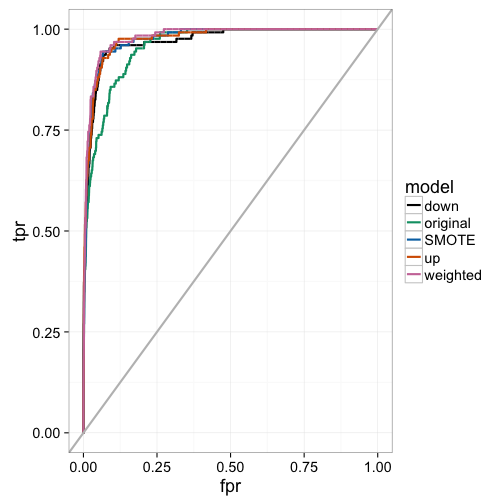
Final thoughts
In the above post, I outline some steps to help improve classification performance when you have imbalanced classes. Although weighting outperformed the sampling techniques in this simulation, this may not always be the case. Because of this, it is important to compare different techniques to see which works best for your data. I have actually found that in many cases, there is no huge benefit in using either weighting or sampling techniques when classes are moderately imbalanced (i.e., no worse than 10:1) in conjunction with a threshold-invariant metric like the AUC. In the next post, I will go over some caveats to keep in mind when using the AUC in the case of imbalanced classes and how other metrics can be more informative. Stay tuned!
转自:http://dpmartin42.github.io/blogposts/r/imbalanced-classes-part-1
Handling Class Imbalance with R and Caret - An Introduction的更多相关文章
- 【机器学习与R语言】12- 如何评估模型的性能?
目录 1.评估分类方法的性能 1.1 混淆矩阵 1.2 其他评价指标 1)Kappa统计量 2)灵敏度与特异性 3)精确度与回溯精确度 4)F度量 1.3 性能权衡可视化(ROC曲线) 2.评估未来的 ...
- 统计计算与R语言的资料汇总(截止2016年12月)
本文在Creative Commons许可证下发布. 在fedora Linux上断断续续使用R语言过了9年后,发现R语言在国内用的人逐渐多了起来.由于工作原因,直到今年暑假一个赴京工作的机会与一位统 ...
- R贡献文件中文
贡献文件 注意: 贡献文件的CRAN区域被冻结,不再被主动维护. 英文 --- 其他语言 手册,教程等由R用户提供.R核心团队对内容不承担任何责任,但我们非常感谢您的努力,并鼓励大家为此列表做出贡献! ...
- (转)8 Tactics to Combat Imbalanced Classes in Your Machine Learning Dataset
8 Tactics to Combat Imbalanced Classes in Your Machine Learning Dataset by Jason Brownlee on August ...
- 【机器学习Machine Learning】资料大全
昨天总结了深度学习的资料,今天把机器学习的资料也总结一下(友情提示:有些网站需要"科学上网"^_^) 推荐几本好书: 1.Pattern Recognition and Machi ...
- CAN
CAN Introduction Features Network Topology(CANbus網路架構) MESSAGE TRANSFER(CAN通訊的資料格式) 1.DATA FRAME(資料通 ...
- readline函数分析
函数功能:提示用户输入命令,并读取命令/****************************************************************************/ /* ...
- 普通程序员转型AI免费教程整合,零基础也可自学
普通程序员转型AI免费教程整合,零基础也可自学 本文告诉通过什么样的顺序进行学习以及在哪儿可以找到他们.可以通过自学的方式掌握机器学习科学家的基础技能,并在论文.工作甚至日常生活中快速应用. 可以先看 ...
- 从信用卡欺诈模型看不平衡数据分类(1)数据层面:使用过采样是主流,过采样通常使用smote,或者少数使用数据复制。过采样后模型选择RF、xgboost、神经网络能够取得非常不错的效果。(2)模型层面:使用模型集成,样本不做处理,将各个模型进行特征选择、参数调优后进行集成,通常也能够取得不错的结果。(3)其他方法:偶尔可以使用异常检测技术,IF为主
总结:不平衡数据的分类,(1)数据层面:使用过采样是主流,过采样通常使用smote,或者少数使用数据复制.过采样后模型选择RF.xgboost.神经网络能够取得非常不错的效果.(2)模型层面:使用模型 ...
随机推荐
- 微信和支付宝支付模式详解及实现(.Net标准库)- OSS开源系列
支付基本上是很多产品都必须的一个模块,大家最熟悉的应该就是微信和支付宝支付了,不过更多的可能还是停留在直接sdk的调用上,甚至和业务系统高度耦合,网上也存在各种解决方案,但大多形式各异,东拼西凑而成. ...
- druid查询
查询是发送HTTP请求到,Broker, Historical或者Realtime节点.查询的JSON表达和每种节点类型公开相同的查询接口. Queries are made using an HTT ...
- apache-maven-3.3.9 环境配置
本地 maven 环境 安装 Maven 之前要求先确定你的 JDK 已经安装配置完成.Maven是 Apache 下的一个项目,目前我的新版本是 3.3.9. 1.官网下载 Maven:http:/ ...
- 字典树 Trie树
什么是Trie树? 形如 其中从根节点到红色节点的路径上的字母所连成的字符串即为一个Trie树上所存的字符串. 比如,这个trie树上有ab,abc,bd,dda这些字符串. 至于怎么构建和查找或添加 ...
- Android学习探索之运用MVP设计模式实现项目解耦
前言: 一直致力于提高开发效率降低项目耦合,今天想抽空学习一下MVP架构设计模式,学习一下如何运用到项目中. MVP架构设计模式 MVP模式是一种架构设计模式,也是一种经典的界面模式.MVP中的M代表 ...
- JSON 解析工具的封装(Java)
JSON 解析工具的封装(Java) 一直想有一个属于自己的JSON工具,今天终于弄好了..... 1.添加pom依赖包 <!--json解析--> <dependency> ...
- 【日常】C++ 的那些“坑” —— delete 与 析构函数 与 virtual 的 9 个小例子
C++中有无数的坑,但毕竟-- 今天就踩到了,也算是基本问题了,记录一下,顺便以后可以考考自己.你也可以猜猜答案,大牛绕行. 0x1 先看这个: #include <stdio.h> #i ...
- Java工程中使用Mybatis (工程结合Mybatis,数据可以结合Swing使用)
2011年6月iBatis 更名为 MyBatis,从 iBatis 到 MyBatis,不只是名称上的变化,MyBatis 提供了更为强大的功能,同时并没有损失其易用性,相反,在很多地方都借助于 J ...
- 使用HTML5地理位置定位到城市的方法及注意事项
介绍 本文将简述一下如何通过HTML5和百度地图开放平台提供的API来实现对浏览器的定位.实现效果为显示出用户所在的省市,即: XXX省 XXX市. 实现思路 利用HTML5 提供的API获取到用户的 ...
- 【算法系列学习】巧妙建图,暴搜去重 Counting Cliques
E - Counting Cliques http://blog.csdn.net/eventqueue/article/details/52973747 http://blog.csdn.net/y ...