
Measuring & Optimizing I/O Performance
By Ilya Grigorik on June 23, 2009
 Measuring and optimizing IO performance
is somewhat of a black art: the tools are there, the resources and discussions are plenty, but it is also incredibly easy to get lost in the forest. I speak from recent experience. Having gone down multiple false starts with filesystem optimization, RAID tweaking,
and even app-level changes it really helped to finally step back and revisit the basics. Many man pages and discussion threads later, a few useful realizations emerged: iostat is your best friend, but it can also be incredibly deceiving; refreshing your memory
of disk latencies will go a long way; disks and filesystems are fast, but not that fast.
Monitoring IO Performance with iostat
If IO performance is suspect, iostat is your best friend. Having said that, the man pages are cryptic so don't be surprised if you find
yourself reading the source. To get started, identify the device in question and start a monitoring process:
# -k output rates in kB

# -x output extended stats

# -d monitoring single device

# sample stats every 5 seconds for device /dev/sdh

$ iostat -dxk /dev/sdi 5
Next, allocate yourself a couple of hours to understand the output or expect to find yourself down a wrong path in no time flat (been there, done that). iostat is a popular tool amongst the database crowd, so not surprisingly you'll find a lot of great discussions documenting the
use. Depending on your application you will need to focus on different metrics, but as a gentle introduction let's take a look at await, svctime and avgque:
- await - The average time (in milliseconds) for I/O requests issued to the device to be served. This includes the time spent by the requests in queue and the time spent servicing them.
- svctime - The average service time (in milliseconds) for I/O requests that were issued to the device.
- avgqu-sz - The average queue length of the requests that were issued to the device.

First off, await is a deceiving metric! Even though it claims to measure average time, it is better understood
as an aggregate function, so don't be mislead by it: avgqu-sz * svctm / (%util/100). Ideally, await should be roughly equal to your svctime, which leads us to a corollary: your average queue size is ideally
hovering around single digits. Understanding these variables alone can tell you volumes about the application generating the load.
Disk Latencies Refresher & EBS Performance
 Disk access
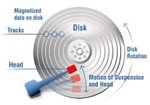
time is determined via the sum of several variables: spin-up, seek, rotational delay, and transfer time. Assuming your disk is not is not sleeping we can discount the spin-up
time, which leaves us with seek (time for the disk arm to find the track: ~10ms), rotational
delay (time to get the right sector under the head: depends on RPM), and the actual transfer time. Hence, in the worst case we will take ~10ms to seek, 60s/7200RPM ~= 8ms in rotational delay, plus the read time. On average, for a 7.2k RPM
disk this translates into roughly ~5ms access time (~20ms in worst case) to read the first byte!
Armed with this knowledge we can now put Amazon's EBS performance in context: on average our EBS mounts show 10~30ms svctime, which all things considered is not outrageous for a SAN. This number also dips into low single digits at nights and on weekends,
which points to the fact that as with any shared resource, the performance of EBS degrades during the day.
Having said that, a 6x performance difference based on time of day is definitely not anything to sneeze at, so let's hope Amazon is on top of this!
Average queue size (avgqu-sz) is a popular metric in the DBA circles, but do be
careful with it when
running on a SAN or any multi-spindle device. Ideally, your queue size (avgqu-sz) for a single disk should be in single digits, which means that the underlying device is well matched to the IO load generated by the application. Conversely,
if the queue size is artificially low, chances are your application code can benefit from some tuning: do less disk flushing, think about caching or buffering, or in other words, double check the assumption that IO is the bottleneck!
Disks, Filesystems and Facebook Case Study: Haystack
 Average access time on our disks places some hard
limits on the number of IOPs - at 5ms average, we get a very optimistic 200 req/s with no read time. Hence, if you're trying to store several hundred files a second, you might want to revisit the architecture or seriously think about switching to SSD's! Databases
such as MySQL work around this constraint by minimizing the number of file handles, caching data, and using aggressive buffering techniques. Willing to potentially loose a little bit of data with InnoDB? Set flush_log_at_trx_commit
to 2 to avoid flushing on every transaction in favor of a periodic one second flush. In similar fashion, you can tweak your MyISAM key
buffers, or even place your index and data files on different drives.
Facebook team recently released the details of their Haystack photo storage system which serves as a great case study
of working around the IO bottlenecks: over 15PB of photo storage, and ~360 new photos being uploaded every second as of April '09. To meet the requirements, they dropped the POSIX filesystem semantics and went for an append only structure with a separate in-memory
index which stores the direct inode offsets for each photo. As a result, each photo access is translated into a single IO request - a huge win. Read through it, fascinating
stuffand an illustrative example of optimizing for IO.

Ilya Grigorik is a web performance engineer and developer advocate on the Make The Web Fast team
at Google, where he spends his days and nights on making the web fast and driving adoption of performance best practices.
Follow @igrigorik
Measuring & Optimizing I/O Performance的更多相关文章
- Optimizing Item Import Performance in Oracle Product Hub/Inventory
APPLIES TO: Oracle Product Hub - Version 12.1.1 to 12.1.1 [Release 12.1] Oracle Inventory Management ...
- PatentTips - Optimizing Write Combining Performance
BACKGROUND OF THE INVENTION The use of a cache memory with a processor facilitates the reduction of ...
- [Forward]Improving Web App Performance With the Chrome DevTools Timeline and Profiles
Improving Web App Performance With the Chrome DevTools Timeline and Profiles We all want to create h ...
- Java性能提示(全)
http://www.onjava.com/pub/a/onjava/2001/05/30/optimization.htmlComparing the performance of LinkedLi ...
- Migrating Oracle on UNIX to SQL Server on Windows
Appendices Published: April 27, 2005 On This Page Appendix A: SQL Server for Oracle Professionals Ap ...
- (转) [it-ebooks]电子书列表
[it-ebooks]电子书列表 [2014]: Learning Objective-C by Developing iPhone Games || Leverage Xcode and Obj ...
- 数据库调优过程(一):SqlServer批量复制(bcp)[C#SqlBulkCopy]性能极低问题
背景 最近一段给xx做项目,这边最头疼的事情就是数据库入库瓶颈问题. 环境 服务器环境:虚拟机,分配32CPU,磁盘1.4T,4T,5T,6T几台服务器不等同(转速都是7200r),内存64G. 排查 ...
- 跨过slf4j和logback,直接晋级log4j 2
今年一直关注log4j 2,但至今还没有出正式版.等不及了,今天正式向大家介绍一下log4j的升级框架,log4j 2. log4j,相信大家都熟悉,至今对java影响最大的logging系统,至今仍 ...
- 论文笔记:Model-Agnostic Meta-Learning for Fast Adaptation of Deep Networks
Model-Agnostic Meta-Learning for Fast Adaptation of Deep Networks ICML 2017 Paper:https://arxiv.org/ ...
随机推荐
- sed 删除换行符
sed 删除换行符 sed ':label;N;s/\n/:/;b label' filename sed ':label;N;s/\n/:/;t label' filename 上面的两条命令可以实 ...
- "浏览器端" 使用 commonjs 模块规范开发网页应用,像开发 node 那样开发网页应用
Containjs 1.0 Containjs 是什么? Containjs 是一个基于 Commonjs 模块管理规范的 浏览器端 的 JavaScript 模块加载器(目前为非标准的,代码会持续迭 ...
- iOS网络编程笔记——XML文档解析
今天利用多余时间研究了一下XML文档解析,虽然现在移动端使用的数据格式基本为JSON格式,但是XML格式毕竟多年来一直在各种计算机语言之间使用,是一种老牌的经典的灵活的数据交换格式.所以我认为还是很有 ...
- 带金属光泽的模型shader的实现
最近捣鼓了一下金属光泽的shader的实现,在一些高模展示的时候或者模型的金属部分的表现的时候,我们需要给模型添加一些金属光泽,表现出一个模型某些金属装备上有一定的反光.今天我主要写一种基于贴图实现的 ...
- SpringMVC中重定向底层原理
只要将数据放入model中, 也能取到值,原因是model临时放入session域中,当从定向到另一个url时,底层把数据拼接在url地址后面(重定向一定是get请求方式),同时将session域 ...
- JDK中日期和时间的几个常用类浅析(二)
java.util.Calendar JDK中的java.util.Calendar类主要是用来处理日期和时间相关的算法运算.当你需要做一些关于日期和时间的高级算数操作时,此类可能就是你的最好选择 ...
- WP8.1小梦词典开发1:金山词霸API使用
原文出自:http://www.bcmeng.com/windows-phone-api/ 今天开始小梦给大家分享一下小梦词典开发中几个关键问题,首先我们来看查词功能的实现.小梦词典的查词功能是通过金 ...
- webpack学习笔记(二)-- 初学者常见问题及解决方法
这篇文章是webpack学习第二篇,主要罗列了本人在实际操作中遇到的一些问题及其解决方法,仅供参考,欢迎提出不同意见. 注:本文假设读者已有webpack方面相关知识,故文中涉及到的专有名词不做另外解 ...
- Android开发之自定义视图
继承View 1.重写onMeasure(int wMeasureSpec,int hMeasureSpec)处理程序,这样可以标明视图尺寸 2.重写onDraw,以便绘制我们自己的自定义视图内 3. ...
- StudyJams学习历程总结
Study Jams 是一个学习 Google 在线课程的活动.该活动由学员自发组建课程学习小组,旨在带领小组成员入门 Android 开发,最终将 Android App 上载至 Google Pl ...