
FreeRTOS --(3)内存管理 heap2
在《FreeRTOS --(2)内存管理 heap1》知道 heap 1 的内存管理其实只是简单的实现了内存对齐的分配策略,heap 2 的实现策略相比 heap 1 稍微复杂一点,不仅仅是提供了分配内存的接口,同时也提供了释放内存的接口;
但是 heap 2 的内存分配策略中,并没有提供空闲内存的合并策略,对内存碎片没有处理;换句话来说,如果有多次的,大小各异的内存申请和释放的场景下,很可能导致很多内存碎片;
1、内存大小
和 heap 1 一样,用于内存管理的内存大小来自于一个大数组,数组的下标就是整个需要被管理的内存的大小,这个是和具体芯片所支持的 RAM 大小相关:
configTOTAL_HEAP_SIZE
被管理的内存定义为:
static uint8_t ucHeap[ configTOTAL_HEAP_SIZE ];
ucHeap 就是管理的对象;
2、对齐
有的处理器是对内存对齐有要求的,比如 ARM-CM3 等,AAPCS规则要求堆栈保持8字节对齐。给任务分配栈时需要保证栈是8字节对齐的。所以这里 FreeRTOS 就需要涉及到对齐操作;针对 ARM-CM3 这类处理器来说,在portmacro.h 文件中,定义了对齐的字节数:
/* Hardware specifics. */

#define portBYTE_ALIGNMENT            8
而在 portable.h 中,定义了对应的 Mask(8字节对齐,那么都要是 8 的倍数,也就是二进制的 4'b1000,所以 MASK 是 4'b0111 也就是 0x07):
#if portBYTE_ALIGNMENT == 8

    #define portBYTE_ALIGNMENT_MASK ( 0x0007 )

#endif
和 heap 1 一样,在处理对齐的时候,由于可能 ucHeap 初始的地址就没对齐,所以这里真正可以对齐分配的内存的 SIZE 就要做一些调整和妥协,由于是 8 字节对齐,所以最多妥协的大小就是 8 字节,也就是真正被管理的内存大小只有 configADJUSTED_HEAP_SIZE,这里可能造成几个字节的浪费(浪费多少,取决于ucHeap 初始地址 ),不过为了对齐,也就忽略了;
/* A few bytes might be lost to byte aligning the heap start address. */

#define configADJUSTED_HEAP_SIZE    ( configTOTAL_HEAP_SIZE - portBYTE_ALIGNMENT )
3、内存块
与 heap 1 不同,heap 2 可以支持分配和释放,那么管理内存的手段势必比 heap 1 复杂一些,heap 2 对内存进行分块管理,将每块内存通过一个表征该内存块的的数据结构表示,以单向链表串在一起;
3.1、数据结构
表达一个内存块的数据结构是 BlockLink_t,它的定义是:
/* Define the linked list structure.  This is used to link free blocks in order

of their size. */

typedef struct A_BLOCK_LINK

{

    struct A_BLOCK_LINK *pxNextFreeBlock;    /*<< The next free block in the list. */

    size_t xBlockSize;                        /*<< The size of the free block. */

} BlockLink_t;
pxNextFreeBlock 指向下一个内存块的 BlockLink_t 结构;
xBlockSize 代表本内存块的大小;
3.2、数据结构对齐
当然内存块也需要对齐:
static const uint16_t heapSTRUCT_SIZE = ( ( sizeof ( BlockLink_t ) + ( portBYTE_ALIGNMENT - 1 ) ) & ~portBYTE_ALIGNMENT_MASK );
3.3、内存块 Marker
FreeRTOS 为内存管理,定义了两个 BlockLink_t 结构体,xStart 和 xEnd:
/* Create a couple of list links to mark the start and end of the list. */

static BlockLink_t xStart, xEnd;
xStart 和 xEnd 仅仅作为 mark,标记内存块的起始和结束;
3.4、可用内存
在 heap2 中定义了 xFreeBytesRemaining 来代表当前可用于分配的内存,每当内存被分配出去,这个值会减,内存被free 后,该值增加:
/* Keeps track of the number of free bytes remaining, but says nothing about

fragmentation. */

static size_t xFreeBytesRemaining = configADJUSTED_HEAP_SIZE;
4、分配内存
和 heap 1 一样,内存分配使用 pvPortMalloc 函数,传入的是希望拿到的内存,返回值拿到的内存起始地址,如果分配失败返回 NULL;
/*-----------------------------------------------------------*/

void *pvPortMalloc( size_t xWantedSize )

{

BlockLink_t *pxBlock, *pxPreviousBlock, *pxNewBlockLink;

static BaseType_t xHeapHasBeenInitialised = pdFALSE;

void *pvReturn = NULL;

    vTaskSuspendAll();

    {

        /* If this is the first call to malloc then the heap will require

        initialisation to setup the list of free blocks. */

        if( xHeapHasBeenInitialised == pdFALSE )

        {

            prvHeapInit();

            xHeapHasBeenInitialised = pdTRUE;

        }

        /* The wanted size is increased so it can contain a BlockLink_t

        structure in addition to the requested amount of bytes. */

        if( xWantedSize > 0 )

        {

            xWantedSize += heapSTRUCT_SIZE;

            /* Ensure that blocks are always aligned to the required number of bytes. */

            if( ( xWantedSize & portBYTE_ALIGNMENT_MASK ) != 0 )

            {

                /* Byte alignment required. */

                xWantedSize += ( portBYTE_ALIGNMENT - ( xWantedSize & portBYTE_ALIGNMENT_MASK ) );

            }

        }

        if( ( xWantedSize > 0 ) && ( xWantedSize < configADJUSTED_HEAP_SIZE ) )

        {

            /* Blocks are stored in byte order - traverse the list from the start

            (smallest) block until one of adequate size is found. */

            pxPreviousBlock = &xStart;

            pxBlock = xStart.pxNextFreeBlock;

            while( ( pxBlock->xBlockSize < xWantedSize ) && ( pxBlock->pxNextFreeBlock != NULL ) )

            {

                pxPreviousBlock = pxBlock;

                pxBlock = pxBlock->pxNextFreeBlock;

            }

            /* If we found the end marker then a block of adequate size was not found. */

            if( pxBlock != &xEnd )

            {

                /* Return the memory space - jumping over the BlockLink_t structure

                at its start. */

                pvReturn = ( void * ) ( ( ( uint8_t * ) pxPreviousBlock->pxNextFreeBlock ) + heapSTRUCT_SIZE );

                /* This block is being returned for use so must be taken out of the

                list of free blocks. */

                pxPreviousBlock->pxNextFreeBlock = pxBlock->pxNextFreeBlock;

                /* If the block is larger than required it can be split into two. */

                if( ( pxBlock->xBlockSize - xWantedSize ) > heapMINIMUM_BLOCK_SIZE )

                {

                    /* This block is to be split into two.  Create a new block

                    following the number of bytes requested. The void cast is

                    used to prevent byte alignment warnings from the compiler. */

                    pxNewBlockLink = ( void * ) ( ( ( uint8_t * ) pxBlock ) + xWantedSize );

                    /* Calculate the sizes of two blocks split from the single

                    block. */

                    pxNewBlockLink->xBlockSize = pxBlock->xBlockSize - xWantedSize;

                    pxBlock->xBlockSize = xWantedSize;

                    /* Insert the new block into the list of free blocks. */

                    prvInsertBlockIntoFreeList( ( pxNewBlockLink ) );

                }

                xFreeBytesRemaining -= pxBlock->xBlockSize;

            }

        }

        traceMALLOC( pvReturn, xWantedSize );

    }

    ( void ) xTaskResumeAll();

    #if( configUSE_MALLOC_FAILED_HOOK == 1 )

    {

        if( pvReturn == NULL )

        {

            extern void vApplicationMallocFailedHook( void );

            vApplicationMallocFailedHook();

        }

    }

    #endif

    return pvReturn;

}

/*-----------------------------------------------------------*/
首先调用 vTaskSuspendAll(); 来挂起所有任务,不允许进程调度;
接着调用 prvHeapInit(); 来初始化相关的内存管理的链表结构:
static void prvHeapInit( void )

{

BlockLink_t *pxFirstFreeBlock;

uint8_t *pucAlignedHeap;

    /* Ensure the heap starts on a correctly aligned boundary. */

    pucAlignedHeap = ( uint8_t * ) ( ( ( portPOINTER_SIZE_TYPE ) &ucHeap[ portBYTE_ALIGNMENT ] ) & ( ~( ( portPOINTER_SIZE_TYPE ) portBYTE_ALIGNMENT_MASK ) ) );

    /* xStart is used to hold a pointer to the first item in the list of free

    blocks.  The void cast is used to prevent compiler warnings. */

    xStart.pxNextFreeBlock = ( void * ) pucAlignedHeap;

    xStart.xBlockSize = ( size_t ) 0;

    /* xEnd is used to mark the end of the list of free blocks. */

    xEnd.xBlockSize = configADJUSTED_HEAP_SIZE;

    xEnd.pxNextFreeBlock = NULL;

    /* To start with there is a single free block that is sized to take up the

    entire heap space. */

    pxFirstFreeBlock = ( void * ) pucAlignedHeap;

    pxFirstFreeBlock->xBlockSize = configADJUSTED_HEAP_SIZE;

    pxFirstFreeBlock->pxNextFreeBlock = &xEnd;

}
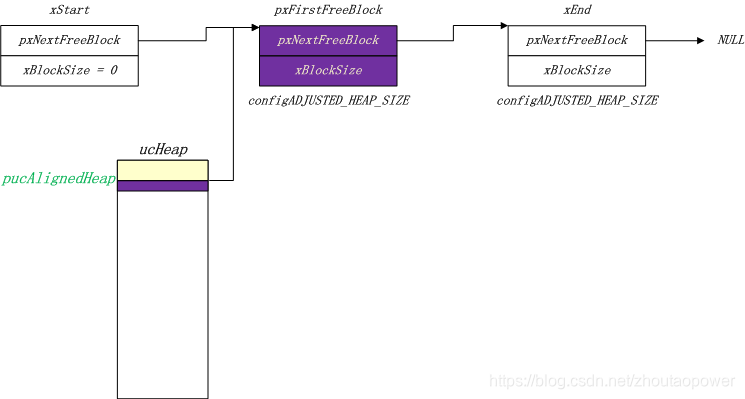
在初始化内存相关的结构的时候,首先将 ucHeap 的地址进行对齐操作,得到可以对齐后用于真实的内存管理的起始地址为:
pucAlignedHeap
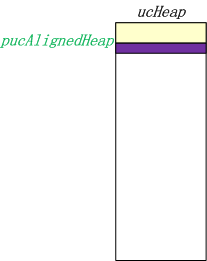
然后初始化 xStart 和 xEnd,这两个 marker,然后将整个可用的内存视为一块,可用的内存的开始地方,放置了一个 BlockLink_t 结构体并初始化它的 xBlockSize 为之前调整过的 configADJUSTED_HEAP_SIZE;
我们在回到 pvPortMalloc 的地方,继续分析;
prvHeapInit() 初始化完成后,便可用分配内存了;分配内存的时候,需要对每一个内存块分配一个标志它的描述符,也就是 BlockLink_t 结构体,所以如果要分配 xWantedSize,那么就要分配 :
xWantedSize += heapSTRUCT_SIZE;
然后,对 xWantedSize 进行字节对齐操作;

接下来便进行链表搜寻,找到 Size 合适的地方,将其分配出来;
值得注意的是,内存块链表是有排序的,开始是 xStart 后面跟的内存块,内存块由小到大,最后是 xEnd;
/*

 * Insert a block into the list of free blocks - which is ordered by size of

 * the block.  Small blocks at the start of the list and large blocks at the end

 * of the list.

 */

#define prvInsertBlockIntoFreeList( pxBlockToInsert )                                \

{                                                                                    \

BlockLink_t *pxIterator;                                                            \

size_t xBlockSize;                                                                    \

                                                                                    \

    xBlockSize = pxBlockToInsert->xBlockSize;                                        \

                                                                                    \

    /* Iterate through the list until a block is found that has a larger size */    \

    /* than the block we are inserting. */                                            \

    for( pxIterator = &xStart; pxIterator->pxNextFreeBlock->xBlockSize < xBlockSize; pxIterator = pxIterator->pxNextFreeBlock )    \

    {                                                                                \

        /* There is nothing to do here - just iterate to the correct position. */    \

    }                                                                                \

                                                                                    \

    /* Update the list to include the block being inserted in the correct */        \

    /* position. */                                                                    \

    pxBlockToInsert->pxNextFreeBlock = pxIterator->pxNextFreeBlock;                    \

    pxIterator->pxNextFreeBlock = pxBlockToInsert;                                    \

}
继续看代码;
如果 pxBlock 不是 xEnd 的话,那么说明找到有 Size 大于期望分配的 Size 的 Block 了;
那么就将返回值:
/* Return the memory space - jumping over the BlockLink_t structure at its start. */

pvReturn = ( void * ) ( ( ( uint8_t * ) pxPreviousBlock->pxNextFreeBlock ) + heapSTRUCT_SIZE );
这里,分配内存,能够实际给调用这个 API 接口使用的内存要从起始的 Block 地址加上 heapSTRUCT_SIZE 开始算,因为 heapSTRUCT_SIZE 已经用来表示这个 Block 的信息了;
然后判断剩余的 SIZE 是否大于最小的可用的空间分配的阈值 heapMINIMUM_BLOCK_SIZE :
#define heapMINIMUM_BLOCK_SIZE ( ( size_t ) ( heapSTRUCT_SIZE * 2 ) )
如果剩余的内存空间还足够那么:
/* If the block is larger than required it can be split into two. */

if( ( pxBlock->xBlockSize - xWantedSize ) > heapMINIMUM_BLOCK_SIZE )

{

    /* This block is to be split into two.  Create a new block

    following the number of bytes requested. The void cast is

    used to prevent byte alignment warnings from the compiler. */

    pxNewBlockLink = ( void * ) ( ( ( uint8_t * ) pxBlock ) + xWantedSize );

    /* Calculate the sizes of two blocks split from the single block. */

     pxNewBlockLink->xBlockSize = pxBlock->xBlockSize - xWantedSize;

     pxBlock->xBlockSize = xWantedSize;

    /* Insert the new block into the list of free blocks. */

    prvInsertBlockIntoFreeList( ( pxNewBlockLink ) );

}
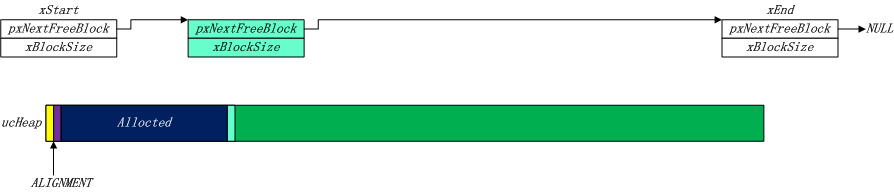
使用新的 pxNewBlockLink 结构表示摘除 pxBlock 内存块后的下一个内存块,并将其初始化,然后按照排序(从小到大的顺序)插入到以 xStart 开始的地方;
所以,被初始化后的内存
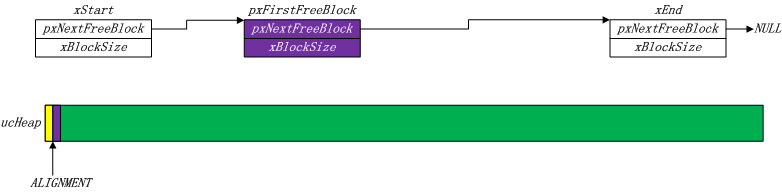
分配一次的结果是:
5、释放内存
heap2 支持释放内存:
void vPortFree( void *pv )

{

uint8_t *puc = ( uint8_t * ) pv;

BlockLink_t *pxLink;

    if( pv != NULL )

    {

        /* The memory being freed will have an BlockLink_t structure immediately

        before it. */

        puc -= heapSTRUCT_SIZE;

        /* This unexpected casting is to keep some compilers from issuing

        byte alignment warnings. */

        pxLink = ( void * ) puc;

        vTaskSuspendAll();

        {

            /* Add this block to the list of free blocks. */

            prvInsertBlockIntoFreeList( ( ( BlockLink_t * ) pxLink ) );

            xFreeBytesRemaining += pxLink->xBlockSize;

            traceFREE( pv, pxLink->xBlockSize );

        }

        ( void ) xTaskResumeAll();

    }

}
来自用户释放的指针 pv 是实际的数据指针,代表这个内存的结构体在他前面 heapSTRUCT_SIZE 的位置,所以该 pv 的 BlockLink_t 结构体指针 pxLink = ( void * )(puc - heapSTRUCT_SIZE);
调用 prvInsertBlockIntoFreeList 将其插入到链表中;并且更新当前剩余的内存量;
释放后的内存如下所示:
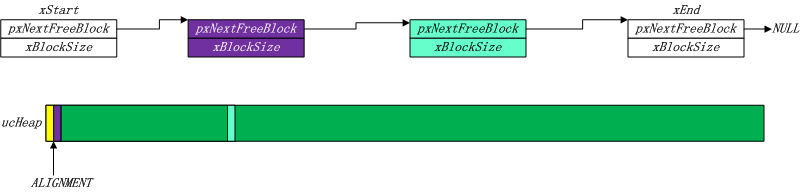
FreeRTOS --(3)内存管理 heap2的更多相关文章
- 轻量级操作系统FreeRTOS的内存管理机制(一)
本文由嵌入式企鹅圈原创团队成员朱衡德(Hunter_Zhu)供稿. 近几年来,FreeRTOS在嵌入式操作系统排行榜中一直位居前列,作为开源的嵌入式操作系统之一,它支持许多不同架构的处理器以及多种编译 ...
- FreeRTOS 动态内存管理
以下转载自安富莱电子: http://forum.armfly.com/forum.php 本章节为大家讲解 FreeRTOS 动态内存管理,动态内存管理是 FreeRTOS 非常重要的一项功能,前面 ...
- FreeRTOS的内存管理
FreeRTOS提供了几个内存堆管理方案,有复杂的也有简单的.其中最简单的管理策略也能满足很多应用的要求,比如对安全要求高的应用,这些应用根本不允许动态内存分配的. FreeRTOS也允许你自己实现内 ...
- freertos之内存管理
任务.信号量.邮箱才调度器开始调度之前就应该创建,所以它不可能像裸奔程序那样的函数调用能确定需要多少内存资源,RTOS提供了3种内存管理的方法: 1 方法一:确定性好适合于任务.信号量.队列都不被删除 ...
- FreeRTOS --(5)内存管理 heap4
FreeRTOS 中的 heap 4 内存管理,可以算是 heap 2 的增强版本,在 <FreeRTOS --(3)内存管理 heap2>中,我们可以看到,每次内存分配后都会产生一个内存 ...
- FreeRTOS内存管理
简介 Freertos的内存管理分别在heap_1.c,heap_2.c,heap_3.c,heap_4.c,heap_5.c个文件中,选择合适的一种应用于嵌入式项目中即可. 本文的图片中 红色部分B ...
- FreeRTOS --(2)内存管理 heap1
转载自https://blog.csdn.net/zhoutaopower/article/details/106631237 FreeRTOS 提供了5种内存堆管理方案,分别对应heap1/heap ...
- FreeRTOS --(6)内存管理 heap5
转载自https://blog.csdn.net/zhoutaopower/article/details/106748308 FreeRTOS 中的 heap 5 内存管理,相对于 heap 4&l ...
- FreeRTOS--堆内存管理
因为项目需要,最近开始学习FreeRTOS,一开始有些紧张,因为两个星期之前对于FreeRTOS的熟悉度几乎为零,经过对FreeRTOS官网的例子程序的摸索,和项目中问题的解决,遇到了很多熟悉的身影, ...
随机推荐
- MVCC多版本并发控制
MVCC多版本并发控制 爱情小傻蛋关注 82019.09.28 23:23:37字数 4,740阅读 91,421 前提概要 什么是MVCC 什么是当前读和快照读? 当前读,快照读和MVCC的关系 M ...
- 解释AOP?
面向切面的编程,或AOP, 是一种编程技术,允许程序模块化横向切割关注点,或横切典型的责任划分,如日志和事务管理.
- java 中有几种方法可以实现一个线程?
继承 Thread 类 实现 Runnable 接口 实现 Callable 接口,需要实现的是 call() 方法
- 使用docker-compose+nginx+uwsgi+django部署项目
(1)centos上下载docker + docker-compose (2)基础目录 (3)首先创建一个纯净的python+django+uwsgi的镜像,便于后期使用(也可不用创建,后期docke ...
- Linux 中进程有哪几种状态?在 ps 显示出来的信息中, 分别用什么符号表示的?
1.不可中断状态:进程处于睡眠状态,但是此刻进程是不可中断的.不可中断, 指进程不响应异步信号. 第 441 页 共 485 页2.暂停状态/跟踪状态:向进程发送一个 SIGSTOP 信号,它就会因响 ...
- w3schools网站的HTML教程之HTML编辑器
使用记事本或文本编辑器编写 HTML HTML 可以使用如下专业的 HTML 编辑器进行编辑: Microsoft WebMatrix Sublime Text 然而,我们推荐使用记事本(PC)或文本 ...
- html 元素 强制不换行
html 中 nowrap是用来强制不换行的 在排版中 对包裹plain text的标签使用nowrap属性即刻实现强制不换行. 如:<p nowrap>强制不换行</p>&l ...
- SQL之总结(二)
4.关于取两个日期之间的年份: ceil(MONTHS_BETWEEN(sysdate, c.sendtime)/12) workTime ceil(n) 取大于等于n的最小整数 floor(n) 取 ...
- .NET程序设计实验一
实验一 语言基础 一.实验目的 1. 熟悉Visual Stido.NET 实验环境: 2. 掌握控制台程序的编写方法: 3. 掌握C#程序设计语言的语法基础: 4. 掌握控制语句和数组的使用. 二 ...
- java中为什么接口中的属性和方法都默认为public?
4)为什么接口中的属性和方法都默认为public?Sun公司当初为什么要把java的接口设计发明成这样? [新手可忽略不影响继续学习]答:如上所述,马克-to-win:既然接口强于抽象类能胜任作为和外 ...