
TWELP™ Vocoder
TWELP™ Vocoder

DSP Innovations Inc. (DSPINI) announces new class of proprietary vocoders for wide range of bit rates from 600 bps up to 9600 bps, based on the newest speech coding technology TWELP™, for Digital Radio (HF, DMR, dPMR, etc.) and other markets.
TWELP™ technology features. The vocoder is based on newest technology of speech coding called "Tri-Wave Excited Linear Prediction"™ (TWELP) that was developed by experts of DSPINI. The technology provides the best speech quality among competitors today, thanks to:
- Advance reliable method of Pitch estimation
- Pitch synchronous analysis
- Advance tri-wave model of excitation:
- Voiced Component Excited Wave (VCEW)
- Unvoiced Component Excited Wave (UCEW)
- Transient Component Excited Wave (TCEW)
- Newest quantization schemes
- Pitch synchronous synthesis
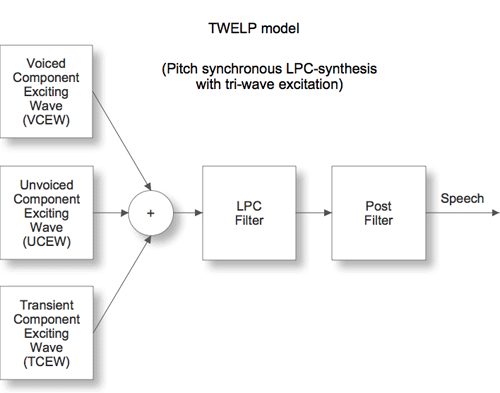
In spite of the fact, that TWELP technology is based on well-known LPC-method, where output speech is gotten by the synthesizing LPC-filter, it is not a variety or combination of well-known speech coding methods, patented comprehensively during last 20-30 years.
TWELP is not WI-based method (PWI, LCWI, etc.), because LPC-excitation is gotten by not interpolation of the pitch-waveforms.
TWELP is not a sinusoidal/harmonic coding method, including MBE-based coding (IMBE, AMBE, MELP, etc.), because LPC-excitation is not gotten as any mixture of sinusoidal/harmonic or noisy components.
TWELP is not MPE-based or CELP-based method (MPE-CELP, ACELP, etc), because LPC-excitation is not a sequence of pulses on some positions.
TWELP is not a mixture of these methods like MELPe or HVXC because of the above mentioned.
TWELP is unique three-component representation of pitch-synchronous LPC residual that is quantized by unique speech-driven quantizers in conjunction with LPC-parameters. New technology allows to achieve much better speech quality in comparison with any known speech coding methods on the same bit rates (from 600 bps up to 9600 bps and wider).
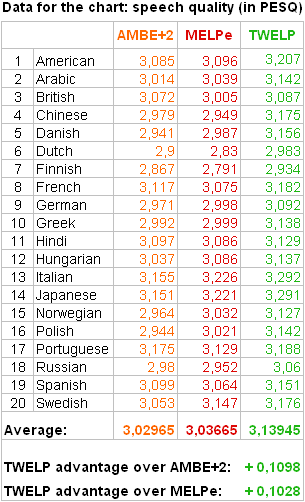
Superiority in speech quality. Here is the comparison with AMBE+2 vocoder. TWELP 2400 bpsvocoder and AMBE-3000 HDK (Rate#33: AMBE+2 2450 bps vocoder) were tested, using ITU-T P.50 speech base for 20 different languages. ITU-T P.862 utility was used for estimation of the speech quality in PESQ terms:
 我觉得这里的MOS分测试有问题,我按照他的方法测试。是分数有差异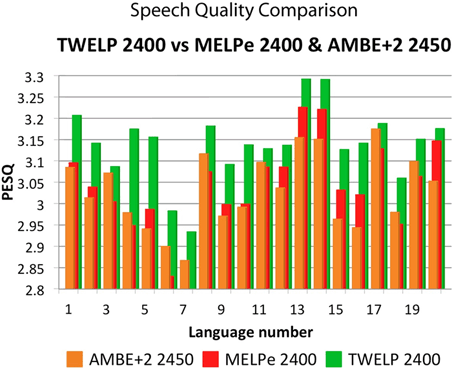
A diagram demonstrates significant superiority of TWELP over AMBE+2 and MELPe in speech quality.
A few independent experts tested by listening TWELP vocoder in comparison with AMBE+2 and MELPe 2400, using method of preferences. Majority of experts preferred AMBE+2 to MELPe and significant majority of the experts preferred TWELP to AMBE+2 and MELPe, having noted much more natural human-sounding of voice in the TWELP vocoder.
Pair comparisons of the TWELP vocoders for other bit rates (TWELP 600 bps vs MELPe 600 bps, TWELP 1200 bps vs MELPe 1200 bps, TWELP 4800 bps vs GSM AMR 4750 bps, TWELP 8 kbps vs G.729 8 kbps and GSM AMR 7.95 kbps, etc.) also showed significant superiority of the TWELP over all competitors first of all in more clear natural sounding of speech. In contrast to ACELP-based vocoders (G.723.1, G.729, GSM AMR, etc.), TWELP vocoders are clear of distortions of speech, that are present in any MPE and CELP-like vocoders due to sparseness of pulses on an input of the synthesizing filter.
Superiority in quality of the non-speech signals. In contrast to other LBR vocoders (MELPe, AMBE+2, etc.), TWELP vocoders provide high quality of non-speech signals, including police, ambulance, fire sirens, etc. This feature in conjunction with high quality natural human-sounding of voice makes TWELP vocoders well suitable for replacement of analog radio by digital radio and also for other applications where high quality transmitting of non-speech signals is relevant along with high quality transmitting of speech signals.
High robustness to acoustic noise. In contrast to other LBR vocoders, TWELP vocoders are well robust to acoustic noise thanks to robust reliable method of pitch estimation and other features of TWELP technology.
High Robustness to the channel errors. "Robust" versions of the TWELP vocoders include FEC that are integrated with vocoder on base of "joint source-channel coding" approach that provides high speech quality simultaneously in noisy channel as well as in noiseless channel. FEC can operate with "soft decisions" as well as with "hard decisions" from a modem. Mode of "soft decisions" provides much better robustness in comparison with mode of "hard decisions".
Additional functionalities. The following additional functionalities are developed by DSPINI and integrated into TWELP vocoders:
- Automatic Gain Control (AGC),
- Noise Cancellation for Speech Enhancement (NCSE)
- Voice Activity Detector (VAD),
- Tone Detection/Generation (Single tones and Dual tones). The tones are transmitted through vocoder.
Technical characteristics and resource requirements:
| Bit Rate (bps) |
Algorithm | Frame size (ms) |
Algorithmic delay (w/o frame size) (ms) |
Sampling rate (kHz) |
Signal format | Bit stream format |
|---|---|---|---|---|---|---|
| 600 1200 2400 4800 9600 |
TWELP | 80 40 20 20 20 |
20 | 8 | Linear 16-bit PCM |
48 48 48 96 192 |
| Name | Functionality | Technical characteristics | |
|---|---|---|---|
| Name | Value | ||
| AGC | Automatic Gain Control | Control range: | 0 ... +20 dB |
| NCSE | Noise Canceller - Speech Enhancer |
SNR increasing | > 6 dB |
| Speech quality improvement | > 0.1 PESQ | ||
| Tone Detector |
Single/Dual tones detection | In accordance with international standards | |
| Tone Generator |
Single/Dual tones generation | Special generator, kept continuity of signal (phase and amplitude of signal of previous frame) | |
| VAD | Voice Activity Detection | Reliable detection speech in background noise | |
| CNG | Comfort Noise Generation | Type of noise | "white" |
| Level | - 60 dB | ||
* DSPINI continues optimization of the TWELP algorithm and code in order to minimize computational complexity of the vocoder.
Guarantee and support. DSPINI guarantees a quality and accordance of all technical characteristics of the product to requirement of current specifications. Testing and other method of quality control are used for guarantee support.
Any platform. Right now, TWELP vocoders for some bit rates are available just for TI's C55 DSP platform. However, DSPINI can port the vocoder software into any other DSP, RISC or general-purposes platform in short time: 2-3 months.
Microchip. TWELP 2400/3600 bps vocoderis available also as chip (IC) from CML Microcircuits.
Licensing terms. To use the vocoders, customer should obtain a license from DSPINI only.
Low price is another advantage of these vocoders. Please contact us to check it out.
Related software. TWELP vocoders may be effectively used in a bundle with other DSPINI's products:
- Linear and acoustic echo cancellers,
- Multichannel noise cancellers (including two-microphone adaptive array),
- Wired or radiomodems for any types of channels and bitrates,
- Other products.
More DSPINI's products on http://www.dspini.com
Please contact to evaluate and purchase:
| DSP INNOVATIONS INC. | |
|---|---|
| E-mail: | request@dspini.com |
| Web: | http://www.dspini.com |
| Tel/Fax: | +7 963 105 32 18 |
| Address: | 4 Slavi, Penza, 440600 |
| Russian Federation | |
Tri-Wave Excited Linear Prediction, TWELP, DSPINI and DSP Innovations logo are trademarks of DSP Innovations Inc. AMBE-3000 and AMBE+2 are trademarks of Digital Voice Systems Inc.
© 2007-2012 DSP Innovations Incorporated. All rights reserved.
TWELP™ Vocoder的更多相关文章
- 【Python五篇慢慢弹(4)】模块异常谈python
模块异常谈python 作者:白宁超 2016年10月10日12:08:31 摘要:继<快速上手学python>一文之后,笔者又将python官方文档认真学习下.官方给出的pythondo ...
- Python基础篇【第5篇】: Python模块基础(一)
模块 简介 在计算机程序的开发过程中,随着程序代码越写越多,在一个文件里代码就会越来越长,越来越不容易维护. 为了编写可维护的代码,我们把很多函数分组,分别放到不同的文件里,这样,每个文件包含的代码就 ...
- python grammar、C/C++ Python Parsing Engine
catalog . Python语言简介 . Python模块 . 嵌入式Python解析引擎: C++调用Python . Python 调用 C (base) . 扩展Python语法解析器功能: ...
- python 深入模块和包
模块可以包含可执行语句以及函数的定义. 这些语句通常用于初始化模块. 它们只在 第一次 导入时执行.只在第一次导入的时候执行,第一次.妈蛋的第一次...后面再次导入就不执行了. [1](如果文件以脚本 ...
- ADT公司G729 方案指标
ADT公司G729 方案指标 G.729 Voice Compression Algorithm and its many annexes G.729 is used in wireless voic ...
- Python模块学习
6. Modules If you quit from the Python interpreter and enter it again, the definitions you have made ...
- Packages
Packages are a way of structuring Python's module namespace by using "dotted module names" ...
- Python Tutorial 学习(六)--Modules
6. Modules 当你退出Python的shell模式然后又重新进入的时候,之前定义的变量,函数等都会没有了. 因此, 推荐的做法是将这些东西写入文件,并在适当的时候调用获取他们. 这就是为人所知 ...
- 常用的gnuradio 模块
---恢复内容开始--- 参考:http://gnuradio.org/redmine/projects/gnuradio/wiki/TutorialsWritePythonApplications ...
随机推荐
- HDU 2594 (next数组的用法)【KMP】
<题目链接> 题目大意: 给两个字符串,求第一串的前缀与第二串的后缀匹配的最长序列以及长度. 解题分析: 看到这个求前缀和后缀相同序列的最大长度,我们不难想到KMP中的next数组.做法就 ...
- 不一样的go语言创世
在这之前,我是一名Java程序员,但最近我却已经好几个月没写Java代码了,因为我已经敲了好几个月的go,这是我连续最长的一段时间在写go.陆陆续续地算下来,也有快一年多的时间在与go打交道.期间 ...
- 【随笔】借鉴 & KPI式设计
1. 别人(某成功案例)是这么做的,我们也就这么做吧 刚来组里一会就目睹了需求讨论会上的一场争执,大概就是某产品经理在解释需求解释到后面有些说不通了就说“xxx App是这么做的我觉得我们也可以这样做 ...
- PLSQL Developer的使用之对象浏览器
PLSQL Developer的使用之对象浏览器 (转自https://www.cnblogs.com/mq0036/p/6437834.html#point11) 能够显示与 PL/SQL 开发相关 ...
- [HihoCoder1369]网络流一·Ford-Fulkerson算法
思路: 最大流模板. #include<queue> #include<cstdio> #include<cctype> #include<vector> ...
- json字符串转换对象的方法
为了方便读者了解json的使用,读者直接粘贴下面代码看效果即可: var json1 = {'name':'小李','age':'11','sex':'女'}; console.log(json1.n ...
- Oracle中使用透明网关链接到Sqlserver(转)
测试环境介绍 1.ORACLEServer Database version:10.2.0 IP:192.168.1.5 ORACLE_HOME:D:\oracle\product\10.2.0\ ...
- ERROR: While executing gem … (Gem::RemoteFetcher::FetchError)
原文地址:https://www.zfanw.com/blog/error-while-executing-gem-gem-remote-fetch-error.html 我对命令行下安装 gem 包 ...
- bugly中批量隐藏版本
App项目使用Bugly的内测分发功能进行整包的测试,但日积月累之后,版本就会特别多.而线上同时跑的版本可能不过三个左右,那么多版本会干扰到查看崩溃.选择版本,如何隐藏呢? 右上角,更多 –> ...
- iOS开发-装饰模式
装饰模式是指在不必改变原类文件和使用继承的情况下,动态地扩展一个对象的功能.通过创建一个包装对象,也就是装饰来包裹真实的对象.装饰模式中的装饰对象和真实对象有相同的接口.这样客户端对象就能以和真实对象 ...