
2023-05-26:golang关于垃圾回收和析构函数的选择题,多数人会选错。
2023-05-26:golang关于垃圾回收和析构的选择题,代码如下:
package main

import (

	"fmt"

	"runtime"

	"time"

)

type ListNode struct {

	Val  int

	Next *ListNode

}

func main0() {

	a := &ListNode{Val: 1}

	b := &ListNode{Val: 2}

	runtime.SetFinalizer(a, func(obj *ListNode) {

		fmt.Printf("a被回收--")

	})

	runtime.SetFinalizer(b, func(obj *ListNode) {

		fmt.Printf("b被回收--")

	})

	a.Next = b

	b.Next = a

}

func main() {

	main0()

	time.Sleep(1 * time.Second)

	runtime.GC()

	time.Sleep(1 * time.Second)

	runtime.GC()

	time.Sleep(1 * time.Second)

	runtime.GC()

	time.Sleep(1 * time.Second)

	runtime.GC()

	time.Sleep(1 * time.Second)

	runtime.GC()

	fmt.Print("结束")

}
代码的运行结果是什么?并说明原因。注意析构是无序的。
A. 结束
B. a被回收--b被回收--结束
C. b被回收--a被回收--结束
D. B和C都有可能
答案2023-05-26:
golang的垃圾回收算法跟java一样,都是根可达算法。代码中main0函数里a和b是互相引用,但是a和b没有外部引用。因此a和b会被当成垃圾被回收掉。而析构函数的调用不是有序的,所以B和C都有可能,答案选D。让我们看看答案是什么,如下:
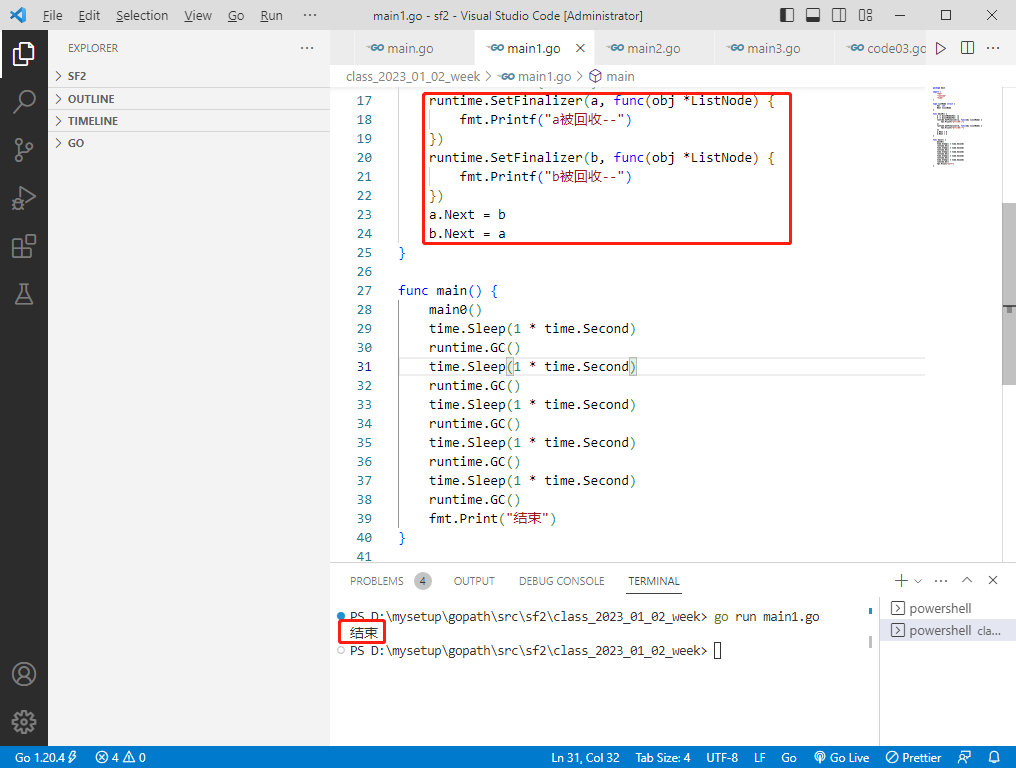
看运行结果,答案不是选D,而是选A。这肯定会出乎很多人意料,golang的垃圾回收算法是根可达算法难不成是假的,大家公认的八股文难道是错的?有这个疑问是好事,但不能全盘否定。让我们看看析构函数的源码吧。代码在 src/runtime/mfinal.go 中,如下:
// SetFinalizer sets the finalizer associated with obj to the provided

// finalizer function. When the garbage collector finds an unreachable block

// with an associated finalizer, it clears the association and runs

// finalizer(obj) in a separate goroutine. This makes obj reachable again,

// but now without an associated finalizer. Assuming that SetFinalizer

// is not called again, the next time the garbage collector sees

// that obj is unreachable, it will free obj.

//

// SetFinalizer(obj, nil) clears any finalizer associated with obj.

//

// The argument obj must be a pointer to an object allocated by calling

// new, by taking the address of a composite literal, or by taking the

// address of a local variable.

// The argument finalizer must be a function that takes a single argument

// to which obj's type can be assigned, and can have arbitrary ignored return

// values. If either of these is not true, SetFinalizer may abort the

// program.

//

// Finalizers are run in dependency order: if A points at B, both have

// finalizers, and they are otherwise unreachable, only the finalizer

// for A runs; once A is freed, the finalizer for B can run.

// If a cyclic structure includes a block with a finalizer, that

// cycle is not guaranteed to be garbage collected and the finalizer

// is not guaranteed to run, because there is no ordering that

// respects the dependencies.

//

// The finalizer is scheduled to run at some arbitrary time after the

// program can no longer reach the object to which obj points.

// There is no guarantee that finalizers will run before a program exits,

// so typically they are useful only for releasing non-memory resources

// associated with an object during a long-running program.

// For example, an os.File object could use a finalizer to close the

// associated operating system file descriptor when a program discards

// an os.File without calling Close, but it would be a mistake

// to depend on a finalizer to flush an in-memory I/O buffer such as a

// bufio.Writer, because the buffer would not be flushed at program exit.

//

// It is not guaranteed that a finalizer will run if the size of *obj is

// zero bytes, because it may share same address with other zero-size

// objects in memory. See https://go.dev/ref/spec#Size_and_alignment_guarantees.

//

// It is not guaranteed that a finalizer will run for objects allocated

// in initializers for package-level variables. Such objects may be

// linker-allocated, not heap-allocated.

//

// Note that because finalizers may execute arbitrarily far into the future

// after an object is no longer referenced, the runtime is allowed to perform

// a space-saving optimization that batches objects together in a single

// allocation slot. The finalizer for an unreferenced object in such an

// allocation may never run if it always exists in the same batch as a

// referenced object. Typically, this batching only happens for tiny

// (on the order of 16 bytes or less) and pointer-free objects.

//

// A finalizer may run as soon as an object becomes unreachable.

// In order to use finalizers correctly, the program must ensure that

// the object is reachable until it is no longer required.

// Objects stored in global variables, or that can be found by tracing

// pointers from a global variable, are reachable. For other objects,

// pass the object to a call of the KeepAlive function to mark the

// last point in the function where the object must be reachable.

//

// For example, if p points to a struct, such as os.File, that contains

// a file descriptor d, and p has a finalizer that closes that file

// descriptor, and if the last use of p in a function is a call to

// syscall.Write(p.d, buf, size), then p may be unreachable as soon as

// the program enters syscall.Write. The finalizer may run at that moment,

// closing p.d, causing syscall.Write to fail because it is writing to

// a closed file descriptor (or, worse, to an entirely different

// file descriptor opened by a different goroutine). To avoid this problem,

// call KeepAlive(p) after the call to syscall.Write.

//

// A single goroutine runs all finalizers for a program, sequentially.

// If a finalizer must run for a long time, it should do so by starting

// a new goroutine.

//

// In the terminology of the Go memory model, a call

// SetFinalizer(x, f) “synchronizes before” the finalization call f(x).

// However, there is no guarantee that KeepAlive(x) or any other use of x

// “synchronizes before” f(x), so in general a finalizer should use a mutex

// or other synchronization mechanism if it needs to access mutable state in x.

// For example, consider a finalizer that inspects a mutable field in x

// that is modified from time to time in the main program before x

// becomes unreachable and the finalizer is invoked.

// The modifications in the main program and the inspection in the finalizer

// need to use appropriate synchronization, such as mutexes or atomic updates,

// to avoid read-write races.

func SetFinalizer(obj any, finalizer any) {

	if debug.sbrk != 0 {

		// debug.sbrk never frees memory, so no finalizers run

		// (and we don't have the data structures to record them).

		return

	}

	e := efaceOf(&obj)

	etyp := e._type

	if etyp == nil {

		throw("runtime.SetFinalizer: first argument is nil")

	}

	if etyp.kind&kindMask != kindPtr {

		throw("runtime.SetFinalizer: first argument is " + etyp.string() + ", not pointer")

	}

	ot := (*ptrtype)(unsafe.Pointer(etyp))

	if ot.elem == nil {

		throw("nil elem type!")

	}

	if inUserArenaChunk(uintptr(e.data)) {

		// Arena-allocated objects are not eligible for finalizers.

		throw("runtime.SetFinalizer: first argument was allocated into an arena")

	}

	// find the containing object

	base, _, _ := findObject(uintptr(e.data), 0, 0)

	if base == 0 {

		// 0-length objects are okay.

		if e.data == unsafe.Pointer(&zerobase) {

			return

		}

		// Global initializers might be linker-allocated.

		//	var Foo = &Object{}

		//	func main() {

		//		runtime.SetFinalizer(Foo, nil)

		//	}

		// The relevant segments are: noptrdata, data, bss, noptrbss.

		// We cannot assume they are in any order or even contiguous,

		// due to external linking.

		for datap := &firstmoduledata; datap != nil; datap = datap.next {

			if datap.noptrdata <= uintptr(e.data) && uintptr(e.data) < datap.enoptrdata ||

				datap.data <= uintptr(e.data) && uintptr(e.data) < datap.edata ||

				datap.bss <= uintptr(e.data) && uintptr(e.data) < datap.ebss ||

				datap.noptrbss <= uintptr(e.data) && uintptr(e.data) < datap.enoptrbss {

				return

			}

		}

		throw("runtime.SetFinalizer: pointer not in allocated block")

	}

	if uintptr(e.data) != base {

		// As an implementation detail we allow to set finalizers for an inner byte

		// of an object if it could come from tiny alloc (see mallocgc for details).

		if ot.elem == nil || ot.elem.ptrdata != 0 || ot.elem.size >= maxTinySize {

			throw("runtime.SetFinalizer: pointer not at beginning of allocated block")

		}

	}

	f := efaceOf(&finalizer)

	ftyp := f._type

	if ftyp == nil {

		// switch to system stack and remove finalizer

		systemstack(func() {

			removefinalizer(e.data)

		})

		return

	}

	if ftyp.kind&kindMask != kindFunc {

		throw("runtime.SetFinalizer: second argument is " + ftyp.string() + ", not a function")

	}

	ft := (*functype)(unsafe.Pointer(ftyp))

	if ft.dotdotdot() {

		throw("runtime.SetFinalizer: cannot pass " + etyp.string() + " to finalizer " + ftyp.string() + " because dotdotdot")

	}

	if ft.inCount != 1 {

		throw("runtime.SetFinalizer: cannot pass " + etyp.string() + " to finalizer " + ftyp.string())

	}

	fint := ft.in()[0]

	switch {

	case fint == etyp:

		// ok - same type

		goto okarg

	case fint.kind&kindMask == kindPtr:

		if (fint.uncommon() == nil || etyp.uncommon() == nil) && (*ptrtype)(unsafe.Pointer(fint)).elem == ot.elem {

			// ok - not same type, but both pointers,

			// one or the other is unnamed, and same element type, so assignable.

			goto okarg

		}

	case fint.kind&kindMask == kindInterface:

		ityp := (*interfacetype)(unsafe.Pointer(fint))

		if len(ityp.mhdr) == 0 {

			// ok - satisfies empty interface

			goto okarg

		}

		if iface := assertE2I2(ityp, *efaceOf(&obj)); iface.tab != nil {

			goto okarg

		}

	}

	throw("runtime.SetFinalizer: cannot pass " + etyp.string() + " to finalizer " + ftyp.string())

okarg:

	// compute size needed for return parameters

	nret := uintptr(0)

	for _, t := range ft.out() {

		nret = alignUp(nret, uintptr(t.align)) + uintptr(t.size)

	}

	nret = alignUp(nret, goarch.PtrSize)

	// make sure we have a finalizer goroutine

	createfing()

	systemstack(func() {

		if !addfinalizer(e.data, (*funcval)(f.data), nret, fint, ot) {

			throw("runtime.SetFinalizer: finalizer already set")

		}

	})

}
看代码,看不出什么。其端倪在注释中。注意如下注释:
// Finalizers are run in dependency order: if A points at B, both have
// finalizers, and they are otherwise unreachable, only the finalizer
// for A runs; once A is freed, the finalizer for B can run.
// If a cyclic structure includes a block with a finalizer, that
// cycle is not guaranteed to be garbage collected and the finalizer
// is not guaranteed to run, because there is no ordering that
// respects the dependencies.
这段英文翻译成中文如下:
Finalizers(终结器)按照依赖顺序运行:如果 A 指向 B,两者都有终结器,并且它们除此之外不可达,则仅运行 A 的终结器;一旦 A 被释放,可以运行 B 的终结器。如果一个循环结构包含一个具有终结器的块,则该循环体不能保证被垃圾回收并且终结器不能保证运行,因为没有符合依赖关系的排序方式。
这意思很明显了,析构函数会检查当前对象A是否有外部对象指向当前对象A。如果有外部对象指向当前对象A时,A的析构是无法执行的;如果有外部对象指向当前对象A时,A的析构才能执行。
代码中的a和b是循环依赖,当析构判断a和b时,都会有外部对象指向a和b,析构函数无法执行。析构无法执行,内存也无法回收。因此答案选A。
去掉析构函数后,a和b肯定会被释放的。不用析构函数去证明,那如何证明呢?用以下代码就可以证明,代码如下:
package main

import (

	"fmt"

	"runtime"

	"time"

)

type ListNode struct {

	Val  [1024 * 1024]bool

	Next *ListNode

}

func printAlloc() {

	var m runtime.MemStats

	runtime.ReadMemStats(&m)

	fmt.Printf("%d KB\n", m.Alloc/1024)

}

func main0() {

	printAlloc()

	a := &ListNode{Val: [1024 * 1024]bool{true}}

	b := &ListNode{Val: [1024 * 1024]bool{false}}

	a.Next = b

	b.Next = a

	// runtime.SetFinalizer(a, func(obj *ListNode) {

	// 	fmt.Printf("a被删除--")

	// })

	printAlloc()

}

func main() {

	fmt.Print("开始")

	main0()

	time.Sleep(1 * time.Second)

	runtime.GC()

	time.Sleep(1 * time.Second)

	runtime.GC()

	time.Sleep(1 * time.Second)

	runtime.GC()

	time.Sleep(1 * time.Second)

	runtime.GC()

	time.Sleep(1 * time.Second)

	runtime.GC()

	fmt.Print("结束")

	printAlloc()

}
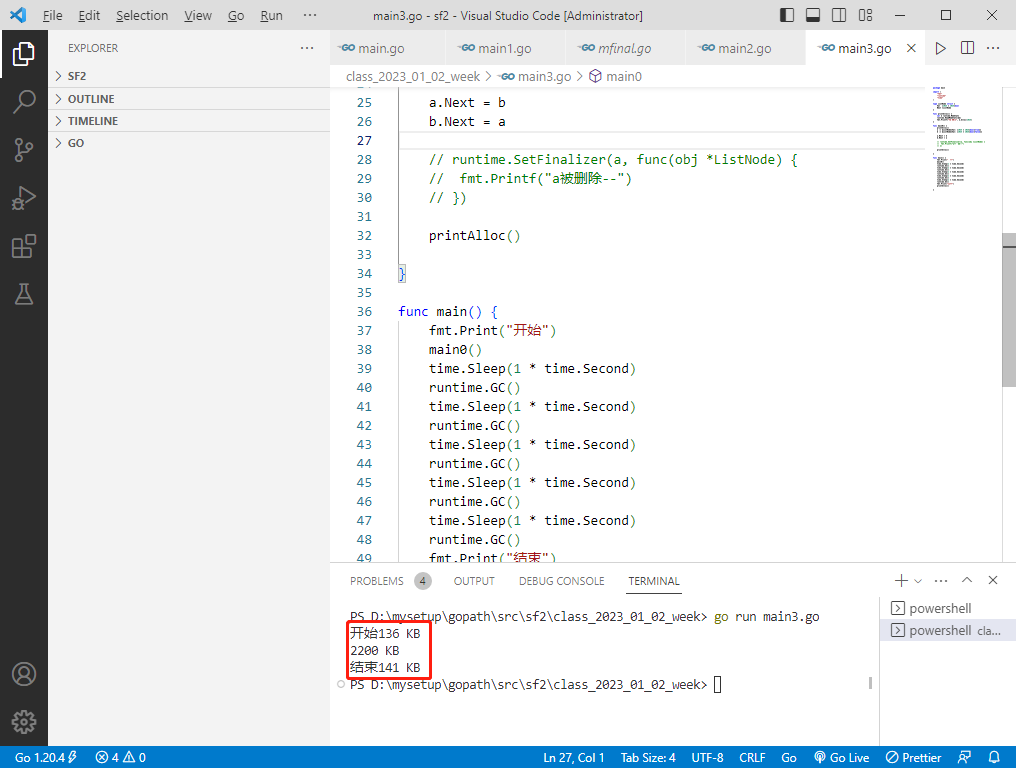
根据运行结果,内存大小明显变小,说明a和b已经被回收了。
让我们再看看有析构函数的情况,运行结果是咋样的,如下:
package main

import (

	"fmt"

	"runtime"

	"time"

)

type ListNode struct {

	Val  [1024 * 1024]bool

	Next *ListNode

}

func printAlloc() {

	var m runtime.MemStats

	runtime.ReadMemStats(&m)

	fmt.Printf("%d KB\n", m.Alloc/1024)

}

func main0() {

	printAlloc()

	a := &ListNode{Val: [1024 * 1024]bool{true}}

	b := &ListNode{Val: [1024 * 1024]bool{false}}

	a.Next = b

	b.Next = a

	runtime.SetFinalizer(a, func(obj *ListNode) {

		fmt.Printf("a被删除--")

	})

	printAlloc()

}

func main() {

	fmt.Print("开始")

	main0()

	time.Sleep(1 * time.Second)

	runtime.GC()

	time.Sleep(1 * time.Second)

	runtime.GC()

	time.Sleep(1 * time.Second)

	runtime.GC()

	time.Sleep(1 * time.Second)

	runtime.GC()

	time.Sleep(1 * time.Second)

	runtime.GC()

	fmt.Print("结束")

	printAlloc()

}
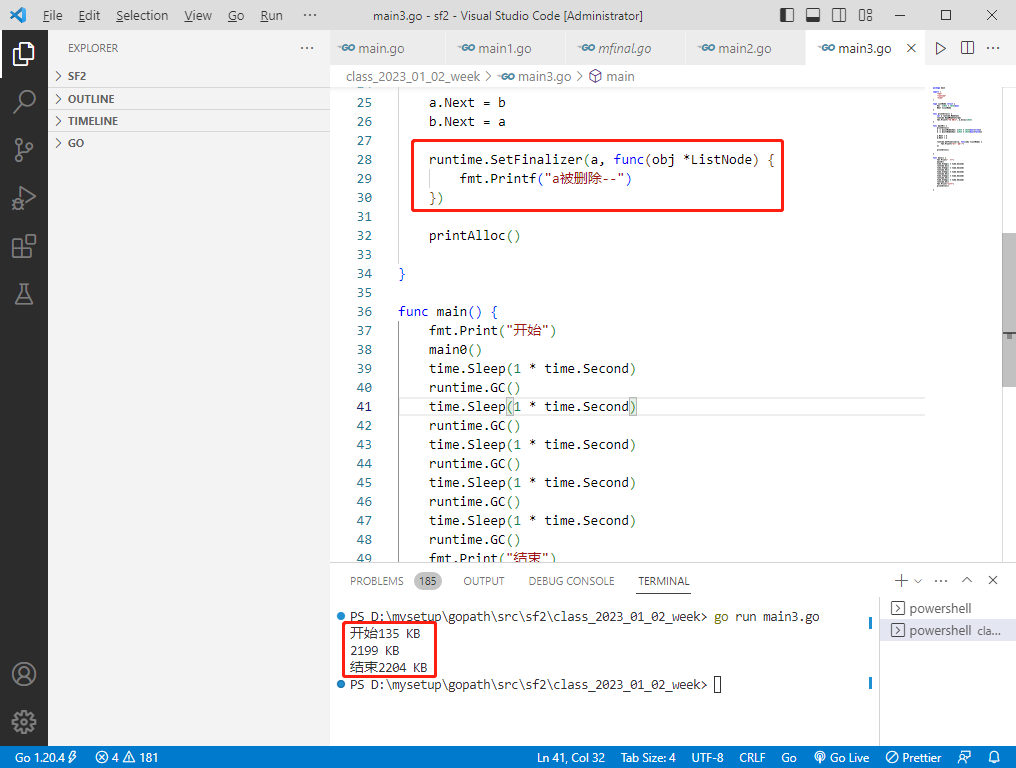
根据运行结果,有析构函数的情况下,a和b确实是无法被回收。
总结
1.不要怀疑八股文的正确性,golang的垃圾回收确实是根可达算法。
2.不要用析构函数去测试无用对象被回收的情况,上面的例子也看到了,两对象的循环引用,析构函数的测试结果就是错误的。只能根据内存变化,看无用对象是否被回收。
3.在写代码的时候,能手动设置引用为nil,最好手动设置,这样能更好的避免内存泄漏。
2023-05-26:golang关于垃圾回收和析构函数的选择题,多数人会选错。的更多相关文章
- golang的垃圾回收(GC)机制
golang的垃圾回收采用的是 标记-清理(Mark-and-Sweep) 算法 就是先标记出需要回收的内存对象快,然后在清理掉: 在这里不介绍标记和清理的具体策略(可以参考https://lengz ...
- 从golang的垃圾回收说起(上篇)
本文来自网易云社区 1 垃圾回收中的重要概念 1.1 定义 In computer science, garbage collection (GC) is a form of automatic me ...
- Golang GC 垃圾回收机制详解
摘要 在实际使用 go 语言的过程中,碰到了一些看似奇怪的内存占用现象,于是决定对go语言的垃圾回收模型进行一些研究.本文对研究的结果进行一下总结. 什么是垃圾回收? 曾几何时,内存管理是程序员开发应 ...
- Golang之垃圾回收
本篇主要是参考了: http://legendtkl.com/2017/04/28/golang-gc/ 说是参考,但其实基本上是原封不动. GC算法简介: 1. 引用计数 引用计数的思想非常简单:每 ...
- 从golang的垃圾回收说起(下篇)
文章来自网易云社区 4 Golang垃圾回收的相关参数 4.1 触发GC gc触发的时机:2分钟或者内存占用达到一个阈值(当前堆内存占用是上次gc后对内存占用的两倍,当GOGC=100时) # 表示 ...
- golang GC 垃圾回收机制
垃圾回收(Garbage Collection,简称GC)是编程语言中提供的自动的内存管理机制,自动释放不需要的对象,让出存储器资源,无需程序员手动执行. Golang中的垃圾回收主要应用三色标记法, ...
- 05.python语法入门--垃圾回收机制
# (1)垃圾回收机制GC# 引用计数# x = 10 # 值10引用计数为1# y = x # 值10引用计数为2## y = 1000 # 值10引用计数减少为1# del x # 值 ...
- C#GC垃圾回收和析构函数和IDisposable的使用
一,什么是GC 1,GC是垃圾回收器,一般来说系统会自动检测不会使用的对象或变量进行内存的释放,不需要手动调用,用Collect()就是强制进行垃圾回收,使内存得到及时的释放,让程序效率更高. 2,G ...
- Golang——垃圾回收GC(2)
1 垃圾回收中的重要概念 1.1 定义 In computer science, garbage collection (GC) is a form of automatic memory manag ...
- 【GoLang】golang垃圾回收 & 性能调优
golang垃圾回收 & 性能调优 参考资料: 如何监控 golang 程序的垃圾回收_Go语言_第七城市 golang的垃圾回收(GC)机制 - 两只羊的博客 - 博客频道 - CSDN.N ...
随机推荐
- 使用sync.Once实现高效的单例模式
1. 简介 本文介绍使用sync.Once来实现单例模式,包括单例模式的定义,以及使用sync.Once实现单例模式的示例,同时也比较了其他单例模式的实现.最后以一个开源框架中使用sync.Once实 ...
- C++/Qt网络通讯模块设计与实现(四)
在C++/Qt网络通讯模块设计与实现(三)中提到了一个概念,即接受者所依附的线程:关注我微信公众号的技术朋友留言对该概念还是不解,这节就单独讲述这个概念的理论与实际应用,这种应用无处不在,因为与Qt的 ...
- Unity C# IEnumrator 与 async 有的区别
前言 IEnumerator 和 async 是在 Unity 和 C# 中处理异步编程的两种不同方法.它们各自有不同的使用场景和优缺点. IEnumerator IEnumerator 是 C# 中 ...
- 打工人都在用的AI工具(第二期)
更多精彩内容,欢迎关注公众号:数量技术宅,也可添加技术宅个人微信号:sljsz01,与我交流. 上周更新的打工人都在用的AI工具(第一期)收到了小伙伴们的高度好评,于是很多小伙伴们急急忙忙的催更,技术 ...
- CentOS8删除boot目录恢复
系统安装完之后,boot分区最好做一个备份,因为这个分区 我们基本不会动它,所以备份一次一劳永逸,以防万一.如果我们不小心 误删除了这个目录,也不用慌,正因为这个分区,我们除了开机 其他时候基本用不到 ...
- Idea快捷键——查找源码
双击shift 输入要查找源码类 相当于查 java_jdk_chm Ctrl+F12 :浏览类
- SpringBoot入门(二):Controller的使用
Controller中注解的使用: @Controller ●该注解用来响应页面,必须配合模板来使用 @RestController ●该注解可以直接响应字符串,返回的类型为JSON格式 ...
- 联系我们html代码
Syntor by Aceto 11 Boleyn Court, Manor Park, Runcorn, Chesire WA7 1SR +44 (0) 1928 579865 + 44 (0) 1 ...
- Fatal error: Uncaught SoapFault exception:解决办法
SOAP-ERROR: Parsing WSDL: failed to load external entity Fatal error: Uncaught SoapFault exception: ...
- 1748E Yet Another Array Counting Problem
1748E Yet Another Array Counting Problem 目录 1748E Yet Another Array Counting Problem 题目大意: 做法 code 题 ...