
Figures Inscribed in Curves (曲线上的图形)
Figures Inscribed in Curves\text{Figures Inscribed in Curves}Figures Inscribed in Curves
A short tour of an old problem
by Mark J. Nielsen (Professor of Mathematics, University of Idaho)
These pages give a brief and informal introduction to one of my favorite unsolved mathematics problems – the so-called “inscribed squares problem”. The question can be informally stated as follows:
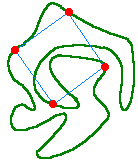
If you draw a curve on a piece of paper that ends where it began but never crosses itself (such as the green curve at right), will it always pass through the four corners of some square?
Notice that we don’t care whether or not the square “stays inside” of the curve – in fact, its sides may cross the curve many times. Nor do we care whether or not the corners of the square appear on the curve in any particular order.
A more exact statement of the question requires a couple of (fairly simple) definitions.
A simple closed curve is the image in the plane R2 of a continuous function f: [0,1] ----> R2 that is one-to-one except that f(0) = f(1).
Intuitively, this is exactly what you’d expect a “closed curve” to be – you start drawing at some point and trace a curve without lifting your pencil from the paper and without making your curve cross itself, ending at the point where you began. The word “simple” refers to the fact that the curve doesn’t cross itself.
Let J be a simple closed curve. We’ll say that a polygon P is inscribed in J if its vertices lie on J.
The inscribed squares problem can now be stated efficiently as:
Does every simple closed curve have an inscribed square?
To me, this is an appealing problem for several reasons:
- It is easy to state and understand the question.
- It has a nice geometric flavor (with a touch of topology for interest).
- It has avoided a complete solution for a long time.
The problem was first posed by Toeplitz in 1911, and while many interesting partial and related results have been given, no one knows the answer to the question above. In fact, the “range of ignorance” with regard to this question is quite astounding! For all the work that has been done on this question, we don’t yet know enough to rule out either of the following extreme possibilities:
- Possibility One: Every closed and bounded set that separates the plane into more than one piece must contain the four vertices of a square.
- Possibility Two: “Most” simple closed curves do not have inscribed squares. (By this we mean that if you were to draw a simple closed curve at random from the set of all simple closed curves, the probability that you’d get one with an inscribed square is zero. This notion can be made exact in several different ways, all of which involve details that we don’t want to get into here!)
Given that we can’t rule out either of these extremes, how much is known? Some of the first efforts to answer the question resulted in proofs that all polygons, differentiable curves, and curves bounding convex regions had inscribed squares. The best result to date is probably the following theorem (1989) due to Walter Stromquist.
Stromquist’s Theorem: If the simple closed curve J is “nice enough” then it has an inscribed square.
[Walter Stromquist, Inscribed squares and square-like quadrilaterals in closed curves, Mathematika 36: 187-197 (1989).]
Here, “nice enough” means the following: for each point P on the curve there must be a coordinate system for the plane in which some piece of the curve containing P is the graph y = f(x) of a continuous function.
At least one prominant mathematician I have met believes that Stromquist’s theorem is good enough to make the statement “All simple closed curves have inscribed squares” morally true – presumably because any curve you could actually draw with pencil and paper is nice enough to be covered by Stromquist’s theorem. In other words, this theorem more-or-less settles the informal version of our original question – any curve you draw on a sheet of paper will have an inscribed square. But the more formal version of the question is far from settled, because “most” simple closed curves have fractal-like behavior and are not “nice” at all. And while it is certainly good to have an answer for the pencil-and-paper version, the topologist in me cares about those curves that exist only in our imaginations. The universe of mathematics is much larger than just what we can draw on paper – if there are curves that don’t admit inscribed squares, I want to know about them.
Note: The following strategy may have occured to you as a possible way to get an inscribed square in an arbitrary (probably not-very-nice) curve J:
- Approximate J by a sequence of “nice” curves (such as polygons) P1, P2, P3, . . .
- Use Stromquist’s Theorem to get a square Qi inscribed in each Pi.
- Take a limit of the squares Q1, Q2, Q3, . . . (or more properly of some subsequence of this sequence of squares) to get a square inscribed in J.
This actually works perfectly well with one small but crucial catch: we can’t guarantee that the sizes of the squares Q1, Q2, Q3, . . . don’t go to zero in the limit. If that happens then the limiting figure is a degenerate square – in other words a single point! (And proving that every simple closed curve contains an inscribed point is not very interesting!) Because of this, any theorem that guarantees an inscribed figure of some minimal size would be extremely important. If we could improve Stromquist’s Theorem to say that “nice” curves have “big” inscribed squares, we’d have the whole matter settled.
But even if we are never able to ultimately answer the big question (which, by the way, I believe we will be able to do!), investigating the inscribed squares problem has led to many interesting side results. Below you will find links to six of these. I have chosen them for the simplicity and/or appeal of their proofs, which you can read by clicking on the theorem name. I have stated the theorems and proofs in their simplest, most intuitive versions, leaving off the messy details that are often necessary to state and prove a theorem in its most general form. If you want all the details, the reference to the relevant research paper is provided.
The first theorem shows that the “nice” behavior demanded by Stromquist’s Theorem can be replaced by symmetry – a different type of “nice” behavior. You will notice in the proof that the symmetry property reduces the number of points to be located on the curve from four to two.
THEOREM A: Every simple closed curve that is symmetric about the origin has an inscribed square.
[Mark J. Nielsen and S.E. Wright, Rectangles inscribed in symmetric continua, Geometriae Dedicata 56: 285-297 (1995).]
The next two theorems don’t require any special behavior on the part of the curve, but also don’t quite guarantee inscribed squares. Instead, they say we can always find inscribed four-sided figures that are related to squares.
THEOREM B: Every simple closed curve has lots of inscribed parallelograms and lots of inscribed rhombuses.
[Mark J. Nielsen, Rhombi inscribed in simple closed curves, Geometriae Dedicata 54: 245-254 (1995).]
THEOREM C: Every simple closed curve has at least one inscribed rectangle.
[Proof due to Vaughan, included in the paper Balancing acts, Topology Proc. 6: 59-75 (1981) by Mark D. Meyerson.]
Finally, many interesting results can be proved about triangles inscribed in curves. This is, of course, a bit easier to deal with than squares, since the number of points to grapple with is only three.
THEOREM D: If J is any simple closed curve and T is any triangle then J has an inscribed triangle similar to T.
[Mark D. Meyerson, Equilateral triangles and continuous curves, Fund. Math. 110: 1-9 (1980).]
THEOREM E: Extending Theorem D, J has so many inscribed triangles similar to T that the vertices of all these inscribed triangles are “dense” in the curve J.
[Mark J. Nielsen, Triangles inscribed in simple closed curves, Geometriae Dedicata 43: 291-297 (1992).]
THEOREM F: If T is any triangle and if J is a simple closed curve in 3-dimensional space R3 (instead of in the plane) that is differentiable (has a tangent line) at at least one point, then J has an inscribed triangle similar to T.
[Eric Rawdon and Jonathan Simon, unpublished(?) – correspondence with Professor Victor Klee.]
If you like geometry, you may enjoy reading a few of the proofs of the above theorems (just follow the links). For a more thorough introduction to the inscribed squares problem, as well as many more references to related papers, consult pp.58-65 and 137-144 in the excellent book Old and New Unsolved Problems in Plane Geometry and Number Theory (1991, Mathematical Association of America) by Victor Klee and Stan Wagon.
You may even feel inspired to try your own hand at chipping away toward a solution to the inscribed squares problem. Below you will find a few exercises to get you warmed-up, followed by some open-ended (and as-yet-unanswered) questions. Good luck – as they say in TV’s The X-files, “the truth is out there somewhere.”
Figures Inscribed in Curves (曲线上的图形)的更多相关文章
- C# 曲线上的点(一) 获取指定横坐标对应的纵坐标值
获取直线上的点,很容易,那曲线呢?二阶贝塞尔.三阶贝塞尔.多段混合曲线,如何获取指定横坐标对应的纵坐标? 如下图形: 实现方案 曲线上的点集 Geometry提供了一个函数GetFlattenedPa ...
- C# 曲线上的点(二) 获取距离最近的点
如何在一条曲线上,获取到距离指定点最近的点位置? 与上一篇 C# 曲线上的点(一) 获取指定横坐标对应的纵坐标值 类似, 我们通过曲线上获取的密集点,通过俩点之间连线,获取连线上最近的点.我们能够获取 ...
- Go 在 Windows 上用户图形界面 GUI 解决方案 Go-WinGUI 国产(使用cef 内核)
Go 在 Windows 上用户图形界面 GUI 解决方案 Go-WinGUI 国产 Go 在服务端的优势不容置疑,但是在桌面应用上却没有好的 GUI 支持,本项目是 Go 语言在 Windows 上 ...
- 零元学Expression Blend 4 - Chapter 37 看如何使用Clip修出想要的完美曲线(上)
原文:零元学Expression Blend 4 - Chapter 37 看如何使用Clip修出想要的完美曲线(上) 几何外部的 UIElement 会在呈现的配置中以视觉化方式裁剪. 几何不一定要 ...
- Winform中设置ZedGraph鼠标悬浮显示举例最近曲线上的点的坐标值和X轴与Y轴的标题
场景 Winform中设置ZedGraph鼠标双击获取距离最近曲线上的点的坐标值: https://blog.csdn.net/BADAO_LIUMANG_QIZHI/article/details/ ...
- Canvas入门(1):绘制矩形、圆、直线、曲线等基本图形
来源:http://www.ido321.com/968.html 一.Canvas的基础知识 Canvas是HTML 5中新增的元素,专门用于绘制图形.canvas元素就相当于一块“画布”,一块无色 ...
- linux 上安装图形界面
linux 上安装 vncserver 后,图形界面里只有灰底和一个terminal 框, 解决方法: 修改 .vnc/xstartup为 unset SESSION_MANAGER # exec / ...
- 用xmanager6启动Linux上的图形界面程序
1.下载Xmanager6 并自行安装,这里不赘述了 2.打开Xmanager.启动Xstart 3.按提示输入:主机IP,协议,用户名,命令,完成后点击“保存”,接着点击“运行”,运行xmanage ...
- Winform中设置ZedGraph鼠标双击获取距离最近曲线上的点的坐标值
场景 WInforn中设置ZedGraph的焦点显示坐标格式化以及显示三个坐标数的解决办法: https://blog.csdn.net/BADAO_LIUMANG_QIZHI/article/det ...
随机推荐
- Python文件访问编码格式问题UnicodeDecodeError: 'gbk' codec can't decode byte 0x80 in position xx: 解决方案
1.Python读取文件 # .打开文件 file = open("ReadMe") # .读取文件类容 text = file.read() print(text) # .关闭文 ...
- Hadoop学习笔记之HBase Shell语法练习
Hadoop学习笔记之HBase Shell语法练习 作者:hugengyong 下面我们看看HBase Shell的一些基本操作命令,我列出了几个常用的HBase Shell命令,如下: 名称 命令 ...
- 关于git的认知
Git,官方的解释为一个开源的分布式版本控制系统,可以有效.高速地处理从很小到非常大的项目版本管理.是一个开放源码的版本控制软件. 就个人而言,这是一种不同开发者之间的代码交流.合并的途径,进而完成目 ...
- 手把手教你使用Java实现一个神经网络
首先看一下运行效果: 下面是项目整体目录: 0.实现神经网络总览 神经网络由层.神经元.权重.激活函数和偏置组成.每层都有一个或者多个神经元,每一个神经元都和神经输入/输出连接,这些连接就是权重. 需 ...
- Nginx--面试基础必会
文章原创于公众号:程序猿周先森.本平台不定时更新,喜欢我的文章,欢迎关注我的微信公众号. 最近一直在更新关于Nginx的系列文章,终于将Nginx的几个关键知识点讲的差不多了.本篇作为Nginx系列的 ...
- 实例化Bean的几种方法
1.使用构造器实例化Bean. 当没有指定实例化方法时,Spring IoC容器能使用默认空构造器.构造器实例化包括默认空构造器和有参数构造器两种方式创建Bean. 2.使用构造器实例 ...
- 更改hadoop集群yarn的webui中的开始时间和结束时间为本地时间
yarn集群的webui地址为:http://rm:8088 执行任务后,任务的开始时间和结束时间都是utc时间,查看很不方便. 查找相关资料发现hadoop有补丁包,补丁地址:https://iss ...
- Scrapy项目 - 实现腾讯网站社会招聘信息爬取的爬虫设计
通过使Scrapy框架,进行数据挖掘和对web站点页面提取结构化数据,掌握如何使用Twisted异步网络框架来处理网络通讯的问题,可以加快我们的下载速度,也可深入接触各种中间件接口,灵活的完成各种需求 ...
- forEach标签
1.forEach标签的简单使用: (1)未设置步长属性时,默认步长为1: <c:forEach "> <c:out value="${number}" ...
- vue.js 实战 todo list
vue.js 起源 vue.js 的作者是尤雨溪,是一名中国人,之前在谷歌工作,现在在全职维护 vue 项目. vue.js 是 2014 年推出来的.现在已经更新到 2.x 版本,3.0 版本会在 ...