
7.1数据注解属性--Key【Code-First系列】
Key特性可以被用到类的属性中,Code-First默认约定,创建一个主键,是以属性的名字“Id”,或者是类名+Id来的。
Key特性重写了这个默认的约定,你可以应用Key特性到一个类的属性上面,不管这个属性的名字是什么,你都可以创建一个主键。
让我们看看下面的代码吧:
using System;
using System.Collections.Generic;
using System.ComponentModel.DataAnnotations;
using System.ComponentModel.DataAnnotations.Schema;
using System.Linq;
using System.Text;
using System.Threading.Tasks;

namespace EF2
{
    [Table("StudentInfo")]
   public class Student
    {
        [Key]
        public int StudentKey { get; set; }

        [Column("Name",TypeName="ntext")]
        [MaxLength()]
        public string StudentName { get; set; }

        [NotMapped()]
        public int? Age { get; set; }

        public int StdId { get; set; }

        [ForeignKey("StdId")]
        public virtual Standard Standard { get; set; }

    }
}
在上面的例子中,Key属性应用到了Student实体的StudnetKey属性上面,那么下面将会得到这个主键:

当然你还可以创建复合主键,使用Key特性和Column特性,使2个列同时作为主键,看看下面的代码吧:
注意:我这里先让大家看看一个错误的例子。创建复合主键的时候,我只用Key特性,看可以不可以呢???
看我的代码:
using System;
using System.Collections.Generic;
using System.ComponentModel.DataAnnotations;
using System.ComponentModel.DataAnnotations.Schema;
using System.Linq;
using System.Text;
using System.Threading.Tasks;

namespace EF2
{
    [Table("StudentInfo")]
   public class Student
    {
        [Key]
        public int StudentKey1 { get; set; }

        [Key]
        public int StudentKey2 { get; set; }

        [Column("Name",TypeName="ntext")]
        [MaxLength()]
        public string StudentName { get; set; }

        [NotMapped()]
        public int? Age { get; set; }

        public int StdId { get; set; }

        [ForeignKey("StdId")]
        public virtual Standard Standard { get; set; }

    }
}
当然我们需要,改一下Main函数的调用代码:
using System;
using System.Collections.Generic;
using System.Linq;
using System.Text;
using System.Threading.Tasks;

namespace EF2
{
    class Program
    {
        static void Main(string[] args)
        {
            Student stuModel = new Student() { StudentKey1 = 1,StudentKey2=1, StudentName = "cfs", StdId = 1 };

            using (var db = new DbContextClass())
            {
                db.Students.Add(stuModel);
                db.SaveChanges();
            }

            Console.WriteLine("Add Success");
            Console.ReadKey();
        }
    }
}
运行程序:

报错了,看一下具体的错误消息:
Unable to determine composite primary key ordering for type 'EF2.Student'. Use the ColumnAttribute (see http://go.microsoft.com/fwlink/?LinkId=386388) or the HasKey method (see http://go.microsoft.com/fwlink/?LinkId=386387) to specify an order for composite primary keys.
大意是:不能创建复合主键,因为没有使用Column特性或者HasKey方法,来指定主键的序列。
然后我们再修改一下代码:
using System;
using System.Collections.Generic;
using System.ComponentModel.DataAnnotations;
using System.ComponentModel.DataAnnotations.Schema;
using System.Linq;
using System.Text;
using System.Threading.Tasks;

namespace EF2
{
    [Table("StudentInfo")]
   public class Student
    {
        [Key]
        [Column]
        public int StudentKey1 { get; set; }

        [Key]
        [Column]
        public int StudentKey2 { get; set; }

        [Column("Name",TypeName="ntext")]
        [MaxLength()]
        public string StudentName { get; set; }

        [NotMapped()]
        public int? Age { get; set; }

        public int StdId { get; set; }

        [ForeignKey("StdId")]
        public virtual Standard Standard { get; set; }

    }
}
看现在我们加了Column特性了吧,现在我们再运行程序:
还是抱上面的错误,然后我们再修改代码:
using System;
using System.Collections.Generic;
using System.ComponentModel.DataAnnotations;
using System.ComponentModel.DataAnnotations.Schema;
using System.Linq;
using System.Text;
using System.Threading.Tasks;

namespace EF2
{
    [Table("StudentInfo")]
   public class Student
    {
        [Key]
        [Column("one")]
        public int StudentKey1 { get; set; }

        [Key]
        [Column("two")]
        public int StudentKey2 { get; set; }

        [Column("Name",TypeName="ntext")]
        [MaxLength()]
        public string StudentName { get; set; }

        [NotMapped()]
        public int? Age { get; set; }

        public int StdId { get; set; }

        [ForeignKey("StdId")]
        public virtual Standard Standard { get; set; }

    }
}
这样还是不行,哈哈,因为没有指定列的顺序,算了,不折腾了,上正确的代码:
using System;
using System.Collections.Generic;
using System.ComponentModel.DataAnnotations;
using System.ComponentModel.DataAnnotations.Schema;
using System.Linq;
using System.Text;
using System.Threading.Tasks;

namespace EF2
{
    [Table("StudentInfo")]
   public class Student
    {
        [Key]
        [Column(Order=1)]
        public int StudentKey1 { get; set; }

        [Key]
        [Column(Order=2)]
        public int StudentKey2 { get; set; }

        [Column("Name",TypeName="ntext")]
        [MaxLength()]
        public string StudentName { get; set; }

        [NotMapped()]
        public int? Age { get; set; }

        public int StdId { get; set; }

        [ForeignKey("StdId")]
        public virtual Standard Standard { get; set; }

    }
}
运行程序之后,看下数据库:

请注意:单个主键,EF Code-First为我们创建的:主键是自动增长的,而复合主键,得到的主键不是自动增长的。
当然,key 属性不仅仅可以引用到int类型的属性上,还可以应用到字符串,日期类型等等。。
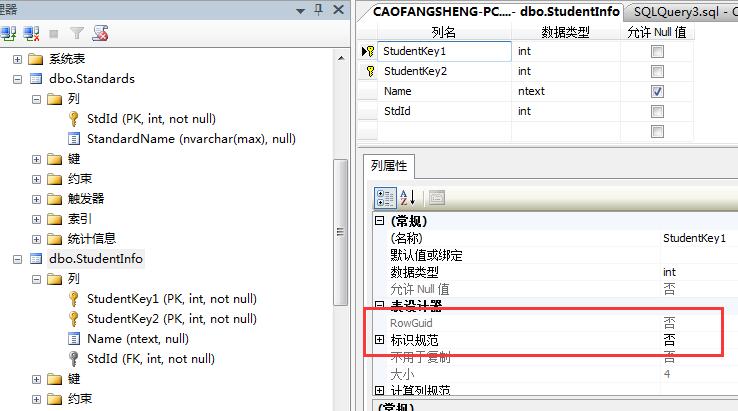
好了,这就是数据注解特性的Key特性了。
7.1数据注解属性--Key【Code-First系列】的更多相关文章
- 7.2 数据注解属性--TimeStamp特性【Code-First 系列】
TimeStamp特性可以应用到领域类中,只有一个字节数组的属性上面,这个特性,给列设定的是tiemStamp类型.在并发的检查中,Code-First会自动使用这个TimeStamp类型的字段. 下 ...
- 7.4 数据注解属性--Required
Required attribute can be applied to a property of a domain class. EF Code-First will create a NOT N ...
- 1.什么是Code First(EF Code First 系列)
EF4.1中开始支持Code First .这种方式在领域设计模式中非常有用.使用Code First模式,你可以专注于领域设计,根据需要,为你一个领域的对象创建类集合,而不是首先来设计数据库,然后来 ...
- 9.3 翻译系列:数据注解特性之Key【EF 6 Code-First 系列】
原文链接:http://www.entityframeworktutorial.net/code-first/key-dataannotations-attribute-in-code-first.a ...
- MVC5中Model层开发数据注解 EF Code First Migrations数据库迁移 C# 常用对象的的修饰符 C# 静态构造函数 MSSQL2005数据库自动备份问题(到同一个局域网上的另一台电脑上) MVC 的HTTP请求
MVC5中Model层开发数据注解 ASP.NET MVC5中Model层开发,使用的数据注解有三个作用: 数据映射(把Model层的类用EntityFramework映射成对应的表) 数据验证( ...
- 7.DataAnnotations(数据注解)【Code-First 系列】
EF Code-First提供了一系列的数据注解的特性,你可以将其应用到你的领域类和属性中,数据注解属性重写了EF默认的约定. System.ComponentModel.DataAnnotation ...
- MVC5中Model层开发数据注解
ASP.NET MVC5中Model层开发,使用的数据注解有三个作用: 数据映射(把Model层的类用EntityFramework映射成对应的表) 数据验证(在服务器端和客户端验证数据的有效性) 数 ...
- ASP.NET MVC5中的数据注解
ASP.NET MVC5中Model层开发,使用的数据注解有三个作用: 数据映射(把Model层的类用EntityFramework映射成对应的表) 数据验证(在服务器端和客户端验证数据的有效性) 数 ...
- ASP.NET MVC5中的数据注解(转载)
ASP.NET MVC5中Model层开发,使用的数据注解有三个作用: 数据映射(把Model层的类用EntityFramework映射成对应的表) 数据验证(在服务器端和客户端验证数据的有效性) 数 ...
随机推荐
- 使用VS2013进行单元测试
这次的作业安装了VS2013,对于它的安装过程我就不再细说了,归结起来就是一个字——等,尤其是语言包,最后只好放弃了装语言包,凭借我3级半的英语水平,明白这些没有问题——这仅仅个玩笑话,其实我是用有道 ...
- SQL Server CheckPoint的几个误区
有关CheckPoint的概念对大多数SQL Server开发或DBA人员都不陌生.但是包括我自己在内,大家对于CheckPoint都或多或少存在某些误区,最近和高文佳同学(感谢高同学的探讨) ...
- 非域环境下搭建自动故障转移镜像无法将 ALTER DATABASE 命令发送到远程服务器实例的解决办法
非域环境下搭建自动故障转移镜像无法将 ALTER DATABASE 命令发送到远程服务器实例的解决办法 环境:非域环境 因为是自动故障转移,需要加入见证,事务安全模式是,强安全FULL模式 做到最后一 ...
- 剑指Offer面试题:31.两个链表的第一个公共节点
一.题目:两个链表的第一个公共节点 题目:输入两个链表,找出它们的第一个公共结点. 链表结点定义如下,这里使用C#语言描述: public class Node { public int key; p ...
- LOMA280保险原理读书笔记
LOMA是国际金融保险管理学院(Life Office Management Association)的英文简称.国际金融保险管理学院是一个保险和金融服务机构的国际组织,它的创建目的是为了促进信息交流 ...
- ASP.NET MVC 路由(一)
ASP.NET MVC路由(一) 前言 从这一章开始,我们即将进入MVC的世界,在学习MVC的过程中在网上搜索了一下,资料还是蛮多的,只不过对于我这样的初学者来看还是有点难度,自己就想看到有一篇引导性 ...
- 解决微信公众号OAuth出现40029(invalid code,不合法的oauth_code)的错误
关于OAuth 官方教程:https://mp.weixin.qq.com/wiki?t=resource/res_main&id=mp1421140842&token=&la ...
- C语言 · 送分啦
问题描述 这题想得分吗?想,请输出"yes":不想,请输出"no". 输出格式 输出包括一行,为"yes"或"no". ...
- PHP设计模式笔记
一.工厂模式:减少new的使用,定义一个类,专门用来创建其它对象例: class A{ static function create(){ return new DB(); } } $db = A:: ...
- Uiautomator 2.0之UiDevice新增API学习小记
1. InstrumentationRegistry类 1.1. 类说明: 一个暴露的注册实例,持有instrumentation运行的进程和参数,还提供了一种简便的方法调用instrumentati ...