
High scalability with Fanout and Fastly
转自:http://blog.fanout.io/2017/11/15/high-scalability-fanout-fastly/
Fanout Cloud is for high scale data push. Fastly is for high scale data pull. Many realtime applications need to work with data that is both pushed and pulled, and thus can benefit from using both of these systems in the same application. Fanout and Fastly can even be connected together!

Using Fanout and Fastly in the same application, independently, is pretty straightforward. For example, at initialization time, past content could be retrieved from Fastly, and Fanout Cloud could provide future pushed updates. What does it mean to connect the two systems together though? Read on to find out.
Proxy chaining
Since Fanout and Fastly both work as reverse proxies, it is possible to have Fanout proxy traffic through Fastly rather than sending it directly to your origin server. This provides some unique benefits:
Cached initial data. Fanout lets you build API endpoints that serve both historical and future content, for example an HTTP streaming connection that returns some initial data before switching into push mode. Fastly can provide that initial data, reducing load on your origin server.
Cached Fanout instructions. Fanout’s behavior (e.g. transport mode, channels to subscribe to, etc.) is determined by instructions provided in origin server responses, usually in the form of special headers such as
Grip-HoldandGrip-Channel. Fastly can cache these instructions/headers, again reducing load on your origin server.High availability. If your origin server goes down, Fastly can serve cached data and instructions to Fanout. This means clients could connect to your API endpoint, receive historical data, and activate a streaming connection, all without needing access to the origin server.
Network flow
Suppose there’s an API endpoint /stream that returns some initial data and then stays open until there is an update to push. With Fanout, this can be implemented by having the origin server respond with instructions:
HTTP/1.1 200 OK

Content-Type: text/plain

Content-Length: 29

Grip-Hold: stream

Grip-Channel: updates

{"data": "current value"}
When Fanout Cloud receives this response from the origin server, it converts it into a streaming response to the client:
HTTP/1.1 200 OK

Content-Type: text/plain

Transfer-Encoding: chunked

Connection: Transfer-Encoding

{"data": "current value"}
The request between Fanout Cloud and the origin server is now finished, but the request between the client and Fanout Cloud remains open. Here’s a sequence diagram of the process:
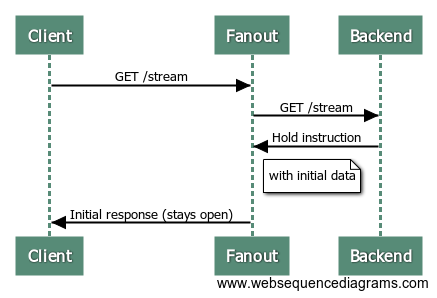
Since the request to the origin server is just a normal short-lived request/response interaction, it can alternatively be served through a caching server such as Fastly. Here’s what the process looks like with Fastly in the mix:
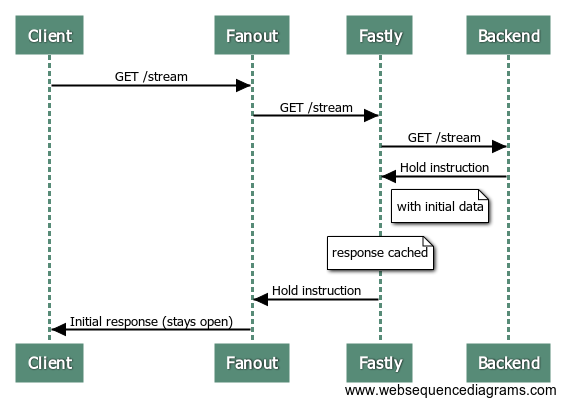
Now, guess what happens when the next client makes a request to the /stream endpoint?
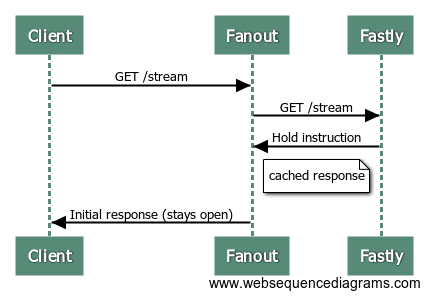
That’s right, the origin server isn’t involved at all! Fastly serves the same response to Fanout Cloud, with those special HTTP headers and initial data, and Fanout Cloud sets up a streaming connection with the client.
Of course, this is only the connection setup. To send updates to connected clients, the data must be published to Fanout Cloud.
We may also need to purge the Fastly cache, if an event that triggers a publish causes the origin server response to change as well. For example, suppose the “value” that the /stream endpoint serves has been changed. The new value could be published to all current connections, but we’d also want any new connections that arrive afterwards to receive this latest value as well, rather than the older cached value. This can be solved by purging from Fastly and publishing to Fanout Cloud at the same time.
Here’s a (long) sequence diagram of a client connecting, receiving an update, and then another client connecting:
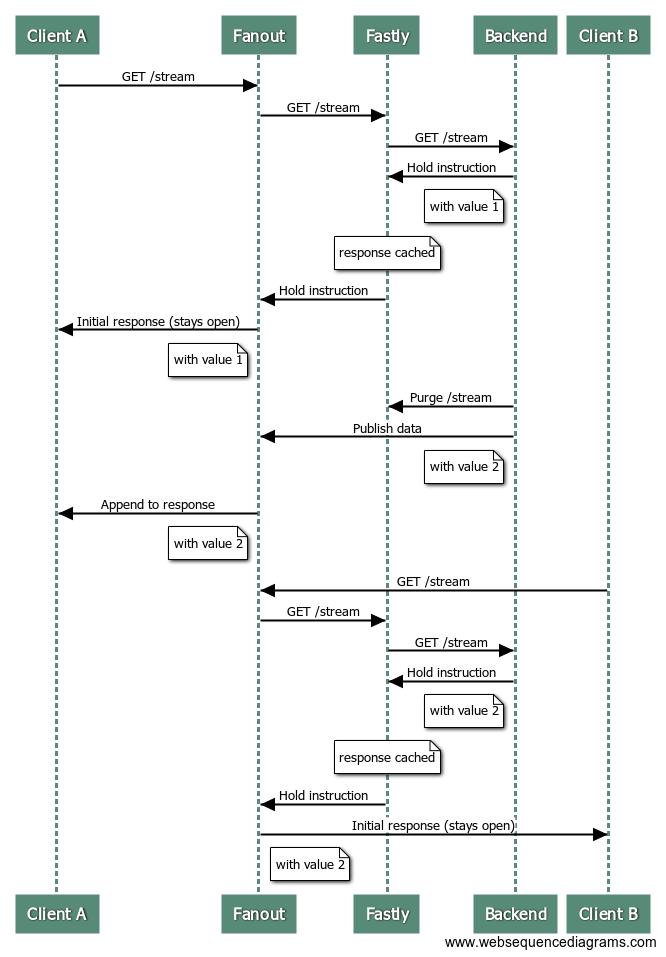
At the end of this sequence, the first and second clients have both received the latest data.
Rate-limiting
One gotcha with purging at the same time as publishing is if your data rate is high it can negate the caching benefit of using Fastly.
The sweet spot is data that is accessed frequently (many new visitors per second), changes infrequently (minutes), and you want changes to be delivered instantly (sub-second). An example could be a live blog. In that case, most requests can be served/handled from cache.
If your data changes multiple times per second (or has the potential to change that fast during peak moments), and you expect frequent access, you really don’t want to be purging your cache multiple times per second. The workaround is to rate-limit your purges. For example, during periods of high throughput, you might purge and publish at a maximum rate of once per second or so. This way the majority of new visitors can be served from cache, and the data will be updated shortly after.
An example
We created a Live Counter Demo to show off this combined Fanout + Fastly architecture. Requests first go to Fanout Cloud, then to Fastly, then to a Django backend server which manages the counter API logic. Whenever a counter is incremented, the Fastly cache is purged and the data is published through Fanout Cloud. The purge and publish process is also rate-limited to maximize caching benefit.
The code for the demo is on GitHub.
High scalability with Fanout and Fastly的更多相关文章
- spring amqp rabbitmq fanout配置
基于spring amqp rabbitmq fanout配置如下: 发布端 <rabbit:connection-factory id="rabbitConnectionFactor ...
- 可扩展性 Scalability
水平扩展和垂直扩展: Horizontal and vertical scaling Methods of adding more resources for a particular applica ...
- RabbitMQ Exchange中的fanout类型
fanout 多播 在之前都是使用direct直连类型的交换机,通过routingkey来决定把消息推到哪个queue中. 而fanout则是把拿到消息推到与之绑定的所有queue中. 分析业务,怎样 ...
- RabbitMQ学习笔记4-使用fanout交换器
fanout交换器会把发送给它的所有消息发送给绑定在它上面的队列,起到广播一样的效果. 本里使用实际业务中常见的例子, 订单系统:创建订单,然后发送一个事件消息 积分系统:发送订单的积分奖励 短信平台 ...
- What is the difference between extensibility and scalability?
You open a small fast food center, with a serving capacity of 5-10 people at a time. But you have en ...
- Achieving High Availability and Scalability - ARR and NLB
Achieving High Availability and Scalability: Microsoft Application Request Routing (ARR) for IIS 7.0 ...
- Improve Scalability With New Thread Pool APIs
Pooled Threads Improve Scalability With New Thread Pool APIs Robert Saccone Portions of this article ...
- A Flock Of Tasty Sources On How To Start Learning High Scalability
This is a guest repost by Leandro Moreira. When we usually are interested about scalability we look ...
- SSIS ->> Reliability And Scalability
Error outputs can obviously be used to improve reliability, but they also have an important part to ...
随机推荐
- php GD 和图像处理函数, 制作一张图片
php GD 和图像处理函数, 制作一张图片 // GD 和图像处理函数 // https://www.php.net/manual/zh/ref.image.php // https://www.p ...
- java基础 String
标准格式:数据类型[] 数组名称 = new 数据类型[] {元素1,元素2,...};省略格式:数据类型[] 数组名称 = {元素1,元素2,...}; Scanner类实现的功能,可以实现键盘输入 ...
- C#使用Autofac实现控制反转IoC和面向切面编程AOP
Autofac是一个.net下非常优秀,性能非常好的IOC容器(.net下效率最高的容器),加上AOP简直是如虎添翼.Autofac的AOP是通过Castle(也是一个容器)项目的核心部分实现的,名为 ...
- 无法生成服务引用(添加WebService)
参考地址:http://www.52study.org/bencandy-120-1076-1.html 问题场景:.在工程中添加WebService,报错: 解决办法: 1.配置该服务引用 将下面 ...
- JavaScript前端和Java后端的AES加密和解密(转)
在实际开发项目中,有些数据在前后端的传输过程中需要进行加密,那就需要保证前端和后端的加解密需要统一.这里给大家简单演示AES在JavaScript前端和Java后端是如何实现加密和解密的. java端 ...
- 2019-07-23 static 和 const 关键字的应用
首先先来了解下内存段,内存段共分为四个,栈.堆.代码段.初始化静态段.程序中不同的声明存放在不同的内存段内,栈空间段是存储占用相同空间长度并且占用空间小的数据类型的地方,比如说整型1, 10, 100 ...
- js基础闭包练习题
题目描述 实现函数 makeClosures,调用之后满足如下条件:1.返回一个函数数组 result,长度与 arr 相同2.运行 result 中第 i 个函数,即 result[i](),结果与 ...
- electron-vue多显示屏下将新窗口投放是其他屏幕
display对象可以获取所有显示屏此处演示程序启动是投放新窗口至另一屏幕 import { app, BrowserWindow } from 'electron' const electron = ...
- Doctype作用,标准模式与兼容模式的区别
<!DOCTYPE>声明位于位于HTML文档中的第一行,处于 <html> 标签之前.告知浏览器的解析器用什么文档标准解析这个文档.DOCTYPE不存在或格式不正确会导致文档以 ...
- 英语Affrike非洲Affrike单词
中文名称阿非利加洲(全称) 外文名称Africa 别 名Affrike 行政区类别洲 下辖地区北非.东非.西非.中非.南非 地理位置东濒印度洋,西临大西洋,北至地中海,南至好望角 面 积3022万平方 ...