
POJ 1921 Paper Cut(计算几何の折纸问题)
Description
Carol's puzzle is simple to state. She folds the paper in a certain manner and then uses a knife to cut through the folded paper. What Mike needs to do is to tell how many pieces the folded paper will turn into after it is cut. To eliminate the ambiguity, we can coordinate the paper as [0, 1] * [0, 1], with the coordinates of lower left corner (0, 0). A fold is denoted by two points (x1, y1) and (x2, y2) on the folding line, with which, the direction of the line is determined by from (x1, y1) to (x2, y2). Carol will always fold the paper from left to right relative to the directed line given (see Figure-1). The cut is determined by the two points on the cut line. Please note that the points given to determine the fold or the cut are not necessarily on the paper. 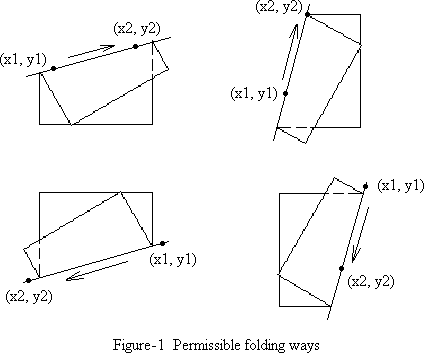
Input
Output
 #include <cstdio>

 #include <algorithm>

 #include <cstring>

 #include <iostream>

 #include <cmath>

 #include <vector>

 #include <map>

 using namespace std;

 typedef long long LL;

 typedef pair<int, int> PII;

 const double PI = acos(-1.0);

 const double EPS = 1e-;

 inline int sgn(double x) {

     return (x > EPS) - (x < -EPS);

 }

 struct Point {

     double x, y;

     Point() {}

     Point(double x, double y): x(x), y(y) {}

     void read() {

         scanf("%lf%lf", &x, &y);

     }

     Point operator + (const Point &rhs) const {

         return Point(x + rhs.x, y + rhs.y);

     }

     Point operator - (const Point &rhs) const {

         return Point(x - rhs.x, y - rhs.y);

     }

     Point operator * (double t) const {

         return Point(x * t, y * t);

     }

     double length() const {

         return sqrt(x * x + y * y);

     }

     Point unit() const {

         double l = length();

         return Point(x / l, y / l);

     }

 };

 double dist(const Point &p1, const Point &p2) {

     return (p1 - p2).length();

 }

 Point rotate(const Point &p, double angle, const Point &o = Point(, )) {

     Point t = p - o;

     double x = t.x * cos(angle) - t.y * sin(angle);

     double y = t.y * cos(angle) + t.x * sin(angle);

     return Point(x, y) + o;

 }

 double cross(const Point &a, const Point &b) {

     return a.x * b.y - a.y * b.x;

 }

 double cross(const Point &sp, const Point &ep, const Point &op) {

     return cross(sp - op, ep - op);

 }

 struct Seg {

     Point st, ed;

     Seg() {}

     Seg(Point st, Point ed): st(st), ed(ed) {}

     void read() {

         st.read(); ed.read();

     }

 };

 typedef Seg Line;

 //return Ax + By + C =0 's A, B, C

 void Coefficient(const Line &L, double &A, double &B, double &C) {

     A = L.ed.y - L.st.y;

     B = L.st.x - L.ed.x;

     C = L.ed.x * L.st.y - L.st.x * L.ed.y;

 }

 //point of intersection

 Point operator * (const Line &a, const Line &b) {

     double A1, B1, C1;

     double A2, B2, C2;

     Coefficient(a, A1, B1, C1);

     Coefficient(b, A2, B2, C2);

     Point I;

     I.x = - (B2 * C1 - B1 * C2) / (A1 * B2 - A2 * B1);

     I.y =   (A2 * C1 - A1 * C2) / (A1 * B2 - A2 * B1);

     return I;

 }

 double Point_to_Line(const Point &p, const Line &L) {

     return fabs(cross(p, L.st, L.ed)/dist(L.st, L.ed));

 }

 Point reflection(const Point &p, const Line &l) {

     Point t = rotate(l.ed - l.st, -PI / );

     return p + t.unit() * ( * Point_to_Line(p, l));

 }

 vector<Point> p_vec, p_buf;

 struct Poly {

     vector<int> id;

     void add(int i) {

         id.push_back(i);

     }

     Point& operator [] (int i) const {

         return p_vec[id[i]];

     }

 };

 vector<Poly> pol_vec, pol_buf;

 map<PII, int> edge_map;

 Point paper[] = {Point(, ), Point(, ), Point(, ), Point(, )};

 void reflection(const Poly &pol, const Line &l) {

     for(int i = ; i < int(pol.id.size()); ++i)

         if(pol.id[i] < int(p_buf.size())) p_buf[pol.id[i]] = reflection(pol[i], l);

 }

 int intersection(int id1, int id2, const Point &p1, const Point &p2) {

     map<PII, int>::iterator it = edge_map.find(make_pair(id1, id2));

     if(it == edge_map.end()) {

         p_vec.push_back(Line(p_vec[id1], p_vec[id2]) * Line(p1, p2));

         edge_map[make_pair(id1, id2)] = edge_map[make_pair(id1, id2)] = p_vec.size() - ;

         return p_vec.size() - ;

     } else return it->second;

 }

 void fold(const Point &p1, const Point &p2, const Poly &pol) {

     Poly res1, res2;

     int last_s = sgn(cross(p1, pol[], p2));

     for(int i = ; i < int(pol.id.size()); ++i) {

         int now_s = sgn(cross(p1, pol[i], p2));

         if(now_s == ) {

             res1.add(pol.id[i]);

             res2.add(pol.id[i]);

         } else if(now_s < ) {

             if(last_s > ) {

                 int k = intersection(pol.id[i - ], pol.id[i], p1, p2);

                 res1.add(k);

                 res2.add(k);

             }

             res1.add(pol.id[i]);

         } else if(now_s > ) {

             if(last_s < ) {

                 int k = intersection(pol.id[i - ], pol.id[i], p1, p2);

                 res1.add(k);

                 res2.add(k);

             }

             res2.add(pol.id[i]);

         }

         last_s = now_s;

     }

     if(res1.id.size() > ) {

         res1.add(res1.id[]);

         reflection(res1, Line(p1, p2));

         reverse(res1.id.begin(), res1.id.end());

         pol_buf.push_back(res1);

     }

     if(res2.id.size() > ) {

         res2.add(res2.id[]);

         pol_buf.push_back(res2);

     }

 }

 void fold(const Point &p1, const Point &p2) {

     p_buf = p_vec;

     edge_map.clear();

     pol_buf.clear();

     for(int i = ; i < int(pol_vec.size()); ++i)

         fold(p1, p2, pol_vec[i]);

     pol_vec = pol_buf;

     for(int i = ; i < int(p_buf.size()); ++i)

         p_vec[i] = p_buf[i];

 }

 void dfs(vector<bool> &vis, int id, const Line &l) {

     vis[id] = true;

     Poly &pol = pol_vec[id];

     for(int i = ; i < int(pol.id.size() - ); ++i) {

         if(sgn(cross(l.ed, pol[i], l.st)) ==  && sgn(cross(l.ed, pol[i + ], l.st)) == ) continue;

         int id1 = pol.id[i], id2 = pol.id[i + ];

         for(int j = ; j < int(pol_vec.size()); ++j) {

             if(vis[j]) continue;

             for(int k = ; k < int(pol_vec[j].id.size() - ); ++k) {

                 if(pol_vec[j].id[k] == id1 && pol_vec[j].id[k + ] == id2) {

                     dfs(vis, j, l);

                     break;

                 }

             }

         }

     }

 }

 int cut(const Line &l) {

     int ret = ;

     vector<bool> vis(p_vec.size());

     for(int i = ; i < int(pol_vec.size()); ++i) {

         if(!vis[i]) {

             dfs(vis, i, l);

             ++ret;

         }

     }

     return ret;

 }

 int main() {

     int T;

     scanf("%d", &T);

     Poly init_pol;

     for(int i = ; i <= ; ++i) init_pol.add(i & );

     while(T--) {

         int n;

         scanf("%d", &n);

         p_vec.clear();

         pol_vec.clear();

         for(int i = ; i < ; ++i) p_vec.push_back(paper[i]);

         for(int i = ; i <= ; ++i) pol_vec.push_back(init_pol);

         Point p1, p2;

         for(int i = ; i <= n; ++i) {

             p1.read(), p2.read();

             fold(p1, p2);

         }

         printf("%d\n", cut(Line(p1, p2)));

     }

 }
POJ 1921 Paper Cut(计算几何の折纸问题)的更多相关文章
- 【BZOJ】1074: [SCOI2007]折纸origami
http://www.lydsy.com/JudgeOnline/problem.php?id=1074 题意:一开始有一个左上角是(0,100),右下角是(100,0)的纸片,现在可以沿有向直线折n ...
- 1074: [SCOI2007]折纸origami
Time Limit: 20 Sec Memory Limit: 162 MBSubmit: 372 Solved: 229[Submit][Status][Discuss] Descriptio ...
- 【题解】折纸 origami [SCOI2007] [P4468] [Bzoj1074]
[题解]折纸 origami [SCOI2007] [P4468] [Bzoj1074] 传送门:折纸 \(\text{origami [SCOI2007] [P4468]}\) \(\text{[B ...
- CSS3写折纸
<!DOCTYPE HTML> <html> <head> <meta http-equiv="Content-Type" content ...
- 折纸问题java实现
/** * 折纸问题 这段代码写的太low了 本人水平有限 哎... 全是字符串了 * @param n * @return * @date 2016-10-7 * @author shaobn */ ...
- 1074: [SCOI2007]折纸origami - BZOJ
Description 桌上有一张边界平行于坐标轴的正方形纸片,左下角的坐标为(0,0),右上角的坐标为(100,100).接下来执行n条折纸命令.每条命令用两个不同点P1(x1,y1)和P2(x2, ...
- CSS3实现文字折纸效果
CSS3实现文字折纸效果 效果图: 代码如下,复制即可使用: <!DOCTYPE html> <html> <head> <title></tit ...
- UVA 177 PaperFolding 折纸痕 (分形,递归)
著名的折纸问题:给你一张很大的纸,对折以后再对折,再对折……每次对折都是从右往左折,因此在折了很多次以后,原先的大纸会变成一个窄窄的纸条.现在把这个纸条沿着折纸的痕迹打开,每次都只打开“一半”,即把每 ...
- ZR#955 折纸
ZR#955 折纸 解法: 可以发现折纸之后被折到上面的部分实际上是没有用的,因为他和下面对应位置一定是一样的,而影响答案的只有每个位置的颜色和最底层的坐标范围.因此,我们只需要考虑最底层即可,即我们 ...
随机推荐
- 搭建Extjs框架(一)
搭建Extjs框架 pc端 github https://github.com/Status400/Extjs-6.2.0-demo 欢迎start 准本工作: 官方下载Extjs ...
- js内部事件机制--单线程原理
原文地址:https://www.xingkongbj.com/blog/js/event-loop.html http://www.haorooms.com/post/js_xiancheng ht ...
- FreeImage 生成带透明通道的GIF
主要方法: 加载图像及读取参数 FreeImage_Load FreeImage_GetWidth FreeImage_GetHeight FreeImage_Allocate FreeImage_G ...
- UDP实现网络通信程序
VC6.0创建基于UDP协议的网络聊天程序 只有一个工程UDP,服务器和客户端都是这个工程,因为UDP中C/S区分不强化 只讲关键部分,避免累赘 1.为对话框添加控件 2.为控件绑定变量和消息函数 启 ...
- ABAP术语-BAPI ExplorerSupertype
Supertype 原文:http://www.cnblogs.com/qiangsheng/archive/2008/03/17/1109837.html Object type from whic ...
- 学生管理系统增删查基本操作(dom4j/sax技术)
基本代码: student.xml <?xml version="1.0" encoding="UTF-8"?><student> &l ...
- vue服务端渲染缓存应用
vue缓存分为页面缓存.组建缓存.接口缓存,这里我主要说到了页面缓存和组建缓存 页面缓存: 在server.js中设置 const LRU = require('lru-cache') const m ...
- Kibana6.3.1安装
Kibana安装 Kibana官方下载地址: https://www.elastic.co/cn/downloads/kibana 也可以直接使用以下命令下载(文章下载目录一概为/home/tools ...
- 一、PHP基础-安装PHP集成环境
目录 PHP运行集成环境下载 phpStudy集成环境安装 XAMPP集成环境安装 WampServer环境安装 作者:吴耀田 个人博客:http://www.cnblogs.com/isaacwy ...
- mongodb安装 超级管理 普通用户
安装MongoDB #1.配置mongo的yum源sudo vi /etc/yum.repos.d/mongodb-org-3.4.repo [mongodb-org-3.4]name=MongoDB ...