
PAT002 Reversing Linked List
题目:
Given a constant K and a singly linked list L, you are supposed to reverse the links of every K elements on L. For example, given L being 1→2→3→4→5→6, if K = 3, then you must output 3→2→1→6→5→4; if K = 4, you must output 4→3→2→1→5→6.
Input Specification:
Each input file contains one test case. For each case, the first line contains the address of the first node, a positive N (<= 105) which is the total number of nodes, and a positive K (<=N) which is the length of the sublist to be reversed. The address of a node is a 5-digit nonnegative integer, and NULL is represented by -1.
Then N lines follow, each describes a node in the format:
Address Data Next
where Address is the position of the node, Data is an integer, and Next is the position of the next node.
Output Specification:
For each case, output the resulting ordered linked list. Each node occupies a line, and is printed in the same format as in the input.
Sample Input:
00100 6 4

00000 4 99999

00100 1 12309

68237 6 -1

33218 3 00000

99999 5 68237

12309 2 33218
Sample Output:
00000 4 33218

33218 3 12309

12309 2 00100

00100 1 99999

99999 5 68237

68237 6 -1

分析:主要考查链表逆序。 如果通过数组进行排序,然后每K个逆序输出,对于多余的节点将无法通过测试,所以实现必须使用链表。
代码:
typedef struct reverseNode {

    long address;

    int value;

    long nextAdd;

    struct reverseNode *next;

} ReverseNode;

ReverseNode *reverseLink(ReverseNode *head, int reverseLen)

{

    ReverseNode *new = head->next;

    ReverseNode *old = new->next;

    int count = ;

    while (count < reverseLen) {

        ReverseNode *temp = old->next;

        old->next = new;

        old->nextAdd = new->address;

        new = old;

        old = temp;

        count++;

    }

    head->next->next = old;

    if (!old) {

        head->next->nextAdd = -;

    } else {

        head->next->nextAdd = old->address;

    }

    ReverseNode *temp = head->next;

    head->next = new;

    head->nextAdd = new->address;

    return temp;

}

int main()

{

    // 读取输入

    long beginAddress;

    int number, reverseLen;

    scanf("%ld %d %d", &beginAddress, &number, &reverseLen);

    ReverseNode *head = (ReverseNode *)malloc(sizeof(ReverseNode));

    ReverseNode *a[number];

    for (int i = ; i < number; i++) {

        long address, nextAdd;

        int value;

        scanf("%ld %d %ld",&address, &value, &nextAdd);

        ReverseNode *node = (ReverseNode *)malloc(sizeof(ReverseNode));

        node->address = address;

        node->value = value;

        node->nextAdd = nextAdd;

        node->next = ;

        a[i] = node;

        if (beginAddress == address) {

            head->next = node;

        }

    }

    // 对输入数据通过链表连接起来

    ReverseNode *temp = head->next;

    int actualNumber = ;

    int recyCount = number;

    while (temp->nextAdd != - && recyCount-- > ) {

        for (int i = ; i < number; i++) {

            ReverseNode *tempNode = a[i];

            if (tempNode->address == temp->nextAdd) {

                temp->next = tempNode;

                temp->nextAdd = tempNode->address;

                temp = temp->next;

                actualNumber++;

                break;

            }

        }

    }

    // 反转

    if (reverseLen > ) {

        int reverseCount = actualNumber / reverseLen; // 需要进行反转的次数

        ReverseNode *tempHead = head;

        while (reverseCount-- > ) {

            tempHead = reverseLink(tempHead, reverseLen);

        }

    }

    ReverseNode *ptr = head->next;

    while (ptr) {

        if (ptr->nextAdd == -) {

            printf("%.5ld %d -1\n", ptr->address, ptr->value);

        } else {

            printf("%.5ld %d %.5ld\n", ptr->address, ptr->value, ptr->nextAdd);

        }

        ptr = ptr->next;

    }

}
运行结果:
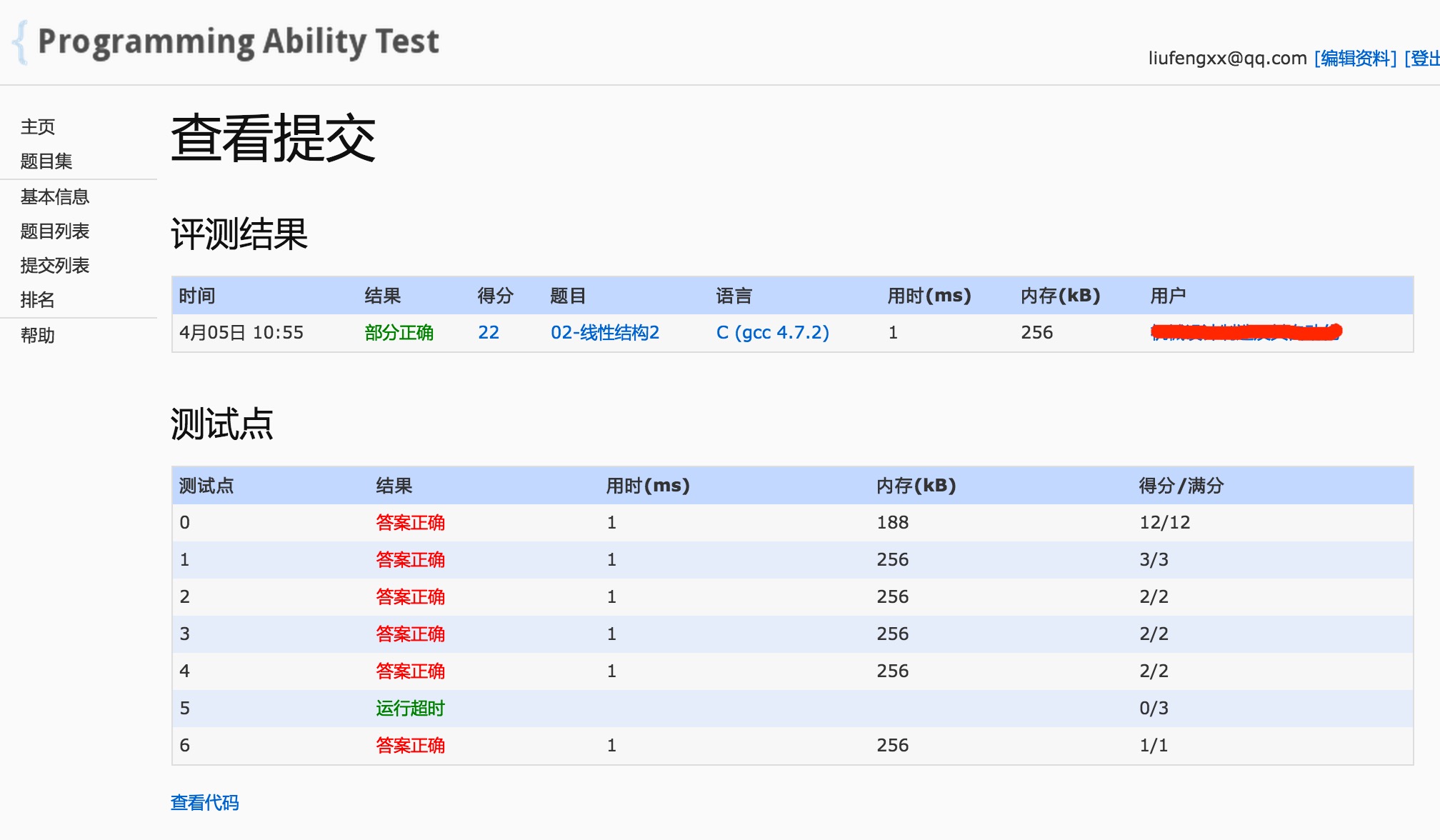
[测试点5,是使用超级大量数据,由于我在将输入数据通过链表连接起来那一步采用的是嵌套循环,复杂度O(N^2),可能是这里导致的,不确定。 但是总体反转思路是这样的,后面找到原因了再进行更新]
PAT002 Reversing Linked List的更多相关文章
- PAT1074 Reversing Linked List (25)详细题解
02-1. Reversing Linked List (25) 时间限制 400 ms 内存限制 65536 kB 代码长度限制 8000 B 判题程序 Standard 作者 CHEN, Yue ...
- PAT 1074 Reversing Linked List[链表][一般]
1074 Reversing Linked List (25)(25 分) Given a constant K and a singly linked list L, you are suppose ...
- pat02-线性结构1. Reversing Linked List (25)
02-线性结构1. Reversing Linked List (25) 时间限制 400 ms 内存限制 65536 kB 代码长度限制 8000 B 判题程序 Standard 作者 CHEN, ...
- 02-线性结构3 Reversing Linked List(25 point(s)) 【链表】
02-线性结构3 Reversing Linked List(25 point(s)) Given a constant K and a singly linked list L, you are s ...
- PTA 02-线性结构3 Reversing Linked List (25分)
题目地址 https://pta.patest.cn/pta/test/16/exam/4/question/664 5-2 Reversing Linked List (25分) Given a ...
- PAT 甲级 1074 Reversing Linked List (25 分)(链表部分逆置,结合使用双端队列和栈,其实使用vector更简单呐)
1074 Reversing Linked List (25 分) Given a constant K and a singly linked list L, you are supposed ...
- PAT_A1074#Reversing Linked List
Source: PAT A1074 Reversing Linked List (25 分) Description: Given a constant K and a singly linked l ...
- 02-线性结构3 Reversing Linked List
02-线性结构3 Reversing Linked List (25分) 时间限制:400ms 内存限制:64MB 代码长度限制:16kB 判题程序:系统默认 作者:陈越 单位:浙江大学 http ...
- 想了很久,一道Microsoft的笔试题目 —— Reversing Linked List
Reversing Linked List Given a constant K and a singly linked list L, you are supposed to reverse the ...
随机推荐
- [Functional Programming Monad] Substitute State Using Functions With A State Monad (get, evalWith)
We take a closer look at the get construction helper and see how we can use it to lift a function th ...
- java中compareTo和compare方法之比较,集合中对象的比较
前言 转自:http://www.cnblogs.com/yueliming/archive/2013/05/22/3092576.html (这里做了一些小改动) 一直一来对集合中对象的比较方案,有 ...
- HDU-2665-Kth number(划分树)
Problem Description Give you a sequence and ask you the kth big number of a inteval. Input The fir ...
- okhttp-OkGo的文件下载模块
OkDownload主要功能 结合OkGo的request进行网络请求,支持与OkGo保持相同的配置方法和传参方式 支持断点下载,支持突然断网,强杀进程后,继续断点下载 每个下载任务具有无状态.下载. ...
- 【Firefly API文档】—— Package Netconnect
http://bbs.gameres.com/forum.php?mod=viewthread&tid=219655 package netconnect 该包中包含的服务端与客户端通信的一些 ...
- SpringMVC响应Restful风格请求404
在学习Springmvc时,使用Restful风格的url,页面提示404错误.为找到原因,编写一个简单的Restful测试用例如下: jsp页面: <a href="user/tes ...
- cookie、localStorage和sessionStorage区别
三者区别见下表: 说明: cookie的处理过程为: 服务器向客户端发送cookie 浏览器将cookie保存 之后每次http请求浏览器都会将cookie发送给服务器端 对于 cookie,我们还需 ...
- 关于new String(new byte[]{0})
今天在做Zxing的二维码的时候,返回的数据竟然是这个样子,郁闷了一小会,说明我用的这个控件有改进的空间.由于时间的原因,最后还是把这个返回的字符串重新组装. Bundle bundle = data ...
- python selenium --一些常用方法
· text 获取该元素的文本 · submit 提交表单 · get_attribute 获得属性值 text 用于获取元素的文本信息 下面把百度首页底部的声明打印输出 #coding=u ...
- openssl 创建证书的总结和注意事项
1.该文章从网上看了好多博客,并经过实践形成.环境为ubuntu12和ubuntu14 "========================================大纲提要和注意事项= ...