
poj1673 EXOCENTER OF A TRIANGLE
地址:http://poj.org/problem?id=1673
题目:
| Time Limit: 1000MS | Memory Limit: 10000K | |
| Total Submissions: 3637 | Accepted: 1467 |
Description
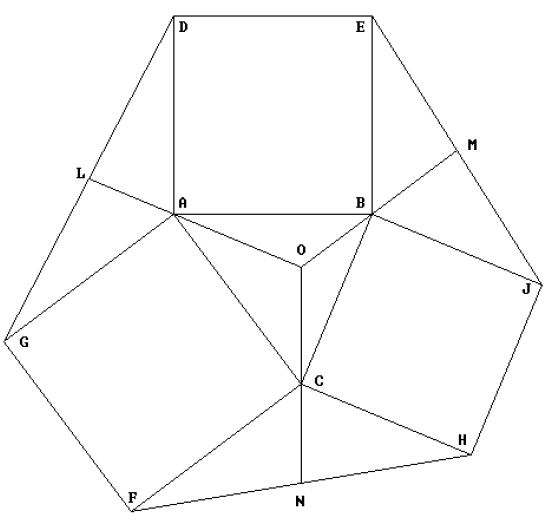
On each side of ABC, construct a square (ABDE, BCHJ and ACFG in the figure below).
Connect adjacent square corners to form the three Extriangles (AGD, BEJ and CFH in the figure).
The Exomedians of ABC are the medians of the Extriangles, which pass through vertices of the original triangle,extended into the original triangle (LAO, MBO and NCO in the figure. As the figure indicates, the three Exomedians intersect at a common point called the Exocenter (point O in the figure).
This problem is to write a program to compute the Exocenters of triangles.
Input
Output
Sample Input
2

0.0 0.0

9.0 12.0

14.0 0.0

3.0 4.0

13.0 19.0

2.0 -10.0
Sample Output
9.0000 3.7500

-48.0400 23.3600
Source
 #include <iostream>

 #include <cstdio>

 #include <cmath>

 #include <algorithm>

 using namespace std;

 const double PI = acos(-1.0);

 const double eps = 1e-;

 /****************常用函数***************/

 //判断ta与tb的大小关系

 int sgn( double ta, double tb)

 {

     if(fabs(ta-tb)<eps)return ;

     if(ta<tb)   return -;

     return ;

 }

 //点

 class Point

 {

 public:

     double x, y;

     Point(){}

     Point( double tx, double ty){ x = tx, y = ty;}

     bool operator < (const Point &_se) const

     {

         return x<_se.x || (x==_se.x && y<_se.y);

     }

     friend Point operator + (const Point &_st,const Point &_se)

     {

         return Point(_st.x + _se.x, _st.y + _se.y);

     }

     friend Point operator - (const Point &_st,const Point &_se)

     {

         return Point(_st.x - _se.x, _st.y - _se.y);

     }

     //点位置相同(double类型)

     bool operator == (const Point &_off)const

     {

         return  sgn(x, _off.x) ==  && sgn(y, _off.y) == ;

     }

 };

 /****************常用函数***************/

 //点乘

 double dot(const Point &po,const Point &ps,const Point &pe)

 {

     return (ps.x - po.x) * (pe.x - po.x) + (ps.y - po.y) * (pe.y - po.y);

 }

 //叉乘

 double xmult(const Point &po,const Point &ps,const Point &pe)

 {

     return (ps.x - po.x) * (pe.y - po.y) - (pe.x - po.x) * (ps.y - po.y);

 }

 //两点间距离的平方

 double getdis2(const Point &st,const Point &se)

 {

     return (st.x - se.x) * (st.x - se.x) + (st.y - se.y) * (st.y - se.y);

 }

 //两点间距离

 double getdis(const Point &st,const Point &se)

 {

     return sqrt((st.x - se.x) * (st.x - se.x) + (st.y - se.y) * (st.y - se.y));

 }

 //两点表示的向量

 class Line

 {

 public:

     Point s, e;//两点表示,起点[s],终点[e]

     double a, b, c;//一般式,ax+by+c=0

     double angle;//向量的角度,[-pi,pi]

     Line(){}

     Line( Point ts, Point te):s(ts),e(te){}//get_angle();}

     Line(double _a,double _b,double _c):a(_a),b(_b),c(_c){}

     //排序用

     bool operator < (const Line &ta)const

     {

         return angle<ta.angle;

     }

     //向量与向量的叉乘

     friend double operator / ( const Line &_st, const  Line &_se)

     {

         return (_st.e.x - _st.s.x) * (_se.e.y - _se.s.y) - (_st.e.y - _st.s.y) * (_se.e.x - _se.s.x);

     }

     //向量间的点乘

     friend double operator *( const Line &_st, const  Line &_se)

     {

         return (_st.e.x - _st.s.x) * (_se.e.x - _se.s.x) - (_st.e.y - _st.s.y) * (_se.e.y - _se.s.y);

     }

     //从两点表示转换为一般表示

     //a=y2-y1,b=x1-x2,c=x2*y1-x1*y2

     bool pton()

     {

         a = e.y - s.y;

         b = s.x - e.x;

         c = e.x * s.y - e.y * s.x;

         return true;

     }

     //半平面交用

     //点在向量左边(右边的小于号改成大于号即可,在对应直线上则加上=号)

     friend bool operator < (const Point &_Off, const Line &_Ori)

     {

         return (_Ori.e.y - _Ori.s.y) * (_Off.x - _Ori.s.x)

             < (_Off.y - _Ori.s.y) * (_Ori.e.x - _Ori.s.x);

     }

     //求直线或向量的角度

     double get_angle( bool isVector = true)

     {

         angle = atan2( e.y - s.y, e.x - s.x);

         if(!isVector && angle < )

             angle += PI;

         return angle;

     }

     //点在线段或直线上 1:点在直线上 2点在s,e所在矩形内

     bool has(const Point &_Off, bool isSegment = false) const

     {

         bool ff = sgn( xmult( s, e, _Off), ) == ;

         if( !isSegment) return ff;

         return ff

             && sgn(_Off.x - min(s.x, e.x), ) >=  && sgn(_Off.x - max(s.x, e.x), ) <=

             && sgn(_Off.y - min(s.y, e.y), ) >=  && sgn(_Off.y - max(s.y, e.y), ) <= ;

     }

     //点到直线/线段的距离

     double dis(const Point &_Off, bool isSegment = false)

     {

         ///化为一般式

         pton();

         //到直线垂足的距离

         double td = (a * _Off.x + b * _Off.y + c) / sqrt(a * a + b * b);

         //如果是线段判断垂足

         if(isSegment)

         {

             double xp = (b * b * _Off.x - a * b * _Off.y - a * c) / ( a * a + b * b);

             double yp = (-a * b * _Off.x + a * a * _Off.y - b * c) / (a * a + b * b);

             double xb = max(s.x, e.x);

             double yb = max(s.y, e.y);

             double xs = s.x + e.x - xb;

             double ys = s.y + e.y - yb;

            if(xp > xb + eps || xp < xs - eps || yp > yb + eps || yp < ys - eps)

                 td = min( getdis(_Off,s), getdis(_Off,e));

         }

         return fabs(td);

     }

     //关于直线对称的点

     Point mirror(const Point &_Off)

     {

         ///注意先转为一般式

         Point ret;

         double d = a * a + b * b;

         ret.x = (b * b * _Off.x - a * a * _Off.x -  * a * b * _Off.y -  * a * c) / d;

         ret.y = (a * a * _Off.y - b * b * _Off.y -  * a * b * _Off.x -  * b * c) / d;

         return ret;

     }

     //计算两点的中垂线

     static Line ppline(const Point &_a,const Point &_b)

     {

         Line ret;

         ret.s.x = (_a.x + _b.x) / ;

         ret.s.y = (_a.y + _b.y) / ;

         //一般式

         ret.a = _b.x - _a.x;

         ret.b = _b.y - _a.y;

         ret.c = (_a.y - _b.y) * ret.s.y + (_a.x - _b.x) * ret.s.x;

         //两点式

         if(fabs(ret.a) > eps)

         {

             ret.e.y = 0.0;

             ret.e.x = - ret.c / ret.a;

             if(ret.e == ret. s)

             {

                 ret.e.y = 1e10;

                 ret.e.x = - (ret.c - ret.b * ret.e.y) / ret.a;

             }

         }

         else

         {

             ret.e.x = 0.0;

             ret.e.y = - ret.c / ret.b;

             if(ret.e == ret. s)

             {

                 ret.e.x = 1e10;

                 ret.e.y = - (ret.c - ret.a * ret.e.x) / ret.b;

             }

         }

         return ret;

     }

     //------------直线和直线(向量)-------------

     //向量向左边平移t的距离

     Line& moveLine( double t)

     {

         Point of;

         of = Point( -( e.y - s.y), e.x - s.x);

         double dis = sqrt( of.x * of.x + of.y * of.y);

         of.x= of.x * t / dis, of.y = of.y * t / dis;

         s = s + of, e = e + of;

         return *this;

     }

     //直线重合

     static bool equal(const Line &_st,const Line &_se)

     {

         return _st.has( _se.e) && _se.has( _st.s);

     }

     //直线平行

     static bool parallel(const Line &_st,const Line &_se)

     {

         return sgn( _st / _se, ) == ;

     }

     //两直线(线段)交点

     //返回-1代表平行,0代表重合,1代表相交

     static bool crossLPt(const Line &_st,const Line &_se, Point &ret)

     {

         if(parallel(_st,_se))

         {

             if(Line::equal(_st,_se)) return ;

             return -;

         }

         ret = _st.s;

         double t = ( Line(_st.s,_se.s) / _se) / ( _st / _se);

         ret.x += (_st.e.x - _st.s.x) * t;

         ret.y += (_st.e.y - _st.s.y) * t;

         return ;

     }

     //------------线段和直线(向量)----------

     //直线和线段相交

     //参数:直线[_st],线段[_se]

     friend bool crossSL( Line &_st, Line &_se)

     {

         return sgn( xmult( _st.s, _se.s, _st.e) * xmult( _st.s, _st.e, _se.e), ) >= ;

     }

     //判断线段是否相交(注意添加eps)

     static bool isCrossSS( const Line &_st, const  Line &_se)

     {

         //1.快速排斥试验判断以两条线段为对角线的两个矩形是否相交

         //2.跨立试验(等于0时端点重合)

         return

             max(_st.s.x, _st.e.x) >= min(_se.s.x, _se.e.x) &&

             max(_se.s.x, _se.e.x) >= min(_st.s.x, _st.e.x) &&

             max(_st.s.y, _st.e.y) >= min(_se.s.y, _se.e.y) &&

             max(_se.s.y, _se.e.y) >= min(_st.s.y, _st.e.y) &&

             sgn( xmult( _se.s, _st.s, _se.e) * xmult( _se.s, _se.e, _st.s), ) >=  &&

             sgn( xmult( _st.s, _se.s, _st.e) * xmult( _st.s, _st.e, _se.s), ) >= ;

     }

 };

 //寻找凸包的graham 扫描法所需的排序函数

 Point gsort;

 bool gcmp( const Point &ta, const Point &tb)/// 选取与最后一条确定边夹角最小的点,即余弦值最大者

 {

     double tmp = xmult( gsort, ta, tb);

     if( fabs( tmp) < eps)

         return getdis( gsort, ta) < getdis( gsort, tb);

     else if( tmp > )

         return ;

     return ;

 }

 class triangle

 {

 public:

     Point a, b, c;//顶点

     triangle(){}

     triangle(Point a, Point b, Point c): a(a), b(b), c(c){}

     //计算三角形面积

     double area()

     {

         return fabs( xmult(a, b, c)) / 2.0;

     }

     //计算三角形外心

     //返回:外接圆圆心

     Point circumcenter()

     {

         double pa = a.x * a.x + a.y * a.y;

         double pb = b.x * b.x + b.y * b.y;

         double pc = c.x * c.x + c.y * c.y;

         double ta = pa * ( b.y - c.y) - pb * ( a.y - c.y) + pc * ( a.y - b.y);

         double tb = -pa * ( b.x - c.x) + pb * ( a.x - c.x) - pc * ( a.x - b.x);

         double tc = a.x * ( b.y - c.y) - b.x * ( a.y - c.y) + c.x * ( a.y - b.y);

         return Point( ta / 2.0 / tc, tb / 2.0 / tc);

     }

     //计算三角形内心

     //返回:内接圆圆心

     Point incenter()

     {

         Line u, v;

         double m, n;

         u.s = a;

         m = atan2(b.y - a.y, b.x - a.x);

         n = atan2(c.y - a.y, c.x - a.x);

         u.e.x = u.s.x + cos((m + n) / );

         u.e.y = u.s.y + sin((m + n) / );

         v.s = b;

         m = atan2(a.y - b.y, a.x - b.x);

         n = atan2(c.y - b.y, c.x - b.x);

         v.e.x = v.s.x + cos((m + n) / );

         v.e.y = v.s.y + sin((m + n) / );

         Point ret;

         Line::crossLPt(u,v,ret);

         return ret;

     }

     //计算三角形垂心

     //返回:高的交点

     Point perpencenter()

     {

         Line u,v;

         u.s = c;

         u.e.x = u.s.x - a.y + b.y;

         u.e.y = u.s.y + a.x - b.x;

         v.s = b;

         v.e.x = v.s.x - a.y + c.y;

         v.e.y = v.s.y + a.x - c.x;

         Point ret;

         Line::crossLPt(u,v,ret);

         return ret;

     }

     //计算三角形重心

     //返回:重心

     //到三角形三顶点距离的平方和最小的点

     //三角形内到三边距离之积最大的点

     Point barycenter()

     {

         Line u,v;

         u.s.x = (a.x + b.x) / ;

         u.s.y = (a.y + b.y) / ;

         u.e = c;

         v.s.x = (a.x + c.x) / ;

         v.s.y = (a.y + c.y) / ;

         v.e = b;

         Point ret;

         Line::crossLPt(u,v,ret);

         return ret;

     }

     //计算三角形费马点

     //返回:到三角形三顶点距离之和最小的点

     Point fermentPoint()

     {

         Point u, v;

         double step = fabs(a.x) + fabs(a.y) + fabs(b.x) + fabs(b.y) + fabs(c.x) + fabs(c.y);

         int i, j, k;

         u.x = (a.x + b.x + c.x) / ;

         u.y = (a.y + b.y + c.y) / ;

         while (step > eps)

         {

             for (k = ; k < ; step /= , k ++)

             {

                 for (i = -; i <= ; i ++)

                 {

                     for (j =- ; j <= ; j ++)

                     {

                         v.x = u.x + step * i;

                         v.y = u.y + step * j;

                         if (getdis(u,a) + getdis(u,b) + getdis(u,c) > getdis(v,a) + getdis(v,b) + getdis(v,c))

                             u = v;

                     }

                 }

             }

         }

         return u;

     }

 };

 triangle tr;

 int main(void)

 {

     int n;

     scanf("%d",&n);

     while(n--)

     {

         scanf("%lf%lf%lf%lf%lf%lf",&tr.a.x,&tr.a.y,&tr.b.x,&tr.b.y,&tr.c.x,&tr.c.y);

         Point ans=tr.perpencenter();

         printf("%.4f %.4f\n",ans.x,ans.y);

     }

     return ;

 }
poj1673 EXOCENTER OF A TRIANGLE的更多相关文章
- POJ 1673 EXOCENTER OF A TRIANGLE(垂心)
题目链接 折腾了半天,没想出怎么证明,以前初中老师教过,不知道怎么办,就量量...受不了,怒抄模版1Y... #include <cstdio> #include <iostream ...
- POJ 1673 EXOCENTER OF A TRIANGLE(解三角形重心)
题目链接:http://poj.org/problem?id=1673 AC代码: #include<cstdio> #include<cmath> #include<a ...
- [转] POJ计算几何
转自:http://blog.csdn.net/tyger/article/details/4480029 计算几何题的特点与做题要领:1.大部分不会很难,少部分题目思路很巧妙2.做计算几何题目,模板 ...
- ACM计算几何题目推荐
//第一期 计算几何题的特点与做题要领: 1.大部分不会很难,少部分题目思路很巧妙 2.做计算几何题目,模板很重要,模板必须高度可靠. 3.要注意代码的组织,因为计算几何的题目很容易上两百行代码,里面 ...
- Soj题目分类
-----------------------------最优化问题------------------------------------- ----------------------常规动态规划 ...
- sicily 1059. Exocenter of a Trian
Description Given a triangle ABC, the Extriangles of ABC are constructed as follows: On each side of ...
- [LeetCode] Triangle 三角形
Given a triangle, find the minimum path sum from top to bottom. Each step you may move to adjacent n ...
- [LeetCode] Pascal's Triangle II 杨辉三角之二
Given an index k, return the kth row of the Pascal's triangle. For example, given k = 3,Return [1,3, ...
- [LeetCode] Pascal's Triangle 杨辉三角
Given numRows, generate the first numRows of Pascal's triangle. For example, given numRows = 5,Retur ...
随机推荐
- python常用内置模块,执行系统命令的模块
Subprocess模块 python3.5将使用Subprocess模块跟操作系统进行交互,比如系统命令,他将替换 os.system os.spawn* subprocess.run()方法封装的 ...
- html5 file 自定义文件过滤
使用 acctpe属性即可 示例: gif,jpg <input type="file" name="pic" accept="image/gi ...
- Redis(六)-- SpringMVC整合Redis
一.pom.xml <project xmlns="http://maven.apache.org/POM/4.0.0" xmlns:xsi="http://www ...
- /etc/redhat-release
该文件用于记录 RedHat 的发行版本信息 [root@localhost ~]$ cat /etc/redhat-release CentOS release 6.5 (Final)
- 【BZOJ2007】[Noi2010]海拔 对偶图最短路
[BZOJ2007][Noi2010]海拔 Description YT市是一个规划良好的城市,城市被东西向和南北向的主干道划分为n×n个区域.简单起见,可以将YT市看作 一个正方形,每一个区域也可看 ...
- java合并两个升序数组为一个新的有序数组
转自:http://blog.csdn.net/laozhaokun/article/details/37531247 题目:有两个有序数组a,b,现需要将其合并成一个新的有序数组. 简单的思路就是先 ...
- 三维凸包求重心到面的最短距离(HDU4273)
http://acm.hdu.edu.cn/showproblem.php?pid=4273 Rescue Time Limit: 2000/1000 MS (Java/Others) Memo ...
- 熵 互信息 Gini指数 和 不纯度
在学习决策树类的算法时,总是绕不开 信息熵.Gini指数和它们相关联的概念,概念不清楚,就很难理解决策树的构造过程,现在把这些概念捋一捋. 信息熵 信息熵,简称熵,用来衡量随机变量的不确定性大小,熵越 ...
- 焦作网络赛B-Mathematical Curse【dp】
A prince of the Science Continent was imprisoned in a castle because of his contempt for mathematics ...
- Oracle系统结构之修改oracle内存参数
Linux主机16g内存,修改oracle数据库内存参数: 1.编辑/etc/fstab文件:针对tmpfs行将defaults改成defaults,size=12g(千万注意格式,不能出现错误) 修 ...