
Cassandra go语言client使用
关于什么是cassandra,可以参考:
http://blog.csdn.net/zyz511919766/article/details/38683219
比较了HBASE、mongodb 和 cassandra
1)HBASE 和 cassandra 都是列式存储,但是 cassandra部署方便,扩展容易
2) mongodb 并不是真正的列式存储,数据扩容比较麻烦,需要提前做好集群分区
casandra是 p2p(gossip)实现的bigtable, 数据一致性可以通过参数配置(R+W >N), 写操作完成是all node,还是指定的node个数,才进行返回。
数据模型:
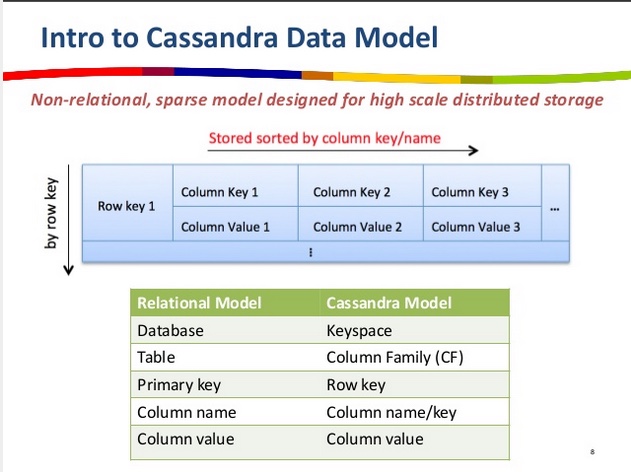
尝试了cassandra的两个client。
1. "github.com/gocql/gocql"
2."github.com/hailocab/gocassa"
gocassa是在gocql上面的封装,提供更方便的操作。
在用cassandra之前,建议先熟悉一下CQL,类似 SQL语句的语法。
作为一个client, 我们需要考虑的点:
1)连接池
2)批量操作
3)可能还会考虑同步操作(同时更新两个table中的数据)
cassandra部署和使用都还算简单,比较困难的是,要摆脱传统的db设计范式思维,要根据后续的数据查询来设计你的bigtable结构,方便将来的查询。
贴上几个相关的参考资料:
http://www.slideshare.net/yukim/cql3-in-depth (CQL相关介绍)
http://www.slideshare.net/jaykumarpatel/cassandra-data-modeling-best-practices
http://www.infoq.com/cn/articles/best-practices-cassandra-data-model-design-part2 (ebay的cassandra实践)
然后,贴上两个client使用示例:
package main

import (

    "fmt"

    "log"

    "time"

    "github.com/gocql/gocql"

)

func main() {

    // connect to the cluster

    cluster := gocql.NewCluster("127.0.0.1")

    cluster.Keyspace = "demo"

    cluster.Consistency = gocql.Quorum

    //设置连接池的数量,默认是2个(针对每一个host,都建立起NumConns个连接)

    cluster.NumConns =

    session, _ := cluster.CreateSession()

    time.Sleep( * time.Second) //Sleep so the fillPool can complete.

    fmt.Println(session.Pool.Size())

    defer session.Close()

    //unlogged batch, 进行批量插入,最好是partition key 一致的情况

    t := time.Now()

    batch := session.NewBatch(gocql.UnloggedBatch)

    for i := ; i < ; i++ {

        batch.Query(`INSERT INTO bigrow (rowname, iplist) VALUES (?,?)`, fmt.Sprintf("name_%d", i), fmt.Sprintf("ip_%d", i))

    }

    if err := session.ExecuteBatch(batch); err != nil {

        fmt.Println("execute batch:", err)

    }

    bt := time.Now().Sub(t).Nanoseconds()

    t = time.Now()

    for i := ; i < ; i++ {

        session.Query(`INSERT INTO bigrow (rowname, iplist) VALUES (?,?)`, fmt.Sprintf("name_%d", i), fmt.Sprintf("ip_%d", i))

    }

    nt := time.Now().Sub(t).Nanoseconds()

    t = time.Now()

    sbatch := session.NewBatch(gocql.UnloggedBatch)

    for i := ; i < ; i++ {

        sbatch.Query(`INSERT INTO bigrow (rowname, iplist) VALUES (?,?)`, "samerow", fmt.Sprintf("ip_%d", i))

    }

    if err := session.ExecuteBatch(sbatch); err != nil {

        fmt.Println("execute batch:", err)

    }

    sbt := time.Now().Sub(t).Nanoseconds()

    fmt.Println("bt:", bt, "sbt:", sbt, "nt:", nt)

    //----------out put------------------

    // ./rawtest

    // bt: 5795593 sbt: 3003774 nt: 261775

    //------------------------------------

    // insert a tweet

    if err := session.Query(`INSERT INTO tweet (timeline, id, text) VALUES (?, ?, ?)`,

        "me", gocql.TimeUUID(), "hello world").Exec(); err != nil {

        log.Fatal(err)

    }

    var id gocql.UUID

    var text string

    /* Search for a specific set of records whose 'timeline' column matches

     * the value 'me'. The secondary index that we created earlier will be

     * used for optimizing the search */

    if err := session.Query(`SELECT id, text FROM tweet WHERE timeline = ? LIMIT `,

        "me").Consistency(gocql.One).Scan(&id, &text); err != nil {

        log.Fatal(err)

    }

    fmt.Println("Tweet:", id, text)

    // list all tweets

    iter := session.Query(`SELECT id, text FROM tweet WHERE timeline = ?`, "me").Iter()

    for iter.Scan(&id, &text) {

        fmt.Println("Tweet:", id, text)

    }

    if err := iter.Close(); err != nil {

        log.Fatal(err)

    }

    query := session.Query(`SELECT * FROM bigrow where rowname = ?`, "")

    // query := session.Query(`SELECT * FROM bigrow `)

    var m map[string]interface{}

    m = make(map[string]interface{}, )

    err := query.Consistency(gocql.One).MapScan(m)

    if err != nil {

        log.Fatal(err)

    }

    fmt.Printf("%#v", m)

}
package main

import (

    "fmt"

    "time"

    "github.com/hailocab/gocassa"

)

// This test assumes that cassandra is running on default port locally and

// that the keySpace called 'test' already exists.

type Sale struct {

    Id         string

    CustomerId string

    SellerId   string

    Price      int

    Created    time.Time

}

func main() {

    keySpace, err := gocassa.ConnectToKeySpace("not_exist_demo", []string{"127.0.0.1"}, "", "")

    if err != nil {

        panic(err)

    }

    salesTable := keySpace.Table("sale", Sale{}, gocassa.Keys{

        PartitionKeys: []string{"Id"},

    })

    // Create the table - we ignore error intentionally

    err = salesTable.Create()

    fmt.Println(err)

    // We insert the first record into our table - yay!

    err = salesTable.Set(Sale{

        Id:         "sale-1",

        CustomerId: "customer-1",

        SellerId:   "seller-1",

        Price:      ,

        Created:    time.Now(),

    }).Run()

    if err != nil {

        panic(err)

    }

    result := Sale{}

    if err := salesTable.Where(gocassa.Eq("Id", "sale-1")).ReadOne(&result).Run(); err != nil {

        panic(err)

    }

    fmt.Println(result)

}
更多配置可参考:
https://github.com/gocql/gocql/blob/master/cluster.go#L57
// ClusterConfig is a struct to configure the default cluster implementation

// of gocoql. It has a varity of attributes that can be used to modify the

// behavior to fit the most common use cases. Applications that requre a

// different setup must implement their own cluster.

type ClusterConfig struct {

    Hosts             []string          // addresses for the initial connections

    CQLVersion        string            // CQL version (default: 3.0.0)

    ProtoVersion      int               // version of the native protocol (default: 2)

    Timeout           time.Duration     // connection timeout (default: 600ms)

    Port              int               // port (default: 9042)

    Keyspace          string            // initial keyspace (optional)

    NumConns          int               // number of connections per host (default: 2)

    NumStreams        int               // number of streams per connection (default: max per protocol, either 128 or 32768)

    Consistency       Consistency       // default consistency level (default: Quorum)

    Compressor        Compressor        // compression algorithm (default: nil)

    Authenticator     Authenticator     // authenticator (default: nil)

    RetryPolicy       RetryPolicy       // Default retry policy to use for queries (default: 0)

    SocketKeepalive   time.Duration     // The keepalive period to use, enabled if > 0 (default: 0)

    ConnPoolType      NewPoolFunc       // The function used to create the connection pool for the session (default: NewSimplePool)

    DiscoverHosts     bool              // If set, gocql will attempt to automatically discover other members of the Cassandra cluster (default: false)

    MaxPreparedStmts  int               // Sets the maximum cache size for prepared statements globally for gocql (default: 1000)

    MaxRoutingKeyInfo int               // Sets the maximum cache size for query info about statements for each session (default: 1000)

    PageSize          int               // Default page size to use for created sessions (default: 5000)

    SerialConsistency SerialConsistency // Sets the consistency for the serial part of queries, values can be either SERIAL or LOCAL_SERIAL (default: unset)

    Discovery         DiscoveryConfig

    SslOpts           *SslOptions

    DefaultTimestamp  bool // Sends a client side timestamp for all requests which overrides the timestamp at which it arrives at the server. (default: true, only enabled for protocol 3 and above)

}
连接池,默认采用是NewSimplePool,这里用的是roud robin
源码:https://github.com/gocql/gocql/blob/master/connectionpool.go#L454
ConnPoolType 是一个接口,可以自己实现接口来定制话自己的策略。
数据一致性策略,通过Consistency配置,默认是Quorum(大部分节点):
type Consistency uint16

const (

    Any         Consistency = 0x00

    One         Consistency = 0x01

    Two         Consistency = 0x02

    Three       Consistency = 0x03

    Quorum      Consistency = 0x04

    All         Consistency = 0x05

    LocalQuorum Consistency = 0x06

    EachQuorum  Consistency = 0x07

    LocalOne    Consistency = 0x0A

)
Cassandra go语言client使用的更多相关文章
- Redis:安装、配置、操作和简单代码实例(C语言Client端)
Redis:安装.配置.操作和简单代码实例(C语言Client端) - hj19870806的专栏 - 博客频道 - CSDN.NET Redis:安装.配置.操作和简单代码实例(C语言Client端 ...
- 对比Cassandra、 Mongodb、CouchDB、Redis、Riak、 Membase、Neo4j、HBase
转自:http://www.cnblogs.com/alephsoul-alephsoul/archive/2013/04/26/3044630.html 导读:Kristóf Kovács 是一位软 ...
- C语言使用hiredis访问redis
Hiredis 是Redis数据库的简约C客户端库.它是简约的,因为它只是增加了对协议的最小支持,但是同时它使用了一个高级别的 printf-like API,所以对于习惯了 printf 风格的C编 ...
- HDFS简单介绍及用C语言訪问HDFS接口操作实践
一.概述 近年来,大数据技术如火如荼,怎样存储海量数据也成了当今的热点和难点问题,而HDFS分布式文件系统作为Hadoop项目的分布式存储基础,也为HBASE提供数据持久化功能,它在大数据项目中有很广 ...
- 8种Nosql数据库系统对比
导读:Kristóf Kovács 是一位软件架构师和咨询顾问,他最近发布了一片对比各种类型NoSQL数据库的文章. 虽然SQL数据库是非常有用的工具,但经历了15年的一支独秀之后垄断即将被打破.这只 ...
- 8种NOsql
虽然SQL数据库是非常有用的工具,但经历了15年的一支独秀之后垄断即将被打破.这只是时间问题:被迫使用关系数据库,但最终发现不能适应需求的情况不胜枚举. 但是NoSQL数据库之间的不同,远超过两 SQ ...
- 【转】8种Nosql数据库系统对比
导读:Kristóf Kovács 是一位软件架构师和咨询顾问,他最近发布了一片对比各种类型nosql数据库的文章.文章由敏捷翻译 – 唐尤华编译.如需转载,请参见文后声明. 虽然SQL数据库是非常有 ...
- thrift 安装介绍
一.About thrift thrift是一种可伸缩的跨语言服务的发展软件框架.它结合了功能强大的软件堆栈的代码生成引擎,以建设服务,工作效率和无缝地与C + +,C#,Ja ...
- Data Base 关于nosql的讲解
Data Base 关于nosql的讲解 nosql非关系型数据库. 优点: 1.可扩展 2.大数据量,高性能 3.灵活的数据模型 4.高可用 缺点: 1.不正式 2.不标准 非关系型数据库有哪些: ...
随机推荐
- linux如何查看CPU,内存,机器型号,网卡信息
查看CPU信息(型号)# cat /proc/cpuinfo | grep name | cut -f2 -d: | uniq -c 8 Intel(R) Xeon(R) CPU ...
- [Linux内核]ctrl-z/fg/bg/nohup/setsid/()与&/disown/screen
转自:https://my.oschina.net/alphajay/blog/65058 My Tips: Ctrl -z -> suspend fg -> ...
- 三、thinkphp
'URL_PATHINFO_DEPR'=>'-',//修改URL的分隔符 'TMPL_L_DELIM'=>'<{', //修改左定界符 'TMPL_R_DELIM'=>'}&g ...
- jvm 调整tomcat的堆内存和常驻内存catalina.sh
4.2 性能优化 tomcat性能取决于你的内存大小 上策:优化代码 中策:jvm优化机制 垃圾回收机制 把不需要的内存回收 优化jvm--优化垃圾回收策略 优化catalina.sh配置文件. ...
- Linux - 静默安装oracle数据库总结
Web服务器上面的Linux一般是不会有图形界面的,所有通过图形界面来安装Linux的方式在没有图形界面的Linux上面是行不通的,我们要使用的安装方式叫做Linux的静默安装.即在没有图形界面的Li ...
- JQuery Show()的几种效果 总有一种是你需要的
1 show()方法和hide()方法 $("selector").show() 从display:none还原元素默认或已设置的display属性$("selecto ...
- 关于Unity的游戏的运行模式
游戏有个入口main函数,执行完main函数就返回 main函数中的步骤 1.初始化 2.while(true){ a.检查有没有消息,包括鼠标有没有被点击,键盘有没有被点击,自定义事件等等,有消息就 ...
- (转自)视频流中的DTS/PTS到底是什么;
翻译了一下: Q:hi,这可能是一个弱智问题,但是当我使用bbMEG1.24beta17编码时,一直以来总是遇到这个下溢的问题.我从日志文件中得到的唯一启示就是我应该更改mux率...但是帮助文档却 ...
- hdu 1756:Cupid's Arrow(计算几何,判断点在多边形内)
Cupid's Arrow Time Limit: 3000/1000 MS (Java/Others) Memory Limit: 32768/32768 K (Java/Others)Tot ...
- Docker 使用及常用命令
https://yeasy.gitbooks.io/docker_practice/content/image/dockerfile/expose.html docker practice 资料 -- ...