
HDU 2722 Here We Go(relians) Again (最短路)
Problem Description
The Gorelians are a warlike race that travel the universe conquering new worlds as a form of recreation. Given their violent, fun-loving nature, keeping their leaders alive is of serious concern. Part of the Gorelian security plan involves changing the traffic patterns of their cities on a daily basis, and routing all Gorelian Government Officials to the Government Building by the fastest possible route.
Fortunately for the Gorelian Minister of Traffic (that would be you), all Gorelian cities are laid out as a rectangular grid of blocks, where each block is a square measuring 2520 rels per side (a rel is the Gorelian Official Unit of Distance). The speed limit between two adjacent intersections is always constant, and may range from 1 to 9 rels per blip (a blip, of course, being the Gorelian Official Unit of Time). Since Gorelians have outlawed decimal numbers as unholy (hey, if you're the dominant force in the known universe, you can outlaw whatever you want), speed limits are always integer values. This explains why Gorelian blocks are precisely 2520 rels in length: 2520 is the least common multiple of the integers 1 through 9. Thus, the time required to travel between two adjacent intersections is always an integer number of blips.
In all Gorelian cities, Government Housing is always at the northwest corner of the city, while the Government Building is always at the southeast corner. Streets between intersections might be one-way or two-way, or possibly even closed for repair (all this tinkering with traffic patterns causes a lot of accidents). Your job, given the details of speed limits, street directions, and street closures for a Gorelian city, is to determine the fastest route from Government Housing to the Government Building. (It is possible, due to street directions and closures, that no route exists, in which case a Gorelian Official Temporary Holiday is declared, and the Gorelian Officials take the day off.)
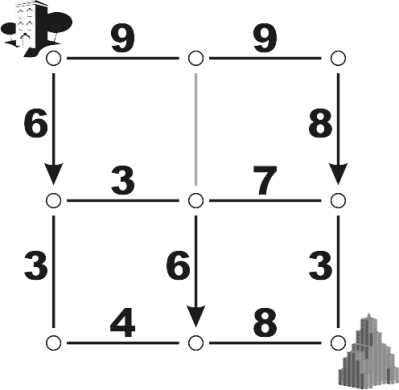
The picture above shows a Gorelian City marked with speed limits, one way streets, and one closed street. It is assumed that streets are always traveled at the exact posted speed limit, and that turning a corner takes zero time. Under these conditions, you should be able to determine that the fastest route from Government Housing to the Government Building in this city is 1715 blips. And if the next day, the only change is that the closed road is opened to two way traffic at 9 rels per blip, the fastest route becomes 1295 blips. On the other hand, suppose the three one-way streets are switched from southbound to northbound (with the closed road remaining closed). In that case, no route would be possible and the day would be declared a holiday.
Input
The input consists of a set of cities for which you must find a fastest route if one exists. The first line of an input case contains two integers, which are the vertical and horizontal number of city blocks, respectively. The smallest city is a single block, or 1 by 1, and the largest city is 20 by 20 blocks. The remainder of the input specifies speed limits and traffic directions for streets between intersections, one row of street segments at a time. The first line of the input (after the dimensions line) contains the data for the northernmost east-west street segments. The next line contains the data for the northernmost row of north-south street segments. Then the next row of east-west streets, then north-south streets, and so on, until the southernmost row of east-west streets. Speed limits and directions of travel are specified in order from west to east, and each consists of an integer from 0 to 9 indicating speed limit, and a symbol indicating which direction traffic may flow. A zero speed limit means the road is closed. All digits and symbols are delimited by a single space. For east-west streets, the symbol will be an asterisk '*' which indicates travel is allowed in both directions, a less-than symbol '<' which indicates travel is allowed only in an east-to-west direction, or a greater-than symbol '>' which indicates travel is allowed only in a west-to-east direction. For north-south streets, an asterisk again indicates travel is allowed in either direction, a lowercase "vee" character 'v' indicates travel is allowed only in a north-to-south directions, and a caret symbol '^' indicates travel is allowed only in a south-to-north direction. A zero speed, indicating a closed road, is always followed by an asterisk. Input cities continue in this manner until a value of zero is specified for both the vertical and horizontal dimensions.
Output
For each input scenario, output a line specifying the integer number of blips of the shortest route, a space, and then the word "blips". For scenarios which have no route, output a line with the word "Holiday".
Sample Input
2 2
9 * 9 *
6 v 0 * 8 v
3 * 7 *
3 * 6 v 3 *
4 * 8 *
2 2
9 * 9 *
6 v 9 * 8 v
3 * 7 *
3 * 6 v 3 *
4 * 8 *
2 2
9 * 9 *
6 ^ 0 * 8 ^
3 * 7 *
3 * 6 ^ 3 *
4 * 8 *
0 0
Sample Output
1715 blips
1295 blips
Holiday
分析:
有个n*m大小的矩形,起点在矩形的左上角, 终点在右下角, 里面一个小矩形代表一个街区(block)。
每个小矩形的边长都是2520, 小矩形的边有一个速度限制,范围是0~9, 如果是0表示这条边不能行驶。
关于输入部分,由上到下,从左到右,按照上图的对应的位置方式给出数据,
每一条边是 "数字"+“空格”+“符号”的形式,
数字表示这条边的限速,符号表示这条路是单向(还分东西, 南北)的还是双向的。
其实主旨思想就是在求一个最从左上角到右下角的最短路,关键就在于确定每一个点对应的编号,以及每一条路所对应的起点和终点。
每行输入的奇数行肯定是表示的横向的路径,路径条数就是列数,偶数行表示的是竖向的路径,路径条数就是列数+1,这些就没必要解释了把。
然后是确定每一个点所对应的编号:
对于横向的路径,第i行的第j个点所对应的编号就是(m+1)(i/2)+j,所连接的另一个点编号就是该点的编号加1、减1
而对于纵向的路径,第i行的第j个点所对应的编号就是(m+1)(i/2-1)+j,所连接的另一个点编号就是该点的编号加m、减m。
这样就完全把路径给保存下来了。
代码:
#include<iostream>

#include<stdio.h>

#include<string.h>

#include<queue>

#include<utility>

using namespace std;

const int INF = 0x3f3f3f3f;

int n,m,u,w;

int  num;//一共涉及到的点的数目

char str[150];

const int vNum=445;

const int eNum=vNum*vNum/2;

int Count;

typedef pair<int,int>pii;

struct Node

{

    int to,val;

    int Next;

}node[eNum];

int head[vNum];

int dis[vNum];

struct Node1

{

    int len,num;

};

void add(int u,int v,int w)

{

    node[Count].to=v;

    node[Count].val=w;

    node[Count].Next=head[u];

    head[u]=Count;

    Count++;

}

void spfa(int src)

{

    for(int i=1;i<=num;i++)

        dis[i]=INF;

    dis[src]=0;

    queue<Node1>q;

    Node1 Now,Next;

    Now.len=dis[src];

    Now.num=src;

    q.push(Now);

    while(!q.empty())

    {

        Now=q.front();

        q.pop();

        int u=Now.num;//得到点

        if(dis[u]!=Now.len)continue;

        for(int i=head[u];i!=-1;i=node[i].Next)

        {

            int v=node[i].to;

            int temp=dis[u]+node[i].val;

            if(dis[v]>temp)

            {

                dis[v]=temp;

                Next.len=dis[v];

                Next.num=v;

                q.push(Next);

            }

        }

    }

}

int main()

{

    while(~scanf("%d%d",&n,&m)&&n&&m)

    {

        getchar();

        Count=0;

        num=(n+1)*(m+1);//最后一个点的标号

        memset(head,-1,sizeof(head));

        for(int i=1; i<=2*n+1; i++)//对于n行的图形,那么一共需要输入的路径就有2*n+1行

        {

            gets(str);

            int len=strlen(str);

            if(i&1)//输入的是行的信息

            {

                for(int j=0,k=1; j<len; j+=4,k++) //数字、空格、方向、空格四个一个循环

                {

                    u=(m+1)*(i/2)+k;//一个点对应的一个编号

                    w=str[j]-'0';//获得速度

                    if(w==0) continue;

                    if(str[j+2]=='*')//双向的

                    {

                        add(u,u+1,2520/w);

                        add(u+1,u,2520/w);

                    }

                    else if(str[j+2]=='<')//单向的从右到左

                    {

                        add(u+1,u,2520/w);

                    }

                    else//单向的从左到右

                    {

                        add(u,u+1,2520/w);

                    }

                }

            }

            else//输入的是列的信息

            {

                for(int j=0,k=1; j<len; j+=4,k+=1)

                {

                    u=(m+1)*(i/2-1)+k;//每次上面的那个点代表的数字

                    w=str[j]-'0';

                    if(w==0)continue;

                    if(str[j+2]=='*')//双向的

                    {

                        add(u,u+m+1,2520/w);

                        add(u+m+1,u,2520/w);

                    }

                    else if(str[j+2]=='v')//从上到下

                    {

                        add(u,u+m+1,2520/w);

                    }

                    else if(str[j+2]=='^')//从下到上

                    {

                        add(u+m+1,u,2520/w);

                    }

                }

            }

        }

        spfa(1);

        if(dis[num]!=INF)

            printf("%d blips\n",dis[num]);

        else

        printf("Holiday\n");

    }

    return 0;

}
HDU 2722 Here We Go(relians) Again (最短路)的更多相关文章
- POJ 3653 & ZOJ 2935 & HDU 2722 Here We Go(relians) Again(最短路dijstra)
题目链接: PKU:http://poj.org/problem? id=3653 ZJU:problemId=1934" target="_blank">http ...
- HDU 2722 Here We Go(relians) Again (spfa)
Here We Go(relians) Again Time Limit : 2000/1000ms (Java/Other) Memory Limit : 32768/32768K (Java/ ...
- hdu 2722 Here We Go(relians) Again (最短路径)
Here We Go(relians) Again Time Limit: 2000/1000 MS (Java/Others) Memory Limit: 32768/32768 K (Jav ...
- HDU 2722 Here We Go(relians) Again
最短路,建图太麻烦,略过…… #include <cstdio> #include <cstring> #include <queue> const int INF ...
- 【HDOJ】2722 Here We Go(relians) Again
根据矩阵建图,然后求最短路径. #include <cstdio> #include <cstring> #include <cstdlib> #define L ...
- hdu 5545 The Battle of Guandu spfa最短路
题目链接: http://acm.hdu.edu.cn/showproblem.php?pid=5545 题意:有N个村庄, M 个战场: $ 1 <=N,M <= 10^5 $; 其中曹 ...
- HDU 3416 Marriage Match IV (求最短路的条数,最大流)
Marriage Match IV 题目链接: http://acm.hust.edu.cn/vjudge/contest/122685#problem/Q Description Do not si ...
- hdu - 2586 How far away ?(最短路共同祖先问题)
题目链接:http://acm.hdu.edu.cn/showproblem.php?pid=2586 最近公共祖先问题~~LAC离散算法 题目大意:一个村子里有n个房子,这n个房子用n-1条路连接起 ...
- HDU 6071 Lazy Running (同余最短路 dij)
Lazy Running Time Limit: 2000/1000 MS (Java/Others) Memory Limit: 524288/524288 K (Java/Others)To ...
随机推荐
- [转帖]USB-C和Thunderbolt 3连接线你搞懂了吗?---没搞明白.
USB-C和Thunderbolt 3连接线你搞懂了吗? 2018年11月25日 07:30 6318 次阅读 稿源:威锋网 3 条评论 按照计算行业的风潮,USB Type-C 将会是下一代主流的接 ...
- 2013成都网赛1010 hdu 4737 A Bit Fun
题意:定义f(i, j) = ai|ai+1|ai+2| ... | aj (| 指或运算),求有多少对f(i,j)<m.1 <= n <= 100000, 1 <= m &l ...
- VS2013 UML 如何复制文件
如:复制活动图,文件复制了显示不了 正确做法:新建活动图,打开源活动图,全选,复制,在新建的活动图粘贴,以此实现复制
- [LOJ3052] [十二省联考 2019] 春节十二响
题目链接 LOJ:https://loj.ac/problem/3052 洛谷:https://www.luogu.org/problemnew/show/P5290 BZOJ:https://www ...
- Unity使用C#实现简单Scoket连接及服务端与客户端通讯
简介: 网络编程是个很有意思的事情,偶然翻出来很久之前刚开始看Socket的时候写的一个实例,贴出来吧 Unity中实现简单的Socket连接,c#中提供了丰富的API,直接上代码. 服务端代码: [ ...
- Codeforces 148D 一袋老鼠 Bag of mice | 概率DP 水题
除非特别忙,我接下来会尽可能翻译我做的每道CF题的题面! Codeforces 148D 一袋老鼠 Bag of mice | 概率DP 水题 题面 胡小兔和司公子都认为对方是垃圾. 为了决出谁才是垃 ...
- 牛客网NOIP赛前集训营-普及组(第一场)
前三题略 T4: 题目描述 小A有n个长度都是L的字符串.这些字符串只包含前8个小写字符,'a'~'h'.但这些字符串非常的混乱,它们几乎长得互不相同.小A想通过一些规则,让它们长得尽可能相同.小A现 ...
- 仿微博的JQuery日历控件
实现原理主要是处理table,生成tr td,其中最重要的是如何找出每月第一天是星期几,然后就能对应出这个月的余下天数. 日历控件网上一搜一大把,但是我觉得自己写一遍还是有好处的.代码可以查看本页源代 ...
- NATS_11:NATS集群构建与验证
NATS服务集群化 NATS支持每一个服务按照集群模式方式运行.你可以将这些服务组织在一起形成一个集群来提高服务器的容量的消息传递系统,并可以提升整个系统的弹性话和高可用性. 注意,NATS集群服务器 ...
- [大数据]-hadoop2.8和spark2.1完全分布式搭建
一.前期准备工作: 1.安装包的准备: VMware(10.0版本以上) : 官方网站:https://www.vmware.com/cn.html 官方下载地址:http://www.vmware. ...