
Notes on Probabilistic Latent Semantic Analysis (PLSA)
转自:http://www.hongliangjie.com/2010/01/04/notes-on-probabilistic-latent-semantic-analysis-plsa/
I highly recommend you read the more detailed version of http://arxiv.org/abs/1212.3900
Formulation of PLSA
There are two ways to formulate PLSA. They are equivalent but may lead to different inference process.


Let’s see why these two equations are equivalent by using Bayes rule.
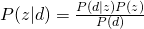



The whole data set is generated as (we assume that all words are generated independently):

The Log-likelihood of the whole data set for (1) and (2) are:


EM
For  or
or  , the optimization is hard due to the log of sum. Therefore, an algorithm called Expectation-Maximization is usually employed. Before we introduce anything about EM, please note that EM is only guarantee to find a local optimum (although it may be a global one).
First, we see how EM works in general. As we shown for PLSA, we usually want to estimate the likelihood of data, namely  , given the paramter
  . The easiest way is to obtain a maximum likelihood estimator by maximizing . However, sometimes, we also want to include some hidden variables which are usually useful for our task. Therefore, what we really want to maximize is
  , the complete likelihood. Now, our attention becomes to this complete likelihood. Again, directly maximizing this likelihood is usually difficult. What we would like to show here is to obtain a lower bound of the likelihood and maximize this lower bound.
We need Jensen’s Inequality to help us obtain this lower bound. For any convex function  , Jensen’s Inequality states that :

Thus, it is not difficult to show that :

and for concave functions (like logarithm), it is :

Back to our complete likelihood, we can obtain the following conclusion by using concave version of Jensen’s Inequality :



Therefore, we obtained a lower bound of complete likelihood and we want to maximize it as tight as possible. EM is an algorithm that maximize this lower bound through a iterative fashion. Usually, EM first would fix current value and maximize  and then use the new value to obtain a new guess on , which is essentially a two stage maximization process. The first step can be shown as follows:





The first term is the same for all  . Therefore, in order to maximize the whole equation, we need to minimize KL divergence between and
  , which eventually leads to the optimum solution of
  . So, usually for E-step, we use current guess of to calculate the posterior distribution of hidden variable as the new update score. For M-step, it is problem-dependent. We will see how to do that in later discussions.
Another explanation of EM is in terms of optimizing a so-called Q function. We devise the data generation process as  . Therefore, the complete likelihood is modified as:

Think about how to maximize  . Instead of directly maximizing it, we can iteratively maximize
  as :
as :


Now take the expectation of this equation, we have:

The last term is always non-negative since it can be recognized as the KL-divergence of  and
and  . Therefore, we obtain a lower bound of Likelihood :

The last two terms can be treated as constants as they do not contain the variable , so the lower bound is essentially the first term, which is also sometimes called as “Q-function”. 
EM of Formulation 1
In case of Formulation 1, let us introduce hidden variables  to indicate which hidden topic is selected to generated
  in
in  (
( ). Therefore, the complete likelihood can be formulated as :


From the equation above, we can write our Q-function for the complete likelihood  :
:

For E-step, simply using Bayes Rule, we can obtain:


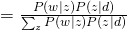
For M-step, we need to maximize Q-function, which needs to be incorporated with other constraints:


and take all derivatives:






Therefore, we can easily obtain:




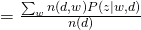
EM of Formulation 2
Use similar method to introduce hidden variables to indicate which is selected to generated and and we can have the following complete likelihood :


Therefore, the Q-function  would be :

For E-step, again, simply using Bayes Rule, we can obtain:

For M-step, we maximize the constraint version of Q-function:


and take all derivatives:





Therefore, we can easily obtain:


Notes on Probabilistic Latent Semantic Analysis (PLSA)的更多相关文章
- NLP —— 图模型(三)pLSA(Probabilistic latent semantic analysis,概率隐性语义分析)模型
LSA(Latent semantic analysis,隐性语义分析).pLSA(Probabilistic latent semantic analysis,概率隐性语义分析)和 LDA(Late ...
- 主题模型之概率潜在语义分析(Probabilistic Latent Semantic Analysis)
上一篇总结了潜在语义分析(Latent Semantic Analysis, LSA),LSA主要使用了线性代数中奇异值分解的方法,但是并没有严格的概率推导,由于文本文档的维度往往很高,如果在主题聚类 ...
- Latent semantic analysis note(LSA)
1 LSA Introduction LSA(latent semantic analysis)潜在语义分析,也被称为LSI(latent semantic index),是Scott Deerwes ...
- 主题模型之潜在语义分析(Latent Semantic Analysis)
主题模型(Topic Models)是一套试图在大量文档中发现潜在主题结构的机器学习模型,主题模型通过分析文本中的词来发现文档中的主题.主题之间的联系方式和主题的发展.通过主题模型可以使我们组织和总结 ...
- Latent Semantic Analysis (LSA) Tutorial 潜语义分析LSA介绍 一
Latent Semantic Analysis (LSA) Tutorial 译:http://www.puffinwarellc.com/index.php/news-and-articles/a ...
- 潜语义分析(Latent Semantic Analysis)
LSI(Latent semantic indexing, 潜语义索引)和LSA(Latent semantic analysis,潜语义分析)这两个名字其实是一回事.我们这里称为LSA. LSA源自 ...
- 潜在语义分析Latent semantic analysis note(LSA)原理及代码
文章引用:http://blog.sina.com.cn/s/blog_62a9902f0101cjl3.html Latent Semantic Analysis (LSA)也被称为Latent S ...
- 海量数据挖掘MMDS week4: 推荐系统之隐语义模型latent semantic analysis
http://blog.csdn.net/pipisorry/article/details/49256457 海量数据挖掘Mining Massive Datasets(MMDs) -Jure Le ...
- Latent Semantic Analysis(LSA/ LSI)原理简介
LSA的工作原理: How Latent Semantic Analysis Works LSA被广泛用于文献检索,文本分类,垃圾邮件过滤,语言识别,模式检索以及文章评估自动化等场景. LSA其中一个 ...
随机推荐
- 【C#学习笔记】改变字体
using System; using System.Collections.Generic; using System.ComponentModel; using System.Data; usin ...
- LSTM网络(Long Short-Term Memory )
本文基于前两篇 1. 多层感知机及其BP算法(Multi-Layer Perceptron) 与 2. 递归神经网络(Recurrent Neural Networks,RNN) RNN 有一个致命的 ...
- 配置dg出现的错误
ORA-09925: Unable to create audit trail file Linux-x86_64 Error: 30: Read-only file system 没有创建adump ...
- Android View绘制13问13答
1.View的绘制流程分几步,从哪开始?哪个过程结束以后能看到view? 答:从ViewRoot的performTraversals开始,经过measure,layout,draw 三个流程.draw ...
- javac 命令用法
引用自己写的Class 在java中手动编译时,总提示找不到类,调试成功后,特把目录结构与编译成功的命令列出: 样例一: 文件名 MessageStore.java Hello.java 源码 pac ...
- Word2003使用VBA教程
[正文] 注:本文中所有vba代码都是储存在doc中,而非normal.dot 1.打开一个.doc文档 2.按ALT+F11 3.左侧 Project-插入-模块 4.输入自己的代码,一定要是函数的 ...
- AE 中的查找与定位,以城市查找为例
在文本框输入一个城市,在地图上查找,当找到后让mapcontrol自动跳转到地图上该点. IQueryFilter filter = new QueryFilterClass(); filter.Wh ...
- 说说shell脚本中的export 和 source,bash
小弟刚刚接触linux,对linux上的很多东西都比较陌生,所以写一写博客,当做自己工作的总结和技术的积累吧,也是鞭策自己不断努力的去学习. 今天之所以起这个标题,把export,source ,ba ...
- Dev gridControl z
Dev gridControl 添加表标题 1.OptionsView ->ShowViewCaption = True 2.ViewCaption = "标题" Dev g ...
- hdu 1527 取石子游戏(Wythoff Game)
题意:Wythoff Game 思路:Wythoff Game #include<iostream> #include<stdio.h> #include<math.h& ...