
ASP.NET MVC5+EF6+EasyUI 后台管理系统(59)-BLL层重构
系列目录
前言:
这应该是本系统最后一次重构,将重构BLL层和Model层。来完全取代代码生成器生成的BLL层和DAL层。完全废掉了代码生成器的DAL,BLL,MODEL层。
全自动生成增,删,改,查的通用方法和模型转换与BLL层的模型事务脱离,后续文章,会以一些插件或功能为目的,继续完善,进行分享,最后60节的文章会对本系统做一个总结
(但是还没时间写,相信60节的文章能让你快速了解到本系统的优势和架构,就算你从未阅读之前的所有文章)
继上次的DAL层重构(上一节),本来只想重构DAL层算了,但是鉴于本人是代码强迫症患者,所以花了些时间把BLL层重构。
在此务必共鸣一个问题,代码重构不是架构改变,这个系统的架构完全还是原来的接口多层注入架构!如下图所示完全不变

最后必须让初学者理解一个知识点:分部类 partial 关键字,因为我们的重构是围绕分部类而实现,包括接口
partial 关键字指示可在命名空间中定义该类、结构或接口的其他部分。所有部分都必须使用 partial 关键字。在编译时,各个部分都必须可用来形成最终的类型。各个部分必须具有相同的可访问性,如 public、private 等。
如果将任意部分声明为抽象的,则整个类型都被视为抽象的。如果将任意部分声明为密封的,则整个类型都被视为密封的。如果任意部分声明基类型,则整个类型都将继承该类。
指定基类的所有部分必须一致,但忽略基类的部分仍继承该基类型。各个部分可以指定不同的基接口,最终类型将实现所有分部声明所列出的全部接口。在某一分部定义中声明的任何类、结构或接口成员可供所有其他部分使用。最终类型是所有部分在编译时的组合。
下列声明:
partial class Earth : Planet, IRotate { }

partial class Earth : IRevolve { }
等效于下列声明:
class Earth : Planet, IRotate, IRevolve { }
1.改变现状
相比我们DAL层,重构BLL层是有技术难度的,因为业务层涉及模型的转换构成,虽然只重构模块的(增、删、改、查),下面我们开始
下载上一节代码(https://yunpan.cn/cYUdjssbmiLrL 访问密码 e622)来分析业务层。
分析:IBLL,BLL
IBLL层不用说了,跟IDAL层是一致的
所以我们直接复制IDAL的TT模版修改后如下
<#@ template language="C#" debug="false" hostspecific="true"#>

<#@ include file="../../Apps.Models/Common.ttinclude"#><#@

 output extension=".cs"#>

 <#

const string inputFile = @"../../Apps.Models/DB.edmx";

var textTransform = DynamicTextTransformation.Create(this);

var code = new CodeGenerationTools(this);

var ef = new MetadataTools(this);

var typeMapper = new TypeMapper(code, ef, textTransform.Errors);

var    fileManager = EntityFrameworkTemplateFileManager.Create(this);

var itemCollection = new EdmMetadataLoader(textTransform.Host, textTransform.Errors).CreateEdmItemCollection(inputFile);

var codeStringGenerator = new CodeStringGenerator(code, typeMapper, ef);

if (!typeMapper.VerifyCaseInsensitiveTypeUniqueness(typeMapper.GetAllGlobalItems(itemCollection), inputFile))

{

    return string.Empty;

}

WriteHeader(codeStringGenerator, fileManager);

foreach (var entity in typeMapper.GetItemsToGenerate<EntityType>(itemCollection))

{

            fileManager.StartNewFile("I"+entity.Name + "BLL.cs");

#>

using System;

using Apps.Common;

using System.Collections.Generic;

using Apps.Models<#=entity.Name.IndexOf("_")>?"."+entity.Name.Substring(,entity.Name.IndexOf("_")):".Sys" #>;

namespace Apps.IBLL

{

    public partial interface I<#=entity.Name #>BLL

    {

        List<<#=entity.Name #>Model> GetList(ref GridPager pager, string queryStr);

        bool Create(ref ValidationErrors errors, <#=entity.Name #>Model model);

        bool Delete(ref ValidationErrors errors, string id);

        bool Delete(ref ValidationErrors errors, string[] deleteCollection);

        bool Edit(ref ValidationErrors errors, <#=entity.Name #>Model model);

        <#=entity.Name #>Model GetById(string id);

        bool IsExists(string id);

    }

<#

            EndNamespace(code);

}

fileManager.Process();

#>
ICommonBLL.tt

非常好。业务层完成跟预期是一样的!这样我们直接可以看到我们原来的ISysSample可以由
using System.Collections.Generic;

using Apps.Common;

using Apps.Models.Sys;

namespace Apps.IBLL

{

    public interface ISysSampleBLL

    {

        List<SysSampleModel> GetList(ref GridPager pager, string queryStr);

        bool Create(ref ValidationErrors errors, SysSampleModel model);

        bool Delete(ref ValidationErrors errors, string id);

        bool Delete(ref ValidationErrors errors, string[] deleteCollection);

        bool Edit(ref ValidationErrors errors, SysSampleModel model);

        SysSampleModel GetById(string id);

        bool IsExist(string id);

    }

}
变为--->
using System.Collections.Generic;

using Apps.Common;

using Apps.Models.Sys;

namespace Apps.IBLL

{

    public partial interface ISysSampleBLL

    {

    }

}
代码行数发生质的改变,可以我们就可以扩展自己的接口方法,利用partial类
照样画葫芦,业务层也生成
直接上TT代码
<#@ template language="C#" debug="false" hostspecific="true"#>

<#@ include file="../../Apps.Models/Common.ttinclude"#><#@

 output extension=".cs"#>

 <#

 const string usingName = "";

const string inputFile = @"../../Apps.Models/DB.edmx";

var textTransform = DynamicTextTransformation.Create(this);

var code = new CodeGenerationTools(this);

var ef = new MetadataTools(this);

var typeMapper = new TypeMapper(code, ef, textTransform.Errors);

var    fileManager = EntityFrameworkTemplateFileManager.Create(this);

var itemCollection = new EdmMetadataLoader(textTransform.Host, textTransform.Errors).CreateEdmItemCollection(inputFile);

var codeStringGenerator = new CodeStringGenerator(code, typeMapper, ef);

if (!typeMapper.VerifyCaseInsensitiveTypeUniqueness(typeMapper.GetAllGlobalItems(itemCollection), inputFile))

{

    return string.Empty;

}

WriteHeader(codeStringGenerator, fileManager);

foreach (var entity in typeMapper.GetItemsToGenerate<EntityType>(itemCollection))

{

    if(entity.Name.StartsWith("Sys") || entity.Name.StartsWith("JOB"))

        {

            fileManager.StartNewFile(""+entity.Name + "BLL.cs");

            var simpleProperties = typeMapper.GetSimpleProperties(entity);

#>

using System;

using System.Collections.Generic;

using System.Linq;

using Apps.Models;

using Apps.Common;

using Microsoft.Practices.Unity;

using System.Transactions;

using Apps.IBLL;

using Apps.IDAL;

using Apps.BLL.Core;

using Apps.Locale;

using Apps.Models<#=entity.Name.IndexOf("_")>?"."+entity.Name.Substring(,entity.Name.IndexOf("_")):".Sys" #>;

namespace Apps.BLL

{

    public partial class <#=entity.Name #>BLL:I<#=entity.Name #>BLL

    {

        [Dependency]

        public I<#=entity.Name #>Repository m_Rep { get; set; }

        public virtual List<<#=entity.Name #>Model> GetList(ref GridPager pager, string queryStr)

        {

            IQueryable<<#=entity.Name #>> queryData = null;

            if (!string.IsNullOrWhiteSpace(queryStr))

            {

                queryData = m_Rep.GetList(

                <#

                int i =;

                if (simpleProperties.Any()){foreach(var edmProperty in simpleProperties){

                if(i==)

                {

                #>

                <#=codeStringGenerator.Property(edmProperty).ToString().IndexOf("string")>?"a=>a."+edmProperty+".Contains(queryStr)":""#>

                <#

                if(codeStringGenerator.Property(edmProperty).ToString().IndexOf("string")>)

                {

                i=;

                }

                }

                else if(i==)

                {#>

                <#=codeStringGenerator.Property(edmProperty).ToString().IndexOf("string")>?"|| a."+edmProperty+".Contains(queryStr)":""#>

                <#

                }

                #>

<#}

}#>

                );

            }

            else

            {

                queryData = m_Rep.GetList();

            }

            pager.totalRows = queryData.Count();

            //排序

            queryData = LinqHelper.SortingAndPaging(queryData, pager.sort, pager.order, pager.page, pager.rows);

            return CreateModelList(ref queryData);

        }

        public virtual List<<#=entity.Name #>Model> CreateModelList(ref IQueryable<<#=entity.Name #>> queryData)

        {

            List<<#=entity.Name #>Model> modelList = (from r in queryData

                                              select new <#=entity.Name #>Model

                                              {

<#

if (simpleProperties.Any())

{

foreach(var edmProperty in simpleProperties)

{

#>

                                                    <#=edmProperty#> = r.<#=edmProperty#>,

<#

}

}

#>

                                              }).ToList();

            return modelList;

        }

        public virtual bool Create(ref ValidationErrors errors, <#=entity.Name #>Model model)

        {

            try

            {

                <#=entity.Name #> entity = m_Rep.GetById(model.Id);

                if (entity != null)

                {

                    errors.Add(Resource.PrimaryRepeat);

                    return false;

                }

                entity = new <#=entity.Name #>();

               <#

if (simpleProperties.Any())

{

foreach(var edmProperty in simpleProperties)

{

#>

                entity.<#=edmProperty#> = model.<#=edmProperty#>;

<#

}

}

#>

                if (m_Rep.Create(entity))

                {

                    return true;

                }

                else

                {

                    errors.Add(Resource.InsertFail);

                    return false;

                }

            }

            catch (Exception ex)

            {

                errors.Add(ex.Message);

                ExceptionHander.WriteException(ex);

                return false;

            }

        }

         public virtual bool Delete(ref ValidationErrors errors, string id)

        {

            try

            {

                if (m_Rep.Delete(id) == )

                {

                    return true;

                }

                else

                {

                    return false;

                }

            }

            catch (Exception ex)

            {

                errors.Add(ex.Message);

                ExceptionHander.WriteException(ex);

                return false;

            }

        }

        public virtual bool Delete(ref ValidationErrors errors, string[] deleteCollection)

        {

            try

            {

                if (deleteCollection != null)

                {

                    using (TransactionScope transactionScope = new TransactionScope())

                    {

                        if (m_Rep.Delete(deleteCollection) == deleteCollection.Length)

                        {

                            transactionScope.Complete();

                            return true;

                        }

                        else

                        {

                            Transaction.Current.Rollback();

                            return false;

                        }

                    }

                }

                return false;

            }

            catch (Exception ex)

            {

                errors.Add(ex.Message);

                ExceptionHander.WriteException(ex);

                return false;

            }

        }

        public virtual bool Edit(ref ValidationErrors errors, <#=entity.Name #>Model model)

        {

            try

            {

                <#=entity.Name #> entity = m_Rep.GetById(model.Id);

                if (entity == null)

                {

                    errors.Add(Resource.Disable);

                    return false;

                }

                              <#

if (simpleProperties.Any())

{

foreach(var edmProperty in simpleProperties)

{

#>

                entity.<#=edmProperty#> = model.<#=edmProperty#>;

<#

}

}

#>

                if (m_Rep.Edit(entity))

                {

                    return true;

                }

                else

                {

                    errors.Add("没有数据改变");

                    return false;

                }

            }

            catch (Exception ex)

            {

                errors.Add(ex.Message);

                ExceptionHander.WriteException(ex);

                return false;

            }

        }

        public virtual <#=entity.Name #>Model GetById(string id)

        {

            if (IsExists(id))

            {

                <#=entity.Name #> entity = m_Rep.GetById(id);

                <#=entity.Name #>Model model = new <#=entity.Name #>Model();

                              <#

if (simpleProperties.Any())

{

foreach(var edmProperty in simpleProperties)

{

#>

                model.<#=edmProperty#> = entity.<#=edmProperty#>;

<#

}

}

#>

                return model;

            }

            else

            {

                return null;

            }

        }

        public virtual bool IsExists(string id)

        {

            return m_Rep.IsExist(id);

        }

          public void Dispose()

        {

        }

    }

<#

            EndNamespace(code);

        }

}

fileManager.Process();

#>
CommonBLL.tt
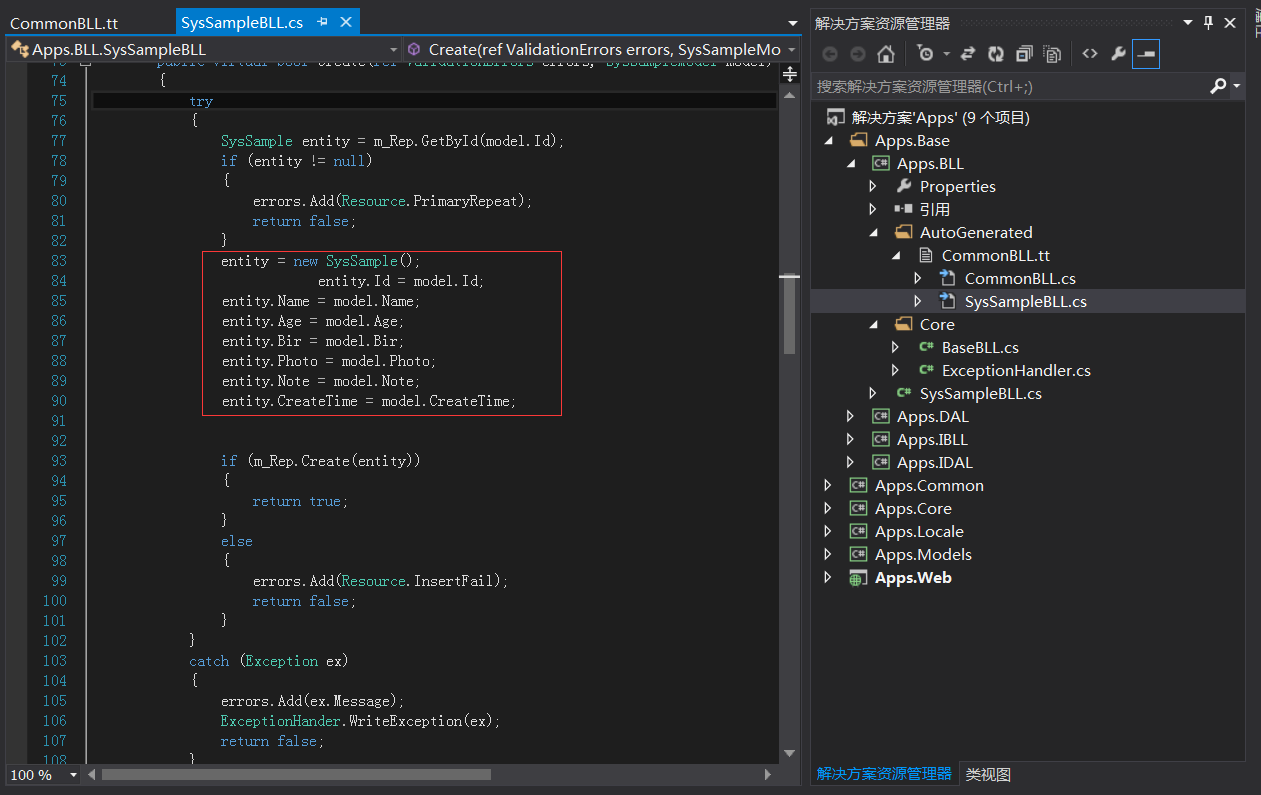
由于每一个业务模型的属性都不一致,这里不能用List<T>来做,所以,一个表会生成一个BLL类。(图中红色部分)
如果生成红色部分。主要看下面代码
<#

if (simpleProperties.Any())

{

foreach(var edmProperty in simpleProperties)

{

#>

   <#=edmProperty#> = r.<#=edmProperty#>,

<#

}

}

#>
获取表模型的所有属性,所有这段对很多人是有帮助的,请收藏,说不定你以后要用到
OK,编译通过,运行正确,还是熟悉的面孔
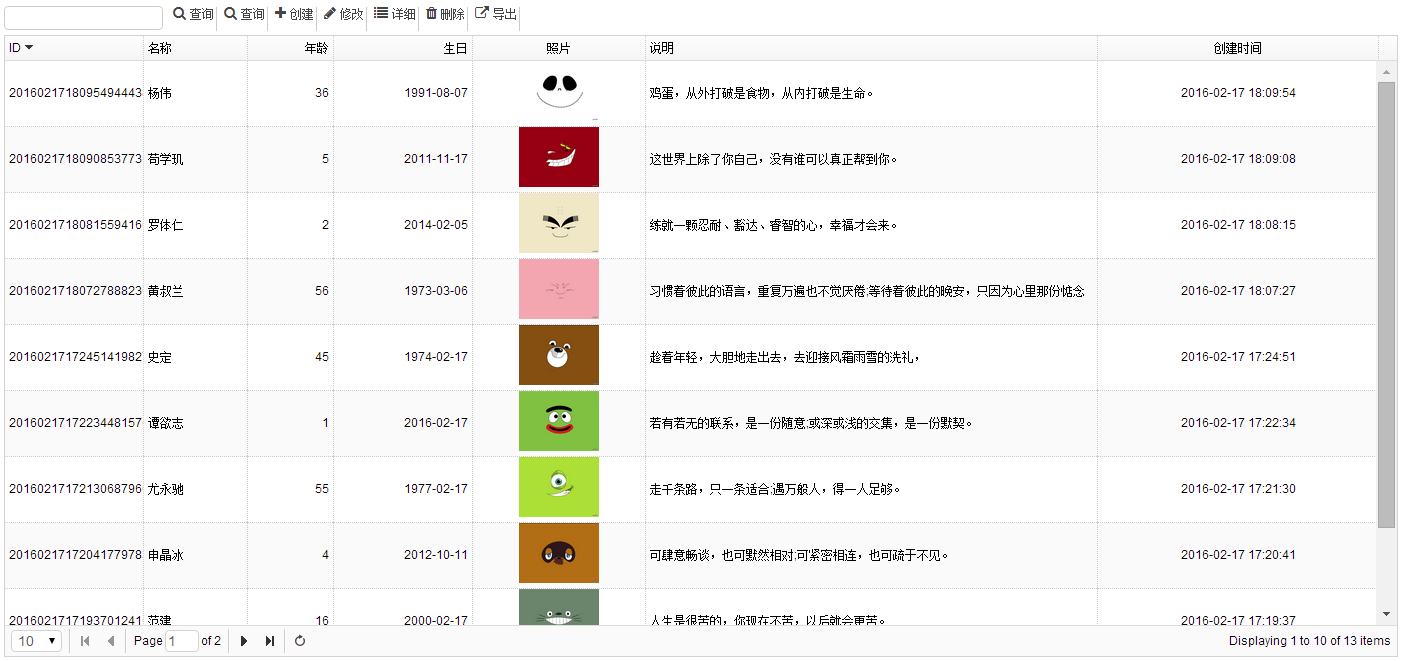
但是至此。我们的业务层和数据访问层,可以说是一行代码都没写。足够体现了TT模版的强大之处,相比我们之前要用代码生成器来得极其方便
2.引发问题
直到上面步骤,一切都很顺利,没有一点不妥。
有经验的园友会发现,里面东西都是写死的。而且分部类不可以重写自己。
比如说。我在处理 entity.Name = model.Name;时候我想entity.Name = model.Name.TrimStart() 去掉字符串前面的空格,那么可以看到根本无法操作。
然而我们需要重写,但是又发现无法重写分部类的方法,怎么做?必须用一张图来看,我是这么做的
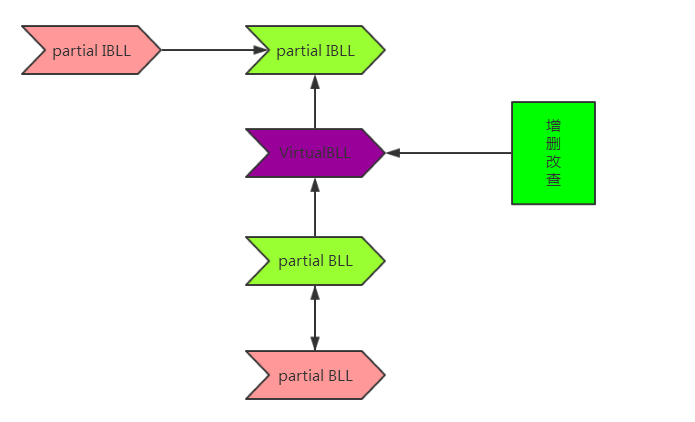
- 绿色是我们已经重构完成的。
- 紫色是我们需要重构的一个TT模版,这是所有都是虚方法的类
- 粉色是我们自己扩张的业务方法,目前为空
虚方法是可以重写的关键字是virtual 以下重写之后优先级高于前者 用override。用代码来说明
改变一下CommonBLL.tt
<#@ template language="C#" debug="false" hostspecific="true"#>

<#@ include file="../../Apps.Models/Common.ttinclude"#><#@

 output extension=".cs"#>

 <#

 const string usingName = "";

const string inputFile = @"../../Apps.Models/DB.edmx";

var textTransform = DynamicTextTransformation.Create(this);

var code = new CodeGenerationTools(this);

var ef = new MetadataTools(this);

var typeMapper = new TypeMapper(code, ef, textTransform.Errors);

var    fileManager = EntityFrameworkTemplateFileManager.Create(this);

var itemCollection = new EdmMetadataLoader(textTransform.Host, textTransform.Errors).CreateEdmItemCollection(inputFile);

var codeStringGenerator = new CodeStringGenerator(code, typeMapper, ef);

if (!typeMapper.VerifyCaseInsensitiveTypeUniqueness(typeMapper.GetAllGlobalItems(itemCollection), inputFile))

{

    return string.Empty;

}

WriteHeader(codeStringGenerator, fileManager);

foreach (var entity in typeMapper.GetItemsToGenerate<EntityType>(itemCollection))

{

    if(entity.Name.StartsWith("Sys") || entity.Name.StartsWith("JOB"))

        {

            fileManager.StartNewFile("Virtual_"+entity.Name + "BLL.cs");

            var simpleProperties = typeMapper.GetSimpleProperties(entity);

#>

using System;

using System.Collections.Generic;

using System.Linq;

using Apps.Models;

using Apps.Common;

using Microsoft.Practices.Unity;

using System.Transactions;

using Apps.IBLL;

using Apps.IDAL;

using Apps.BLL.Core;

using Apps.Locale;

using Apps.Models<#=entity.Name.IndexOf("_")>?"."+entity.Name.Substring(,entity.Name.IndexOf("_")):".Sys" #>;

namespace Apps.BLL

{

    public class Virtual_<#=entity.Name #>BLL

    {

        [Dependency]

        public I<#=entity.Name #>Repository m_Rep { get; set; }

        public virtual List<<#=entity.Name #>Model> GetList(ref GridPager pager, string queryStr)

        {

            IQueryable<<#=entity.Name #>> queryData = null;

            if (!string.IsNullOrWhiteSpace(queryStr))

            {

                queryData = m_Rep.GetList(

                <#

                int i =;

                if (simpleProperties.Any()){foreach(var edmProperty in simpleProperties){

                if(i==)

                {

                #>

                <#=codeStringGenerator.Property(edmProperty).ToString().IndexOf("string")>?"a=>a."+edmProperty+".Contains(queryStr)":""#>

                <#

                if(codeStringGenerator.Property(edmProperty).ToString().IndexOf("string")>)

                {

                i=;

                }

                }

                else if(i==)

                {#>

                <#=codeStringGenerator.Property(edmProperty).ToString().IndexOf("string")>?"|| a."+edmProperty+".Contains(queryStr)":""#>

                <#

                }

                #>

<#}

}#>

                );

            }

            else

            {

                queryData = m_Rep.GetList();

            }

            pager.totalRows = queryData.Count();

            //排序

            queryData = LinqHelper.SortingAndPaging(queryData, pager.sort, pager.order, pager.page, pager.rows);

            return CreateModelList(ref queryData);

        }

        public virtual List<<#=entity.Name #>Model> CreateModelList(ref IQueryable<<#=entity.Name #>> queryData)

        {

            List<<#=entity.Name #>Model> modelList = (from r in queryData

                                              select new <#=entity.Name #>Model

                                              {

<#

if (simpleProperties.Any())

{

foreach(var edmProperty in simpleProperties)

{

#>

                                                    <#=edmProperty#> = r.<#=edmProperty#>,

<#

}

}

#>

                                              }).ToList();

            return modelList;

        }

        public virtual bool Create(ref ValidationErrors errors, <#=entity.Name #>Model model)

        {

            try

            {

                <#=entity.Name #> entity = m_Rep.GetById(model.Id);

                if (entity != null)

                {

                    errors.Add(Resource.PrimaryRepeat);

                    return false;

                }

                entity = new <#=entity.Name #>();

               <#

if (simpleProperties.Any())

{

foreach(var edmProperty in simpleProperties)

{

#>

                entity.<#=edmProperty#> = model.<#=edmProperty#>;

<#

}

}

#>

                if (m_Rep.Create(entity))

                {

                    return true;

                }

                else

                {

                    errors.Add(Resource.InsertFail);

                    return false;

                }

            }

            catch (Exception ex)

            {

                errors.Add(ex.Message);

                ExceptionHander.WriteException(ex);

                return false;

            }

        }

         public virtual bool Delete(ref ValidationErrors errors, string id)

        {

            try

            {

                if (m_Rep.Delete(id) == )

                {

                    return true;

                }

                else

                {

                    return false;

                }

            }

            catch (Exception ex)

            {

                errors.Add(ex.Message);

                ExceptionHander.WriteException(ex);

                return false;

            }

        }

        public virtual bool Delete(ref ValidationErrors errors, string[] deleteCollection)

        {

            try

            {

                if (deleteCollection != null)

                {

                    using (TransactionScope transactionScope = new TransactionScope())

                    {

                        if (m_Rep.Delete(deleteCollection) == deleteCollection.Length)

                        {

                            transactionScope.Complete();

                            return true;

                        }

                        else

                        {

                            Transaction.Current.Rollback();

                            return false;

                        }

                    }

                }

                return false;

            }

            catch (Exception ex)

            {

                errors.Add(ex.Message);

                ExceptionHander.WriteException(ex);

                return false;

            }

        }

        public virtual bool Edit(ref ValidationErrors errors, <#=entity.Name #>Model model)

        {

            try

            {

                <#=entity.Name #> entity = m_Rep.GetById(model.Id);

                if (entity == null)

                {

                    errors.Add(Resource.Disable);

                    return false;

                }

                              <#

if (simpleProperties.Any())

{

foreach(var edmProperty in simpleProperties)

{

#>

                entity.<#=edmProperty#> = model.<#=edmProperty#>;

<#

}

}

#>

                if (m_Rep.Edit(entity))

                {

                    return true;

                }

                else

                {

                    errors.Add(Resource.NoDataChange);

                    return false;

                }

            }

            catch (Exception ex)

            {

                errors.Add(ex.Message);

                ExceptionHander.WriteException(ex);

                return false;

            }

        }

        public virtual <#=entity.Name #>Model GetById(string id)

        {

            if (IsExists(id))

            {

                <#=entity.Name #> entity = m_Rep.GetById(id);

                <#=entity.Name #>Model model = new <#=entity.Name #>Model();

                              <#

if (simpleProperties.Any())

{

foreach(var edmProperty in simpleProperties)

{

#>

                model.<#=edmProperty#> = entity.<#=edmProperty#>;

<#

}

}

#>

                return model;

            }

            else

            {

                return null;

            }

        }

        public virtual bool IsExists(string id)

        {

            return m_Rep.IsExist(id);

        }

          public void Dispose()

        {

        }

    }

<#

            EndNamespace(code);

        }

}

fileManager.Process();

#>
VirtualBLL.tt
更Common代码基本一致,只是头部变了,文件名称变了
public class Virtual_SysSampleBLL
那么重新创建一个CommonBLL.tt
<#@ template language="C#" debug="false" hostspecific="true"#>

<#@ include file="../../Apps.Models/Common.ttinclude"#><#@

 output extension=".cs"#>

 <#

const string usingName = "";

const string inputFile = @"../../Apps.Models/DB.edmx";

var textTransform = DynamicTextTransformation.Create(this);

var code = new CodeGenerationTools(this);

var ef = new MetadataTools(this);

var typeMapper = new TypeMapper(code, ef, textTransform.Errors);

var    fileManager = EntityFrameworkTemplateFileManager.Create(this);

var itemCollection = new EdmMetadataLoader(textTransform.Host, textTransform.Errors).CreateEdmItemCollection(inputFile);

var codeStringGenerator = new CodeStringGenerator(code, typeMapper, ef);

if (!typeMapper.VerifyCaseInsensitiveTypeUniqueness(typeMapper.GetAllGlobalItems(itemCollection), inputFile))

{

    return string.Empty;

}

WriteHeader(codeStringGenerator, fileManager);

foreach (var entity in typeMapper.GetItemsToGenerate<EntityType>(itemCollection))

{

    if(entity.Name.StartsWith("Sys") || entity.Name.StartsWith("JOB"))

        {

            fileManager.StartNewFile(entity.Name + "BLL.cs");

            var simpleProperties = typeMapper.GetSimpleProperties(entity);

#>

using System;

using System.Collections.Generic;

using System.Linq;

using Apps.Models;

using Apps.Common;

using Microsoft.Practices.Unity;

using System.Transactions;

using Apps.IBLL;

using Apps.IDAL;

using Apps.BLL.Core;

using Apps.Locale;

using Apps.Models<#=entity.Name.IndexOf("_")>?"."+entity.Name.Substring(,entity.Name.IndexOf("_")):".Sys" #>;

namespace Apps.BLL

{

    public partial class <#=entity.Name #>BLL: Virtual_<#=entity.Name #>BLL,I<#=entity.Name #>BLL

    {

    }

<#

            EndNamespace(code);

        }

}

fileManager.Process();

#>
CommonBLL.tt
代码生成后如下,什么都没有实现继承接口,和上面的TT模版的类
namespace Apps.BLL

{

    public partial class SysSampleBLL: Virtual_SysSampleBLL,ISysSampleBLL

    {

    }

}
好吧,我只是想省掉写: Virtual_SysSampleBLL,ISysSampleBLL
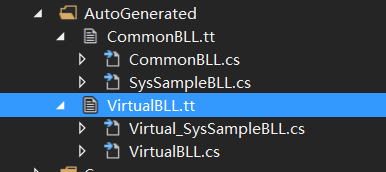
OK,运行之后还是熟悉的面孔,但是可以重载了,我们重载一下,好处理我们的业务!
新建SysSampleBLL.cs
namespace Apps.BLL

{

    public partial class SysSampleBLL

    {

        public override bool Create(ref ValidationErrors errors, SysSampleModel model)

        {

            try

            {

                SysSample entity = m_Rep.GetById(model.Id);

                if (entity != null)

                {

                    errors.Add(Resource.PrimaryRepeat);

                    return false;

                }

                entity = new SysSample();

                entity.Id = model.Id;

                entity.Name = model.Name.TrimStart();

                entity.Age = model.Age;

                entity.Bir = model.Bir;

                entity.Photo = model.Photo;

                entity.Note = model.Note;

                entity.CreateTime = model.CreateTime;

                if (m_Rep.Create(entity))

                {

                    return true;

                }

                else

                {

                    errors.Add(Resource.InsertFail);

                    return false;

                }

            }

            catch (Exception ex)

            {

                errors.Add(ex.Message);

                ExceptionHander.WriteException(ex);

                return false;

            }

        }

    }

}
同样的。我们可以对Model层进行重构,类似BLL层。利用虚属性,可以对属性进行注解。来获得优先级,和一次生成编译通过
//------------------------------------------------------------------------------

// <auto-generated>

//     此代码已从模板生成。

//

//     手动更改此文件可能导致应用程序出现意外的行为。

//     如果重新生成代码,将覆盖对此文件的手动更改。

// </auto-generated>

//------------------------------------------------------------------------------

using Apps.Models;

using System;

namespace Apps.Models.Sys

{

    public class Virtual_SysSampleModel

    {

            public virtual string Id { get; set; }

            public virtual string Name { get; set; }

            public virtual Nullable<int> Age { get; set; }

            public virtual Nullable<System.DateTime> Bir { get; set; }

            public virtual string Photo { get; set; }

            public virtual string Note { get; set; }

            public virtual Nullable<System.DateTime> CreateTime { get; set; }

        }

}
//------------------------------------------------------------------------------

// <auto-generated>

//     此代码已从模板生成。

//

//     手动更改此文件可能导致应用程序出现意外的行为。

//     如果重新生成代码,将覆盖对此文件的手动更改。

// </auto-generated>

//------------------------------------------------------------------------------

using Apps.Models;

using System;

namespace Apps.Models.Sys

{

    public partial class SysSampleModel:Virtual_SysSampleModel

    {

    }

}
然后自己建Model对其重载
-------------------------------------------------------------------丑陋的分割线----------------------------------------------------------------------------------------
到此,我们重构了DAL层和BLL层。对比原来的代码生成器方式。我们新建一个表不用再生成DAL层和BLL层的代码。直达界面
利用代码生成器获得控制器和View视图。直接得到界面。一个字爽。大家可以下载代码来研究
代码生成器在第一节下载,但是代码生成器本人很久没有维护,可能生成的index.cshtml会有一些问题,但是好很好解决。自己花点时间来设计成自己的前端生成器。
OK、本文到此结束,谢谢
ASP.NET MVC5+EF6+EasyUI 后台管理系统(59)-BLL层重构的更多相关文章
- ASP.NET MVC5+EF6+EasyUI 后台管理系统(1)-前言与目录(持续更新中...)
开发工具:VS2015(2012以上)+SQL2008R2以上数据库 您可以有偿获取一份最新源码联系QQ:729994997 价格 666RMB 升级后界面效果如下: 任务调度系统界面 http: ...
- ASP.NET MVC5+EF6+EasyUI 后台管理系统(1)-前言与目录(转)
开发工具:VS2015(2012以上)+SQL2008R2以上数据库 您可以有偿获取一份最新源码联系QQ:729994997 价格 666RMB 升级后界面效果如下: 日程管理 http://ww ...
- ASP.NET MVC5+EF6+EasyUI 后台管理系统(63)-Excel导入和导出-自定义表模导入
系列目录 前言 上一节使用了LinqToExcel和CloseXML对Excel表进行导入和导出的简单操作,大家可以跳转到上一节查看: ASP.NET MVC5+EF6+EasyUI 后台管理系统(6 ...
- ASP.NET MVC5+EF6+EasyUI 后台管理系统-WebApi的用法与调试
1:ASP.NET MVC5+EF6+EasyUI 后台管理系统(1)-WebApi与Unity注入 使用Unity是为了使用我们后台的BLL和DAL层 2:ASP.NET MVC5+EF6+Easy ...
- ASP.NET MVC5+EF6+EasyUI 后台管理系统(51)-系统升级
系统很久没有更新内容了,期待已久的更新在今天发布了,最近花了2个月的时间每天一点点,从原有系统 MVC4+EF5+UNITY2.X+Quartz 2.0+easyui 1.3.4无缝接入 MVC5+E ...
- ASP.NET MVC5+EF6+EasyUI 后台管理系统(58)-DAL层重构
系列目录 前言:这是对本文系统一次重要的革新,很久就想要重构数据访问层了,数据访问层重复代码太多.主要集中增删该查每个模块都有,所以本次是为封装相同接口方法 如果你想了解怎么重构普通的接口DAL层请查 ...
- ASP.NET MVC5+EF6+EasyUI 后台管理系统(34)-文章发布系统①-简要分析
系列目录 最新比较闲,为了学习下Android的开发构建ASP.NET MVC4+EF5+EasyUI+Unity2.x注入的后台管理系统(1)-前言与,虽然有点没有目的的学习,但还是了解了Andro ...
- ASP.NET MVC5+EF6+EasyUI 后台管理系统(54)-工作流设计-所有流程监控
系列目录 先补充一个平面化登陆页面代码,自己更换喜欢的颜色背景 @using Apps.Common; @{ Layout = null; } <!DOCTYPE html> <ht ...
- ASP.NET MVC5+EF6+EasyUI 后台管理系统(56)-插件---单文件上传与easyui使用fancybox
系列目录 https://yunpan.cn/cZVeSJ33XSHKZ 访问密码 0fc2 今天整合lightbox插件Fancybox1.3.4,发现1.3.4版本太老了.而目前easyui 1 ...
- ASP.NET MVC5+EF6+EasyUI 后台管理系统(29)-T4模版
系列目录 本节不再适合本系统,在58,59节已经重构.请超过本节 这讲适合所有的MVC程序 很荣幸,我们的系统有了体验的地址了.演示地址 之前我们发布了一个简单的代码生成器,其原理就是读取数据库的表结 ...
随机推荐
- nohup程序后台执行
Linux常用命令,用于不挂断的执行程序. nohup命令:如果你正在运行一个进程,而且你觉得在退出帐户时该进程还不会结束,那么可以使用nohup命令.该命令可以在你退出帐户/关闭终端之后继续运行相应 ...
- 用MongoDB分析合肥餐饮业
看了<从数据角度解析福州美食>后难免心痒,动了要分析合肥餐饮业的念头,因此特地写了Node.js爬虫爬取了合肥的大众点评数据.分析数据库我并没有采用MySQL而是用的MongoDB,是因为 ...
- 封装集合(Encapsulate Collection)
封装就是将相关的方法或者属性抽象成为一个对象. 封装的意义: 对外隐藏内部实现,接口不变,内部实现自由修改. 只返回需要的数据和方法. 提供一种方式防止数据被修改. 更好的代码复用. 当一个类的属性类 ...
- Java程序员应该了解的10个面向对象设计原则
面向对象设计原则: 是OOPS(Object-Oriented Programming System,面向对象的程序设计系统)编程的核心,但大多数Java程序员追逐像Singleton.Decorat ...
- “风投云涌”:那些被资本看中的IT企业的风光与辛酸
进入七月份以来,纷享销客获得D轮融资1亿美元,撼动业界,资本与IT联姻令一部分创业者眼红的同时,没有人注意到背后的风险. 科技与资本的结合,是当今经济社会前行的宏大主题.相关统计显示,软件行 ...
- android绘制圆形图片的两种方式
看下效果先 下面有完整的示例代码 使用BitmapShader(着色器) 我们在绘制view 的时候 就是小学上美术课 用水彩笔在本子上画画 使用着色器绘制圆形图片最简单的理解方式 就是把bitmap ...
- swift 中关于open ,public ,fileprivate,private ,internal,修饰的说明
关于 swift 中的open ,public ,fileprivate,private, internal的区别 以下按照修饰关键字的访问约束范围 从约束的限定范围大到小的排序进行说明 open,p ...
- PHP 数组浅析
PHP的数组具有如下特点:1.数组初始化时无需指定长度:2.数组中的元素无需相同类型:3.数组的长度可变4.可使用var_dump(参数)或者print_r( 参数) 函数查看数组变量.5.数组内的 ...
- XSS 前端防火墙 —— 可疑模块拦截
上一篇介绍的系统,已能预警现实中的大多数 XSS 攻击,但想绕过还是很容易的. 由于是在前端防护,策略配置都能在源代码里找到,因此很快就能试出破解方案.并且攻击者可以屏蔽日志接口,在自己电脑上永不发出 ...
- 深入浅出聊优化:从Draw Calls到GC
前言: 刚开始写这篇文章的时候选了一个很土的题目...<Unity3D优化全解析>.因为这是一篇临时起意才写的文章,而且陈述的都是既有的事实,因而给自己“文(dou)学(bi)”加工留下的 ...