
分析配置DispatcherServlet类时load-on-startup标签作用
<servlet>

    <servlet-name>DispatcherServlet</servlet-name>

    <servlet-class>org.springframework.web.servlet.DispatcherServlet</servlet-class>

    <init-param>

        <param-name>contextConfigLocation</param-name>

        <param-value>classpath:application.xml</param-value>

    </init-param>

    <load-on-startup>1</load-on-startup>

</servlet>
SpringMVC中DispatcherServlet是该框架的核心,所有的请求处理及返回都要经过该Servlet,于是我们必须在web.xml里面配置该Servlet,大多时候我们在配置该Servlet的时候都会顺手配置一下:<load-on-startup>数值</load-on-startup>元素。起初就是以为加载DispatcherServlet的,我们来详细研究一下关于load-on-startup的作用及其过程。
作用:load-on-startup元素标记容器表示是否在启动的时候就加载这个servlet(实例化并调用其init()方法),而<load-on-startup>x</load-on-startup>中x的取值1,2,3,4,5代表的是优先级,而非启动延迟时间。
过程:
1、因为该servlet是实例化并调用init()方法的,我们先进入该类寻找init()方法
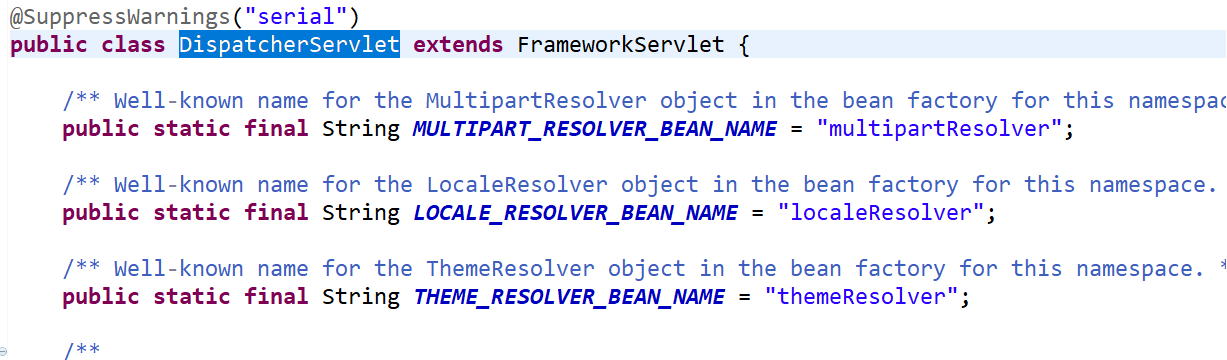
从该类中可看出其定义的几个resolver都是由final修饰,表示该属性一旦被初始化便不可改变,这里不可改变的意思对基本类型来说是其值不可变,而对对象属性来说其引用不可再变。
所以我们在配置这些的时候不能随意定值,必须和其一致,如下示例:
<!--application.xml中的multipartResolver的id是个定值,如果写错了就会报错-->

<bean id="multipartResolver" class="org.springframework.web.multipart.commons.CommonsMultipartResolver" p:defaultEncoding="UTF-8" p:maxInMemorySize="1024000"></bean>
经查找并未在DispatcherServlet中找到init()方法,我们往上一级找其父类(FrameworkServlet)未果,再往上一级(HttpServletBean)通过查找在HttpServletBean中找到了该方法
    /**

     * Map config parameters onto bean properties of this servlet, and

     * invoke subclass initialization.

     * @throws ServletException if bean properties are invalid (or required

     * properties are missing), or if subclass initialization fails.

     */

    @Override

    public final void init() throws ServletException {

        if (logger.isDebugEnabled()) {

            logger.debug("Initializing servlet '" + getServletName() + "'");

        }

        // Set bean properties from init parameters.

        PropertyValues pvs = new ServletConfigPropertyValues(getServletConfig(), this.requiredProperties);

        if (!pvs.isEmpty()) {

            try {

                BeanWrapper bw = PropertyAccessorFactory.forBeanPropertyAccess(this);

                ResourceLoader resourceLoader = new ServletContextResourceLoader(getServletContext());

                bw.registerCustomEditor(Resource.class, new ResourceEditor(resourceLoader, getEnvironment()));

                initBeanWrapper(bw);

                bw.setPropertyValues(pvs, true);

            }

            catch (BeansException ex) {

                if (logger.isErrorEnabled()) {

                    logger.error("Failed to set bean properties on servlet '" + getServletName() + "'", ex);

                }

                throw ex;

            }

        }

        // Let subclasses do whatever initialization they like.

        initServletBean();

        if (logger.isDebugEnabled()) {

            logger.debug("Servlet '" + getServletName() + "' configured successfully");

        }

    }
由其介绍可知其作用大概是,map配置参数到这个servlet的bean属性,并调用子类初始化,其子类初始化的处理就在于initServletBean();的作用,我们去寻找此方法的来源
(HttpServletBean)中找到了,但是个空方法,我们往回继续找在(FrameworkServlet)中找到了
    /**

     * Overridden method of {@link HttpServletBean}, invoked after any bean properties

     * have been set. Creates this servlet's WebApplicationContext.

     */

    @Override

    protected final void initServletBean() throws ServletException {

        getServletContext().log("Initializing Spring FrameworkServlet '" + getServletName() + "'");

        if (this.logger.isInfoEnabled()) {

            this.logger.info("FrameworkServlet '" + getServletName() + "': initialization started");

        }

        long startTime = System.currentTimeMillis();

        try {

            this.webApplicationContext = initWebApplicationContext();

            initFrameworkServlet();

        }

        catch (ServletException ex) {

            this.logger.error("Context initialization failed", ex);

            throw ex;

        }

        catch (RuntimeException ex) {

            this.logger.error("Context initialization failed", ex);

            throw ex;

        }

        if (this.logger.isInfoEnabled()) {

            long elapsedTime = System.currentTimeMillis() - startTime;

            this.logger.info("FrameworkServlet '" + getServletName() + "': initialization completed in " +

                    elapsedTime + " ms");

        }

    }
我们打开initWebApplicationContext()方法:
    /**

     * Initialize and publish the WebApplicationContext for this servlet.

     * <p>Delegates to {@link #createWebApplicationContext} for actual creation

     * of the context. Can be overridden in subclasses.

     * @return the WebApplicationContext instance

     * @see #FrameworkServlet(WebApplicationContext)

     * @see #setContextClass

     * @see #setContextConfigLocation

     */

    protected WebApplicationContext initWebApplicationContext() {

        WebApplicationContext rootContext =

                WebApplicationContextUtils.getWebApplicationContext(getServletContext());

        WebApplicationContext wac = null;

        if (this.webApplicationContext != null) {

            // A context instance was injected at construction time -> use it

            wac = this.webApplicationContext;

            if (wac instanceof ConfigurableWebApplicationContext) {

                ConfigurableWebApplicationContext cwac = (ConfigurableWebApplicationContext) wac;

                if (!cwac.isActive()) {

                    // The context has not yet been refreshed -> provide services such as

                    // setting the parent context, setting the application context id, etc

                    if (cwac.getParent() == null) {

                        // The context instance was injected without an explicit parent -> set

                        // the root application context (if any; may be null) as the parent

                        cwac.setParent(rootContext);

                    }

                    configureAndRefreshWebApplicationContext(cwac);

                }

            }

        }

        if (wac == null) {

            // No context instance was injected at construction time -> see if one

            // has been registered in the servlet context. If one exists, it is assumed

            // that the parent context (if any) has already been set and that the

            // user has performed any initialization such as setting the context id

            wac = findWebApplicationContext();

        }

        if (wac == null) {

            // No context instance is defined for this servlet -> create a local one

            wac = createWebApplicationContext(rootContext);

        }

        if (!this.refreshEventReceived) {

            // Either the context is not a ConfigurableApplicationContext with refresh

            // support or the context injected at construction time had already been

            // refreshed -> trigger initial onRefresh manually here.

            onRefresh(wac);

        }

        if (this.publishContext) {

            // Publish the context as a servlet context attribute.

            String attrName = getServletContextAttributeName();

            getServletContext().setAttribute(attrName, wac);

            if (this.logger.isDebugEnabled()) {

                this.logger.debug("Published WebApplicationContext of servlet '" + getServletName() +

                        "' as ServletContext attribute with name [" + attrName + "]");

            }

        }

        return wac;

    }
整个过程就是为了给wac赋值,并返回该值,最后执行了onRefresh()方法:
@Override

protected void onRefresh(ApplicationContext context) {

    initStrategies(context);

}
然后执行initStrategies方法:
/**

* Initialize the strategy objects that this servlet uses.

* <p>May be overridden in subclasses in order to initialize further strategy objects.

 */

protected void initStrategies(ApplicationContext context) {

    //用于处理上传请求。处理方法是将普通的request包装成MultipartHttpServletRequest,后者可以直接调用getFile方法获取File.

    initMultipartResolver(context);

    //SpringMVC主要有两个地方用到了Locale:一是ViewResolver视图解析的时候;二是用到国际化资源或者主题的时候。

    initLocaleResolver(context);

    //用于解析主题。SpringMVC中一个主题对应一个properties文件,里面存放着跟当前主题相关的所有资源、

    //如图片、css样式等。SpringMVC的主题也支持国际化,

     initThemeResolver(context);

    //用来查找Handler的。

    initHandlerMappings(context);

    //从名字上看,它就是一个适配器。Servlet需要的处理方法的结构却是固定的,都是以request和response为参数的方法。

    //如何让固定的Servlet处理方法调用灵活的Handler来进行处理呢?这就是HandlerAdapter要做的事情

    initHandlerAdapters(context);

    //其它组件都是用来干活的。在干活的过程中难免会出现问题,出问题后怎么办呢?

    //这就需要有一个专门的角色对异常情况进行处理,在SpringMVC中就是HandlerExceptionResolver。

    initHandlerExceptionResolvers(context);

    //有的Handler处理完后并没有设置View也没有设置ViewName,这时就需要从request获取ViewName了,

    //如何从request中获取ViewName就是RequestToViewNameTranslator要做的事情了。

    initRequestToViewNameTranslator(context);

     //ViewResolver用来将String类型的视图名和Locale解析为View类型的视图。

    //View是用来渲染页面的,也就是将程序返回的参数填入模板里,生成html(也可能是其它类型)文件。

    initViewResolvers(context);

     //用来管理FlashMap的,FlashMap主要用在redirect重定向中传递参数。

    initFlashMapManager(context);

}
至此就完成了整个初始化过程了。
分析配置DispatcherServlet类时load-on-startup标签作用的更多相关文章
- 精尽Spring Boot源码分析 - 配置加载
该系列文章是笔者在学习 Spring Boot 过程中总结下来的,里面涉及到相关源码,可能对读者不太友好,请结合我的源码注释 Spring Boot 源码分析 GitHub 地址 进行阅读 Sprin ...
- 当web项目没有配置<welcome-file>index_1.jsp</welcome-file>默认标签启动tomcat后默认访问的页面是什么呢?
当web项目没有配置index_1.jsp默认标签启动tomcat后默认访问的页面是什么呢? 结果我启动后居然默认打开了index.jsp页面 为什么呢?为什么会访问我的.indexjsp页面呢?不是 ...
- 01 - spring mvc 概述及配置DispatcherServlet
1.Spring mvc 基于model2实现,整体框架流程如(图片来自百度): ①web容器接收到http请求,若匹配DispatcherServlet的请求映射路径(web.xml),则容器会交给 ...
- spring in action学习笔记十五:配置DispatcherServlet和ContextLoaderListener的几种方式。
在spring in action中论述了:DispatcherServlet和ContextLoaderListener的关系,简言之就是DispatcherServlet是用于加载web层的组件的 ...
- springboot mvc自动配置(一)自动配置DispatcherServlet和DispatcherServletRegistry
所有文章 https://www.cnblogs.com/lay2017/p/11775787.html 正文 springboot的自动配置基于SPI机制,实现自动配置的核心要点就是添加一个自动配置 ...
- Spring MVC+Spring +Hibernate配置事务,但是事务不起作用
最近做项目,被一个问题烦恼了很久.使用Spring MVC+Spring +Hibernate开发项目,在使用注解配置事务管理,刚开始发现无论如何数据库都无法更新,但是可以从数据库查询到数据.怀疑是配 ...
- Eventlog Analyzer日志管理系统、日志分析工具、日志服务器的功能及作用
Eventlog Analyzer日志管理系统.日志分析工具.日志服务器的功能及作用 Eventlog Analyzer是用来分析和审计系统及事件日志的管理软件,能够对全网范围内的主机.服务器.网络设 ...
- [Tomcat 源码分析系列] (一) : Tomcat 启动脚本-startup.bat
概述 我们通常使用 Tomcat 中的 startup.bat 来启动 Tomcat. 但是这其中干了一些什么事呢? 大家都知道一个 Java 程序需要启动的话, 肯定需要 main 方法, 那么这个 ...
- web.xml配置DispatcherServlet
1. org.springframework.web.servlet.DispatcherServlet 所在jar包: <dependency> <groupId>org.s ...
随机推荐
- 拿到别人的Django程序如何在本地RUN起来
在Pycharm IDE下 Edit Configurations 1.检查Python interpreter 2.检查 Working directory 3.Settings 数据库配置
- 洛谷P1131 时态同步
题意: 给一个n点的树,每条边都有边权,问从根出发需要增加多少长度,使得最终的儿子到根的距离是一样的 思路: 上来一个思路wa了3次,看完题解之后,又一次豁然开朗…… orz #include< ...
- 安装多个xcode对homebrew影响
安装多个xcode,可能会导致无法识别默认使用哪个xcode的情况,这时候执行下列语句,设置默认xcode sudo xcode-select --switch /Applications/Xcode ...
- DreamWeaver CC 中的回车
在Dreamweaver CC中换行有两种: 第一种是在设计视图中直接回车,对应的代码是<p>标签,即新生成一个段落. (注:在DreamWeaver CC编辑的代码中,按下回车相当于 ) ...
- python基础教程系列1-基础语法
最近在学习python,主要通过廖雪峰的python教程入门,看看自己能够花多少时间最快入门.通过写博客梳理自己的知识点,强化自己的记忆.总的学习思路是,快速学习一遍教程,然后做一些算法题目实践,再然 ...
- C:变量的声明与定义
声明变量不需要建立存储空间,如:extern int a; 定义变量需要建立存储空间,如:int b; #include <stdio.h> int main() { //extern 关 ...
- opencv python:模糊操作
均值模糊 中值模糊 自定义模糊 模糊操作的基本原理 基于离散卷积 定义好每个卷积核 不同卷积核得到不同的卷积效果 模糊是卷积的一种表象 blur cv2.blur(image, (1, 3)) 第二个 ...
- mysql数据库数据备份还原
1.直接在命令行里面执行 备份一个数据库:mysqldump -h server -u username -p password db_name > database-sqlbkp_`date ...
- mDNS故障排查(译)
WLC上mDNS网关的理解及排查 第一部分:介绍 这篇文档描述了Bonjour协议在WLC上的操作,该文档旨在协助工程师理解该工作流量的原理以及提供故障排查的指导. 第二部分:需求和前提 知识需求: ...
- C++ STL之unordered_map和unordered_set的使⽤
写在最前面,本文摘录于柳神笔记: unordered_map 在头⽂件 #include <unordered_map> 中, unordered_set 在头⽂件 #include &l ...