
2017 ACM/ICPC Asia Regional Shenyang Online
cable cable cable
Time Limit: 2000/1000 MS (Java/Others) Memory Limit: 32768/32768 K (Java/Others)
Total Submission(s): 2084 Accepted Submission(s): 1348
Now you have M display screens and K different signal sources(K≤M≤232−1). Select K display screens from M display screens, how many cables are needed at least so that **any** K display screens you select can show exactly K different colors.
there is one line contains two integers M and K.
20 15
90
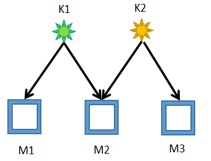
As the picture is shown, when you select M1 and M2, M1 show the color of K1, and M2 show the color of K2.
When you select M3 and M2, M2 show the color of K1 and M3 show the color of K2.
When you select M1 and M3, M1 show the color of K1.
#include <bits/stdc++.h>

using namespace std;

typedef long long ll;

typedef unsigned long long ull;

const int N = 1e6+;

const int INF=0x3f3f3f3f;

int main()

{

    ll n,k;

    while(cin>>n>>k)

    {

        cout<<k*(n-k+)<<endl;

    }

    return ;

}
array array array
Time Limit: 2000/1000 MS (Java/Others) Memory Limit: 32768/32768 K (Java/Others)
Total Submission(s): 2917 Accepted Submission(s): 1170
Kiddo: "I have an array A and a number k, if you can choose exactly k elements from A and erase them, then the remaining array is in non-increasing order or non-decreasing order, we say A is a magic array. Now I want you to tell me whether A is a magic array. " Conan: "emmmmm..." Now, Conan seems to be in trouble, can you help him?
1≤T≤20
1≤n≤105
0≤k≤n
1≤Ai≤105
4 1
1 4 3 7
5 2
4 1 3 1 2
6 1
1 4 3 5 4 6
A is a magic array.
A is not a magic array.
#include<iostream>

#include<algorithm>

#include<stdio.h>

using namespace std;

const int N=1e6+;

const int INF=0x3f3f3f3f;

int a[N],g[N],f[N],b[N],c[N],n,h[N];

int main() {

    int t,n,last,l,i,m,x;

    cin>>t;

    while(t--)

    {

        cin>>n>>m;

        for(int i=; i<n; i++)

            cin>>a[i],h[n-i-]=a[i];

        fill(g,g+n,INF);

        b[]=;

        for(int i=; i<n; i++)

        {

            int j=lower_bound(g, g+n,a[i])-g;

               g[j]=a[i];

               b[i]=j;

        }

        l=lower_bound(g, g+n,INF)-g-;

        last=INF;

        for(i=n-;i>=;i--)

        {

            if(l==-)break;

            if(b[i]==l&&a[i]<last)

            {

                last=a[i];

                c[l]=last;

                l--;

            }

        }

        l=lower_bound(g, g+n,INF)-g;

        l=n-l;x=l;

        fill(g,g+n,INF);

        b[]=;

        for(int i=; i<n; i++)

        {

            int j=lower_bound(g, g+n,h[i])-g;

               g[j]=h[i];

               b[i]=j;

        }

        l=lower_bound(g, g+n,INF)-g-;

        last=INF;

        for(i=n-;i>=;i--)

        {

            if(l==-)break;

            if(b[i]==l&&a[i]<last)

            {

                last=a[i];

                c[l]=last;

                l--;

            }

        }

        l=lower_bound(g, g+n,INF)-g;

        if(x>n-l)

        x=n-l;

        if(x<=m)

        puts("A is a magic array.");

        else puts("A is not a magic array.");

        //printf("%d\n",l);

    }

    return ;

}
number number number
Time Limit: 2000/1000 MS (Java/Others) Memory Limit: 32768/32768 K (Java/Others)
Total Submission(s): 2021 Accepted Submission(s): 1068
⋅ F0=0,F1=1;
⋅ Fn=Fn−1+Fn−2 (n≥2).
Give you an integer k, if a positive number n can be expressed by
n=Fa1+Fa2+...+Fak where 0≤a1≤a2≤⋯≤ak, this positive number is mjf−good. Otherwise, this positive number is mjf−bad.
Now, give you an integer k, you task is to find the minimal positive mjf−bad number.
The answer may be too large. Please print the answer modulo 998244353.
Each test case includes an integer k which is described above. (1≤k≤109)
找规律+矩阵快速幂
#include<cstdio>

#include<algorithm>

#include<cstring>

#include<iostream>

using namespace std;

const long long M =;

struct Matrix

{

    long long a[][];

    Matrix()

    {

        memset(a, , sizeof(a));

    }

    Matrix operator * (const Matrix y)

    {

        Matrix ans;

        for(long long i = ; i <= ; i++)

            for(long long j = ; j <= ; j++)

                for(long long k = ; k <= ; k++)

                    ans.a[i][j] += a[i][k]*y.a[k][j];

        for(long long i = ; i <= ; i++)

            for(long long j = ; j <= ; j++)

                ans.a[i][j] %= M;

        return ans;

    }

    void operator = (const Matrix b)

    {

        for(long long i = ; i <= ; i++)

            for(long long j = ; j <= ; j++)

                a[i][j] = b.a[i][j];

    }

};

long long solve(long long x)

{

    Matrix ans, trs;

    ans.a[][] = ans.a[][] = ;

    trs.a[][] = trs.a[][] = trs.a[][] = ;

    while(x)

    {

        if(x&)

            ans = ans*trs;

        trs = trs*trs;

        x >>= ;

    }

    return ans.a[][];

}

int main()

{

    long long n;

    while(~scanf("%lld", &n))

    {

        cout <<(solve(*n+)-+M)%M << endl;

    }

    return ;

}
transaction transaction transaction
Time Limit: 4000/2000 MS (Java/Others) Memory Limit: 132768/132768 K (Java/Others)
Total Submission(s): 2245 Accepted Submission(s): 682
As we know, the price of this book was different in each city. It is ai yuan in it city. Kelukin will take taxi, whose price is 1yuan per km and this fare cannot be ignored.
There are n−1 roads connecting n cities. Kelukin can choose any city to start his travel. He want to know the maximum money he can get.
For each test case:
first line contains an integer n (2≤n≤100000) means the number of cities;
second line contains n numbers, the ith number means the prices in ith city; (1≤Price≤10000)
then follows n−1 lines, each contains three numbers x, y and z which means there exists a road between x and y, the distance is zkm (1≤z≤1000).
4
10 40 15 30
1 2 30
1 3 2
3 4 10
#include<bits/stdc++.h>

using namespace std;

const int N=1e5+;

vector<pair<int,int> >G[N];

int sell[N],buy[N],ans;

int vis[N];

void dfs(int x)

{

    for(int i=;i<(int)G[x].size();i++)

    {

        int v=G[x][i].first;

        int w=G[x][i].second;

        if(vis[v])continue;

        vis[v]=;

        dfs(v);

        buy[x]=min(buy[x],buy[v]+w);

        sell[x]=max(sell[x],sell[v]-w);

    }

    ans=max(ans,buy[x]-sell[x]);

    ans=max(ans,sell[x]-buy[x]);

}

int main()

{

    int T;

    scanf("%d",&T);

    while(T--)

    {

        int n;

        scanf("%d",&n);

        memset(vis,,sizeof(vis));

        for(int i=;i<=n;i++)

            G[i].clear();

        for(int i=;i<=n;i++)

        {

            scanf("%d",&sell[i]);

            buy[i]=sell[i];

        }

        for(int i=;i<n;i++)

        {

            int u,v,w;

            scanf("%d%d%d",&u,&v,&w);

            G[u].push_back({v,w});

            G[v].push_back({u,w});

        }

        ans=;

        vis[]=;

        dfs();

        printf("%d\n",ans);

    }

    return ;

}
card card card
Time Limit: 8000/4000 MS (Java/Others) Memory Limit: 32768/32768 K (Java/Others)
Total Submission(s): 2684 Accepted Submission(s): 755
One day, MJF takes a stack of cards and talks to him: let's play a game and if you win, you can get all these cards. MJF randomly assigns these cards into n heaps, arranges in a row, and sets a value on each heap, which is called "penalty value".
Before the game starts, WYJ can move the foremost heap to the end any times.
After that, WYJ takes the heap of cards one by one, each time he needs to move all cards of the current heap to his hands and face them up, then he turns over some cards and the number of cards he turned is equal to the penaltyvalue.
If at one moment, the number of cards he holds which are face-up is less than the penaltyvalue, then the game ends. And WYJ can get all the cards in his hands (both face-up and face-down).
Your task is to help WYJ maximize the number of cards he can get in the end.So he needs to decide how many heaps that he should move to the end before the game starts. Can you help him find the answer?
MJF also guarantees that the sum of all "penalty value" is exactly equal to the number of all cards.
For each test case:
the first line is an integer n (1≤n≤106), denoting n heaps of cards;
next line contains n integers, the ith integer ai (0≤ai≤1000) denoting there are ai cards in ith heap;
then the third line also contains n integers, the ith integer bi (1≤bi≤1000) denoting the "penalty value" of ith heap is bi.
4 6 2 8 4
1 5 7 9 2
For the sample input:

+ If WYJ doesn't move the cards pile, when the game starts the state of cards is:

	4 6 2 8 4

	1 5 7 9 2

WYJ can take the first three piles of cards, and during the process, the number of face-up cards is 4-1+6-5+2-7. Then he can't pay the the "penalty value" of the third pile, the game ends. WYJ will get 12 cards.

+ If WYJ move the first four piles of cards to the end, when the game starts the state of cards is:

	4 4 6 2 8

	2 1 5 7 9

WYJ can take all the five piles of cards, and during the process, the number of face-up cards is 4-2+4-1+6-5+2-7+8-9. Then he takes all cards, the game ends. WYJ will get 24 cards.

It can be improved that the answer is 4.

**huge input, please use fastIO.**
直接模拟下,但是有个细节就是全部都可以取到
#include<stdio.h>

#include<algorithm>

#include<string.h>

using namespace std;

int a[],b[];

int main()

{

    int n,x,i,s,p,y,q,r;

    while(~scanf("%d",&n))

    {

        for(i=;i<n;i++)

        scanf("%d",&a[i]),b[i]=a[i];

        for(i=;i<n;i++)

        {

            scanf("%d",&x);

            a[i]-=x;

        }

        s=;p=i;y=;q=;r=;

        for(i=;i<n;i++)

        {

            s+=a[i];

            if(s<)

            {

                if(q<y)

                {

                    q=y,r=p;

                }

                y=;

                s=;

                p=i+;

            }

            y+=b[i];

        }

        if(p==n)

        {

            printf("%d\n",r);

            continue;

        }

        for(i=;i<p;i++)

        {

            s+=a[i];

            if(s<)

            {

                if(q<y)

                {

                    q=y,r=p;

                }

                break;

            }

            y+=b[i];

        }

        if(q<y)

        {

            q=y,r=p;

        }

        printf("%d\n",r);

    }

}
2017 ACM/ICPC Asia Regional Shenyang Online的更多相关文章
- 2017 ACM/ICPC Asia Regional Shenyang Online spfa+最长路
transaction transaction transaction Time Limit: 4000/2000 MS (Java/Others) Memory Limit: 132768/1 ...
- 2017 ACM/ICPC Asia Regional Shenyang Online(部分题解)
HDU 6197 array array array 题意 输入n和k,表示输入n个整数和可以擦除的次数k,如果至多擦除k次能是的数组中的序列是不上升或者是不下降序列,就是魔力数组,否则不是. 解题思 ...
- HDU 6205(尺取法)2017 ACM/ICPC Asia Regional Shenyang Online
题目链接 emmmm...思路是群里群巨聊天讲这题是用尺取法.....emmm然后就没难度了,不过时间上3000多,有点.....盗了个低配本的读入挂发现就降到2800左右, 翻了下,发现神犇Clar ...
- HDU 6198(2017 ACM/ICPC Asia Regional Shenyang Online)
思路:找规律发现这个数是斐波那契第2*k+3项-1,数据较大矩阵快速幂搞定. 快速幂入门第一题QAQ #include <stdio.h> #include <stdlib.h& ...
- 2017 ACM/ICPC Asia Regional Shenyang Online array array array
2017-09-15 21:05:41 writer:pprp 给出一个序列问能否去掉k的数之后使得整个序列不是递增也不是递减的 先求出LIS,然后倒序求出最长递减子序列长度,然后判断去k的数后长度是 ...
- 2017 ACM/ICPC Asia Regional Shenyang Online card card card
题意:看后面也应该知道是什么意思了 解法: 我们设置l,r,符合条件就是l=起始点,r=当前点,不符合l=i+1 学习了一下FASTIO #include <iostream> #incl ...
- 2017 ACM/ICPC Asia Regional Shenyang Online transaction transaction transaction
Problem Description Kelukin is a businessman. Every day, he travels around cities to do some busines ...
- 2017 ACM/ICPC Asia Regional Shenyang Online number number number
题意:求n个斐波那契数列组合都无法得到的最小数字 解法: 1 我们先暴力的求出前面几个数字 2 然后再暴力的求递推 3 接着矩阵快速幂(没写错吧?) /*#include<bits/stdc++ ...
- 2017 ACM/ICPC Asia Regional Shenyang Online cable cable cable
Problem Description Connecting the display screen and signal sources which produce different color s ...
随机推荐
- 什么是OOA/OOD
Object Oriented Analyzing Object Oriented Design Object Oriented Programming ooa(object oriented ana ...
- 安装ubuntu虚拟环境
一. 安装 1. 准备: 1). Oracle VM VirtualBox https://www.virtualbox.org/ 2). Ubuntu 18.04.2 LTS https://ubu ...
- PHP-PHPExcel用法详解
以下文章来源:diandian_520 http://blog.csdn.net/diandian_520/article/details/7827038 1.header header(" ...
- make 与makefile(会不会写 makefile,从一个侧面说明了一个人是否具备完成大型工程的能力。)
跟我一起写 Makefile /**/ 陈皓 (CSDN) 概述 —— 什么是makefile?或许很多Winodws的程序员都不知道这个东西,因为那些Windows的IDE都为你做了这个工作,但我觉 ...
- C#编写高并发数据库控制
往往大数据量,高并发时, 瓶颈都在数据库上, 好多人都说用数据库的复制,发布, 读写分离等技术, 但主从数据库之间同步时间有延迟.代码的作用在于保证在上端缓存服务失效(一般来说概率比较低)时,形成倒瓶 ...
- websphere7.0异常:SRVE0255E: 尚未定义要处理 /wcm 的 Web 组/虚拟主机
websphere7.0错误:SRVE0255E: 尚未定义要处理 /wcm 的 Web 组/虚拟主机. SRVE0255E: 尚未定义要处理 /wcm 的 Web 组/虚拟主机.SRVE0255E: ...
- Java8新特性Lambda表达式
List<RoleDO> allRoles = roleService.list(); //获取角色中备注不是app的集合List<RoleDO> webRoles = all ...
- Linux内核漏洞利用-环境配置(转)
实验环境: Ubuntu-14.04.1 x86 linux-2.6.32.1 busybox-1.27.2 qemu 0x00 安装qemu sudo apt-get install qemu qe ...
- POJ 3080 Blue Jeans、POJ 3461 Oulipo——KMP应用
题目:POJ3080 http://poj.org/problem?id=3080 题意:对于输入的文本串,输出最长的公共子串,如果长度相同,输出字典序最小的. 这题数据量很小,用暴力也是16ms,用 ...
- 几种优化web页面加载速度的策略
剥离静态资源请求到CDN 一般在主域名下的HTTP请求里都会携带大量Cookie信息,最大4KB,每个域名下最多50条:但如果仅仅访问js/css/jpeg等静态资源文件的话是不需要Cookie信息, ...