
spark 划分stage Wide vs Narrow Dependencies 窄依赖 宽依赖 解析 作业 job stage 阶段 RDD有向无环图拆分 任务 Task 网络传输和计算开销 任务集 taskset
每个job被划分为多个stage。划分stage的一个主要依据是当前计算因子的输入是否是确定的,如果是则将其分在同一个stage,从而避免多个stage之间的消息传递开销。
http://spark.apache.org/docs/latest/rdd-programming-guide.html
【Spark actions are executed through a set of stages, separated by distributed “shuffle” operations. 】
Shared Variables
Normally, when a function passed to a Spark operation (such as map or reduce) is executed on a remote cluster node, it works on separate copies of all the variables used in the function. These variables are copied to each machine, and no updates to the variables on the remote machine are propagated back to the driver program. Supporting general, read-write shared variables across tasks would be inefficient. However, Spark does provide two limited types of shared variables for two common usage patterns: broadcast variables and accumulators.
Broadcast Variables
Broadcast variables allow the programmer to keep a read-only variable cached on each machine rather than shipping a copy of it with tasks. They can be used, for example, to give every node a copy of a large input dataset in an efficient manner. Spark also attempts to distribute broadcast variables using efficient broadcast algorithms to reduce communication cost.
Spark actions are executed through a set of stages, separated by distributed “shuffle” operations. Spark automatically broadcasts the common data needed by tasks within each stage. The data broadcasted this way is cached in serialized form and deserialized before running each task. This means that explicitly creating broadcast variables is only useful when tasks across multiple stages need the same data or when caching the data in deserialized form is important.
Broadcast variables are created from a variable v by calling SparkContext.broadcast(v). The broadcast variable is a wrapper around v, and its value can be accessed by calling the value method. The code below shows this:
scala> val broadcastVar = sc.broadcast(Array(1, 2, 3))

broadcastVar: org.apache.spark.broadcast.Broadcast[Array[Int]] = Broadcast(0)

scala> broadcastVar.value

res0: Array[Int] = Array(1, 2, 3)
After the broadcast variable is created, it should be used instead of the value v in any functions run on the cluster so that v is not shipped to the nodes more than once. In addition, the object v should not be modified after it is broadcast in order to ensure that all nodes get the same value of the broadcast variable (e.g. if the variable is shipped to a new node later).
Accumulators
Accumulators are variables that are only “added” to through an associative and commutative operation and can therefore be efficiently supported in parallel. They can be used to implement counters (as in MapReduce) or sums. Spark natively supports accumulators of numeric types, and programmers can add support for new types.
As a user, you can create named or unnamed accumulators. As seen in the image below, a named accumulator (in this instance counter) will display in the web UI for the stage that modifies that accumulator. Spark displays the value for each accumulator modified by a task in the “Tasks” table.
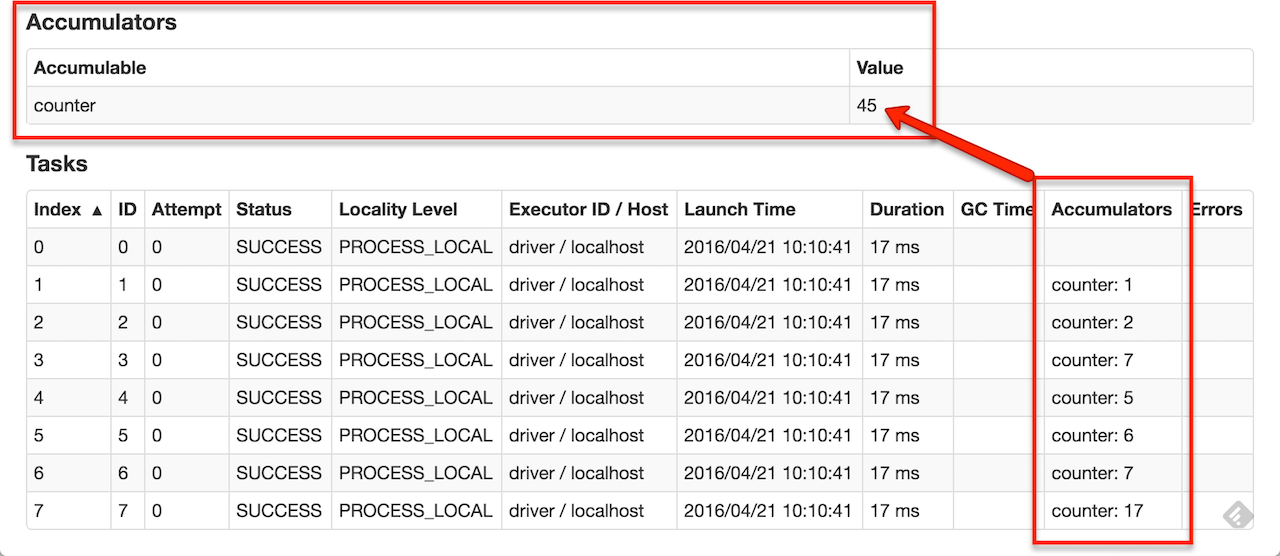
Tracking accumulators in the UI can be useful for understanding the progress of running stages (NOTE: this is not yet supported in Python).
A numeric accumulator can be created by calling SparkContext.longAccumulator() or SparkContext.doubleAccumulator() to accumulate values of type Long or Double, respectively. Tasks running on a cluster can then add to it using the add method. However, they cannot read its value. Only the driver program can read the accumulator’s value, using its value method.
The code below shows an accumulator being used to add up the elements of an array:
scala> val accum = sc.longAccumulator("My Accumulator")

accum: org.apache.spark.util.LongAccumulator = LongAccumulator(id: 0, name: Some(My Accumulator), value: 0)

scala> sc.parallelize(Array(1, 2, 3, 4)).foreach(x => accum.add(x))

...

10/09/29 18:41:08 INFO SparkContext: Tasks finished in 0.317106 s

scala> accum.value

res2: Long = 10
While this code used the built-in support for accumulators of type Long, programmers can also create their own types by subclassing AccumulatorV2. The AccumulatorV2 abstract class has several methods which one has to override: reset for resetting the accumulator to zero, addfor adding another value into the accumulator, merge for merging another same-type accumulator into this one. Other methods that must be overridden are contained in the API documentation. For example, supposing we had a MyVector class representing mathematical vectors, we could write:
class VectorAccumulatorV2 extends AccumulatorV2[MyVector, MyVector] {

  private val myVector: MyVector = MyVector.createZeroVector

  def reset(): Unit = {

    myVector.reset()

  }

  def add(v: MyVector): Unit = {

    myVector.add(v)

  }

  ...

}

// Then, create an Accumulator of this type:

val myVectorAcc = new VectorAccumulatorV2

// Then, register it into spark context:

sc.register(myVectorAcc, "MyVectorAcc1")
Note that, when programmers define their own type of AccumulatorV2, the resulting type can be different than that of the elements added.
For accumulator updates performed inside actions only, Spark guarantees that each task’s update to the accumulator will only be applied once, i.e. restarted tasks will not update the value. In transformations, users should be aware of that each task’s update may be applied more than once if tasks or job stages are re-executed.
Accumulators do not change the lazy evaluation model of Spark. If they are being updated within an operation on an RDD, their value is only updated once that RDD is computed as part of an action. Consequently, accumulator updates are not guaranteed to be executed when made within a lazy transformation like map(). The below code fragment demonstrates this property:
Scala
Java
Python
val accum = sc.longAccumulator
data.map { x => accum.add(x); x }
// Here, accum is still 0 because no actions have caused the map operation to be computed.
Narrow Wide Dependencies 宽依赖 窄依赖
shuffle
窄依赖 宽依赖 解析
Wide vs Narrow Dependencies · rohgar/scala-spark-4 Wiki · GitHub https://github.com/rohgar/scala-spark-4/wiki/Wide-vs-Narrow-Dependencies
窄 父RDD的一个分区,在RDD转换过程中,最多只会被一个子RDD的分区使用
宽 多个
一个Spark应用程序会被分解为多个作业Job提交给Spark集群进行处理。然而,作业并不是应用程序被执行的最小计算单元。
Spark集群收到作业后还要就爱那个作业继续进行2次切分和规划,并进行相应的调度。
第一步:将作业按照RDD转换操作处理为最小的处理单元,即任务Task
第二步:对任务进行规划,生成包含多个任务的阶段Stage
这两步都是由SparkContext创建的DAGScheduler实例进行
其输入是一个作业中的RDD有向无环图,输出为一系列任务
对应宽依赖,应尽量切分到不同的阶段中,以避免过大的网络传输和计算开销
连续窄依赖的RDD转换,则尽量多地放入同一个阶段
一旦遇到一个宽依赖的类型的RDD转换操作,则生成一个新的阶段
整个依赖链被划分为多个stage阶段,每个stage内都是一组互相关联、但彼此之间没有shuffle依赖关系的任务集合,称为任务集 Taskset。
DAGScheduler不仅负责将作业分割为多个阶段,还负责管理调度阶段的提交。
waitingStages集合
runningStages集合
failedStages集合
DAGScheduler是反向遍历整个RDD依赖链
Task调度
DAG
DAGScheduler
TaskScheduler 为每一个收到的TaskSet创建一个TaskSetManager,TaskSetManager决定每个Task应该在哪个物理在哪个物理资源上执行,并将调度计划发给TaskScheduler,TaskScheduler将Task提交给Spark集群实际执行。
TaskScheduler通过ShedulerBackend来了解可以分给应用程序的物理资源的的情况。
TaskSetManager不与底层实际的物理节点通信。
Scheduling Within an Application
Job Scheduling - Spark 2.3.0 Documentation http://spark.apache.org/docs/latest/job-scheduling.html
作业的两种调度顺序
spark 划分stage Wide vs Narrow Dependencies 窄依赖 宽依赖 解析 作业 job stage 阶段 RDD有向无环图拆分 任务 Task 网络传输和计算开销 任务集 taskset的更多相关文章
- 窄依赖与宽依赖&stage的划分依据
RDD根据对父RDD的依赖关系,可分为窄依赖与宽依赖2种. 主要的区分之处在于父RDD的分区被多少个子RDD分区所依赖,如果一个就为窄依赖,多个则为宽依赖.更好的定义应该是: 窄依赖的定义是子RDD的 ...
- Spark --【宽依赖和窄依赖】
前言 Spark中RDD的高效与DAG图有着莫大的关系,在DAG调度中需要对计算过程划分stage,暴力的理解就是stage的划分是按照有没有涉及到shuffle来划分的,没涉及的shuffle的都划 ...
- Spark 中的宽依赖和窄依赖
Spark中RDD的高效与DAG图有着莫大的关系,在DAG调度中需要对计算过程划分stage,而划分依据就是RDD之间的依赖关系.针对不同的转换函数,RDD之间的依赖关系分类窄依赖(narrow de ...
- Spark RDD概念学习系列之RDD的依赖关系(宽依赖和窄依赖)(三)
RDD的依赖关系? RDD和它依赖的parent RDD(s)的关系有两种不同的类型,即窄依赖(narrow dependency)和宽依赖(wide dependency). 1)窄依赖指的是每 ...
- Spark宽依赖、窄依赖
在Spark中,RDD(弹性分布式数据集)存在依赖关系,宽依赖和窄依赖. 宽依赖和窄依赖的区别是RDD之间是否存在shuffle操作. 窄依赖 窄依赖指父RDD的每一个分区最多被一个子RDD的分区所用 ...
- 大数据开发-从cogroup的实现来看join是宽依赖还是窄依赖
前面一篇文章提到大数据开发-Spark Join原理详解,本文从源码角度来看cogroup 的join实现 1.分析下面的代码 import org.apache.spark.rdd.RDD impo ...
- 021 RDD的依赖关系,以及造成的stage的划分
一:RDD的依赖关系 1.在代码中观察 val data = Array(1, 2, 3, 4, 5) val distData = sc.parallelize(data) val resultRD ...
- 小记--------spark的宽依赖与窄依赖分析
窄依赖: Narrow Dependency : 一个RDD对它的父RDD,只有简单的一对一的依赖关系.RDD的每个partition仅仅依赖于父RDD中的一个partition,父RDD和子RDD的 ...
- Spark剖析-宽依赖与窄依赖、基于yarn的两种提交模式、sparkcontext原理剖析
Spark剖析-宽依赖与窄依赖.基于yarn的两种提交模式.sparkcontext原理剖析 一.宽依赖与窄依赖 二.基于yarn的两种提交模式深度剖析 2.1 Standalne-client 2. ...
随机推荐
- 标准C程序设计七---32
Linux应用 编程深入 语言编程 标准C程序设计七---经典C11程序设计 以下内容为阅读: <标准C程序设计>(第7版) 作者 ...
- 详解DNS域名解析全过程
关于dns域名解析的大致过程很多人都知道,但有些细枝末节的东西容易遗忘,今天有空整理一下,作为以后复习用,如有不对的地方,还望指正.解析大致过程如图(不喜欢看图的可以直接跳过): 当一个用户在地址栏输 ...
- [Bzoj5359][Lydsy1805月赛]寻宝游戏(dp)
5359: [Lydsy1805月赛]寻宝游戏 Time Limit: 2 Sec Memory Limit: 512 MBSubmit: 71 Solved: 19[Submit][Status ...
- sed命令2
测试文件sedtest.txt,内容为: [root@localhost sed]# cat sedtest.txt my cat's name is betty it's a cat; this i ...
- mac 安装opencv-python
Mac下安装opencv-python 项目中使用的是opencv 2的版本,因此下面说一下opencv2的一些安装流程. 安装方法 1:如果没有homebrew的话,需要先安装 安装命令: ruby ...
- Eclipse安装Spring工具套件
前言: 安装spring工具套件是为了更快捷的使用spring,但是我觉得既然已经有了maven,工具套件其实不那么重要. 而且装好后我发觉没什么两样,只是新建bean文件时比较爽一点. 安装步骤: ...
- cookie读取设置name
cookie就是k-v形式,可以理解为一个hashmap cookie就是k-v形式,可以理解为一个hashmap cookie就是k-v形式,可以理解为一个hashmap 建立一个无生命周期的coo ...
- Android Base64转图片
最近做一个项目里面有关于图片展示的需求,但是任性的后台跟我说没有图片服务器,只能给我base64让我自己转成图片,好吧,我忍,转就转吧.. 首先第一步咱还是谦虚点上百度查查别人咋转的,结果似乎各位码友 ...
- DLL注入新姿势:反射式DLL注入研究
在分析koadic渗透利器时,发现它有一个注入模块,其DLL注入实现方式和一般的注入方式不一样.搜索了一下发现是由HarmanySecurity的Stephen Fewer提出的ReflectiveD ...
- py3处理数据库
处理mysql使用 pymysql模块 import pymysql conn=pymysql.connect(host='127.0.0.1',port=3306,user='root',passw ...