
NEURAL NETWORKS, PART 2: THE NEURON
NEURAL NETWORKS, PART 2: THE NEURON
A neuron is a very basic classifier. It takes a number of input signals (a feature vector) and outputs a single value (a prediction). A neuron is also a basic building block of neural networks, and by combining together many neurons we can build systems that are capable of learning very complicated patterns. This is part 2 of an introductory series on neural networks. If you haven’t done so yet, you might want to start by learning about the background to neural networks in part 1.
Neurons in artificial neural networks are inspired by biological neurons in nervous systems (shown below). A biological neuron has three main parts: the main body (also known as the soma), dendrites and an axon. There are often many dendrites attached to a neuron body, but only one axon, which can be up to a meter long. In most cases (although there are exceptions), the neuron receives input signals from dendrites, and then outputs its own signals through the axon. Axons in turn connect to the dendrites of other neurons, using special connections called synapses, forming complex neural networks.
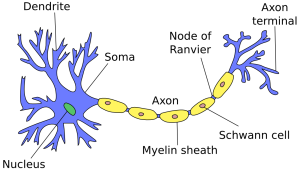 Figure 1: Biological neuron in a nervous system
Below is an illustration of an artificial neuron, where the input is passed in from the left and the prediction comes out from the right. Each input position has a specific weight in the neuron, and they determine what output to give, given a specific input vector. For example, a neuron could be trained to detect cities. We can then take the vector for London from the previous section, give it as input to our neuron, and it will tell us it’s a city by outputting value 1. If we do the same for the word Tuesday, it will give a 0 instead, meaning that it’s not a city.
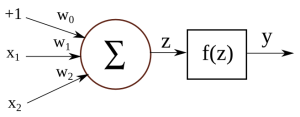 Figure 2: Artificial neuron
You might notice that there’s a constant value of +1 as one of the input signals, and it has a separate weight w0. This is called a bias, and it allows the network to shift the activation function up or down. Biases are not strictly required for building neurons or neural networks, but they can be very important to the performance, depending on the types of feature values you are using.
Let’s say we have an input vector [1,x1,x2] and a weight vector [w0,w1,w2]. Internally, we first multiply the corresponding input values with their weights, and add them together:
z=(w0×1)+(w1×x1)+(w2×x2)
Then, we pass the sum through an activation function. In this case we will use the sigmoid function (also known as the logistic curve) as our activation function.
y=f(z)=f((w0×1)+(w1×x1)+(w2×x2))
where
f(t)=11+e−t
The sigmoid function takes any real value and maps it to a range between 0 and 1. When plotted, a sigmoid function looks like this:
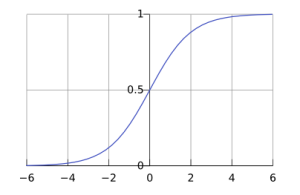 Figure 3: Sigmoid function
Using a sigmoid as our activation function has some benefits:
- Regardless of input, it will map everything to a range between 0 and 1. We don’t have to worry about output values exploding for unexpected input vectors.
- The function is non-linear, which allows us to learn more complicated non-linear relationships in our neural networks.
- It is differentiable, which comes in handy when we try to perform backpropagation to train our neural networks.
However, it is not required to use an activation function, and there exist many successful network architectures that don’t use one. We could also use a different activation, such as a hyperbolic tangent or a rectifier.
We have now looked at all the components of a neuron, but we’re not going to stop here. Richard Feynman once said “What I cannot create, I do not understand”, so let us create a working example of a neuron. Here is the complete code required to test a neuron with pre-trained weights:
|
1
2
3
4
5
6
7
8
9
10
11
12
13
14
15
16
17
18
19
20
21
22
23
24
25
26
27
28
29
30
31
32
33
34
35
36
37
38
39
40
41
42
43
44
45
46
47
48
49
50
51
52
53
54
55
56
57
|
public class SimpleNeuron { private double[] weights; public SimpleNeuron(double[] weights){ this.weights = weights; } public double classify(double[] input){ double value = 0.0; // Adding the bias value += weights[0] * 1.0; // Adding the rest of the weights for(int i = 0; i < input.length; i++) value += weights[i + 1] * input[i]; // Passing the value through the sigmoid activation function value = 1.0 / (1.0 + Math.exp(-1.0 * value)); return value; } public static void main(String[] args) { // Creating data structures to hold the data String[] names = new String[5]; double[][] vectors = new double[5][2]; // Inserting the data names[0] = "London"; vectors[0][0] = 0.86; vectors[0][1] = 0.09; names[1] = "Paris"; vectors[1][0] = 0.74; vectors[1][1] = 0.11; names[2] = "Tuesday"; vectors[2][0] = 0.15; vectors[2][1] = 0.77; names[3] = "Friday"; vectors[3][0] = 0.05; vectors[3][1] = 0.82; names[4] = "???"; vectors[4][0] = 0.59; vectors[4][1] = 0.19; // Initialising the weights double[] weights = {0.0, 100.0, -100.0}; SimpleNeuron neuron = new SimpleNeuron(weights); // Classifying each of the data points for(int i = 0; i < names.length; i++){ double prediction = neuron.classify(vectors[i]); System.out.println(names[i] + " : " + (int)prediction); } }} |
The classify() function is the interesting part in this code. It takes a feature vector as an argument and returns the prediction value y. For testing, we use the examples from the previous section and try to classify each of them. The output of running this code will be as follows:
|
1
2
3
4
5
|
London : 1Paris : 1Tuesday : 0Friday : 0??? : 1 |
As you can see, the neuron has successfully separated cities from days. It has also provided a label for the previously-unknown example – apparently the last data point should belong with cities as well.
For this code example, I manually chose and hard-coded weight values, so that it would provide a good classification. In later sections we will see how to have the system learn these values automatically, using some training data.
Now that we know about individual neurons, in the next section we’ll look at how to connect them together and form neural networks.
NEURAL NETWORKS, PART 2: THE NEURON的更多相关文章
- 【转】Artificial Neurons and Single-Layer Neural Networks
原文:written by Sebastian Raschka on March 14, 2015 中文版译文:伯乐在线 - atmanic 翻译,toolate 校稿 This article of ...
- [转]Neural Networks, Manifolds, and Topology
colah's blog Blog About Contact Neural Networks, Manifolds, and Topology Posted on April 6, 2014 top ...
- A Beginner's Guide To Understanding Convolutional Neural Networks(转)
A Beginner's Guide To Understanding Convolutional Neural Networks Introduction Convolutional neural ...
- [CS231n-CNN] Training Neural Networks Part 1 : activation functions, weight initialization, gradient flow, batch normalization | babysitting the learning process, hyperparameter optimization
课程主页:http://cs231n.stanford.edu/ Introduction to neural networks -Training Neural Network ________ ...
- Hacker's guide to Neural Networks
Hacker's guide to Neural Networks Hi there, I'm a CS PhD student at Stanford. I've worked on Deep Le ...
- ON THE EVOLUTION OF MACHINE LEARNING: FROM LINEAR MODELS TO NEURAL NETWORKS
ON THE EVOLUTION OF MACHINE LEARNING: FROM LINEAR MODELS TO NEURAL NETWORKS We recently interviewed ...
- Stanford机器学习---第五讲. 神经网络的学习 Neural Networks learning
原文 http://blog.csdn.net/abcjennifer/article/details/7758797 本栏目(Machine learning)包括单参数的线性回归.多参数的线性回归 ...
- 深度学习笔记(三 )Constitutional Neural Networks
一. 预备知识 包括 Linear Regression, Logistic Regression和 Multi-Layer Neural Network.参考 http://ufldl.stanfo ...
- 提高神经网络的学习方式Improving the way neural networks learn
When a golf player is first learning to play golf, they usually spend most of their time developing ...
随机推荐
- PHPExcel的读取excel的操作
首先导入类库: require_once 'PHPExcel.php'; require_once 'PHPExcel\IOFactory.php'; require_once 'PHPExcel\R ...
- Win32下 Qt与Lua交互使用:配置Qt下Lua运行环境
Lua与C++之间可以实现非常强的交互性.Lua中可以使用C++中的函数,C++中也可以使用Lua中的函数.由此可以引发出很多奇思妙想了. 简单来说,Lua动态的特性补充了C++的功能.当然,也看你具 ...
- 一个基于MVVM的TableView组件化实现方案
AITableView https://github.com/chentoo/AITableView cocoapods: pod ‘AITableView’ 做什么用? 这是一个简化UITableV ...
- 一个玩具程序——测试密码强度(pure C)
替人写的C语言作业… 介绍: 程序名称:密码强度检测程序 注释风格:doxygen 测试环境:linux3.6, gcc4.7window7, vs2012 已知问题:1. 算法与参考链接不一致,结果 ...
- Windows Socket五种I/O模型
转载:http://www.cnblogs.com/tianzhiliang/archive/2010/08/31/1813637.html 如果你想在Windows平台上构建服务器应用,那么I/O模 ...
- 7第七章联接和APPLY运算符(转载)
7第七章联接和APPLY运算符 原文链接 本文由豆约翰博客备份专家远程一键发布
- oracle set命令
SQL>set colsep' '; //-域输出分隔符SQL>set echo off; //显示start启动的脚本中的每个sql命令,缺省为onSQL> set ...
- 网络解析之XML及JSON
首先要加入类库GDataXMLNode和JSON 解析本地文件Students.txt <students> <student> <name>汤姆 </nam ...
- 浅谈iOS开发的协议(protocol)和代理(delegate)
协议和代理对于一个新手来说确实不讨好理解,也有很多的iOS开发的老手对此是懂非懂的.网上的很多博文只是讲了怎么使用,并没有说的很明白.下面我谈一下我的理解. 1.你要先搞明白,协议和代理为什么会出现, ...
- 不知道的陷阱:C#委托和事件的困惑
转载网址:http://www.cnblogs.com/buptzym/archive/2013/03/15/2962300.html 不知道的陷阱:C#委托和事件的困惑 一. 问题引入 通常,一 ...